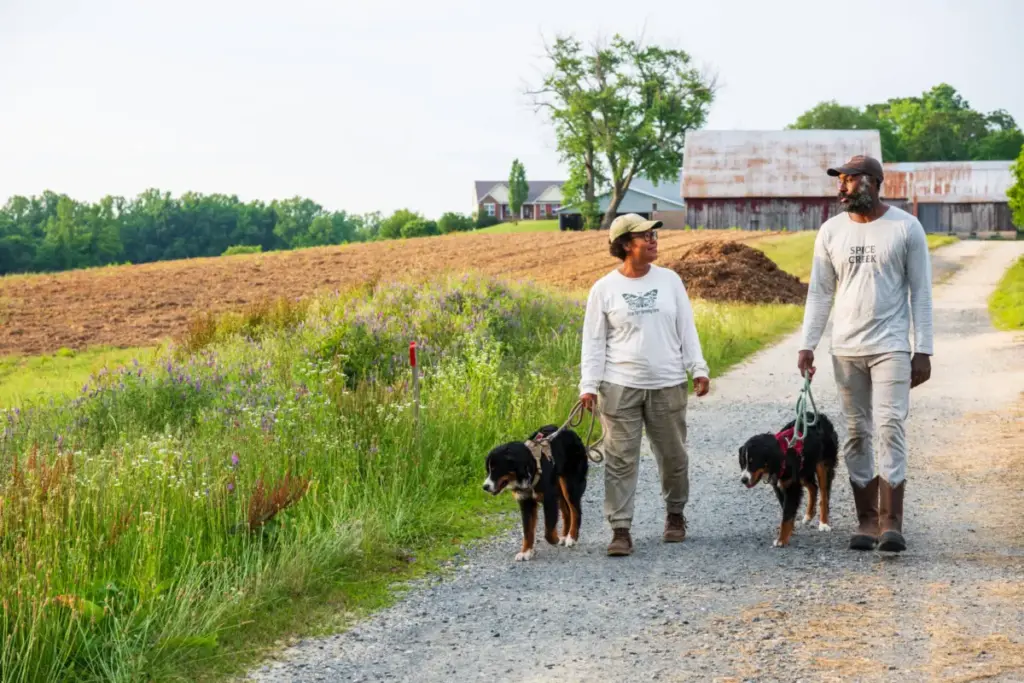
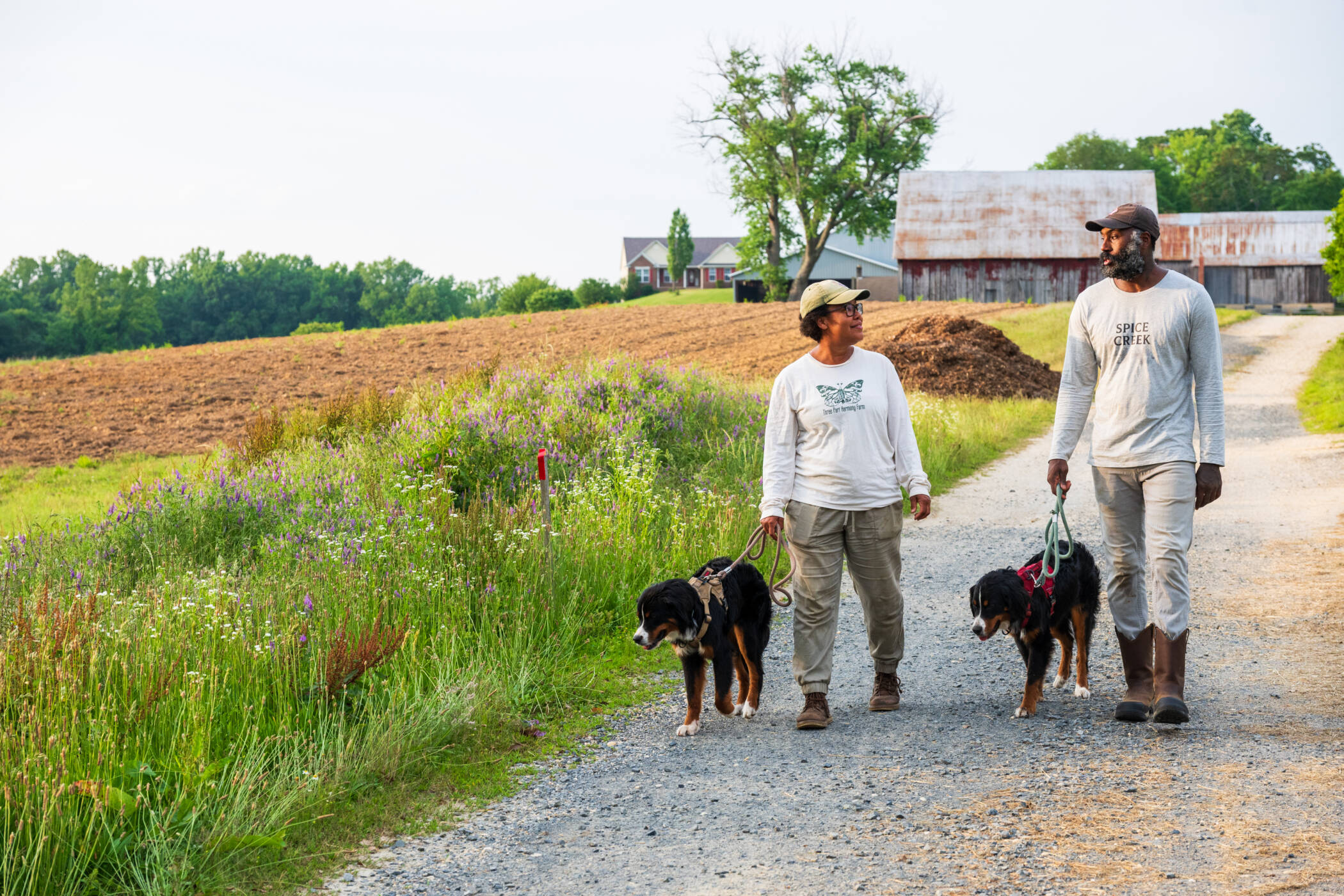
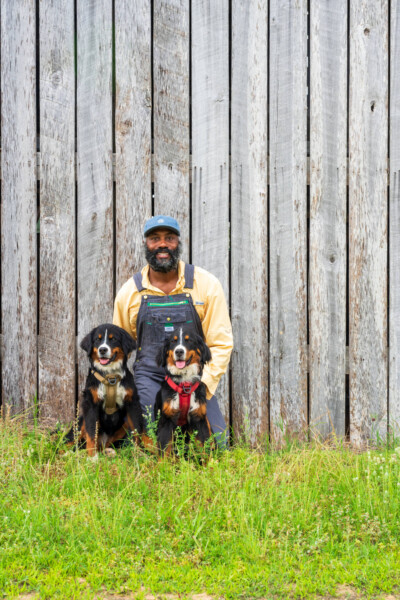
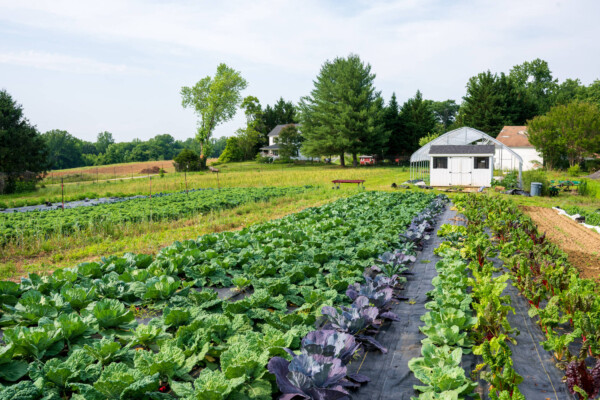
On a humid, early summer morning at Spice Creek Farm in Brandywine, Maryland, vitality hums quietly across the landscape. Rows of kale and Swiss chard sit at their absolute productive peak, while peppers and squash bulk up beneath the mid-Atlantic sun. Nearby, tomato plants stretch skyward, crying out for vertical support. D’Real Graham meticulously drives in wooden posts and sets up a wire trellis, working to train the heavy vines and keep the ripening fruit safely off the soil. Sniffing around the leafy greens and keeping a watchful eye are Ruby and Ivy, the couple’s energetic Bernese Mountain dogs.
For Graham and his life partner, Gail Taylor, this 24-acre expanse represents far more than a commercial agricultural enterprise. It is the living, breathing foundation of a deeply held mission: to build a healthy, equitable, and supportive community rooted in regenerative organic agriculture.
While Taylor has spent more than a decade successfully raising food on compact urban plots—most notably founding Washington, D.C.’s Three Part Harmony Farm—the 2025 growing season marks the couple’s first full year on this expansive rural canvas, located roughly 25 miles southeast of the nation’s capital. A former tobacco farm, Spice Creek Farm bridges the gap between historical reckoning and a progressive, cooperative future. Here, Taylor and Graham are spearheading an ambitious vision to establish a regional food hub, anchor a blossoming "Black Agrarian Corridor" in southern Maryland, and prove that ecological land stewardship and social justice can grow hand in hand.
Their unwavering dedication and early operational successes have not gone unnoticed. Spice Creek Farm was named a finalist for the inaugural U.S. Good Farmer Award—a collaborative initiative between the Rodale Institute and the Davines Group designed to honor "outstanding farmers making positive environmental and social contributions to agriculture through regenerative organic practices." To scale their operations effectively, the couple is actively collaborating with the Rodale Institute’s expert consulting team, navigating the complex intersection of agricultural expansion, soil remediation, and community building.
Detailed Chronology: From Policy Desks to Rural Acreage
The path that brought Taylor and Graham to the rolling hills of Prince George’s County was anything but conventional. Both started their professional lives far away from the agricultural sector, eventually finding their true calling through deep-rooted personal pivots and hands-on farm labor.
The Path of Gail Taylor
Gail Taylor grew up near Albany, New York, before earning a degree in U.S. foreign policy and Latin America from Syracuse University. Her academic pursuits took her to Guatemala and Chile, exposing her to complex socio-political systems and global food dynamics. Seeking a departure from traditional policy work, Taylor moved to Washington, D.C., where she discovered a tangible way to enact positive change: farming.
In 2005, she began volunteering at Deep Roots Farm, a 200-acre regenerative organic farm in Upper Marlboro, Maryland, managed by Gale Livingstone. By the following season, Livingstone had hired Taylor full-time.
As her responsibilities grew, so did her commitment to feeding her community. However, the grueling daily commute from her urban home out to the rural farm eventually took its toll. In 2011, Taylor drafted a grassroots business plan for an innovative backyard Community Supported Agriculture (CSA) subscription service based right out of her Washington home.
"Three people offered me the use of their yards to grow food, and I set up a greenhouse in mine to raise seedlings for sale," Taylor recalls. "I rode my bike to each yard on Thursdays to collect the harvest, which I put on my porch for the six CSA members."
Hungry to expand her impact, Taylor identified an unused two-acre plot near Catholic University destined for an urban farm. However, local tax structures made the project cost-prohibitive. At the time, Washington, D.C., lacked property tax exemptions for agricultural land—a standard policy in many farming counties.
Demonstrating her tenacity and policy background, Taylor enlisted pro bono legal assistance from American University law students to spearhead advocacy efforts. Her leadership culminated in the passage of the landmark D.C. Urban Farming and Food Security Act of 2014, which successfully transformed municipal tax laws and authorized the city to lease public land to growers. In 2015, Taylor launched Three Part Harmony Farm on the site. By 2024, its meticulously managed 64 beds (each measuring 3 by 100 feet) yielded an astounding 7,000 pounds of fresh, hyper-local food annually.
The Journey of D’Real Graham
D’Real Graham’s journey to agriculture similarly began away from the soil. Raised in Michigan, Graham pursued a career in education and relocated to Washington, D.C., to work for an educational non-profit. Like Taylor, he eventually felt a profound calling to pivot away from indoor office culture.
Seeking hands-on experience, Graham also began volunteering at Deep Roots Farm. Entering the space with humility, he faced a steep learning curve.
"At first, Farmer Gale only trusted me to weed," Graham recalls with a smile, "but I came to it humbly and was willing to learn."
By the end of his first season, Graham’s dedication earned him the keys to the delivery van, alongside management duties for the farm’s bustling stands at three weekly farmers markets.
After meeting at Deep Roots, Taylor and Graham formed a personal and professional partnership. In 2019, Graham officially joined the team at Three Part Harmony Farm. Together, the couple began searching for a larger tract of land that could accommodate increased production volumes while serving as the physical home for their long-held dream: a multi-farm food hub.
Securing the Land at Spice Creek
In 2022, the couple initially leased the Brandywine property to supplement their urban harvest. By December 2023, with crucial financial and structural backing from Dirt Capital Partners—an investment firm specializing in regenerative organic agriculture—Taylor and Graham entered into a favorable lease-to-purchase agreement for the entire 24-acre parcel.
Supporting Context & Metrics: Remediation and Ecosystem Building
Transitioning a conventional, chemically dependent agricultural plot into a thriving regenerative organic haven requires immense physical labor, scientific precision, and ecological patience.
Historical Reckoning and Soil Rehabilitation
When Taylor and Graham acquired the Brandywine property, they inherited a rich and complex history. Originally owned for generations by the locally prominent Baden family, the acreage had long been utilized for intensive cash-cropping—first cultivating tobacco, and later corn and soybeans. Historical research conducted by Graham revealed a sobering human legacy tied to the soil: at one point prior to emancipation, 110 enslaved people labored on the grounds.
Geographically, the farm is bounded on one side by Spice Creek, which flows directly into the Patuxent River, a vital tributary of the Chesapeake Bay watershed. Ecologically, the decades of conventional farming had taken a severe toll. Heavy machinery used by prior corn and soybean operators had severely compacted the soil, while synthetic fertilizers and herbicides stripped the earth of its natural microbial life.
"The soil was so degraded that we brought in seven truckloads of compost in summer 2022," Graham notes. "We rented a skid steer, and I spent three days spreading the compost."
Building Infrastructure from the Ground Up
Following initial soil remediation, the couple erected robust deer fencing and hand-dug their first round of production beds. Their inaugural harvests yielded sweet potatoes, white potatoes, watermelons, eggplants, and tomatillos.
Since those early days, the operational footprint has expanded dramatically. Utilizing a walk-behind tractor, the couple has installed additional production beds, laid down drip irrigation water lines, built a dedicated post-harvest wash station, and constructed a small greenhouse for starting seedlings. Beyond vegetables, their agricultural diversity is expanding.
"We’re about to plant cotton and cowpeas," Graham explains. "We are growing cotton because we want to learn how to grow it and to restore our community’s relationship to the plant."
Simultaneously, a field adjacent to the historic brick farmhouse has been seeded with native flora specifically chosen to attract pollinators. This zone will soon host pastured chickens, protected from predators by their working Bernese Mountain dogs, Ruby and Ivy. Additionally, goats are being integrated into the management plan to assist with targeted pasture clearing and brush control.
Farm Facts At-a-Glance
Location: Spice Creek Farm, Brandywine, Maryland (Prince George’s County)
Production Window: 48 weeks of food production annually
Official Statements & Expert Guidance: Scaling with the Rodale Institute
As Spice Creek Farm scales its operations, the couple has encountered the classic infrastructural bottlenecks familiar to growing agricultural enterprises. To navigate these hurdles, Taylor and Graham are working closely with the Rodale Institute’s consulting team.
The Role of Agricultural Consulting
Kegan Hilaire, the Rodale Institute’s small farms and diversified vegetable consultant, has provided vital technical guidance to Spice Creek Farm, advising on everything from chicken pasture preparation to equipment procurement and stream conservation grants.
"When farmers begin to scale up, they need to balance their short-term needs for infrastructure and equipment to keep up with their growth, while staying focused on their long-term plans," Hilaire explains. "A walk-behind tractor can get you started, for example, but it’s not going to be enough when you’re working 20 acres. You also need simple infrastructure for post-harvest preparation and storage that can handle the volume you’re harvesting now, while you save for a bigger cooler and processing space."
Rodale Institute consultants assist beginning and transitioning farmers across the United States with every facet of organic production—ranging from soil building, weed management, and crop rotations to organic certification navigation, recordkeeping, and inspection preparation. To date, the Institute’s consulting network has supported over 1,000 farmers across the contiguous U.S., transitioning more than 45,000 acres to organic production as part of a broader mission to reach 1 million organic acres nationwide.
"Each farmer has a main contact they can reach out to with any question," Hilaire notes, "but there is a whole team behind the main consultant, and we all work together to serve the farmer’s needs."
Future Outlook: Building the Black Agrarian Corridor
Looking toward the horizon, Spice Creek Farm faces systemic hurdles common to independent organic producers nationwide. Recent shifts in federal agricultural policy have brought significant reductions in grant funding and capital support for small-scale organic farms.
"We didn’t bring a lot of capital to this," Graham reflects. "We have depended on grants for funding, and those cuts have had a big impact on us."
Furthermore, attracting reliable farm labor remains a persistent challenge within the industry.
"For many Black and Brown people, working in agriculture has negative connotations," Graham observes.
To combat this and build a reliable workforce, the farm is structurally reorganizing its residential spaces. In 2025, an employee is living on-site in the historic roadside brick house. Long-term plans involve converting a smaller central cabin into a personal residence for Taylor and Graham, dedicating the larger brick house entirely to employee housing to better attract passionate agricultural workers.
Rebuilding Regional Networks
Rather than operating in isolation, Taylor and Graham are actively weaving a resilient fabric of cooperation among local growers in southern Maryland. Graham meets regularly with a half-dozen neighboring farmers to share insights, resources, and crop-rotation strategies.
"We think it makes sense to rotate in coordination with each other, so we are serving customers without competing to sell the same products," Graham says, emphasizing the crucial emotional and social support found in shared communal meals with peers who truly understand the agricultural lifestyle.
This collaborative ethos is the beating heart of their master plan. Taylor aims to reactivate the multi-farm CSA model she pioneered in Washington, D.C., which once pooled harvests from 12 distinct sources to feed 270 members.
"We want to relaunch that idea here, creating important marketing opportunities for other farmers while offering customers the chance to choose to buy from Black farmers, women farmers, and regenerative organic farmers," Taylor explains. "We believe we can all succeed together."
Ultimately, Spice Creek Farm envisions a future defined by education, ecological restoration, and generational empowerment. Alongside food production, the farm plans to host community workshops educating consumers on healthy nutrition and land vitality.
"We aspire to be land stewards as much as farmers," Graham concludes.
"We wake up every day with the goals of building the soil and producing food that’s good for people," Taylor adds. "We want to get to the point where we can nurture the next wave of beginning farmers."