The global automotive landscape is undergoing a tectonic shift, one defined not by the legacy assembly lines of Detroit, Wolfsburg, or Tokyo, but by the relentless, hyper-scaled production juggernaut of China. While Western media outlets frequently fixate on trade policy skirmishes in the European Union or tariff walls in the United States, a far more transformative revolution is quietly unfolding closer to China’s doorstep. Southeast Asia has rapidly emerged as the world’s most dynamic frontier for electric vehicle (EV) adoption, acting as the primary pressure valve and growth engine for China’s unprecedented export machine.
According to comprehensive new trade and market data compiled by global energy think tank Ember, China shipped a staggering $9.2 billion worth of electric vehicles overseas in May, eclipsing the previous all-time monthly record of $9.1 billion set just a month prior in April. This represents a blistering 49% year-over-year surge. To contextualize this meteoric rise, one needs only to look backward a mere half-decade: as recently as 2020, total monthly Chinese EV exports struggled to clear the $1 billion threshold. Today, China is not merely participating in the global automotive market; it is actively reshaping it through sheer scale, aggressive pricing, and strategic geographic expansion.
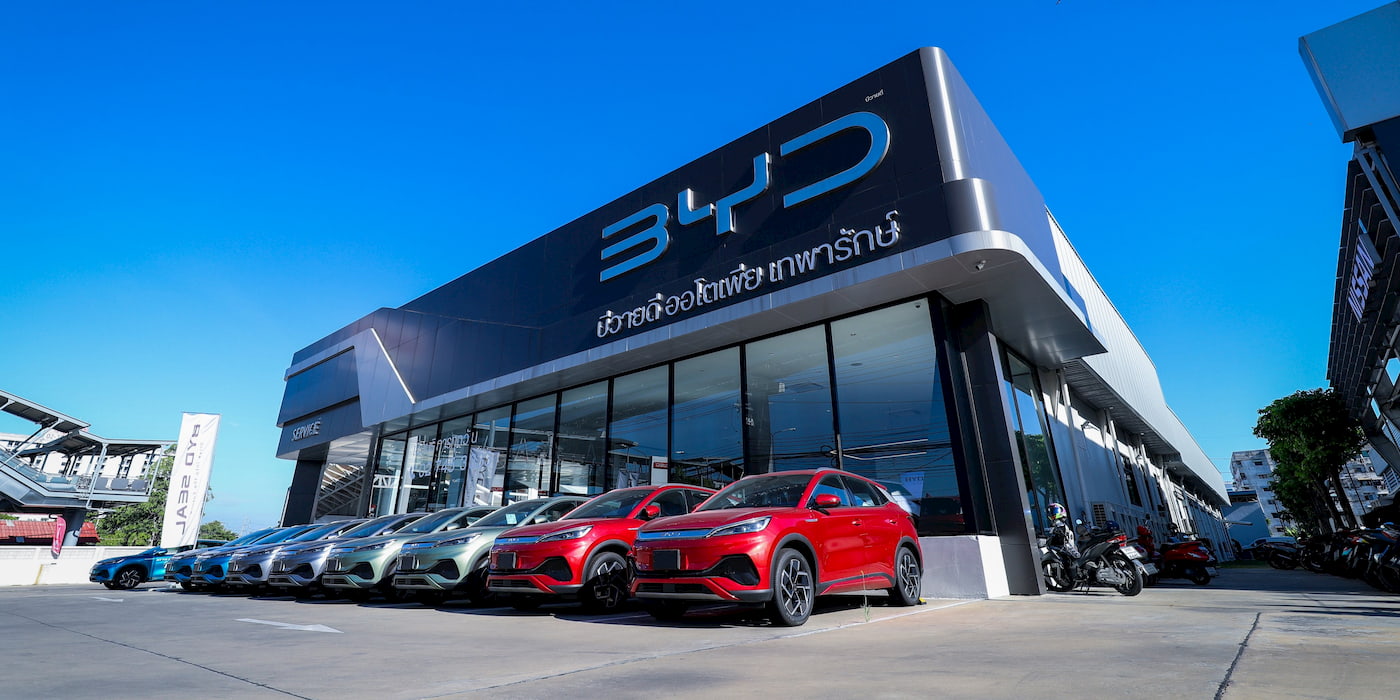
At the heart of this international surge is the Association of Southeast Asian Nations (ASEAN) bloc. Fuel regional incentives, aggressive infrastructural development, and an acute geopolitical energy crunch have converged to turn Southeast Asia into a fertile testing ground for Chinese automakers like BYD, SAIC, and Great Wall Motor. As fossil fuel prices skyrocket due to ongoing supply disruptions rooted in the Middle East, regional governments and everyday consumers alike are finding that the transition to electric mobility is no longer merely an environmental goal—it is an urgent economic imperative.
Detailed Chronology of a Manufacturing Juggernaut
To understand the mechanics of China’s current export supremacy, one must trace the deliberate, methodical scaling of its domestic EV supply chain over the past decade. The trajectory from a localized, subsidy-driven domestic market to an unstoppable global exporter is a masterclass in industrial policy and capital deployment.
The Foundation Years (2015–2020)
For years, China’s massive investments in battery manufacturing, raw material processing, and vehicle assembly were viewed by Western legacy automakers as an expensive, isolated domestic experiment. Backed by government subsidies, national mandates, and a hyper-competitive local ecosystem, Chinese manufacturers refined their craft away from the prying eyes of legacy competitors. By 2020, monthly EV exports routinely hovered below the $1 billion mark, serving niche international markets with rudimentary commercial vehicles and low-range passenger cars.
The Post-Pandemic Breakout (2021–2023)
As global supply chains convulsed in the wake of the COVID-19 pandemic, Chinese automakers emerged with a distinct competitive advantage: secure access to lithium-iron-phosphate (LFP) batteries, vertically integrated supply chains, and advanced software integration. By 2022 and 2023, export volumes began to climb exponentially. Brands that were once household names only in Shenzhen or Shanghai—such as BYD—began establishing beachheads in neighboring markets, utilizing cost advantages and rapid product iteration cycles to undercut legacy internal combustion engine (ICE) vehicles.
The Record-Breaking Spring of 2026
The first half of 2026 has brought this multi-year trajectory to a definitive inflection point. In April, China crossed an unprecedented psychological barrier by exporting $9.1 billion worth of electric passenger vehicles in a single month. This record stood for barely thirty days before being shattered in May, when total export values reached $9.2 billion.
Delving into the May shipment data reveals the granular composition of this export wave. China exported approximately 448,000 electric passenger vehicles in total during the month. This comprised roughly 279,000 Battery Electric Vehicles (BEVs)—the undisputed heavy artillery of the EV transition—alongside 169,000 Plug-in Hybrid Electric Vehicles (PHEVs), which are proving exceptionally popular in developing markets where charging infrastructure remains a work in progress. This diversification of powertrain offerings has allowed Chinese brands to capture demand across vastly different infrastructural landscapes.
Supporting Context & Metrics: The ASEAN Market Explosion
While Europe and Latin America remain vital destinations for Chinese vehicle exports, the ASEAN region has experienced a structural transformation that outpaces nearly every other geographic sector. In May alone, Chinese EV exports to ASEAN nations shattered previous ceilings, touching a record $1.2 billion.
This momentum is sustained by specific national policies, targeted import metrics, and regional supply chain integration:
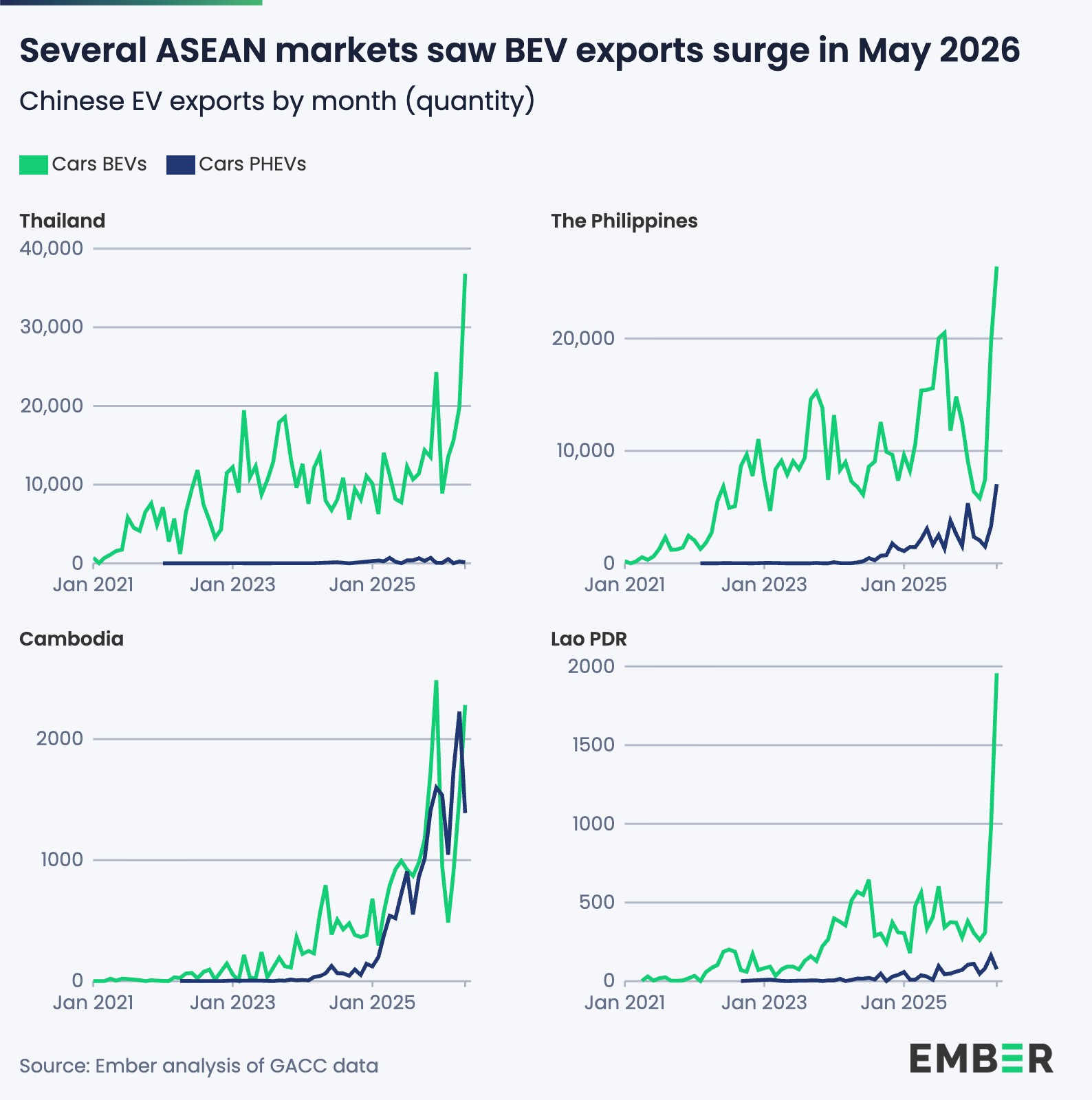
Thailand: Long recognized as the "Detroit of Southeast Asia" due to its heavy concentration of Japanese legacy ICE manufacturing, Thailand has pivoted aggressively toward electrification. In May, Thai importers welcomed more than 36,000 Chinese EVs, making the country the single largest destination within the bloc for Chinese automotive shipments. Generous consumer subsidies and tax breaks have incentivized major Chinese players to establish local assembly plants, turning Thailand into an export hub within an export hub.
The Philippines: Surging closely behind Thailand, shipments to the Philippines topped 33,000 vehicles in May. Urban centers grappling with severe traffic congestion and high urban air pollution are increasingly turning to affordable, tech-forward electric mobility options imported directly from Chinese ports.
Cambodia: In a bid to rapidly modernize its vehicle fleet, Cambodia enacted sweeping tariff reforms in late March, cutting customs duties on BEVs to zero while drastically slashing tariffs on PHEVs from 35% to 7%. While BEVs currently dominate the influx of Chinese vehicles, the slashed PHEV tariffs have opened a secondary growth corridor for hybrid adoption.
Laos: Perhaps no nation has implemented as radical a series of policy shifts as Laos. Beyond reducing EV registration and service fees, the Laotian government enacted a mandatory compliance metric requiring all domestic transportation companies to ensure that EVs comprise at least 10% of their operational fleets by the end of 2026. Most dramatically, in May, Laos instituted a temporary blanket ban on imports of traditional ICE passenger cars through the end of the year, deliberately starving the fossil fuel market to force an accelerated transition toward electric alternatives.
The Macroeconomic Catalyst: Energy Security and Fossil Fuel Volatility
While proactive government incentives and aggressive corporate pricing strategies have laid the groundwork for Southeast Asia’s EV boom, a powerful external catalyst has forced the region’s green transition into hyperdrive: the ongoing energy crisis tied to geopolitical instability in the Middle East.
For decades, many ASEAN nations remained acutely vulnerable to global crude oil price fluctuations, bearing the fiscal burden of heavy petroleum import dependencies. As conflict in the Middle East rattled global energy markets, spiking fuel prices at the pump imposed an immediate and painful tax on working-class households and logistics fleets across Southeast Asia.
This macroeconomic shock fundamentally altered the consumer and political calculus surrounding electric mobility. No longer framed solely as an eco-conscious luxury, the shift to electric vehicles became an existential strategy for national energy security and household financial survival.
Lam Pham, Ember’s energy analyst for Asia, captured the gravity of this shift:
"The current energy crisis has reinforced the value of electrification as a pathway to greater energy security, reduced fuel import exposure, and long-term transport cost savings."
This sentiment is echoed by Euan Graham, Ember’s senior electricity and data analyst, who contextualized the regional velocity:
"Southeast Asia is fast becoming one of the most dynamic destinations for electric vehicles, and China is supplying that demand at scale and speed."
By decoupling personal mobility and commercial logistics from volatile international oil supply chains, Southeast Asian economies are utilizing Chinese EVs as a pragmatic shield against external economic shocks.
Official Statements and Industry Insights
The convergence of record-breaking export data, shifting geopolitical trade winds, and localized policy interventions has forced international energy analysts and market watchers to re-evaluate the global EV roadmap. For years, the narrative of the global EV transition was written exclusively through the prism of Western regulatory bodies—such as the European Union’s 2035 combustion engine ban or the United States’ Inflation Reduction Act.
However, industry experts argue that overlooking the Global South, and Southeast Asia in particular, is a fundamental analytical error.
Market observers point out that Chinese automakers are not simply dumping excess inventory into developing markets; rather, they are executing a sophisticated, long-term regional integration strategy. By establishing localized distribution networks, investing in charging infrastructure joint ventures, and building regional manufacturing plants (particularly in Thailand and Indonesia), Chinese original equipment manufacturers (OEMs) are embedding themselves deeply into the economic fabric of ASEAN nations.
Furthermore, the flexibility demonstrated by Chinese manufacturers in catering to dual markets—supplying both high-tech BEVs for urbanized hubs and versatile PHEVs for regions with developing electrical grids—highlights an adaptive capability that legacy Western automakers have struggled to match. While Western brands have frequently stumbled over high price points and software integration hurdles, Chinese brands have weaponized affordability, rapid iteration, and supply chain resilience to capture the imagination and wallets of emerging middle-class consumers across Asia.
Future Outlook: What Lies Ahead for Global EV Markets
As the calendar moves deeper into the second half of 2026, the structural trajectory of global electric vehicle adoption is clear, even if regulatory hurdles and trade friction threaten to complicate the map.
Several critical trends will dictate the evolution of this market over the coming years:
The Maturation of ASEAN Manufacturing Hubs: As countries like Thailand and Indonesia continue to draw foreign direct investment from Chinese automakers, the nature of trade will likely evolve. Instead of direct vehicle exports from mainland Chinese ports, an increasing percentage of Southeast Asian EV demand will be fulfilled by local assembly plants using regional supply chains. This localized production will help insulate Chinese brands against potential regional trade tariffs or protectionist pushback.
The Ripple Effect of Drastic Policy Interventions: Policies such as Laos’s temporary ban on ICE imports and Cambodia’s zero-duty framework for BEVs will serve as case studies for other developing economies globally. If these nations successfully lower their national carbon emissions and mitigate the fiscal drain of oil imports without destabilizing their transportation networks, neighboring developing nations in South Asia, Africa, and Latin America are likely to replicate these aggressive regulatory playbooks.
The Persistent Threat of Energy Volatility: With geopolitical tensions in the Middle East showing few signs of permanent resolution, baseline fossil fuel prices are expected to remain volatile. This persistent economic pressure will continue to act as an artificial accelerator for EV adoption, eroding the market share of traditional internal combustion vehicles far faster than historical projections anticipated.
Global Trade Friction: Naturally, China’s unstoppable export juggernaut will continue to face defensive maneuvers from established Western economies. As Europe and North America debate and implement tariffs, countervailing duties, and domestic content requirements to protect their native auto industries, Chinese manufacturers will likely double down on their pivot toward the Global South. Markets in Southeast Asia, Latin America, and the Middle East will absorb the surplus production, cementing China’s status as the undisputed architect of the developing world’s electric mobility transition.
Ultimately, the record-breaking export numbers recorded in May 2026 are not an isolated financial anomaly. They are the numerical manifestation of a permanent restructuring of the global automotive order. Southeast Asia may not always command the daily headlines generated by trade wars in Brussels or Washington, but beneath the surface, it is serving as the crucible where the future of global transportation is actively being forged.