

Executive Overview
Perched more than 2,300 meters (7,500 feet) above sea level on a high-altitude plateau at the precipice of the Great Rift Valley escarpment lies Asmara, the capital city of Eritrea. Known internationally for its stunning density of early-to-mid 20th-century urban design, Asmara stands as an architectural anomaly. In July 2017, the city achieved a monumental milestone when it was officially inscribed as a UNESCO World Heritage Site under the designation "Asmara: A Modernist African City."
This prestigious recognition marked several historic firsts: it became the first modernist urban site anywhere in the world to be inscribed in its entirety, and Africa’s first explicitly modernist World Heritage Site. Yet, the architectural identity of Asmara is inextricably bound to a complex and deeply paradoxical historical reality. The city’s extraordinary collection of Futurism, Rationalism, Art Deco, and Expressionist structures was born out of Italian colonial ambitions in the Horn of Africa during the fascist era.
Following a tumultuous trajectory of war, decolonization, and decades of national isolation, these physical remnants of foreign subjugation were unexpectedly embraced, preserved, and recontextualized. Today, Asmara’s built environment functions not as a monument to colonial oppression, but as a cherished pillar of post-colonial Eritrean national identity. The ongoing documentation, conservation, and study of this urban landscape—spearheaded by landmark preservation initiatives—highlight a rare narrative of architectural reclamation. This article explores how a colonial blueprint transformed into a sovereign nation’s most enduring symbol.
Detailed Chronology
To understand Asmara’s current status as a global architectural marvel, one must trace its evolution from a modest cluster of highland agricultural villages into an ambitious imperial capital, and finally into a sovereign, protected urban landscape.
Pre-Colonial Roots: The Four Villages
Before the arrival of European powers, the geography that would become Asmara was a collection of distinct highland settlements. According to enduring local oral tradition, the city derives its name from “Arbate Asmera,” which translates roughly from the Tigrinya language as "the four made them unite." This moniker commemorates a pivotal historical accord among four warring local clans—Geza Gana, Geza Asmae, Geza Serare, and Geza Kebessa—who agreed to put down their weapons, reconcile their differences, and live together peacefully.
For centuries, the settlement remained small and agrarian, though its strategic geographic positioning on the edge of the plateau eventually elevated its status. By the late 14th century, the settlement was noted in Latin travel itineraries as a critical waypoint along burgeoning trade routes connecting the interior highlands to the vital Red Sea port city of Massawa.
The Italian Colonial Incursion and Urban Expansion (1889–1941)
Eritrea’s modern architectural trajectory shifted dramatically in the late 19th century. Following the opening of the Suez Canal and Italy’s unification, the Italian government sought to establish its own colonial empire in East Africa. In 1889, the Treaty of Wichale was signed, and Italy formally established the colony of Eritrea. By 1897, Governor Ferdinando Martini made the strategic decision to relocate the colonial administrative capital from the coastal heat of Massawa to the cooler, healthier highland climate of Asmara.
What followed was a rapid, highly calculated wave of urban planning and construction. Initially, the development served administrative and military purposes, separating the European population from the indigenous Eritrean population through strict segregationist zoning policies. However, as Italy’s fascist regime under Benito Mussolini consolidated power in the 1930s, Asmara’s development accelerated exponentially.
The city was envisioned as Piccola Roma ("Little Rome"), a grand showcase of Italian engineering prowess and imperial might. Architects, engineers, and urban planners flooded the city, bringing with them the bleeding-edge design philosophies of Europe. They bypassed traditional neoclassical styles in favor of radical modernist experimentation. During this brief, intense construction boom between 1935 and 1941—spurred by the preparations for the invasion of Ethiopia—Asmara transformed into an avant-garde canvas. Architects designed gas stations, cinemas, administrative buildings, and residential villas using experimental concrete forms, sleek geometric lines, and nautical motifs, effectively turning the city into one of the most concentrated collections of Modernist architecture on Earth.
British Military Administration and Post-War Stagnation (1941–1952)
Italy’s imperial ambitions crumbled during World War II. In 1941, British forces defeated the Italian army in East Africa, leading to the establishment of the British Military Administration (BMA) in Eritrea. During this era, the frantic construction boom abruptly halted. While the British dismantled some industrial infrastructure and managed local affairs, they left the physical fabric of Asmara largely untouched.
In 1952, following a United Nations resolution, Eritrea was federated with Ethiopia under a constitutional arrangement that guaranteed autonomy. However, this federation was systematically undermined over the ensuing decade. In 1962, Ethiopian Emperor Haile Selassie unilaterally dissolved the federation, annexing Eritrea as Ethiopia’s 14th province and sparking a brutal 30-year war for independence.
The Independence Struggle and National Isolation (1961–1991)
The ensuing decades of the Eritrean War of Independence deeply affected the country’s social and economic fabric. Asmara, while serving as the strategic core of the Ethiopian occupation, was largely insulated from the hyper-development, demolition, and high-rise construction booms that radically transformed other global cities during the late 20th century.
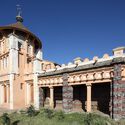
Paradoxically, this prolonged period of conflict, economic hardship, and subsequent national isolation acted as an architectural time capsule. While historic modernist structures in European and American cities were frequently torn down to make way for post-war brutalism or corporate glass towers, Asmara’s buildings remained frozen in time. The lack of capital for large-scale urban renewal unintentionally preserved the pristine integrity of the 1930s Italian modernist experiments.
Sovereignty and Heritage Reclamation (1991–Present)
Eritrea finally secured its de facto independence in 1991, followed by international recognition in 1993 after a landslide referendum. The newly formed government inherited a city rich in architectural heritage but structurally weathered by decades of neglect.
Rather than erasing these physical markers of Italian colonialism—as many post-colonial nations did with their former oppressors’ monuments—Eritreans chose a different path. They recognized the architectural landscape as an integral part of their local history and urban identity. Local architects, historians, and municipal authorities began rallying for the protection of these structures. This grassroots and governmental momentum culminated in the establishment of targeted conservation initiatives, ultimately paving the way for Asmara’s landmark inscription on the UNESCO World Heritage list in July 2017.
Supporting Context & Metrics
To fully appreciate the scope of Asmara’s architectural heritage, one must examine the quantitative and qualitative dimensions that set it apart on the global stage.
Architectural Typologies and Iconic Structures
Asmara’s built environment is categorized by a breathtaking variety of architectural styles spanning the early 20th century, dominated by Italian Rationalism, Futurism, and Art Deco. Among the thousands of preserved historic structures, several iconic buildings stand out as masterworks of modern design:
- The Fiat Tagliero Building (1938): Designed by Italian engineer Giuseppe Pettazzi, this iconic service station is arguably Asmara’s most famous modernist masterpiece. Styled to evoke an airplane in mid-flight, the building features two massive, cantilevered reinforced-concrete wings that stretch 15 meters out on either side without any visible vertical support. Legend holds that Italian authorities were so skeptical of the structural integrity that Pettazzi was forced to stand beneath the wings with a pistol during the removal of the scaffolding to prove they would not collapse.
- Cinema Impero (1938): A stunning example of Art Deco cinema architecture, designed by Mario Messina. Its striking geometric facade features a dramatic grid of backlit circular glass bricks and vertical fins, showcasing the era’s obsession with cinematic glamour and mechanized speed.
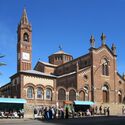
- Our Lady of the Rosary Catholic Cathedral: Completed in 1923, this Lombard-Romanesque style cathedral features a soaring 57-meter-high bell tower that dominates the Asmara skyline, blending European ecclesiastical traditions with local stone masonry.
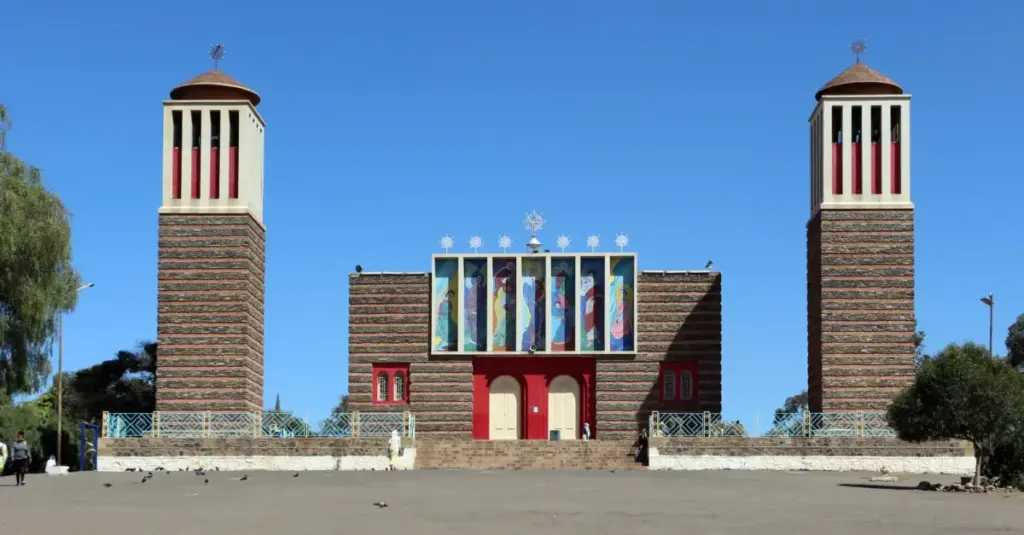
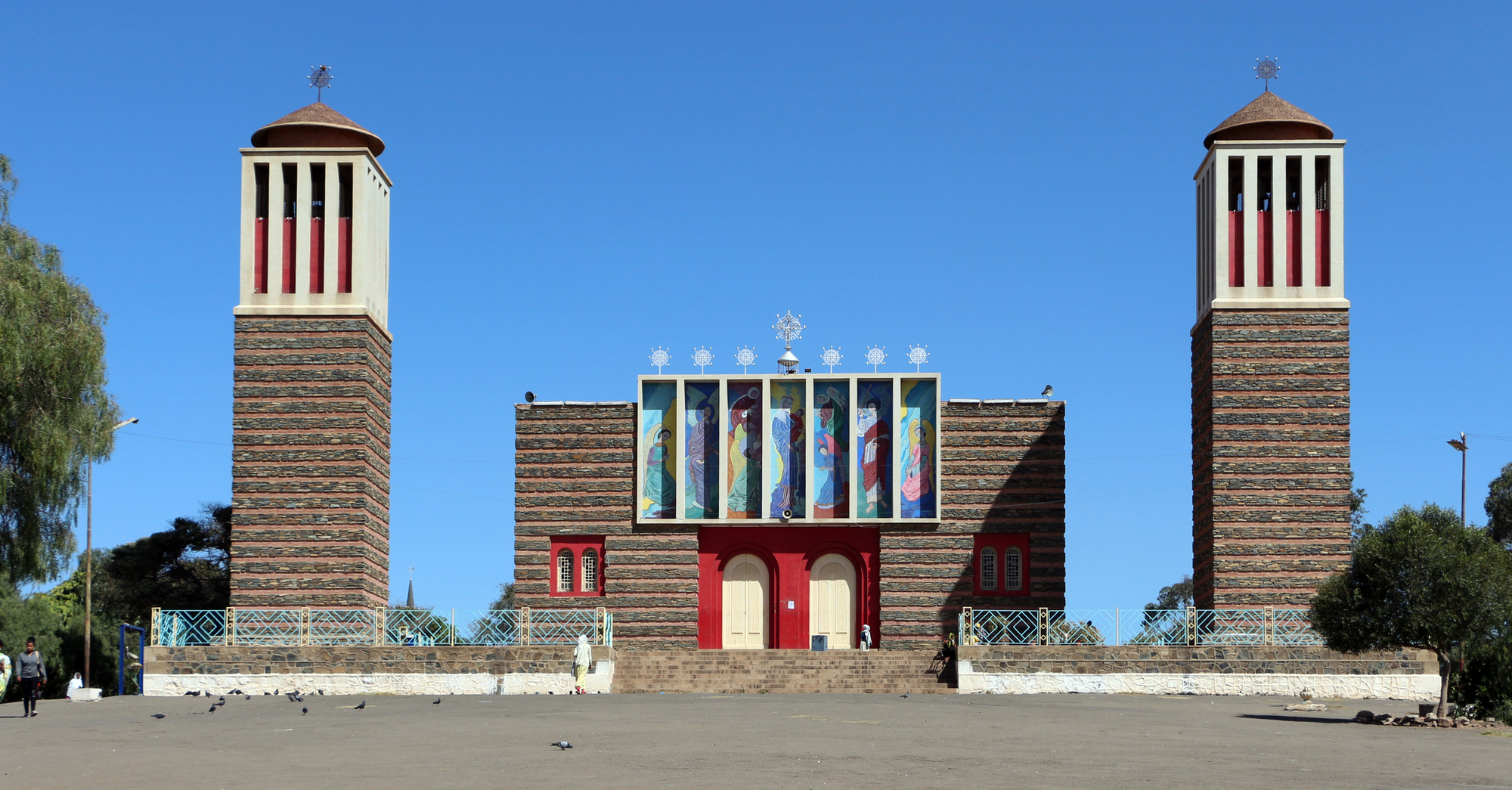
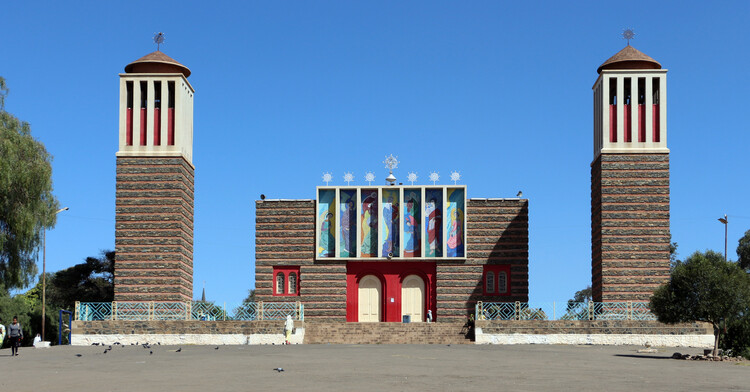
- St. Mary’s Orthodox Cathedral: A vital spiritual and cultural landmark that reflects the deep-rooted indigenous religious heritage interacting harmoniously with the surrounding cosmopolitan urban fabric.
Key Geographic and Demographic Metrics
- Elevation: Situated at over 2,300 meters (approx. 7,550 feet) above sea level, making it one of the highest capital cities in the world.
- UNESCO Inscription Date: July 2017 ("Asmara: A Modernist African City").
- Protected Zone Area: Encompasses an extensive urban master plan covering roughly 4 square kilometers of concentrated heritage structures, comprising thousands of individual historic buildings.
- Historical Construction Window: The vast majority of the modernist inventory was constructed during a concentrated six-year window between 1935 and 1941.
Official Statements and Expert Perspectives
The preservation of Asmara has generated significant discourse among international architectural historians, urban planners, and preservation bodies regarding the delicate intersection of colonial history and indigenous heritage reclamation.
In evaluating the city’s unique cultural landscape during the 2017 UNESCO inscription process, international heritage experts emphasized the deliberate agency of the Eritrean people in claiming ownership over the space. Dr. Medhanie Teklemariam, a prominent local architect and key figure in Asmara’s heritage preservation community, noted in past project documents:
"Asmara’s architecture is no longer just a physical archive of Italian colonial design; it has been fundamentally re-authored by the people who live in it. The buildings were constructed by Italian hands under coercion, but they have been maintained, inhabited, and loved by Eritreans for generations. They belong to our national story now."
The Asmara Heritage Project (AHP), established by local authorities with international support, was created specifically to document, map, and assess every single historic structure within the capital’s boundaries. An executive summary released by the project directorate during its peak documentation phase underscored the mission’s dual objective:

"Our mandate is not merely to archive stone and concrete, but to secure the socio-cultural continuity of Asmara. Documenting this urban fabric provides the foundational data required for sustainable conservation, ensuring that the physical identity of our capital survives for future generations without succumbing to unregulated modern development."
UNESCO’s evaluation report for the 2017 World Heritage listing further highlighted the city’s global significance, stating that Asmara represents "an exceptional example of early modernist urbanism in Africa at the beginning of the 20th century and its application in an African context." The committee noted that the city successfully merges European avant-garde planning theories with local topography, labor, and cultural integration.
Future Outlook
As Asmara looks toward the future, it faces a complex set of preservation and socio-economic challenges. While its UNESCO World Heritage status has placed the city firmly on the global cultural map, safeguarding thousands of aging modernist concrete and stucco structures requires continuous technical expertise, substantial financial resources, and rigorous municipal oversight.

One of the primary challenges moving forward is balancing heritage preservation with the demands of a growing urban population. Many of the historic buildings require specialized structural remediation to combat weathering, seismic vulnerabilities, and the natural degradation of 1930s-era reinforced concrete. Local conservationists are actively working to train a new generation of Eritrean architects, engineers, and craftspeople in specialized restoration techniques unique to early modernist materials.
Furthermore, as global travel and diplomatic engagement slowly evolve, Asmara faces the dual prospect of increased tourism. Urban planners emphasize the necessity of sustainable tourism frameworks that protect the delicate historical core from commercial over-exploitation while simultaneously injecting much-needed capital into local preservation funds.
Ultimately, the Asmara Heritage Project and the city’s ongoing preservation efforts stand as a testament to the resilience of urban memory. By transforming a physical legacy originally designed to project foreign dominance into a cherished symbol of national sovereignty, Asmara has redefined how post-colonial societies interact with their built environments. The city remains a living, breathing museum of modernist ambition—proudly preserved by the people who call it home.



