To the casual observer standing on its windswept shores, the North Sea often cuts an unappealing figure. Its waters glower in shades of slate grey, dull brown, and deep turbidity, creating the impression of a nutrient-heavy, sediment-filled aquatic desert where very little life can thrive. For decades, even the friends and family of Dutch cinematographer Peter van Rodijnen openly questioned why he spent countless hours exploring what they affectionately, yet dismissively, termed "this murky bowl of soup."
Inspired in his youth by the pioneering underwater adventures of Jacques Cousteau in far more temperate and crystalline waters, Van Rodijnen harbored a singular obsession: to pull back the murky veil shrouding the shallow sea shared by north-west Europe. Alongside director Mark Verkerk, Van Rodijnen embarked on a nearly decade-long collaborative journey that culminated in the stunning feature documentary North Sea, Nature Untamed.
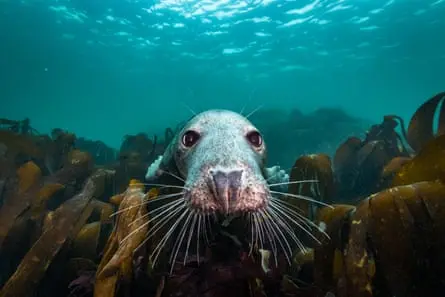
The film shatters long-held assumptions about this heavily exploited body of water. Despite enduring centuries of maritime commerce, intensive industrial fishing, oil extraction, and rapid coastal development, vast stretches of the North Sea pulse with an astonishing array of life. Luminous pinks, vibrant purples, and deep greens flourish across expansive kelp forests, while starfish, lobsters, brittle stars, seals, and majestic basking sharks carve out a living in the shallows. This hidden European wilderness rivals the visual spectacle of tropical reefs—yet it remains one of the planet’s most challenging and misunderstood marine environments.
Detailed Chronology of an Impossible Shoot
Decades of Persistence: The Genesis of a Vision
Van Rodijnen’s relationship with the North Sea did not begin as a blockbuster film project; it was a slow-burn labor of love born out of localized exploration. As camera technology advanced exponentially over a 20-year period, the Dutch diver began capturing increasingly pristine and revealing footage of marine ecosystems just off the coast of the Netherlands.
Nearly ten years ago, Van Rodijnen joined forces with director Mark Verkerk, recognizing that the sheer logistical hurdle of capturing the North Sea required a unified, long-term vision. "We started with the idea," Van Rodijnen recalls, "that if somebody can make a movie about the North Sea, it’s got to be us."
Yet, translating this vision into a feature-length cinematic narrative proved to be an exercise in extreme endurance. Unlike the tropical waters where diving is predictable and visibility stretches for dozens of meters, the North Sea operates under entirely different rules. Epic annual plankton blooms form the foundational base of the marine food web, fueling a massive pyramid of life. Ironically, however, these very same biological explosions—combined with shallow depths and powerful, sweeping tides—frequently reduce underwater visibility to near zero.
"It’s no accident that there are virtually no films about the North Sea," director Mark Verkerk notes with a grimace. "This is really one of the first big attempts. It is incredibly difficult."
Battling the Elements: The Seven-Year Production Odyssey
The production team spent seven years executing carefully scheduled shoots alongside commercial fishers and windfarm construction sites, while simultaneously chasing unpredictable, highly mobile marine life such as dolphins, bluefin tuna, and basking sharks. The elements, however, proved to be their most formidable adversaries.
Four out of every five planned dives in the North Sea were summarily cancelled due to dangerously rough seas, gale-force winds, and unpredictable swells. When conditions finally permitted a descent, the cinematographers faced a compounding set of physiological and technical constraints.
"The visibility can be poor, there can be lots of currents, it is cold," Van Rodijnen explains, reflecting on the arduous conditions. "You’ve got depth and the limitations of your scuba devices, so you have 20 or 30 minutes of filming per dive. It’s about patience, but it’s more about persistence. You need to just keep pushing to get the shots. I had some sleepless nights, I can tell you."
Supporting Context & Metrics: The Ecosystem and Its Human Engineers
A Complex Ecological Web
North Sea, Nature Untamed consciously rejects the conventional wildlife documentary trope of portraying nature as an untouched paradise devoid of human presence. While the film is populated by charismatic species—including hyper-intelligent orcas, inquisitive seals, and the remarkably conscientious shorthorn sculpin (which nurses neon-pink eggs until they develop eyes and wriggle out into the dark water)—its core thesis is systemic rather than individualistic.
"The big idea is to show the whole system working," asserts Verkerk. "It’s fantastic to see the bluefin tuna come back and orcas thriving, but they only do that because of this massive system supporting all of that life."
This living system relies heavily on foundational species whose declines ripple upward through the trophic levels. The documentary exposes the devastating cascading effects of sand eel population drops on seabirds like puffins, directly linking industrial overfishing to avian starvation.
Industry, Innovation, and Bycatch
Humans are explicitly framed as the principal engineering force of the North Sea ecosystem—wielding power for both immense destruction and unexpected restoration. Van Rodijnen embeds himself within various commercial fishing fleets to document the stark realities of modern harvesting.
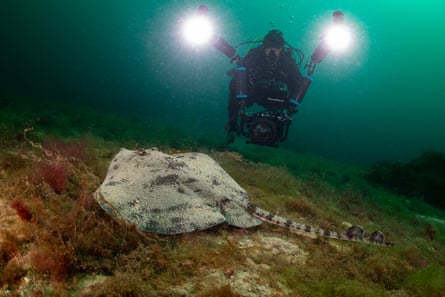
A journey aboard a clean, conscientious Dutch fishing vessel highlights the complexities of sustainable fishing. Eschewing destructive beam and bottom trawling—methods that drag heavy steel beams and weighted nets across the seabed, effectively obliterating benthic habitats and benthic life—this crew utilizes alternative methods. Even so, watching the daily operations proves emotionally taxing for the filmmaker. Van Rodijnen witnesses his own "film stars"—delicate sharks and rays—discarded haphazardly as unwanted bycatch.
In stark contrast, a later excursion onto an industrial mackerel fishing vessel operating off the Shetland Islands reveals the sheer scale of modern extraction. A pod of local orcas has learned to recognize the distinct acoustic signature of the ship’s winches, tailing the vessel to pick off scattered mackerel escaping the massive net. Yet, the disparity in consumption is staggering: while a pod of orcas might devour 1,000 mackerel in a single day, the industrial vessel vacuums up thousands of fish in minutes, pumping them via giant suction tubes directly into massive steel storage vats.
The Acoustic Crisis of Offshore Windfarms
Beyond fishing, the North Sea has endured decades of heavy industrial extraction, from oil and gas drilling to the ongoing green energy revolution. While the documentary avoids the fossil fuel infrastructure, it directly confronts the dual-edged nature of the offshore windfarm boom.
"Underwater is not just a world that you don’t see, but it’s also a world that you don’t hear," Verkerk points out. During the construction phase, massive hydraulic pile-drivers pound steel pilings deep into the seabed, sending concussive noise shockwaves cascading through the water column.
"The sound is pretty deafening above the water, but underwater it can be 20 times louder," Verkerk explains. "Because visibility is not so good in the North Sea, a lot of marine life is geared for sound. The impact is not just on whales, but right down to the actual development of a fish egg."
Official Statements and Perspectives
Despite witnessing scenes of ecological devastation and industrial bycatch, Van Rodijnen resists the urge to craft a purely polemical or finger-pointing documentary. His time living alongside commercial fishers instilled a deep appreciation for the nuance of maritime livelihoods.
"Once you get on the boat with those guys and you’re living together for a couple of days, you don’t always agree, but you start to understand their situation."
— Peter van Rodijnen, Cinematographer
Van Rodijnen openly dismisses the notion that sweeping regulatory strokes can solve the sea’s ecological woes. "It’s naive to think we can make one big Marine Protected Area out of the North Sea. That just won’t happen. There’s lots of nuance to understand."
While he remains an outspoken opponent of bottom trawling and unmanaged bycatch, he notes that certain fisheries—such as the Shetland mackerel fishery—utilize mid-water nets that avoid seabed destruction and adhere strictly to scientific quotas.
"Give nature a chance and it responds. It’s good to keep a constant eye on how the system reacts to these many windfarms being built. But in the end, they can absolutely have a positive effect on marine life."
— Peter van Rodijnen
Director Mark Verkerk emphasizes that the North Sea serves as a global micro-cosmos for the challenges facing marine environments worldwide:
"It’s very much out of sight, out of mind, isn’t it? Even for those of us who live around the North Sea, it’s a little underwhelming. But it is actually an incredibly interesting sea. A lot of the problems facing seas and oceans all around the world are at their most acute here—the North Sea is leading the way in exploitation, but also in solutions."
— Mark Verkerk, Director
Future Outlook: Artificial Reefs and Global Resonance
The Unexpected Sanctuary of Windfarms and Shipwrecks
As European nations race to expand offshore renewable energy infrastructure, a surprising ecological silver lining has emerged. During one of his most revealing dives, Van Rodijnen explored a pile of rocks that had accidentally fallen from a commercial cargo ship some 30 years prior. Structurally identical to the boulders used to anchor modern wind turbine bases, this accidental debris heap had undergone a radical metamorphosis. Over three decades, its barren grey exterior transformed into a vibrant, multi-colored artificial reef blanketed in dense seaweeds, anemones, and sheltering fish.
Because commercial bottom trawling and other invasive fishing practices are legally or practically prevented within safety zones surrounding sizeable windfarms, these industrial installations have inadvertently functioned as de facto marine protected areas. Over the coming decades, marine biologists expect thousands of mini artificial reefs to flourish around turbine foundations.
A Universal Message from Regional Waters
The cultural trajectory of North Sea, Nature Untamed has surprised even its creators. Following a successful two-year theatrical and community screening tour across the Netherlands, Belgium, and Germany, the documentary has found unexpected resonance in nations completely devoid of a North Sea coastline, including Austria and Switzerland. International distribution interest has since sparked across China, Japan, Argentina, and Italy.
Ultimately, the film transcends its geographic boundaries because it taps into a universal human disconnect from the aquatic world.
"There’s a lot of parties wanting to get something out of the oceans," Van Rodijnen concludes, "and there are a lot of discussions about the North Sea. What we’re trying to do with the film is spark wonder by showing what’s down there. Then you bring about a bit of love and understanding."