

Executive Overview
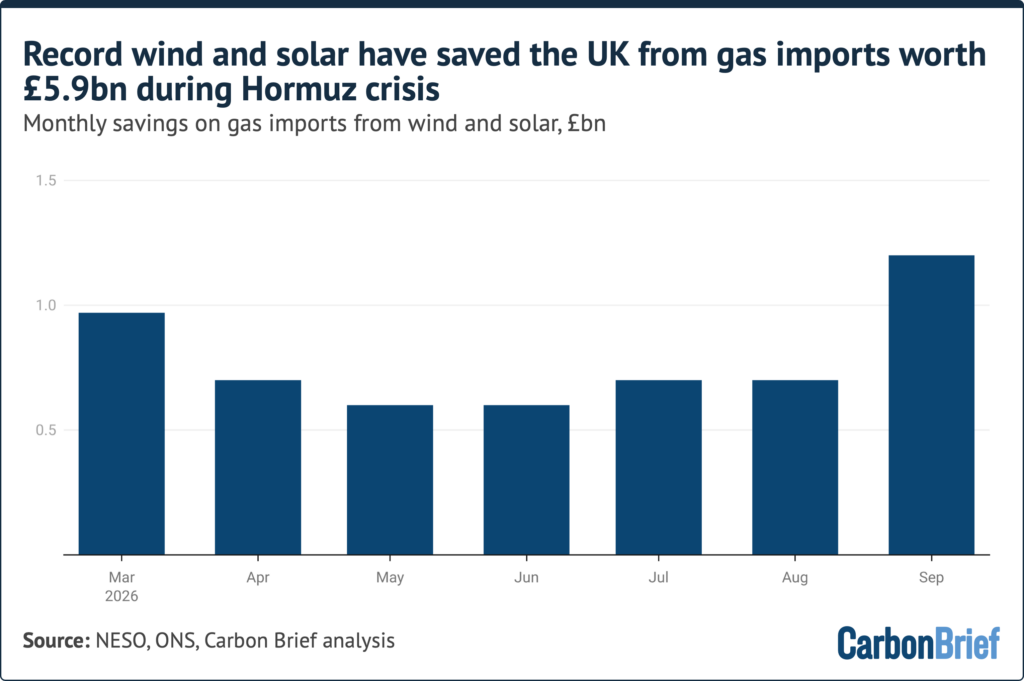
As a fresh geopolitical crisis in the Middle East sends shockwaves through international energy markets, new economic analysis reveals that the United Kingdom has successfully insulated its power sector from billions of pounds in potential fossil fuel costs. According to comprehensive data released by Carbon Brief, record-breaking power generation from wind and solar infrastructure has saved the UK an estimated £5.9 billion in avoided natural gas imports since the outbreak of the Hormuz crisis in early 2026.
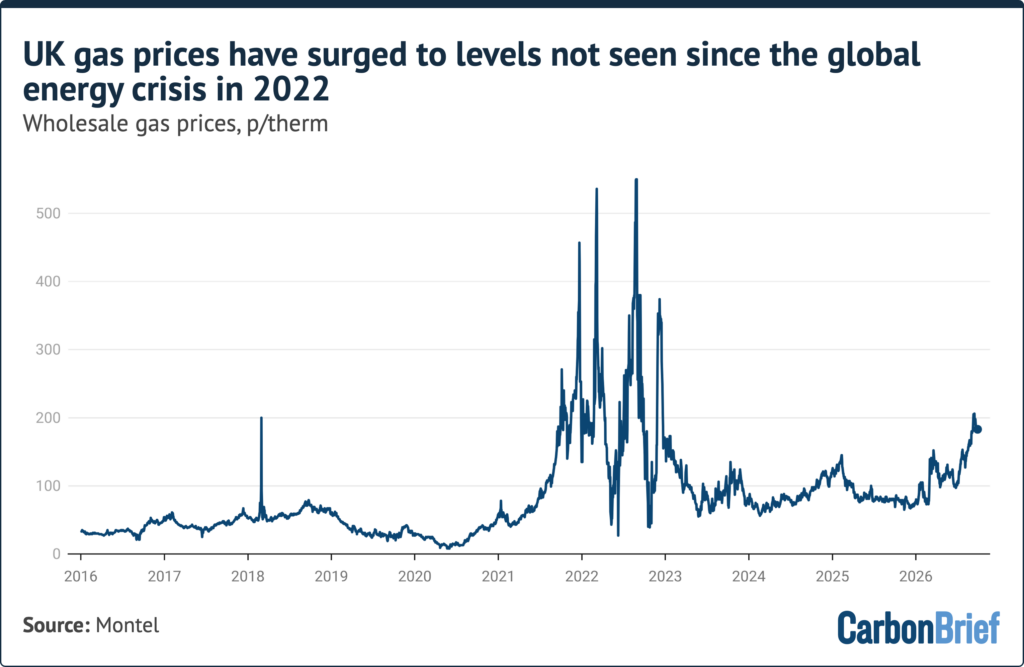
The global energy sector has been thrown into disarray following the outbreak of military conflict between the United States and Iran in February 2026, which severely restricted maritime traffic through the Strait of Hormuz—a vital bottleneck for worldwide liquefied natural gas (LNG) and crude oil transit. While wholesale gas prices have soared back toward historic highs last seen during the 2022 European energy crisis, domestic clean energy generation in the UK has reached unprecedented levels, expanding by 14% year-on-year.
       2026 UK Electricity Generation Share (Year-to-Date)
       ┌────────────────────────────────────────────────────────┐
       │ Wind & Solar: 41% [==================================] │
       │ Gas-Fired:    25% [====================]               │
       └────────────────────────────────────────────────────────┘
By substituting fossil-fuel generation with zero-carbon renewables, the UK reduced its reliance on gas-fired electricity by nearly 10% in 2026 to date. Wind and solar sources accounted for a record 41% of total UK power demand, significantly outstripping natural gas, which supplied just 25%. Without this clean-power surge, British energy suppliers would have been forced to procure the equivalent of more than 100 additional supertanker cargoes of LNG on an inflated and highly competitive spot market.
Detailed Chronology: From Pipeline Disruption to Maritime Conflict
To fully understand the magnitude of the current market disruption, the ongoing crisis must be viewed through a timeline of escalating structural vulnerabilities in global fossil fuel supply chains.
+-----------------------------------------------------------------------------------+
| CHRONOLOGY OF GLOBAL GAS SHOCKS AND UK MARKET PRICE IMPACTS                       |
+-----------------------------------------------------------------------------------+
| 2019            | Pre-Crisis Baseline                                             |
|                 | Wholesale gas averages ~30p–35p per therm.                        |
+-----------------+-----------------------------------------------------------------+
| Feb 2022        | Russian Invasion of Ukraine                                     |
|                 | Pipeline flows to Europe curtailed; triggers severe global shock.|
+-----------------+-----------------------------------------------------------------+
| 2023–Early 2026 | The "High Baseline" Plateau                                     |
|                 | UK gas prices stabilize at ~90p/therm (3x 2019 levels).         |
+-----------------+-----------------------------------------------------------------+
| Feb–Mar 2026    | Outbreak of US-Iran War / Strait of Hormuz Crisis               |
|                 | Global LNG trade disrupted; UK gas prices rise to 134p/therm.   |
+-----------------+-----------------------------------------------------------------+
| Sept 2026       | Pre-Winter Squeeze & Storage Deficits                           |
|                 | UK gas surges to 189p/therm; monthly renewable savings hit £1.3bn|
+-----------------------------------------------------------------------------------+
The Post-2022 Market Baseline
Following Russia’s invasion of Ukraine in February 2022 and the subsequent curtailment of pipeline supplies to Western Europe, global natural gas markets entered an era of structural tightness. Between 2023 and early 2026, wholesale gas prices in the UK averaged 90p per therm—roughly three times higher than the pre-2020 average. This persistent elevated baseline meant European economies were entering 2026 with zero cushion against further supply disruptions.
The Spring Escalation: War in the Gulf
The delicate equilibrium collapsed in late February 2026 with the outbreak of direct conflict between US and Iranian forces. As maritime warfare effectively choked the Strait of Hormuz, global LNG exports from Middle Eastern producers ground to a near-halt.
- March 2026: UK wholesale gas prices climbed to an average of 134p per therm (nearly four times 2019 levels).
- April–May 2026: Initial tracking by Carbon Brief indicated that UK wind and solar output had blunted the early impact of the crisis, avoiding £1 billion in gas imports by April, a total that expanded to £1.7 billion by May.
The Autumn Squeeze
By September 2026, wholesale gas prices spiked further, averaging 189p per therm—the highest monthly average since the peak of the 2022 energy crisis. This dramatic late-summer price spike was driven by a combination of compounding risks: persistent maritime blockades, below-average European gas storage reserves, and seasonal stockpiling ahead of winter heating demand.
Despite these severe headwinds, UK wind and solar facilities delivered a stellar performance in September, generating nearly 10 terawatt-hours (TWh) of electricity and shielding the UK economy from £1.3 billion in gas import costs in that single month alone.
Supporting Context & Metrics: Quantifying the Clean Energy Shield
The resilience provided by renewable energy can be quantified across generation volumes, trade balances, consumer bill variations, and broader macroeconomic impacts.
Generation Dynamics and Fuel Displacement
The substitution effect between clean energy and gas-fired thermal plants has fundamentally reordered the UK’s power supply curve throughout 2026.
| Metric | 2026 Performance / Value | Context & Historical Comparison |
|---|---|---|
| Total Avoided Gas Imports | £5.9 Billion | Cumulative savings since February 2026 conflict outbreak |
| September Monthly Savings | £1.3 Billion | Driven by ~10 TWh of combined solar and wind output |
| Avoided LNG Deliveries | >100 Tankers | Equivalent volume of supertanker spot cargoes saved |
| Renewable Share of Power | 41% | Record year-to-date share for wind and solar combined |
| Gas-Fired Share of Power | 25% | Down from dominant historical shares; generation dropped ~10% YoY |
| Clean Output Growth | +14% YoY | Year-on-year increase in combined wind and solar generation |
UK Wholesale Gas Price Escalation (pence per therm)
    200 ─────────────────────────────────────────── 189p (Sept 2026)
    160 ───────────────────────────── 134p (Mar-Aug 2026)
    120 ────────────────── 90p (2023-Early 2026)
     80 ─
     40 ─ 35p (2019)
      0 ┴──────────┬──────────────┬──────────────────┬──────────────
        2019 Pre-Crisis   2023-2025 Baseline   Mid-2026 War    Sept 2026
The European Storage Dilemma and LNG Competition
The sudden loss of Middle Eastern LNG cargoes occurred at a time when European underground gas storage levels were already tracking at their lowest seasonal levels since 2011. Lacking deep long-term storage capacity, European nations entered autumn forced into a fierce bidding war against Asian buyers for uncommitted Atlantic basin LNG cargoes.
This international competition pushed spot prices up worldwide. Separate modeling by the Center for Research on Energy and Clean Air (CREA) indicates that the European Union paid an additional €100 billion for fossil fuel imports during the first six months of the Hormuz crisis. Developing nations in Asia and Latin America faced even harsher conditions, frequently priced out of spot market shipments entirely.
Household Economics: The Decoupling of Gas and Electricity Bills
The divergence between fossil gas and renewable electricity performance is starkly reflected in domestic utility costs under the UK’s energy price cap administered by regulator Ofgem.
       Domestic Utility Bill Changes (Effective Oct 1, 2026)
       ┌────────────────────────────────────────────────────────┐
       │ Gas Bills:         +33% (~£200/yr increase) [========] │
       │ Electricity Bills: +4%  (Broadly Stable)    [=]        │
       └────────────────────────────────────────────────────────┘
According to analysis by the independent thinktank Nesta, typical British household gas bills are scheduled to rise by 33% (an increase of approximately £200 annually). In contrast, average household electricity bills will rise by just 4%.
This decoupling illustrates how zero-marginal-cost generation from wind and solar suppresses wholesale electricity prices, protecting power consumers even as domestic heating gas prices soar.
A similar dynamic is visible in private transport. With global crude disruptions pushing retail diesel to record highs of nearly £2.00 per liter, running costs for internal combustion engines have jumped. Conversely, driver economics show that running an electric vehicle (EV) charged via the UK’s increasingly green power grid is now up to nine times cheaper per mile than operating a petrol or diesel equivalent.
Official Statements and Political Discourse
The geopolitical crisis and its economic fallout dominated debates at the annual Labour Party Conference, framing the UK’s green energy transition as an issue of national security and economic sovereignty.
Energy Secretary Miatta Fahnbulleh
Addressing delegates, Energy Secretary Miatta Fahnbulleh argued that high consumer energy bills are the direct result of prolonged dependence on internationally traded volatile commodities:
"The fundamental reason household budgets remain under severe strain is that our nation remains exposed to volatile global fossil-fuel markets. Every storm in the Middle East or pipeline bottleneck in Europe translates directly into higher domestic heating costs. Expanding our domestic clean energy infrastructure is not just an environmental choice—it is a mandatory economic buffer."
Prime Minister Andy Burnham
Prime Minister Andy Burnham reaffirmed the government’s intention to accelerate structural market reforms aimed at insulating domestic power prices from international gas benchmarks:
"We are already taking more control of our electricity prices with a massive expansion of home-grown renewables and nuclear. I have asked Miatta to speed up the breaking of the link between what we pay for power at home and the international gas market, to get bills down once and for all."
"The link between electricity and gas prices has already begun to break."
 — Andrew Sissons, Director for Sustainable Future at Nesta
Commenting on the divergence between electricity and gas price caps, Andrew Sissons, Director for Sustainable Future at Nesta, noted via social media that despite market distortions, clean power generation is already proving its structural value: "The link between electricity and gas prices has already begun to break in real-time, driven by sheer volume of low-cost generation."
Future Outlook: Market Reform and System Security
While the performance of wind and solar has prevented billions in capital flight during the 2026 crisis, energy analysts emphasize that full insulation requires further market and grid architecture reforms.
1. Reforming Marginal Pricing Mechanisms
Currently, the UK power grid operates on a marginal pricing model, where the final price of electricity across the entire market is frequently set by the most expensive generator called upon to meet demand—typically a natural gas peaking plant.

The government’s priority is to complete the Review of Electricity Market Arrangements (REMA). By decoupling low-marginal-cost renewables from gas-indexed pricing, domestic electricity consumers will be able to fully benefit from cheap wind and solar generation, rather than paying rates tied to 189p-per-therm gas.
                  CURRENT VS. DECOUPLED MARKET ARCHITECTURE

      CURRENT (Marginal Pricing)              FUTURE (Decoupled System)
  ┌──────────────────────────────┐        ┌──────────────────────────────┐
  │ Solar & Wind (Low Cost)      │        │ Solar & Wind (Low Cost)      │
  │            │                 │        │            │                 │
  │            ▼                 │        │            ▼                 │
  │ SET BY: Gas Peaker (High)    │        │ Direct PPA / Green Tariff    │
  │            │                 │        │            │                 │
  │            ▼                 │        │            ▼                 │
  │ ALL Consumer Pays High Price │        │ Consumer Pays Low Clean Rate │
  └──────────────────────────────┘        └──────────────────────────────┘
2. Deployment of Long-Duration Energy Storage (LDES)
To maintain grid stability during extended periods of low wind and sunlight (Dunkelflaute) without relying on gas, significant capital investment is shifting toward Long-Duration Energy Storage (LDES). Key technologies under rapid deployment include:
- Pumped Hydro Storage: Expansion of high-capacity mountain reservoirs.
- Liquid Air Energy Storage (LAES): Utilizing cryogenic cooling to store energy at grid scale.
- Advanced Battery Systems & Green Hydrogen: Providing multi-day reserves to bridge seasonal supply gaps.
3. Geopolitical Security via Clean Power Sovereignty
The Hormuz crisis of 2026 has accelerated a global shift in energy strategy. Energy security is no longer viewed solely as securing diverse fossil fuel import routes, but as eliminating the requirement for fuel imports altogether.
As the UK pushes toward its goal of a clean power grid, the £5.9 billion saved during the 2026 Middle East crisis stands as a concrete proof-of-concept. By turning to domestic wind, solar, nuclear, and long-duration storage, the nation is actively transforming its energy infrastructure from a major economic vulnerability into a resilient, self-sustaining shield against global geopolitical volatility.



