

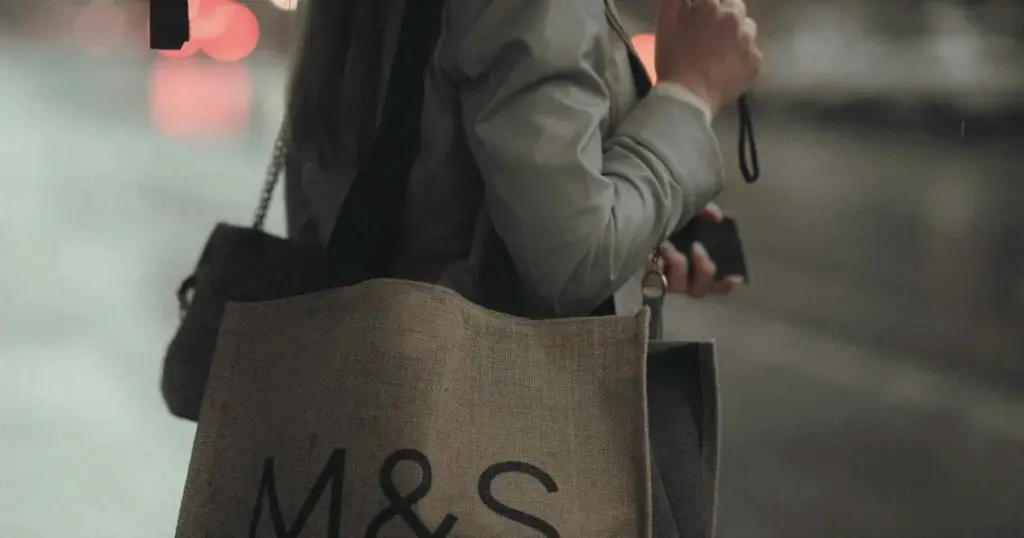
Editor’s Note: Our editors curate highly rated brands that are first assessed by our rigorous ratings system. Buying through our links may earn us a commission—supporting the work we do. Learn more.
Executive Overview
As British heritage retailer Marks & Spencer (M&S) makes its high-profile runway debut at London Fashion Week with a trend-accelerating "see now, buy now" format, an inescapable question hangs over the glittering event: How sustainable are the brand’s actual practices?
According to Good On You’s rigorous sustainability methodology, Marks & Spencer currently receives a middling “It’s a Start” rating. This score reflects a paradox that defines modern retail giants. On one hand, M&S demonstrates commendable transparency, utilizes increasing volumes of recycled synthetics, maps its tier-one supply chain, and participates in circular economy initiatives like clothing take-back schemes and repair services. On the other hand, the company remains a high-volume mass producer.
Worse still, recent strategic pivots—such as the rapid-turnaround "Love That Drop" capsule collections and its accelerated London Fashion Week showcase—push the brand deeper into fast-fashion territory. This trajectory encourages overconsumption, creates immense textile waste, and fails to guarantee a living wage for the countless garment workers powering its global supply chain.
This deep-dive investigation analyzes M&S’s public disclosures, third-party reports, and ethical metrics as of May 2026, evaluating the true cost behind the retailer’s famous high street status.
Detailed Chronology: From 19th-Century Staple to Modern Mass Producer
The Foundation of a British Institution
Founded in 1884, Marks & Spencer evolved from a modest market stall into a cornerstone of British culture. For generations, the brand has functioned as a reliable retail barometer for the UK economy, providing everything from everyday groceries and homewares to dependable, high-calibre fashion.
In the British cultural lexicon, M&S quality became a gold standard—cemented forever by iconic cultural touchstones like its famous advertising tagline, "This is not just food, this is M&S food." However, translating this cultural reputation for quality into the fashion sector has grown increasingly complex in the 21st century.
The Mass-Production Dilemma
As M&S expanded internationally and scaled its operations to fill massive retail spaces with racks of affordable clothing, its business model inevitably shifted toward mass production. This raises a fundamental, systemic question: How can a brand manufacture clothing on such a massive scale, maintain a high standard of quality, and keep prices so low without externalizing the cost onto the environment and labor force?
The 2026 Shift Toward Fast Fashion
Rather than slowing down production to curb textile waste, 2026 marked a concerning acceleration in M&S’s fashion strategy. The brand introduced "Love That Drop," a monthly, trend-led capsule program designed to compress design-to-production cycles into as little as two weeks.
This operational shift directly mirrors the playbook of traditional fast-fashion giants. By prioritizing ultra-fast inventory turns, M&S encourages chronic overconsumption and places severe, often detrimental time pressure on its manufacturing partners. This trajectory culminated in September 2026 with the brand’s debut London Fashion Week runway show, utilizing a "see now, buy now" model. While traditional fashion houses use runways to preview collections six months in advance for wholesale buyers, M&S made its runway items instantly purchasable—further blurring the line between heritage retail and hyper-fast consumerism.
Supporting Context & Metrics: Environmental, Labour, and Animal Welfare Impacts
Environmental Impact: "It’s a Start"
Marks & Spencer earns an “It’s a Start” rating for its environmental footprint.
- Material Innovation vs. Fossil Fuel Dependency: M&S utilizes some lower-impact materials and claims it is on track to completely replace virgin polyester with recycled polyester by 2026. While recycling synthetics is a step forward, polyester remains a fossil-fuel-derived plastic that sheds microplastics into water systems with every wash. Given that polyester is M&S’s second most-used raw material, environmental analysts argue the brand must reduce its overall reliance on the fabric rather than merely swapping virgin plastic for recycled alternatives.
- Carbon and Supply Chain Targets: The brand has implemented science-based targets to lower greenhouse gas emissions across both its direct operations and its manufacturing supply chain.
- The Waste Crisis: Despite these corporate targets, the reality of mass production catches up to M&S at the end of the product lifecycle. Investigative reports from organizations like Changing Markets and Greenpeace have identified M&S garments in textile waste dumps in the Global South, such as Kenya and Ghana. Although M&S maintains that it does not intentionally export excess clothing for dumping, the sheer volume of clothes it produces guarantees that significant quantities end up choking foreign ecosystems.
- Circular Initiatives: To its credit, M&S has launched notable circular initiatives, including an Oxfam clothing take-back scheme, in-house repair services, and a one-year durability guarantee on children’s clothing. However, experts emphasize that no take-back program can offset the fundamental unsustainability of an oversized "take-make-waste" business model.
Labour Rights: Fair Intentions, Missing Living Wages
M&S also scores an “It’s a Start” for labour rights, displaying a mix of commendable transparency and critical gaps.
- Supply Chain Transparency: M&S discloses 100% of its tier-one fashion suppliers in collaboration with the Open Supply Hub. Furthermore, more than half of its final production stage facilities are certified by the Sedex Members Ethical Trade Audit (SMETA) Best Practice Guidance.
- Long-Term Partnerships: During the COVID-19 pandemic, M&S enacted robust policies to protect supply chain workers, a success the brand attributed to its long-term, stable relationships with partner factories—the gold standard in ethical sourcing. It has also spearheaded initiatives to support vulnerable women and girls within its supply chain network.
- The Living Wage Blindspot: Despite these positive steps, a glaring omission remains: there is no evidence that M&S ensures workers throughout its supply chain are paid a living wage. The brand has yet to adopt a recognized living wage benchmark. Given the sheer scale of M&S’s manufacturing volume, countless garment workers are likely left without the means to live comfortably, making living wage implementation the single most critical area for future improvement.
Animal Welfare: Progress with Caveats
In animal welfare, M&S maintains its “It’s a Start” ranking.
- Formal Policies and Certifications: The brand operates under a formal animal welfare policy aligned with the Five Domains. It sources wool exclusively from non-mulesed sheep and ensures all leather is acquired from tanneries certified by the Leather Working Group (WG). Additionally, M&S has set a target to source 100% of its animal fibers from "preferred" certified sources (such as the Responsible Wool Standard and Global Recycled Standard) by 2030.
- Continued Reliance on Animal Products: Despite these certified sourcing policies, M&S continues to utilize substantial amounts of leather, shearling, wool, down, and alpaca—materials intrinsically tied to animal slaughter and suffering. Analysts advocate for a transition away from animal-derived materials entirely, suggesting M&S leverage its massive purchasing power to pioneer and fund emerging, non-plastic biomaterials.
Official Statements and Brand Accountability
When evaluated holistically, M&S performs better than many high street competitors regarding transparency. By disclosing tier-one suppliers, tracking progress toward sustainability targets, and openly reporting material shifts, the brand demonstrates accountability.
Yet, external analysts express deep frustration that these sustainability gains are being undermined by commercial pivots toward fast fashion. As Good On You notes:
"M&S has put in the work to improve its practices over the years… But we can’t help be disappointed by the brand’s recent shifts towards fast fashion business models, including more clothing drops."
To transition from a middling score to a “Good” or “Great” rating, M&S must undertake structural transformations:
- Cap Production Volumes: Scale back overall clothing production to combat overconsumption and textile waste at the root.
- Deepen Traceability: Expand transparency beyond tier-one suppliers to include raw material producers.
- Commit to Living Wages: Legally bind its manufacturing partners to pay all garment workers a verified living wage.
- Reduce Animal Fiber Reliance: Phase out heavy reliance on cashmere, wool, and leather in favor of cruelty-free, next-generation sustainable alternatives.
Future Outlook: Better Alternatives on the High Street
While Marks & Spencer remains a beloved one-stop shop for family apparel and homeware at accessible price points, conscious consumers seeking truly sustainable options can look toward brands achieving top-tier ratings on Good On You.
Top-Rated Sustainable Alternatives
- Toad&Co: A US-based brand crafting socially and environmentally conscious menswear and womenswear (sizes XS–2XL) equally suited for outdoor adventures and daily wear. (See Rating)
- Harvest & Mill: Exclusively grown, milled, and sewn in the US, this brand creates unbleached, undyed organic cotton basics that actively support local farming ecosystems and biodiversity. (See Rating)
- Colorful Standard: A Danish label creating timeless, seasonless, organic cotton essentials in sizes XS–2XL, explicitly designed to fight the cycle of overconsumption. (See Rating)
- SeamsFriendly: Specializing in custom-tailored, zero-waste womenswear, menswear, and children’s clothing using lower-impact fabrics like organic cotton and linen. Shoppers can input exact body measurements for a personalized fit, minimizing unsold inventory waste. (Enjoy an exclusive 10% off with code SF-GY10 at checkout). (See Rating)
- Sheep Inc: A carbon-negative knitwear pioneer focusing on traceable, ethically sourced merino wool under strict principles of animal welfare and climate harmony. (See Rating)
Good On You publishes the world’s most comprehensive ratings of fashion and beauty brands’ impact on people, the planet, and animals. Explore the complete directory at Good On You.



