

Executive Overview: The Dawn of an Unforgiving Climate Reality
The global climate crisis has entered a volatile, non-linear phase. Years of scientific warnings regarding anthropogenic global warming are no longer abstract projections confined to academic policy papers; they are manifesting as devastating real-time disasters across every inhabited continent. From the infernos sweeping Southern Europe to catastrophic flash floods driven by glacial collapse in the high Himalayan peaks of Nepal, extreme weather events are shattering historical baselines with relentless frequency and intensity.
As highlighted in a joint assessment by Cristina Rumbaitis del Rio, Senior Advisor on Adaptation and Resilience with the United Nations Foundation, and Mattias Söderberg, Global Climate Lead at the Danish non-governmental organization DanChurchAid, humanity faces an unmistakable imperative: the era of incremental climate adaptation is over. The baseline assumptions, infrastructure designs, and disaster response models forged in the 20th century are fundamentally inadequate for the compound climate shocks of today.
Governments, civil society, and international development institutions are confronting an operational gap. Traditional adaptation strategies were constructed under the premise of linear, predictable shifts in average temperatures and rainfall patterns. Today’s climate reality, however, is characterized by sudden tipping points, feedback loops, and simultaneous multi-hazard events that overwhelm local defense capabilities. Closing this gap requires an overhaul of global adaptation finance, radical improvements in localized resilience mechanisms, and a shift from reactive emergency management to transformative, forward-looking infrastructure planning.
+-----------------------------------------------------------------------------------+
|                        THE PARADIGM SHIFT IN CLIMATE ADAPTATION                   |
+-----------------------------------------------------------------------------------+
| LEGACY ADAPTATION MODEL                      NEXT-GENERATION ADAPTATION MODEL     |
| -----------------------                      ---------------------------------    |
| • Incremental infrastructure upgrades        • Systems-level structural transformation|
| • Based on historical 50/100-year baselines   • Stress-tested against compound risks   |
| • Top-down regional funding allocation       • Direct, locally-led financing (LLA)   |
| • Reactive emergency relief focus            • Proactive multi-hazard early warning   |
+-----------------------------------------------------------------------------------+
Detailed Chronology: Anatomy of Recent Systemic Climate Disasters
The recent cycle of extreme weather events underscores how rapidly global climate stability is deteriorating. The timeline below illustrates how consecutive, compounding events have tested emergency response networks to their absolute breaking point.
       EUROPEAN SUMMER HEATWAVES
       Record temps (>40°C) dry out soils & forests across the Mediterranean basin.
                   │
                   ▼
  JUL  ┌─────────────────────────────────────────────────────────┐
 2024  │ SOUTHERN EUROPEAN MEGAFIRES                             │
       │ Massive firestorms strike Greece, Spain, and Italy,     │
       │ forcing mass evacuations and destroying ecosystems.     │
       └──────────────────────────┬──────────────────────────────┘
                                  │
                                  ▼
  AUG  ┌─────────────────────────────────────────────────────────┐
 2024  │ HIMALAYAN GLACIAL ERUPTION (NEPAL)                      │
       │ Thermal anomalies breach high-altitude glacial lakes;   │
       │ Thame village inundated by sudden GLOF catastrophic wall│
       │ of ice-water debris.                                    │
       └──────────────────────────┬──────────────────────────────┘
                                  │
                                  ▼
  SEP  ┌─────────────────────────────────────────────────────────┐
 2024  │ GLOBAL COMPOUND CASUALTIES & DISPLACEMENT               │
       │ Concurrent droughts, agricultural failures, and flash   │
       │ floods expose vulnerabilities across multiple continents.│
       └─────────────────────────────────────────────────────────┘
The European Crucible: Summer Heatwaves and Uncontrollable Megafires
During the summer months, Southern Europe and the Mediterranean basin endured intense heatwaves, with localized temperatures routinely breaching 40°C (104°F) and in some areas reaching unprecedented heights above 45°C.
- Micro-Climate Desiccation: Prolonged atmospheric heat domes desiccated soil moisture and vegetation, turning ancient forest corridors into dry fuel beds.
- The Greek & Iberian Firestorms: In regions across Greece, Spain, Portugal, and Italy, wildfires exhibited fire behavior that defied standard containment strategies. Wildfires created their own microclimates—generating pyrocumulonimbus clouds—which triggered unpredictable spot fires kilometers ahead of primary fire fronts.
- Socio-Economic Shockwaves: Municipalities were forced into emergency evacuations of tens of thousands of residents and tourists, halting regional tourism economies, overwhelming healthcare systems with heat-stress admissions, and exposing electrical grids to cascading failures as cooling demands surged to peak capacity.
Himalayan Catastrophe: Glacial Outbursts and Downstream Ravages
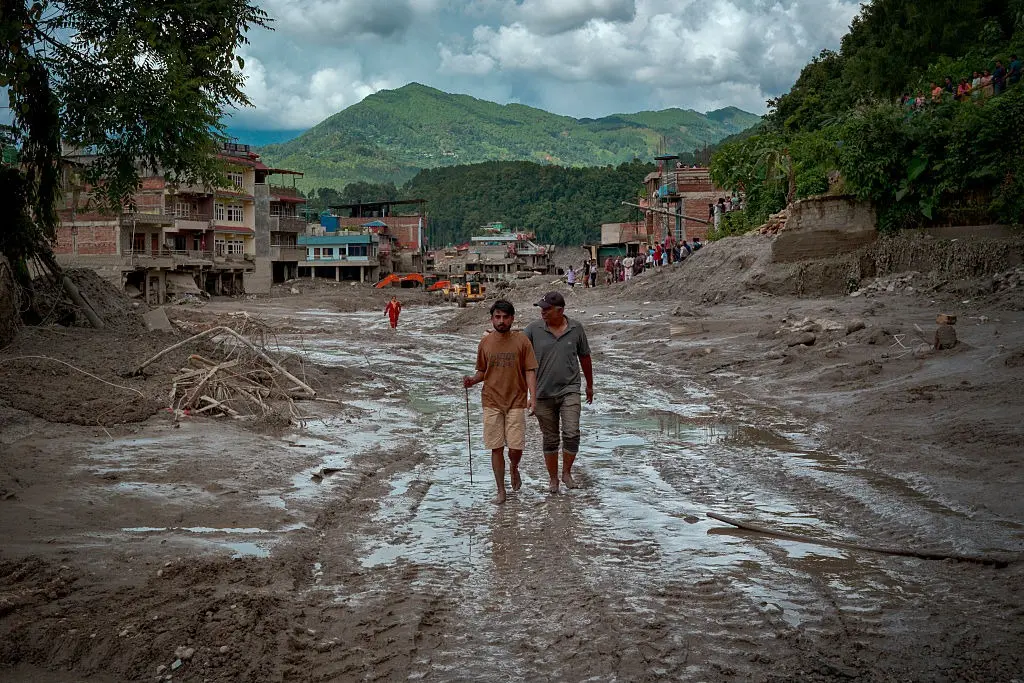
Concurrently, high-altitude mountain ecosystems demonstrated their acute sensitivity to thermal forcing. In the Solukhumbu district of Nepal, home to Everest and critical headwaters for millions downstream, elevated alpine temperatures accelerated glacial thaw.
- The Glacier Collapse: Glacial melt coupled with thermal expansion triggered a massive Glacial Lake Outburst Flood (GLOF) near the high-mountain village of Thame.
- Mechanics of Destruction: Millions of cubic meters of water, heavy silt, boulders, and ice breached natural moraine dams. The resulting torrent swept down the valley, erasing critical civil infrastructure, hydro-electric installations, bridges, and mountain homesteads within minutes.
- Cascading Downstream Impacts: The event disrupted water security and local subsistence agriculture, highlighting how changes in high-altitude cryospheres directly threaten human settlements downstream.
Global Interconnected Shocks
These events were not isolated. Parallel climate anomalies erupted globally:
- North America: Historic heat domes stretched civil grid capacity and accelerated severe seasonal droughts.
- Sub-Saharan Africa: Shifts in tropical precipitation belts caused transitions from multi-year droughts to sudden destructive flash flooding, displacing vulnerable pastoralist communities.
- Latin America: Key maritime pathways, including the Panama Canal, faced operational cutbacks due to prolonged basin-wide droughts, disrupting global supply chains.
Supporting Context & Metrics: Quantifying the Adaptation Gap
The intensity of these disasters emphasizes a stark truth: the financial, structural, and institutional investments dedicated to climate resilience are severely lagging behind the physical impacts of climate change.
       ADAPTATION FINANCE GAP IN DEVELOPING NATIONS (ANNUAL)

  Estimated Needs    [########################################] $215B - $387B
  Current Flows      [########] $28B - $35B
                     +---------+---------+---------+---------+
                     $0       $100B     $200B     $300B     $400B
The Financial and Economic Deficit
Data from the United Nations Environment Programme (UNEP) Adaptation Gap Report highlights a widening fiscal divide:
- Annual Adaptation Finance Gap: Developing nations require an estimated $215 billion to $387 billion annually this decade to implement adequate climate adaptation measures.
- Current Public International Flows: Public multilateral and bilateral adaptation flows remain under $35 billion per year, leaving a structural funding deficit exceeding $200 billion annually.
- Loss and Damage Divergence: While the establishment of the Loss and Damage Fund at COP27 and its operationalization at COP28 were political milestones, total initial pledges (~$700 million) cover less than 0.2% of the actual annual economic losses suffered by vulnerable populations in the Global South.
+----------------------------------------------------------------------------------+
|               KEY METRICS: CLIMATE VULNERABILITY & ADAPTATION GAP                |
+----------------------------------------------------------------------------------+
| Metric Category              | Current Value / Status    | Baseline Trajectory   |
+------------------------------+---------------------------+-----------------------+
| HKH Glacier Volume Reduction | 30%–50% projected loss    | Threatens 1.9 billion |
| (by 2050 at current warming) |                           | downstream residents  |
+------------------------------+---------------------------+-----------------------+
| Global Early Warning Coverage| ~50% of vulnerable        | UN target: 100%       |
| Gap in LDCs                  | countries lack systems    | coverage by 2027      |
+------------------------------+---------------------------+-----------------------+
| Municipal Infrastructure     | Built for 1-in-100-year   | Events now occurring  |
| Failure Thresholds           | historical baselines      | on 1-in-10-year cycles|
+------------------------------+---------------------------+-----------------------+
Cryosphere and Hydrological Tipping Points
Scientific assessments by the International Centre for Integrated Mountain Development (ICIMOD) confirm that glaciers in the Hindu Kush Himalaya (HKH) region are melting at rates unprecedented in recorded history.
- Melt Rate Acceleration: Glaciers melted up to 65% faster in the 2010s compared to the preceding decade.
- Systemic Downstream Vulnerability: Over 1.9 billion people—nearly a quarter of the global population—rely on these mountain water towers for drinking water, agriculture, and power generation. The rapid degradation of these ice structures compromises the water and food security of South Asia.
Official Statements: Perspectives from Policy and Civil Society
Leaders across the climate policy and humanitarian sectors emphasize that current institutional models require immediate structural reform.
Cristina Rumbaitis del Rio, Senior Advisor on Adaptation and Resilience with the United Nations Foundation, stressed the need to redesign structural planning frameworks:
"The events we are witnessing in Southern Europe, across the Himalayas, and throughout the Global South are not black swan occurrences—they are the predicted consequences of an overheated planet. Our infrastructure, agriculture, and municipal planning were engineered for a stable climate baseline that no longer exists. If we continue to build and finance adaptation strategies based on yesterday’s environmental conditions, we are essentially building for failure. We need adaptive designs that account for compound risks, extreme variability, and deep ecological uncertainty."
Mattias Söderberg, Global Climate Lead at DanChurchAid, emphasized the human rights and equity imperatives of international adaptation policy:
"Frontline communities in nations like Nepal, who have contributed virtually nothing to historical greenhouse gas emissions, are paying for global inaction with their lives, homes, and futures. The current paradigm of international climate finance is far too slow, far too bureaucratic, and profoundly inadequate in scale. We cannot tell a family whose village was wiped out by a glacial outburst flood to wait five years for an international funding proposal to clear approval channels. We need direct, locally led adaptation finance that gets resources directly to communities before the disaster strikes."
+-----------------------------------------------------------------------------------+
|                          STAKEHOLDER PERSPECTIVE ANALYSIS                         |
+-----------------------------------------------------------------------------------+
| STAKEHOLDER INSTITUTION    | CORE DIAGNOSIS              | STRATEGIC DEMAND        |
+----------------------------+-----------------------------+-------------------------+
| UN Foundation              | Legacy engineering models   | Systems-level, future-  |
| (Rumbaitis del Rio)        | fail under compound risks.  | proofed urban/rural     |
|                            |                             | infrastructure redesign.|
+----------------------------+-----------------------------+-------------------------+
| DanChurchAid               | Top-heavy, slow climate     | Direct funding to LLA   |
| (Söderberg)                | finance ignores frontline   | mechanisms; streamlined |
|                            | community urgency.          | Loss & Damage payouts.  |
+----------------------------+-----------------------------+-------------------------+
| Frontline Municipalities   | Municipal budgets overwhelmed| Institutional technical |
| (Local Authorities)        | by recurring disasters.     | support and real-time   |
|                            |                             | early warning tools.    |
+----------------------------+-----------------------------+-------------------------+
Future Outlook: Reengineering Global Adaptation Architecture
To respond effectively to the current climate reality, international institutions, national governments, and civil society organizations must pivot from incremental adjustments to systemic, transformative adaptation.
       TRANSFORMATIVE ADAPTATION PILLARS

       ┌─────────────────────────────────────────────────────────┐
       │ 1. LOCALLY LED ADAPTATION (LLA)                         │
       │ Shift control & resources to local actors to ensure     │
       │ rapid, context-specific response strategies.            │
       └──────────────────────────┬──────────────────────────────┘
                                  │
                                  ▼
       ┌─────────────────────────────────────────────────────────┐
       │ 2. REFORMING MULTILATERAL CLIMATE FINANCE               │
       │ Deploy grant-based, non-debt creation instruments and   │
       │ systemic debt-for-climate swap frameworks.              │
       └──────────────────────────┬──────────────────────────────┘
                                  │
                                  ▼
       ┌─────────────────────────────────────────────────────────┐
       │ 3. UNIVERSAL MULTI-HAZARD EARLY WARNINGS                │
       │ Fulfill UN EW4All target by integrating satellite AI    │
       │ hydrology models with Indigenous community alerts.      │
       └─────────────────────────────────────────────────────────┘
Pillar 1: Shift Control to Locally Led Adaptation (LLA)
Traditional adaptation interventions often rely on top-down, bureaucratic frameworks that fail to address the specific vulnerabilities of local communities.
- Direct Funding Channels: Adaptation funding must bypass complex national bureaucracies to deliver resources directly to local municipal authorities, indigenous leaders, and grassroots civil society networks.
- Community-Led Innovation: Integrating local ecological knowledge with modern geospatial modeling yields resilience strategies that are culturally appropriate, ecologically sound, and durable over time.
Pillar 2: Reform Climate Finance Mechanics
The current practice of providing climate adaptation assistance primarily through loans worsens the fiscal distress of vulnerable, highly indebted nations.
- Grant-Based Allocation: Adaptation financing to Least Developed Countries (LDCs) and Small Island Developing States (SIDS) must transition from loan-dominated mechanisms to grant-based funding.
- Debt Swap Mechanisms: Financial innovations, such as debt-for-climate swaps and climate-resilient debt clauses—which suspend debt repayments following major disaster events—must become standard practice across international financial institutions like the World Bank and International Monetary Fund.
Pillar 3: Universal Early Warning and Early Action Frameworks
The United Nations’ Early Warnings for All initiative must be fully resourced and rapidly deployed.
- Bridging the Technology Gap: Half of the world’s countries lack adequate multi-hazard early warning systems. Expanding high-resolution hydro-meteorological networks, satellite glaciology monitoring, and predictive AI modeling is essential to anticipate sudden-onset disasters like GLOFs and flash floods.
- Last-Mile Connectivity: An early warning is only effective if it reaches every community member. Investing in emergency response protocols, evacuation routes, and community training ensures that technical alerts translate into prompt lifesaving actions.
Pillar 4: Infrastructure Stress-Testing for Unprecedented Baselines
Standard civil engineering codes must be reassessed.
- Redefining Safety Margins: Transport networks, sea walls, drainage systems, and power grids must be retrofitted and built to endure extreme scenario models rather than historical weather data.
- Nature-Based Solutions (NbS): Integrating green infrastructure—such as restoring mangrove buffers, expanding mountain forest sponges, and re-wilding urban floodplains—provides flexible, cost-effective defense mechanisms that adapt dynamically to escalating environmental stressors.
Conclusion
The extreme events seen in Southern Europe, the Himalayas, and across the world are clear warnings: climate impacts are rapidly outstripping conventional adaptation measures. As Cristina Rumbaitis del Rio and Mattias Söderberg point out, attempting to manage tomorrow’s climate disasters using yesterday’s playbooks guarantees escalating loss of life and economic instability.
Recognizing this reality requires a total overhaul of climate adaptation planning. Achieving real resilience demands restructuring global financial architectures, directing resources directly to frontline communities, and building flexible infrastructure designed for an unpredictable planet. The choices made by international policymakers today will determine whether humanity adapts to this new climate reality or is continually overwhelmed by it.



