

Executive Overview
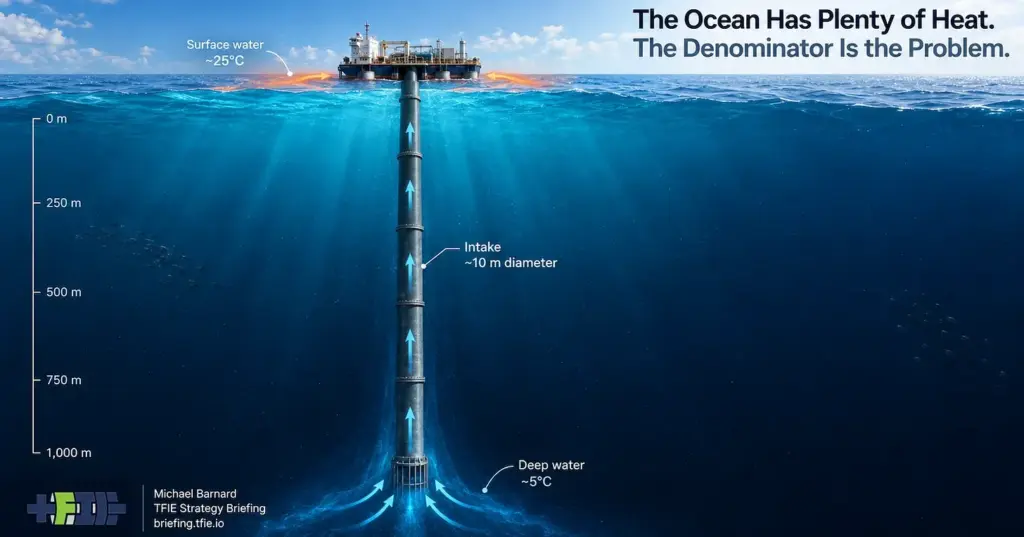
For decades, advocates of Ocean Thermal Energy Conversion (OTEC) have pointed to the Earth’s tropical oceans as an unexhausted, near-limitless battery of clean energy. The fundamental physics of the concept are sound, elegant, and entirely unreliant on speculative science. By harnessing the temperature differential between sun-warmed tropical surface waters—often hovering around a comfortable 25°C—and the icy depths of the deep ocean, sitting at a chilling 4°C to 5°C roughly a kilometer down, a continuous, round-the-clock thermodynamic cycle can be established.
Unlike solar power, which requires sunlight, or wind turbines, which depend on shifting atmospheric conditions, tropical oceans offer a virtually infinite and steady thermal reservoir. The fuel is free, and the temperature gradient is constantly renewed by solar radiation and global ocean currents.
Yet, despite producing net electricity as early as 1979 in Hawaii and seeing subsequent pilot demonstrations in regions like Japan, utility-scale commercial OTEC remains a ghost in the energy transition. While technologies like solar photovoltaics, wind energy, and lithium-ion batteries have scaled exponentially into hundreds of gigawatts of annual deployments, OTEC has languished in pilot-project purgatory.
The barrier is not a failure of thermodynamic theory, but an unforgiving civil-engineering reality. Because the temperature differential between the warm surface and cold deep water is so small, the theoretical efficiency ceiling of an OTEC heat engine is roughly 6.7%. In the real world, accounting for parasitic loads from colossal water pumps, friction losses, and heat exchanger inefficiencies, practical OTEC cycles plunge into the low single digits.
This low efficiency is not merely an abstract academic penalty; it is a heavy physical tax. To generate a meaningful amount of net electricity, an OTEC plant must process staggering, incomprehensible volumes of seawater. The resulting demand for marine infrastructure, massive subterranean pipes, complex offshore platforms, and colossal heat exchangers creates a formidable economic bottleneck. Until the industry can bridge the gap between theoretical oceanic abundance and the harsh financial math of marine civil engineering, OTEC will remain a brilliant physics concept searching for a commercially viable shoreline.
Detailed Chronology: Decades of Promise and Stalled Progress
To understand why OTEC has struggled to break into the modern commercial energy mix, one must look back at its winding, intermittent history of development.
- 1881 — The Theoretical Genesis: French engineer Jacques-Arsène d’Arsonval first proposes the concept of tapping the thermal gradient of the ocean to generate power, suggesting a closed-rankine cycle using a fluid with a low boiling point.
- 1930 — First Physical Demonstration: D’Arsonval’s student, Georges Claude, constructs the world’s first OTEC plant on the coast of Matanzas, Cuba. Utilizing an open-cycle system, Claude successfully generates power, though the installation is ultimately destroyed by rough seas and technical hurdles.
- 1979 — The Modern Era Breakthrough: Operational progress resumes with the mini-OTEC project off the coast of Hawaii. For the first time, a closed-cycle floating OTEC plant produces net electricity at sea, validating decades of theoretical computer modeling and bench testing.
- 1993 — Natural Energy Laboratory of Hawaii Authority (NELHA): A landmark milestone is achieved when a Japanese-backed OTEC facility at NELHA in Hawaii successfully connects to a local utility grid, generating roughly 250 kW of gross power (and around 100 kW of net power after subtracting internal parasitic pumping loads).
- 2010s — International Pilot Scale-Ups: Facilities and testing grounds are expanded in regions like Okinawa, Japan, and further evaluations are conducted in various Pacific Island nations. Companies like Makai Ocean Engineering refine heat exchanger designs and fluid dynamics, proving that the technical components can survive harsh marine environments.
- Present Day — The Deployment Gap: Despite successful isolated demonstrations, the commercial trajectory stalls. While variable renewables (solar and wind) achieve multi-gigawatt economies of scale, OTEC development fails to progress from isolated bespoke engineering projects to standardized, repeatable commercial rollouts.
Supporting Context & Metrics: The Brutal Mathematics of Seawater Flow
The Achilles’ heel of Ocean Thermal Energy Conversion is its denominator: the sheer scale of physical infrastructure required per megawatt of delivered electricity.
To visualize this, consider a reference design for a modest, commercial-scale 100 MW net OTEC plant. Because the thermal efficiency of the system sits stubbornly in the low single digits, thousands of gigawatts of thermal energy must cross the plant’s heat exchangers to yield just 100 megawatts of useful electrical output.
This thermal transfer requires an astronomical volume of water moving continuously through the system:
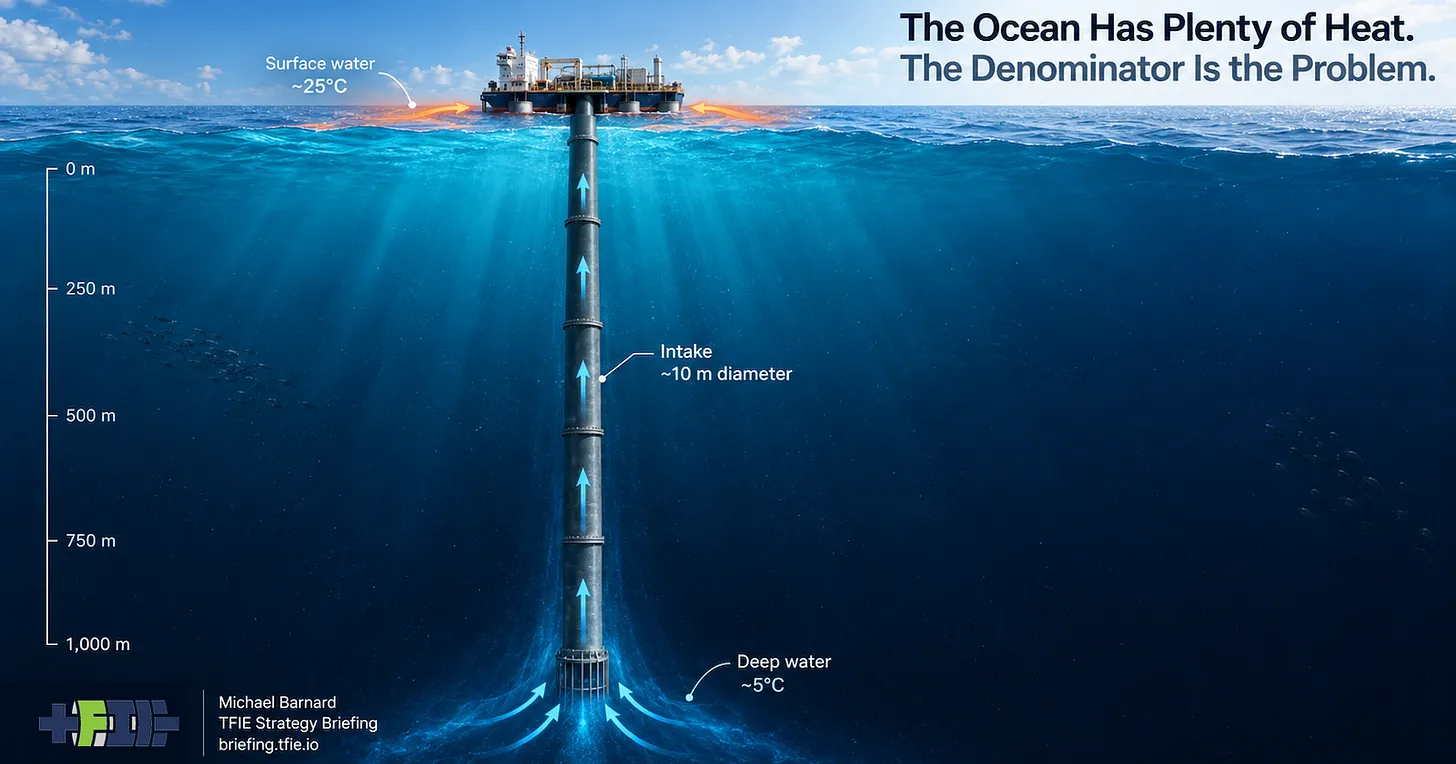
- Deep Cold Seawater: Approximately 235 cubic meters per second must be drawn from a depth of roughly one kilometer.
- Warm Surface Seawater: Approximately 470 cubic meters per second must be pulled from the tropical surface layer.
- Total Combined Flow: A staggering 705 cubic meters per second (705,000 liters every single second).
To put this into perspective, a 100 MW OTEC plant moves a volume of water equivalent to an Olympic-sized swimming pool every 3.5 seconds. Over the course of a single day, the facility cycles an amount of water equivalent to more than 24,000 Olympic swimming pools.
The Engineering Nightmare of Intake and Friction
This relentless deluge must enter the plant through massive intakes, flow through complex screening systems, navigate extensive piping networks and heat exchangers without triggering excessive pressure drops, and then be safely discharged back into the ocean.
The cold-water pipe alone presents a monumental engineering challenge. Engineering reviews for a 100 MW-class intake dictate a structure roughly 10 meters in diameter and 1 kilometer long.
Critics unfamiliar with fluid dynamics often assume that pumping water vertically up a column one kilometer deep requires fighting the full hydrostatic head. In reality, because the water pressure inside and outside the pipe largely balances out, the vertical lift is not the primary obstacle. Instead, the true enemy is fluid friction, turbulence, boundary layers, and pressure losses across bends, screens, and heat transfer surfaces.
When hundreds of tonnes of seawater crash through a system every second, even minute pressure losses compound into massive parasitic loads. Overcoming these internal pumping demands eats heavily into the gross power generated by the turbines, driving up the structural requirements and necessitating pipes of colossal proportions just to keep parasitic losses manageable.
Offshore Complexities
Moving the power plant offshore to shorten the horizontal run to deep water does not eliminate these challenges; it merely trades them for new ones.
A floating OTEC platform can position itself directly above deep water, but it must then suspend a kilometer-long vertical pipe beneath a dynamic, heaving marine vessel. This structure is constantly subjected to severe ocean currents, cyclical fatigue, aggressive marine corrosion, and intense station-keeping loads. Building offshore platforms capable of withstanding these forces over a multi-decade operational lifespan is entirely possible for modern marine engineering—but doing so at a cost that undercuts land-based renewables or competing grid solutions remains an unsolved puzzle.
Official Perspectives & Industry Analysis
Industry experts and energy strategists agree that OTEC’s primary hurdle is no longer proving that a warm ocean and a cold ocean can run a heat engine. That physics is settled. The real debate centers around capital allocation, infrastructure density, and market competitiveness.
Analysts examining the techno-economic viability of marine energy systems point out a stark contrast between OTEC and other low-carbon technologies. While solar panels and wind turbines are manufactured in massive, automated factories on dry land and installed incrementally with modular scalability, OTEC plants are inherently bespoke, capital-intensive megaprojects. Every site requires custom bathymetric mapping, specialized deep-sea pipeline deployment, and heavy marine construction vessels.

In a comprehensive market assessment by TFIE Strategy Briefing, researchers highlighted the critical denominator that OTEC advocates frequently omit from their prospectuses: how much pipe, heat-exchanger surface area, and offshore infrastructure are required for each useful megawatt.
When stacked against competing energy vectors, OTEC struggles to justify its upfront capital expenditure. As energy transition roadmaps for tropical regions like Hawaiʻi demonstrate, policymakers consistently prioritize technologies that offer faster deployment timelines, modular scalability, and lower financial risk—such as utility-scale solar arrays, advanced battery energy storage systems, onshore wind farms, and geothermal resources where geology permits.
Notably, while direct OTEC power generation often falls short of economic viability, elements of the technology—such as Deep Seawater Air Conditioning (DSAC)—find practical, cost-effective niches in urban coastal centers, using cold deep-sea water to cool large buildings without energy-intensive refrigeration cycles.
Future Outlook: What Must Change for OTEC?
Is there a viable future for Ocean Thermal Energy Conversion, or is it destined to remain a textbook footnote of brilliant engineering applied to the wrong economic problem?
The technology’s most plausible path forward lies in specific, highly constrained geographic niches. The ideal candidate locations are steep tropical volcanic islands where:
- Very deep water lies extremely close to the shoreline (minimizing pipe length).
- Local electricity prices are exceptionally high due to imported fossil fuel reliance.
- Land availability is severely restricted, limiting the footprint of large solar or wind farms.
- Cold seawater can be co-utilized for secondary economic benefits, such as air conditioning, aquaculture, or freshwater desalination.
Even in these ideal environments, however, OTEC must directly compete with plummeting prices for solar PV, flexible demand response, and utility-scale battery storage.
For OTEC to finally transition from perpetual pilot project to commercial reality, it does not need another laboratory white paper or theoretical computer simulation. It requires a well-capitalized consortium to build, commission, and operate a multi-megawatt commercial plant in a prime tropical location. This facility must transparently publish its true net electrical output after accounting for parasitic pumping loads, fully accounted installation costs, long-term maintenance metrics, and actual plant availability.
Until an OTEC facility can achieve this milestone and trigger a second commercial order built on standardized, repeatable engineering rather than heroic bespoke construction, the industry will remain anchored by a harsh reality: in the energy market, a massive theoretical resource matters far less than the sheer volume of marine infrastructure required to bring a single megawatt ashore.



