

Executive Overview
The American electric vehicle (EV) market stands at a critical, paradoxical crossroads. Despite widespread consensus that the transportation sector remains the single largest contributor to domestic greenhouse gas emissions, battery-electric vehicles stubbornly account for less than 10 percent of total new-vehicle sales nationwide, with adoption metrics currently plateauing or actively declining. For years, the prevailing automotive playbook dictated that electrifying America meant supersizing: packing massive, heavy battery packs into full-sized frames to mimic the immense driving ranges and creature comforts of traditional internal combustion engine (ICE) monoliths.
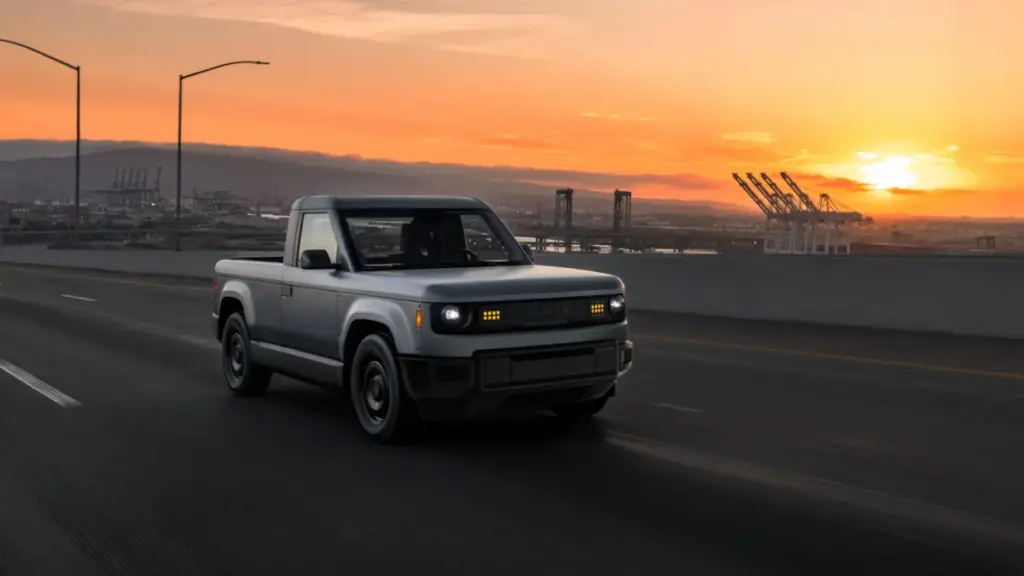
That playbook, however, is failing. The status quo of heavy, over-engineered, and outrageously expensive EVs has crashed against the harsh reality of an acute domestic affordability crisis. Enter Slate Auto, a disruptive automotive startup attempting to rewrite the rules of engagement. Eschewing the industry’s obsession with 300-plus-mile ranges and luxury-tier technology packages, Slate is staking its future on radical austerity. Its flagship offering—a pint-sized, two-door electric pickup truck that is shorter than a Honda Civic and features hand-crank windows straight out of the 20th century—is designed to flip the American car-buying paradigm on its head.
With a modest 65-kilowatt-hour lithium iron phosphate battery offering a quoted top range of just 205 miles, the Slate truck trades cross-country road-trip utility for a price tag that shatters current market norms. Starting at under $25,000, it arrives at a moment when the average price of a new vehicle in the United States hovers around $50,000, and roughly half the country struggles to cover basic household necessities like gas and groceries. Backed by nearly $1.4 billion in venture capital—including high-profile investments from tech luminaries like Jeff Bezos—and boasting thousands of preorders ahead of its late 2026 delivery window, Slate is testing a fundamental hypothesis: are American drivers finally willing to sacrifice range and frills if it means securing an electric vehicle they can actually afford?
Detailed Chronology: The Rise, Fall, and Pivot of American Electrification
To understand the audacious gamble Slate Auto is taking, one must examine the turbulent history of the American EV movement over the past half-decade—a timeline marked by soaring ambitions, regulatory shifts, and ultimately, miscalculated market reads.
2021–2022: The High-Water Mark of Heavy-Duty Optimism
The modern chapter of the US electric truck movement effectively began in May 2021, when Ford Motor Company officially unveiled the F-150 Lightning. Heralded as the ultimate watershed moment for automotive electrification, the vehicle carried immense symbolic weight: it was the battery-powered iteration of America’s single best-selling vehicle for decades. Wall Street cheered, environmentalists celebrated, and consumers flooded dealerships with reservations. When the first shipments rolled off assembly lines in 2022, the base model carried an approachable starting price of roughly $40,000.
At the time, legacy automakers and agile startups alike were locked in an escalating arms race for "range anxiety" mitigation. To convince consumers that EVs were viable substitutes for gas-guzzling trucks and SUVs, manufacturers concluded they needed to deliver upwards of 300 miles of driving range per charge. Achieving this metric required enormous, heavy battery packs—often exceeding 130 kilowatt-hours of capacity—which drove up production costs, inflated vehicle curb weights, and ultimately laid the groundwork for a financial trap.
2023–2025: Economic Pressures and the Collapse of the F-150 Lightning
As inflationary pressures mounted and supply chain bottlenecks wreaked havoc on global manufacturing, the economics of producing massive-battery EVs quickly unraveled. The Ford F-150 Lightning serves as a textbook casualty of this dynamic. By the time it reached its final production year, incremental price increases had pushed the cost of the truck well past $54,000 for baseline configurations, while higher trims breached luxury territory.
Compounding these internal pricing pressures were sweeping macroeconomic and political shifts. Following the transition to the second Trump administration in early 2025, federal policy experienced a sharp pivot. Federal tax credits, consumer incentives, and regulatory compliance targets designed to accelerate EV adoption were drastically slashed or outright dismantled. Without government subsidies to artificially compress the price gap between electric and gas-powered vehicles, middle-class consumers balked. Facing plunging demand and escalating production overhead tied to its oversized battery architecture, Ford made the difficult decision to formally discontinue the F-150 Lightning in December 2025—just four years after its high-profile debut.
Late 2025–Present: The Pragmatic Pivot and Slate’s Emergence
Recognizing that the "bigger is better" ethos had alienated the mass market, forward-thinking designers began plotting a course correction. While legacy giants licked their wounds and adjusted manufacturing footprints, Slate Auto emerged from stealth with a product philosophy that completely rejects the trajectory of the past decade. By stripping away extraneous weight, downsizing the battery pack, and eliminating costly interior technology features in favor of optional modular add-ons, Slate engineered a structural reset.
Simultaneously, traditional automakers are beginning to recalibrate. Ford, signaling a strategic about-face, has confirmed plans to re-enter the compact electric truck space with an upcoming vehicle code-named Fathom, slated for a 20th-century-style accessible price point around $30,000 when it debuts in 2027. Yet, it is Slate that holds the first-mover advantage in this newly forged ascetic segment, with factory tooling scaled to produce up to 100,000 units in its first full year of operation following late 2026 deliveries.
Supporting Context & Metrics: Deconstructing Range Anxiety and the Affordability Crisis
The commercial rationale for Slate’s austerity-driven model rests on two pillars of empirical data: the deep mismatch between actual driving habits and perceived range requirements, and the punishing reality of the contemporary American cost-of-living crisis.
The Myth of the 300-Mile Requirement
For over a decade, automotive marketing departments successfully convinced the American driving public that an electric vehicle was fundamentally incomplete unless it could replicate the 400-to-500-mile highway range of a gasoline tank on demand. This psychological barrier—colloquially known as "range anxiety"—remains one of the most stubborn friction points in consumer adoption surveys.
Yet, hard data from the United States Department of Transportation and independent automotive research groups paints a dramatically different picture of daily mobility:
- The Daily Commute: According to data from the Federal Highway Administration’s National Household Travel Survey, the average American driver puts fewer than 35 miles on their vehicle’s odometer in a single day.
- Trip Distances: Nearly 90 percent of all personal vehicle trips in the United States cover a distance of 20 miles or less.
- Real-World Utilization: Field studies tracking actual EV driver behavior—such as a comprehensive usage analysis published by InsideEVs and Recurrent—reveal that motorists typically consume less than 20 percent of their vehicle’s total battery capacity during a standard daily cycle.
Despite these metrics, American buyers have historically purchased vehicles optimized for their absolute longest annual road trip rather than their mundane, everyday utility. Slate Auto is gambling that a profound shift in consumer psychology is currently underway, catalyzed by economic necessity.
+------------------------------------------------------------------------+
                  AVERAGE DAILY MILEAGE VS. EV RANGE
+------------------------------------------------------------------------+
  Average American Daily Driving:  [ 35 miles ]

  Slate Auto Base Range:           [ 205 miles ]

  Typical Long-Range EV (Tesla):   [ 320+ miles ]
+------------------------------------------------------------------------+
The 2026 Affordability Crisis
That psychological shift is being forced by a punishing economic landscape. According to comprehensive cost-of-living metrics and polling data published by organizations like The Guardian and the Harris Poll, approximately 95 percent of Americans currently believe the country is trapped in a severe affordability crisis. Roughly half of all citizens report struggling regularly to pay for fundamental necessities, including residential rent, utility bills, groceries, and gasoline.
In this climate, the financial calculus of car ownership has turned toxic. With the average price of a new vehicle hovering near $50,000—and monthly auto loan payments routinely exceeding the cost of utility bills—consumers are actively seeking refuge from recurring operational expenses. An unadorned, utilitarian electric truck that retails for under $25,000 and allows its owner to bypass the gas station entirely ceases to look like a compromise; instead, it looks like an economic lifeline.
Global Precedents: The Success of Accessible EVs Abroad
While American manufacturers have stubbornly focused on long-range, luxury-tier vehicles, other global markets have successfully embraced downsized, affordable electrification.
In China, where regulatory support and nimble domestic manufacturing have created the world’s most dynamic EV ecosystem, over 40 million electric vehicles and plug-in hybrids now navigate public roadways, with electric models capturing roughly 50 percent of total new-vehicle sales. Crucially, Chinese consumers have proven entirely comfortable with lower range metrics: the average new EV sold in China in 2025 featured a range of just 247 miles. For comparison, the average range of a new EV sold in the United States during the same period was 329 miles, while the European market sat moderately between the two at 281 miles.
China’s success proves unequivocally that mass-market adoption does not require engineering a vehicle capable of crossing the Mojave Desert on a single charge; it requires engineering a vehicle that fits the budget and daily operational radius of the working class.
Official Statements and Industry Perspectives
The introduction of Slate Auto and the broader philosophical pivot toward minimalist electrification have generated intense debate across the automotive, financial, and environmental sectors.
Industry analysts tracking the supply chain note that the cost of battery cells remains the single most volatile variable in vehicle manufacturing. By reducing the battery capacity of its truck to a lean 65 kilowatt-hours—roughly half the capacity found in heavy-duty electric pickup trucks like the defunct F-150 Lightning—Slate has effectively insulated itself against raw material price shocks involving lithium, cobalt, and nickel.
Financial backers have signaled robust confidence in this structural cost discipline. Over three consecutive funding rounds, institutional investors and high-net-worth individuals, most notably Amazon founder Jeff Bezos, have poured nearly $1.4 billion into Slate Auto. Speaking on condition of anonymity, venture capital partners close to the firm emphasized that the investment thesis is built around "functional subtraction." The premise is straightforward: by stripping away expensive, over-engineered technology suites and heavy battery modules that consumers rarely utilize, startups can unlock profit margins while delivering vehicles at price points legacy automakers have deemed impossible.
Conversely, traditionalists within the American automotive establishment have historically warned that domestic buyers will reject stripped-down interiors and limited range profiles. Critics point to the widespread cultural association of pickup trucks with rugged versatility, cross-country hauling, and high-status trim levels. Hand-crank windows and vinyl-wrapped body panels, these detractors argue, may cross the line from pragmatic austerity into unmarketable deprivation for American consumers accustomed to ventilated leather seats and digital touchscreens.
Yet, Slate’s leadership maintains that these traditional assumptions are outdated. The inclusion of optional, modular upgrade paths—allowing buyers to selectively add features like a Bluetooth stereo system or power windows à la carte—strikes a balance between base-model affordability and consumer personalization, ensuring that the vehicle can adapt to diverse commercial and personal use cases without bloating the core sticker price.
Future Outlook: Can Minimalism Save the US EV Transition?
As Slate Auto prepares to open its factory doors and fulfill its initial wave of preorders in late 2026, the broader automotive landscape is watching closely. The stakes extend far beyond the financial health of a single Silicon Valley-style startup; they strike at the heart of whether the United States can meet its long-term climate targets.
With the transportation sector serving as the nation’s leading source of greenhouse gas emissions, achieving net-zero goals requires rapid, widespread fleet electrification. The strategy of waiting for middle-class families to voluntarily adopt $60,000 luxury electric SUVs has proven mathematically insufficient. True decarbonization demands volume, and volume requires radical affordability.
+------------------------------------------------------------------------+
                     SLATE AUTO: STRATEGIC ROADMAP
+------------------------------------------------------------------------+
  • Q4 2026:      Initial customer deliveries commence
  • Year 1:       Target manufacturing capacity of 100,000 units
  • Year 2+:      Ramping capacity to 150,000 units annually
  • Market Test:  Establishing viability of the <$25,000 electric truck
+------------------------------------------------------------------------+
Slate’s manufacturing infrastructure is built for scale right out of the gate. The company’s primary production facility is engineered to achieve a throughput of 100,000 vehicles during its first operational year, with scaling projections designed to push capacity to 150,000 units shortly thereafter. With thousands of preorders already secured, consumer interest is demonstrably real.
The ultimate question that will determine Slate’s survival—and potentially redefine the trajectory of American automotive engineering—is whether everyday drivers can psychologically transcend their obsession with excessive range and luxury frills in exchange for genuine financial relief. If American motorists prove willing to embrace a smaller footprint, hand-crank windows, and a 205-mile range for less than $25,000, Slate Auto won’t just succeed as a business; it will have successfully unlocked the code to mass-market electrification in the United States.



