For decades, glaciologists have relied on sparse, isolated monitoring tools to study the world’s rapidly changing ice sheets and alpine glaciers. Traditional seismometers, while effective at capturing deep rumblings, provide limited data restricted to single points on a vast, shifting landscape. Furthermore, installing and maintaining these instruments in treacherous crevassed terrain puts researchers at constant risk, while harvesting real-time data remains an expensive logistical hurdle.
Enter a quiet revolution in Earth sciences: distributed acoustic sensing (DAS). Originally developed for industrial and security applications—such as monitoring pipelines and detecting perimeter footprints—DAS transforms ordinary fiber-optic cables into continuous, ultra-dense networks of thousands of virtual seismometers. By firing laser pulses down a hair-thin glass fiber and analyzing the minuscule variations in backscattered light caused by environmental vibrations, scientists can listen to the heartbeat of the cryosphere in unprecedented detail.
In a recent breakthrough study conducted in the Swiss Alps, an international team of researchers deployed a grid of fiber-optic cables across a dynamic alpine glacier. The technology allowed them to expose a critical and deeply troubling mechanism of ice loss known as hydrofracturing. This process occurs when surface meltwater seeps deep into glacial cracks, utilizing the immense density of liquid water to force the ice apart from within.
By capturing over a thousand "icequakes" in a single week, the DAS deployment has offered glaciologists their first high-resolution look at the internal fracture mechanics driving glacial instability. As researchers look to scale this technology to the massive, imperiled ice sheets of Greenland and Antarctica, DAS holds the promise of not only refining global sea-level rise models, but potentially serving as the foundation for life-saving early-warning systems against catastrophic glacial collapses and flash floods.
Detailed Chronology: From Telecommunications Infrastructure to Cryospheric Surveillance
The integration of fiber optics into geophysical research represents one of the most unexpected methodological shifts in modern science. The timeline of this technological migration highlights how telecommunications infrastructure has doubled as an environmental monitoring grid.
Early Industrial Origins: Distributed acoustic sensing was primarily refined by the oil, gas, and security industries. Companies deployed fiber-optic cables along pipelines and borders to detect acoustic disturbances, ground deformations, and unauthorized digging. Engineers realized that any physical disturbance altering the strain on a fiber-optic strand would measurably shift the phase of laser light scattering back through the glass.
Transition to Earth Sciences: Over the past decade, geophysicists began adapting DAS to monitor natural phenomena. Researchers discovered that existing "dark fiber" (unused telecommunications cables buried under roads or laid on seabeds) could be repurposed. Scientists successfully used these lines to spy on volcanic eruptions at Mount Etna, record micro-earthquakes, and track human footsteps above ground.
2025 (Seafloor Deployment in Greenland): Expanding into extreme polar environments, a team of researchers laid a fiber-optic cable directly on the seafloor near a major Greenland glacier. This marine deployment provided unprecedented insight into how rapidly warming ocean waters interact with calving glacier fronts, revealing that the physical break-up of ice stirs the water column, disrupts protective cold-water layers, and accelerates thermal erosion.
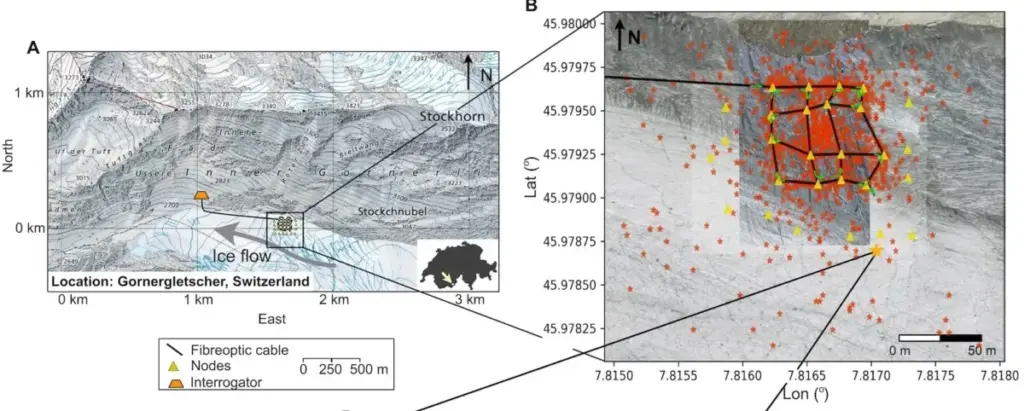
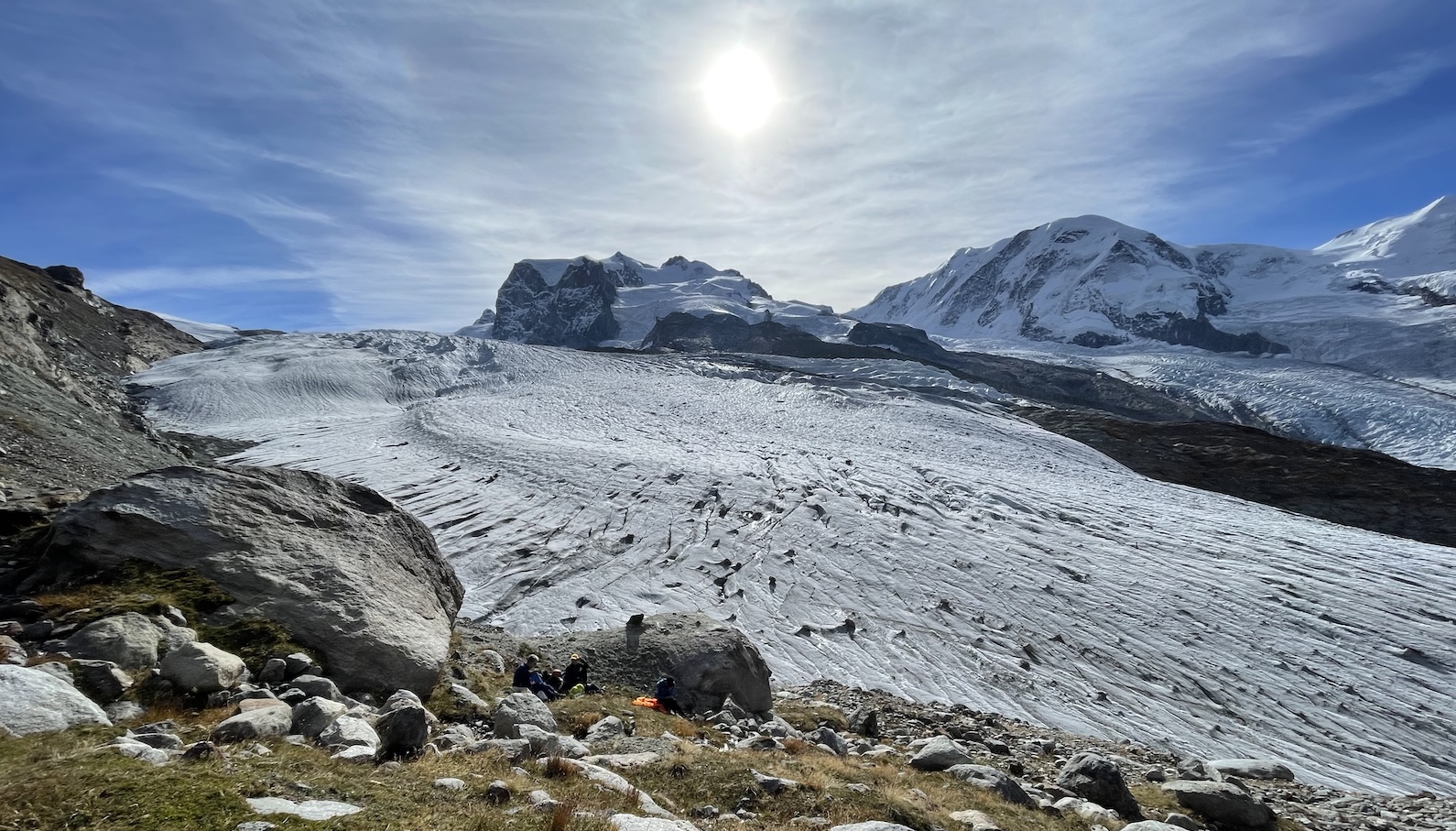
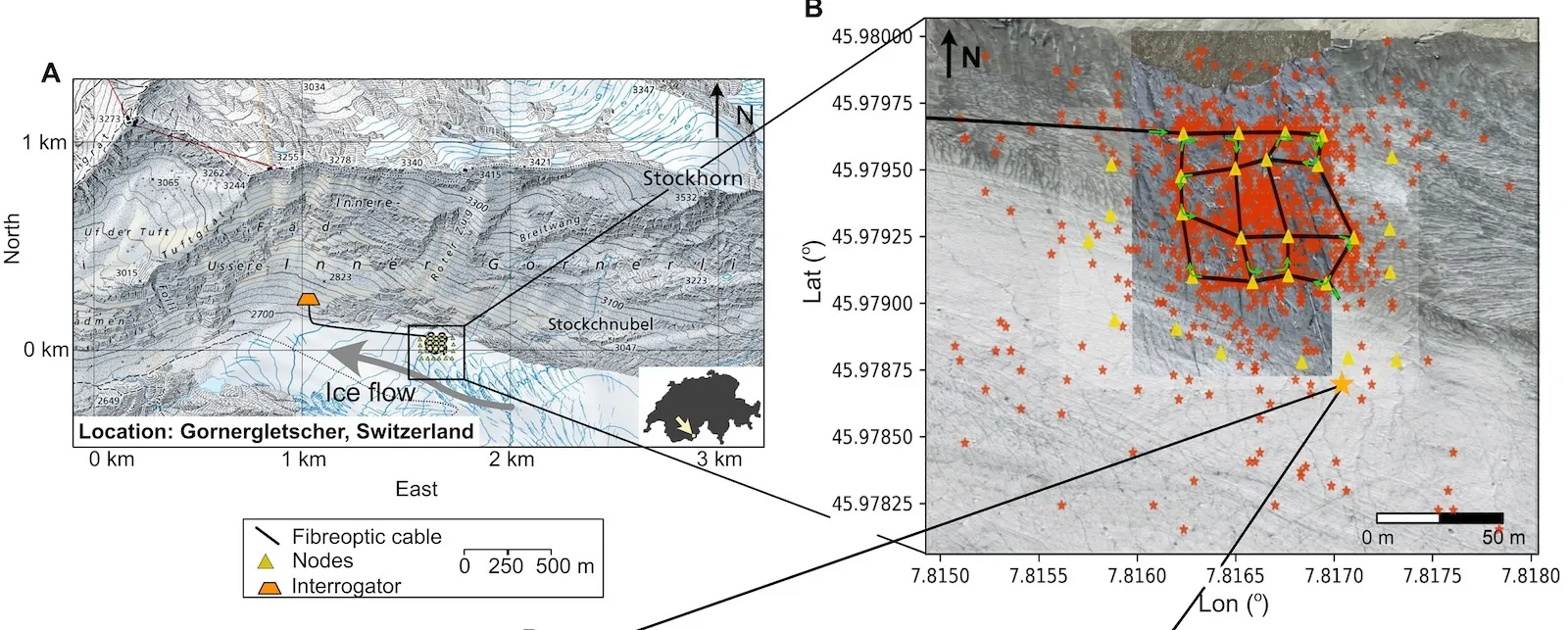
Recent Breakthrough (The Swiss Alps Fieldwork): Most recently, a team led by seismologist Thomas Hudson at ETH Zürich took DAS directly onto an active, undulating alpine glacier (the Gornergletscher). Rather than relying on a single linear cable, the researchers laid out an intricate grid pattern across the ice surface. Connected to a device known as an interrogator, the network beamed laser pulses through the cables, successfully logging thousands of localized stress events in real time. This field campaign produced the first detailed, high-resolution observations of hydrofracturing in action, proving that fiber-optic monitoring could survive and excel within the most hostile, unstable ice environments on Earth.
Supporting Context & Metrics: Decoding the Physics of DAS and Hydrofracturing
To understand why DAS is transforming glaciology, one must examine the fundamental limitations of legacy instruments and the sheer scale of data that fiber optics unlock.
The Mechanics of Distributed Acoustic Sensing
A traditional seismometer records ground motion at a single geographic coordinate. If a researcher wants to map the seismic activity of an entire glacier using traditional methods, they must deploy, power, and maintain dozens—if not hundreds—of individual instruments across dangerous terrain, frequently dealing with failing batteries, harsh weather, and shifting ice.
DAS upends this paradigm. A single strand of fiber-optic cable, which can span kilometers, is transformed by an interrogator unit into an array of continuous strain sensors.
Spatial Resolution: By calculating the exact time it takes for light pulses to travel down the fiber and scatter back, scientists can pinpoint disturbances down to fractions of a meter. A single cable can effectively act as thousands of individual seismometers.
Cost and Safety: Fiber-optic cables are relatively inexpensive. If a section of cable is destroyed by a collapsing ice shelf or a sudden crevasse opening, the financial loss is minimal compared to the destruction of high-end seismic equipment. Crucially, once the cable is laid, researchers can retreat to a safe distance, streaming continuous real-time data back from the interrogator without risking their lives on unstable ice.
Hydrofracturing: The Hidden Engine of Ice Disintegration
For years, climate models focused primarily on surface melting driven by rising atmospheric temperatures and basal melting caused by warm ocean currents. However, the internal structural integrity of glaciers depends heavily on fracture mechanics—specifically, hydrofracturing.
When surface ice melts, liquid water accumulates in pools and streams. Because liquid water is denser and heavier than ice, it flows down into microscopic cracks and crevasses. The immense hydrostatic pressure exerted by this plunging column of water wedges the fractures open, forcing them deeper into the ice sheet.
As the team discovered using DAS on the Swiss glacier, these cracks do not merely penetrate a few meters; they cascade downward, severely compromising the structural coherence of the ice. On the Gornergletscher alone, just one week of monitoring captured more than a thousand "icequakes"—seismic fractures generated as the ice tore apart under water pressure. This mechanism is believed to be the primary driver behind the mass disintegration of massive ice shelves in Greenland and Antarctica.
Official Statements and Expert Insights
The integration of telecommunications technology into glaciology has generated immense enthusiasm within the scientific community, tempered by the sober realization that technological innovation must still be translated into actionable safety measures.
Dr. Thomas Hudson, a seismologist at ETH Zürich and lead author of the recent study detailing the Swiss alpine deployment, emphasizes the unprecedented nature of the observations:
"It’s hypothesized to be a mechanism that can cause mass disintegration of ice shelves and ice sheets in the Antarctic, Greenland, et cetera. But no one’s really observed the mechanism in any detail."
Reflecting on the logistical and operational advantages of fiber optics over traditional hardware, Hudson noted the profound shift in data acquisition:
"Whereas streaming data back from seismometers is not trivial, and then you have to process all the data back in your lab, DAS is actually more promising as a monitoring method, just purely from a data logistics point of view. We can break that fiber optic cable into thousands of strain sensors. So, effectively equivalent to thousands of seismometers."
Addressing the broader implications for public safety, particularly in mountainous regions where unstable glaciers loom over populated valleys and critical infrastructure, Hudson pointed out the urgent need for applied monitoring:
"How deep these cracks go, and how many cracks there are, really matter for the stability of the glacier. These glaciers overhang critical infrastructure like train lines or villages, and so it’s really important in the future to potentially apply this technology."
However, researchers remain cautious about translating raw seismic data into immediate public safety tools. Commenting on catastrophic events such as the recent glacial flash floods and landslides in Nepal, Hudson observed:
"I would be 99.999 percent certain that there were signals that you could pick up [prior to the disaster]. It’s still challenging, right? Our research still doesn’t address the question of how you turn the signals into an accurate early-warning system."
Future Outlook: Global Implications and Early-Warning Horizons
The successful deployment of distributed acoustic sensing in the Swiss Alps and on the Greenland seafloor marks the end of the methodology’s proof-of-concept phase and the beginning of its global application. As scientists look toward the future, the integration of DAS into cryospheric research promises to reshape both climate projections and regional disaster management.
Refining Sea-Level Rise Projections
Global sea-level rise models have historically struggled to accurately account for the non-linear, rapid collapse of polar ice sheets. By deploying DAS networks across key outlet glaciers in Greenland and the sprawling ice shelves of Antarctica, researchers hope to map the subsurface fracture density in real time. Understanding how deeply hydrofracturing penetrates ice sheets will allow climate scientists to feed more accurate physical parameters into predictive models, shedding light on just how fast the world’s coastlines will be reshaped in the coming decades.
Toward Next-Generation Early-Warning Systems
In mountainous regions prone to glacial lake outbursts, avalanches, and catastrophic ice avalanches—such as the Hindu Kush Himalaya range and the European Alps—communities remain vulnerable to sudden environmental shocks. While current research has proven that DAS can successfully detect thousands of micro-fractures before a major failure, the next great engineering and seismological challenge lies in algorithm development. Researchers are working to build automated processing pipelines that can differentiate between normal glacial settling and the distinct acoustic signature of an imminent, catastrophic collapse.
If successful, these systems could transform passive fiber-optic cables into active, life-saving shields for mountain communities. By listening closely to the quietest whispers of shifting ice, scientists are equipping humanity with the critical foresight needed to navigate a rapidly warming world.