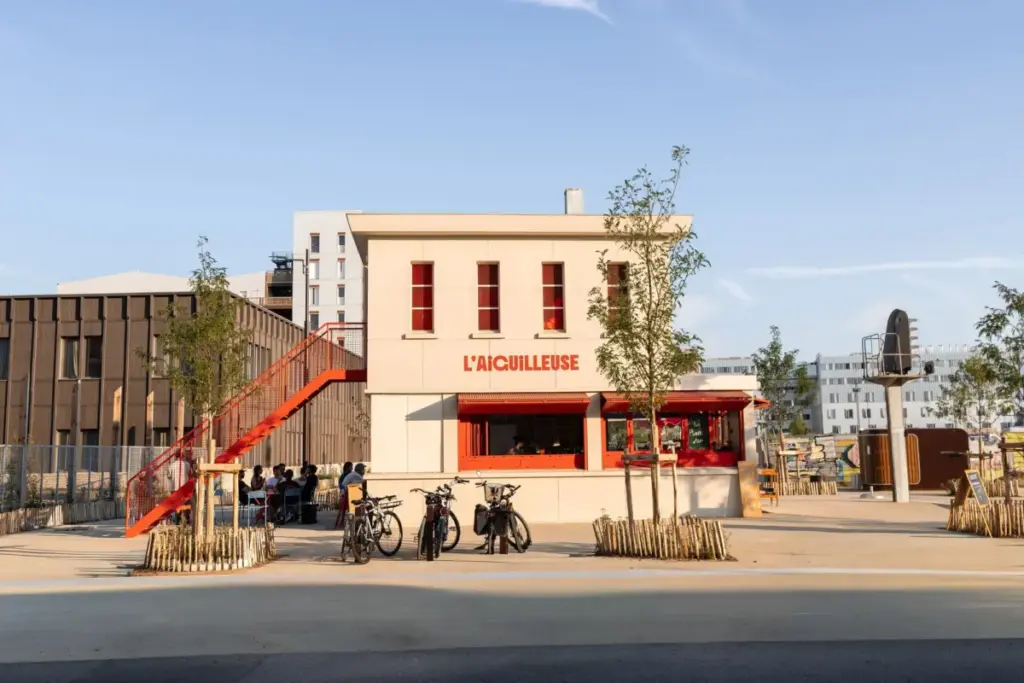
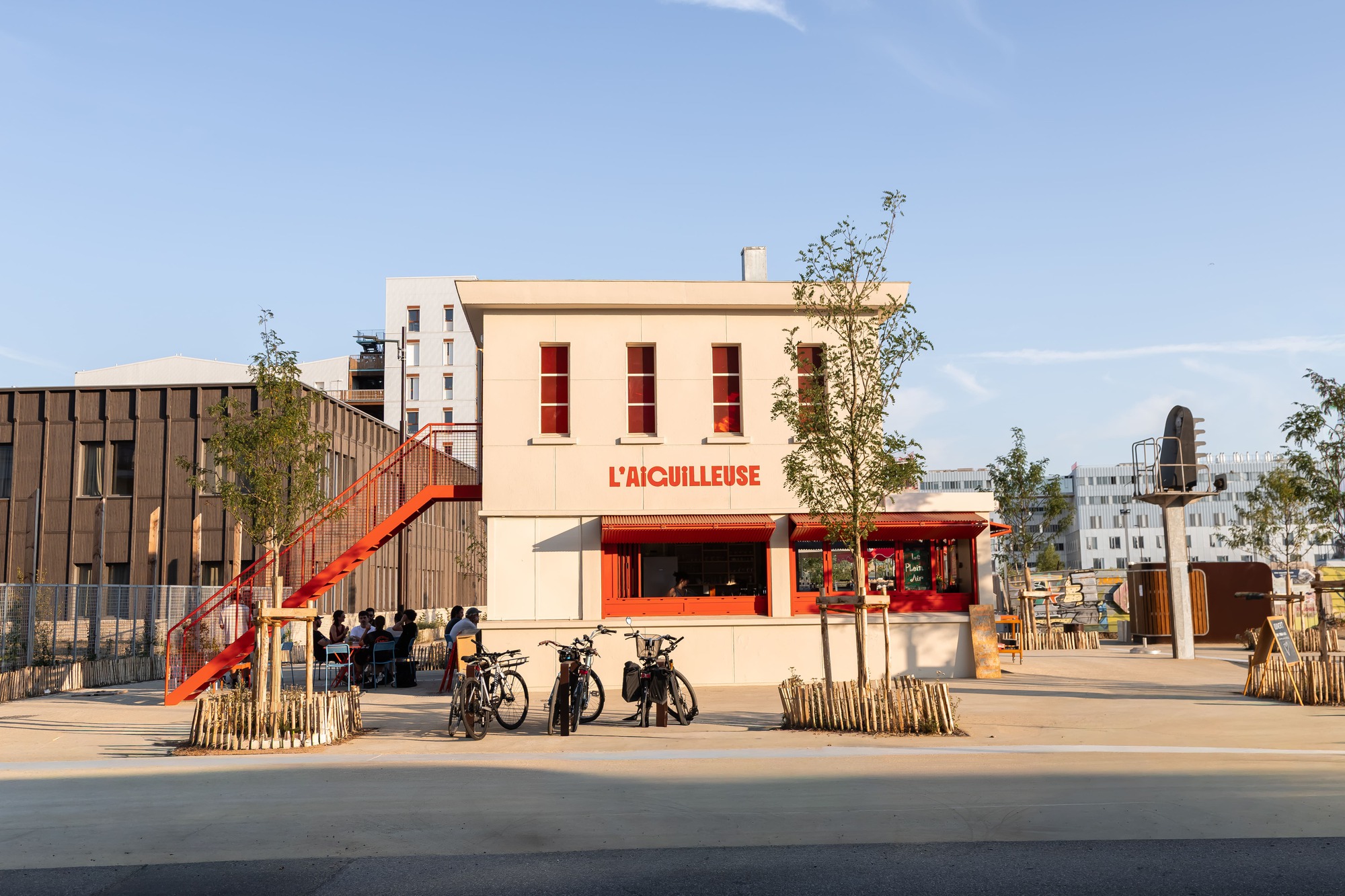
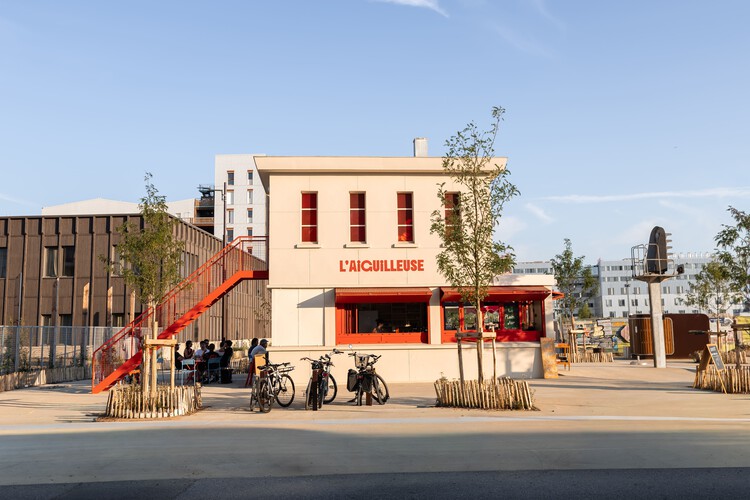
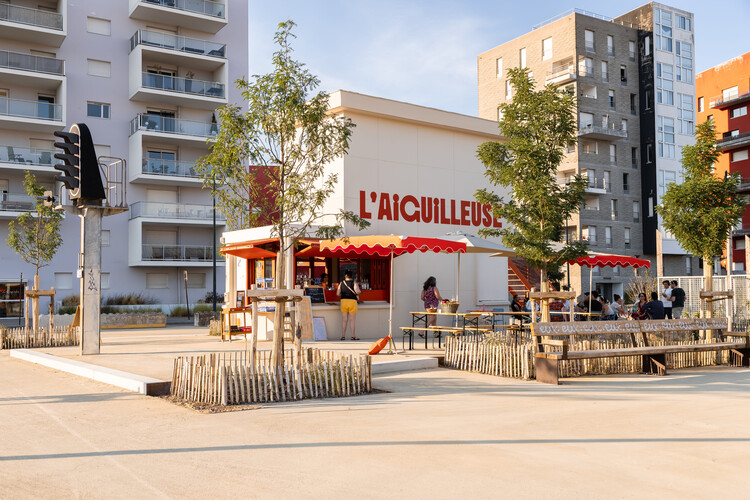
Urban regeneration is rarely a blank slate; more often, it is a delicate archaeological exercise in which the physical artifacts of an industrial past are unearthed, re-contextualized, and woven into the fabric of contemporary civic life. In the heart of the Jardins de l’Estuaire—a burgeoning public park on the Île de Nantes in France—stands a testament to this architectural ethos: L’Aiguilleuse.
Designed by Studio Téré, L’Aiguilleuse represents a masterclass in adaptive reuse, transforming a derelict 1960s railway signal box into a vibrant, community-oriented kiosk-bar. Once an anonymous gear in the machinery of the Nantes-État railway infrastructure, the building was historically responsible for regulating the complex choreography of train movements entering the station. As the surrounding railyards vanished to make way for modern urban expansion, this modest concrete-and-brick structure remained behind—an orphan of the industrial age.
Rather than succumbing to the wrecking ball, the signal box has been thoughtfully resurrected. By preserving its rugged industrial DNA while injecting a warm, inviting hospitality program, Studio Téré has created a social anchor that honors Nantes’ rich railway heritage while offering a modern urban sanctuary. This project exemplifies a broader European shift toward sustainable heritage conservation, proving that even the most utilitarian structures can find a second life as cultural and communal touchstones.
Detailed Chronology
The Industrial Genesis (1960s)
During the mid-20th century, the Île de Nantes was a bustling industrial and logistical nexus. Dominated by shipbuilding yards, warehouses, and an extensive network of freight and passenger rail lines, the island was the beating economic heart of western France.
To manage the dense and potentially hazardous flow of locomotives navigating the Nantes-État infrastructure, railway operators constructed a series of signal boxes (postes d’aiguillage). Built according to the utilitarian standards of the 1960s, these structures were engineered for pure operational efficiency: thick masonry and concrete foundations, elevated viewing platforms to maximize line-of-sight over the tracks, and robust exterior cladding capable of withstanding industrial grime and harsh weather. For decades, signalmen operated within these walls, pulling levers and monitoring panels that dictated the rhythm of the port city.
Deindustrialization and Abandonment (Late 20th Century)
As containerization, shifting global trade, and the modernization of the French rail network (SNCF) rendered traditional urban railyards obsolete, the Île de Nantes underwent a dramatic metamorphosis. The industrial facilities that had defined the island for generations were gradually dismantled.
The railway tracks were ripped up, the warehouses demolished, and the landscape was left in a state of post-industrial limbo. Amidst this clearance, the signal box remained—a lonely concrete sentinel stripped of its purpose. Cut off from the railway network and surrounded by overgrown weeds and vacant lots, the building stood as a silent witness to a bygone era, increasingly vulnerable to vandalism, weather degradation, and eventual demolition.
The Urban Masterplan and Rediscovery (2010s–2020s)
The turning point for the site arrived with the comprehensive masterplan for the Île de Nantes, an ambitious urban renewal project aimed at transforming former industrial brownfields into mixed-use neighborhoods, cultural hubs, and expansive public green spaces. Central to this vision was the creation of the Jardins de l’Estuaire, a linear park designed to reconnect citizens with the Loire River estuary.
Urban planners and municipal authorities recognized that preserving fragments of the island’s industrial heritage was crucial to maintaining a sense of place and historical continuity. Among the scattered remnants, the 1960s signal box caught the attention of designers and city officials. Its compact footprint, distinct volumetric profile, and strategic location within the footprint of the new park made it an ideal candidate for adaptive reuse. A tender was launched to breathe new life into the structure, tasking architects with transforming an obsolete security booth into an active public amenity.
Architectural Intervention and Realization (Studio Téré)
Commissioned to undertake the project, Studio Téré approached the dilapidated signal box with a philosophy of surgical precision and profound respect for its material history. The design team sought to preserve the building’s exterior patina—its weathered concrete, industrial framing, and utilitarian proportions—while entirely reconfiguring the interior to suit food-and-beverage operations.
The renovation involved structural stabilization, the insertion of expansive, thermally efficient glazing to open up the formerly fortress-like ground floor, and the integration of custom millwork designed to maximize the micro-interior space. By 2026, construction culminated in the opening of L’Aiguilleuse, successfully bridging the gap between Nantes’ industrial past and its progressive, park-centric future.
Supporting Context & Metrics
Project Metric / Detail
Specification
Project Name
L’Aiguilleuse
Architectural Firm
Studio Téré
Location
Jardins de l’Estuaire, Île de Nantes, France
Original Typology
1960s Railway Signal Box (Nantes-État infrastructure)
New Typology
Public Kiosk-Bar & Community Amenity
Primary Structural Materials
Exposed Concrete, Structural Steel, Wood, Glass
Photographer
Nina Ducleux
Completion Year
2026
Spatial Dynamics and Materiality
Restoring a structure originally designed for machinery rather than human comfort presents unique architectural challenges. Signal boxes were typically inward-looking, protective enclaves. Studio Téré inverted this paradigm by establishing a porous, conversational relationship between the interior bar and the surrounding park landscape.
The Envelope: The exterior concrete and masonry shell was carefully cleaned rather than aggressively scrubbed, allowing the historical weathering, minor imperfections, and original textures to remain visible. This preservation of patina signals to visitors that the building has a deep, authentic history.
Transparency and Light: Where narrow operational slits or small industrial windows once dominated, large expanses of glass have been introduced. These openings flood the compact interior with natural light and frame panoramic views of the Jardins de l’Estuaire, effectively dissolving the boundary between interior leisure and outdoor recreation.
Interior Craftsmanship: Given the diminutive floor plate of the former signal box, every square centimeter demanded ergonomic optimization. Studio Téré utilized marine-grade wood accents, sleek stainless steel prep counters, and integrated banquette seating. The material palette creates a warm tactile contrast against the cool industrial concrete shell.
Official Statements
While direct transcription of the studio’s design manifesto emphasizes the poetry of industrial archaeology, the overarching ethos of the project has been widely discussed within architectural and municipal circles in Nantes.
"Architecture does not always begin with a blank page; sometimes, our most profound duty is to listen to what the site has already left behind," notes the design philosophy of Studio Téré. "L’Aiguilleuse was never just a dilapidated box of concrete; it was an active participant in the city’s movement and history. By transforming it into a kiosk-bar, we are shifting its purpose from controlling the movement of trains to welcoming the movement of people."
Municipal representatives overseeing the development of the Île de Nantes have similarly championed the project as a model for sustainable civic intervention. By avoiding demolition and new construction, the project minimized embodied carbon while enriching the park’s social infrastructure. Local cultural commentators have praised the kiosk for giving the Jardins de l’Estuaire an instant heart and soul—a place where park-goers can grab a coffee or an evening drink while anchored in the tangible history of the Loire’s industrial shores.
Future Outlook
As cities across the globe grapple with the climate crisis and the imperative to decarbonize, the paradigm of adaptive reuse has transitioned from a niche architectural sub-genre to an absolute necessity. Projects like L’Aiguilleuse offer a compelling blueprint for how minor, seemingly insignificant industrial remnants can be salvaged to enrich contemporary urban life.
Looking forward, the success of L’Aiguilleuse is expected to catalyze further heritage-focused interventions within the Île de Nantes and surrounding brownfield developments. As the Jardins de l’Estuaire mature and surrounding residential and commercial blocks fill out, the kiosk-bar will serve as a permanent historical anchor, reminding new generations of residents that their park was once a bustling engine of national commerce.
Ultimately, L’Aiguilleuse demonstrates that imagination and spatial economy matter far more than scale. By treating a humble 1960s signal box with the same architectural rigor usually reserved for grand civic monuments, Studio Téré has proven that the architecture of the past can be thoughtfully rewritten to serve the convivial needs of the future.