

Executive Overview
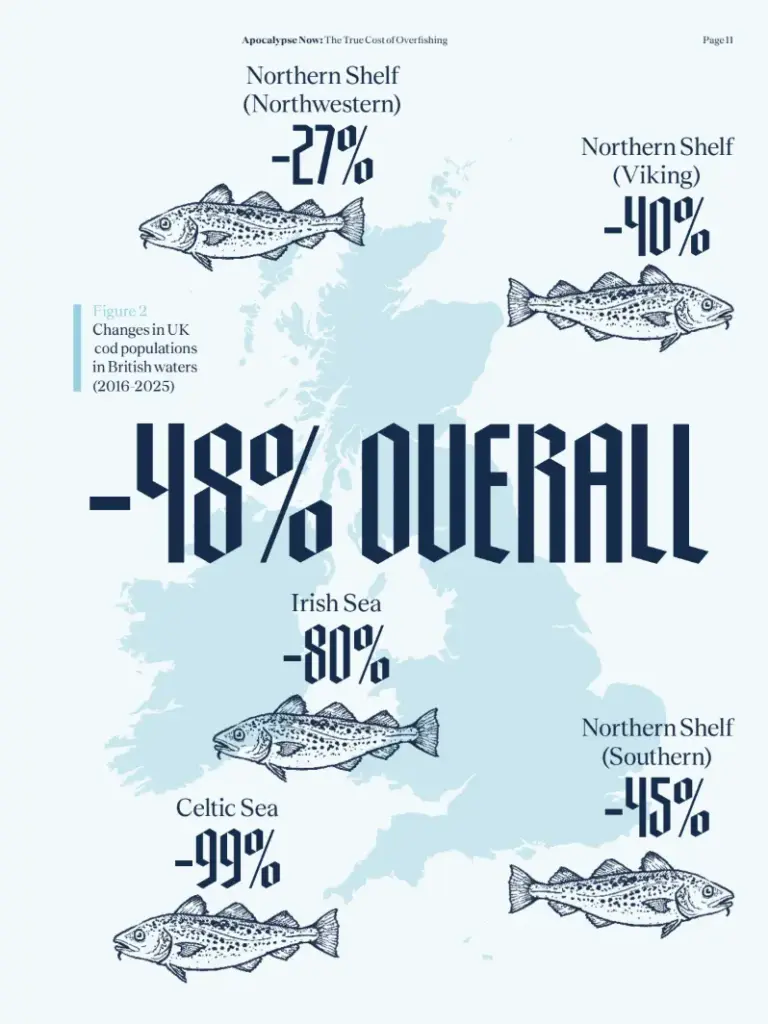
The quintessential British tradition of fish and chips faces an unprecedented existential threat. According to a landmark study released in September 2026 by the ocean conservation charity the Blue Marine Foundation, overall UK cod stocks have plummeted by an alarming 48 per cent over the past decade. Worse still, specific regional populations—most notably in the Celtic Sea—have suffered catastrophic declines, teetering dangerously on the brink of total biological collapse.
Marine scientists and environmental advocates argue that this devastating trajectory is not merely a consequence of natural ocean shifts, but the direct result of systemic overfishing and a persistent government failure to heed scientific warnings. With fisheries policy under intense scrutiny, policymakers are accused of ignoring empirical evidence in favour of short-term economic gains. If immediate, radical interventions are not implemented, Britain’s most iconic marine staple may soon vanish from menus across the country, fundamentally altering coastal economies, marine ecosystems, and culinary heritage alike.
Detailed Chronology: The Decade of Decline
To understand how one of the world’s most historically abundant and heavily consumed fish species reached this perilous tipping point, it is necessary to examine the policy failures, ecological stressors, and data revelations that have defined the past ten years of UK fisheries management.
The Post-Brexit Policy Vacuum (2016–2020)
Following the 2016 referendum and the UK’s subsequent departure from the European Union, the government promised a "blue Brexit"—a golden opportunity to take back control of British waters, rebuild depleted fish stocks, and champion sustainable fishing communities through the Fisheries Act 2020. However, environmental watchdogs warned early on that post-Brexit quota negotiations prioritized political expediency over ecological sustainability. Rather than using the transition to enforce stricter Total Allowable Catches (TACs), management bodies frequently set quotas above maximum sustainable yield (MSY) recommendations provided by marine biologists.
The Warning Signs Intensify (2021–2024)
As industrial fishing fleets continued to operate with minimal oversight in sensitive spawning grounds, independent marine research began to flag exponential drops in juvenile recruitment. The Blue Marine Foundation, alongside academic institutions, published a series of tracking reports demonstrating that traditional management frameworks were failing to account for climate-driven temperature increases in the North Atlantic and surrounding seas. Cod, a cold-water species, found themselves struggling to reproduce successfully as warming waters altered plankton availability and disrupted delicate marine food webs.
The 2026 Crisis Point: The Blue Marine Foundation Report
Published in September 2026, the Blue Marine Foundation’s explosive report—titled The Four Horsemen of the UK Fisheries Policy Apocalypse—shattered any lingering illusions about the health of British fisheries. The report laid bare the chilling reality: across the board, UK cod stocks had experienced an average crash of 48% over the preceding ten years. Most shockingly, the data revealed a near-total wipeout of mature cod in the Celtic Sea, sparking emergency debates in Parliament and widespread media coverage, including prominent investigations by the Daily Mail.
Supporting Context & Metrics: By the Numbers
The empirical data underpinning the 2026 crisis paints a grim picture of marine depletion. While public discourse often generalizes "cod stocks" as a singular entity, marine scientists divide UK waters into distinct biological management units—including the North Sea, the West of Scotland, the Eastern Channel, and the Celtic Sea.
The Celtic Sea Catastrophe
The most harrowing statistic highlighted in the Blue Marine Foundation report focuses on the Celtic Sea population, one of the five distinct cod stocks surrounding the UK. Over the last decade, the total biomass of mature fish in the Celtic Sea has plummeted by a staggering 98 per cent.
- Ecological Implication: A 98% reduction means the spawning stock biomass has fallen far below safe biological limits, severely inhibiting the population’s ability to replenish itself naturally.
- Bycatch Pressure: A significant driver of this collapse has been unmanaged or poorly monitored bycatch, where cod are unintentionally scooped up by vessels targeting other species like Nephrops (langoustines) or flatfish, and subsequently discarded dead.
The National Picture: A 48% Reduction
When aggregated across all UK waters, the total cod biomass has been nearly halved in just ten years. This steep decline directly contradicts official government narratives that claim post-Brexit fisheries management has successfully stabilized marine ecosystems. Instead, environmental economists point out that short-term quotas have repeatedly ignored the precautionary principle outlined in international maritime law.
Socio-Economic Ramifications
The collapse of cod stocks extends far beyond environmental circles; it strikes at the heart of the British food supply chain and hospitality sector.
- The Chip Shop Economy: Thousands of traditional fish and chip shops across the UK are already grappling with inflated energy costs and import tariffs. Sourcing domestic cod has become increasingly difficult and expensive, forcing many independent vendors to substitute cod with cheaper, less traditional alternatives like hake, pollock, or pangasius.
- Coastal Communities: Fishing communities in southwestern England, Wales, and parts of Scotland face severe economic hardship as restrictive emergency quotas threaten to shutter remaining small-scale coastal fleets entirely.
Official Statements and Industry Reactions
The release of the 2026 study has drawn sharp rebukes from environmental organizations, who have launched scathing attacks against the Department for Environment, Food and Rural Affairs (Defra) and marine management agencies.
"Overfishing has driven many of our most iconic commercial stocks to the point of total collapse," noted a senior spokesperson for the Blue Marine Foundation. "For years, successive governments have actively chosen to ignore the overwhelming scientific consensus in favor of appeasing industrial fishing lobbies. The results are now undeniable: we are presiding over the ecological dismantling of our seas."
Environmental lawyers and marine ecologists have accused the government of systemic regulatory failure, pointing out that legally binding targets to restore fish populations to sustainable levels by specific deadlines have been repeatedly missed or quietly deferred.
Meanwhile, representatives from the commercial fishing sector have offered a more defensive perspective, arguing that British fishermen are being made scapegoats for wider ecological phenomena driven by climate change. Industry trade bodies emphasize that domestic vessels operate under some of the strictest monitoring frameworks in the world, and suggest that foreign vessels operating in adjacent international waters share a large portion of the blame for cross-border stock depletion.
Despite these defensive postures, mounting public pressure is forcing industry leaders to acknowledge that radical changes to gear technology, spatial closures, and electronic monitoring are urgently required to prevent permanent commercial extinction.

Future Outlook: Can the Cod Be Saved?
Reversing a 48% national decline—and a 98% regional collapse in the Celtic Sea—will require unprecedented political will, international cooperation, and ecological intervention. Marine conservationists have outlined several non-negotiable pathways for recovery:
- Immediate Emergency Closures: Total moratoria must be placed on targeted cod fishing in critically depleted zones, such as the Celtic Sea, allowing remaining mature populations a multi-year window to spawn without human interference.
- Strict Bycatch Mitigation: Mandatory implementation of highly selective fishing gear, real-time spatial closures when cod presence is detected, and mandatory remote electronic monitoring (REM) on all commercial vessels to eliminate illegal discarding.
- Ecosystem-Based Fisheries Management: Policy must move away from single-species quotas and instead account for warming sea temperatures, habitat degradation, and predator-prey dynamics caused by climate change.
- Accountability and Transparency: Government bodies must be legally mandated to adhere strictly to independent scientific advice, stripping political appointees of the power to arbitrarily inflate catch limits for short-term gain.
Conclusion
The latest findings from the Blue Marine Foundation serve as a stark, unmistakable wake-up call. The prospect of fish and chips disappearing from British culture is no longer a distant, hypothetical eco-fable; it is a very real, imminent consequence of decades of environmental mismanagement. Unless policymakers abandon political expediency and embrace robust, science-led marine stewardship, the rich biological heritage of Britain’s seas will be permanently lost to history—leaving behind empty oceans and silent coastal ports.



