Executive Overview
In an ambitious move to bridge the gap between academic research and grassroots conservation, ocean conservation organization Mission Blue has officially launched its comprehensive Science Initiative. Designed to supercharge protection and restoration efforts across the global Hope Spot network, the initiative aims to seamlessly connect place-based, community-led leadership with credible, practical, and highly usable marine science.
Led by renowned Chief Scientist Dr. Tessa Hempson, the initiative repositions Mission Blue not merely as an advocacy group, but as a dynamic catalyst, convener, connector, facilitator, and multiplier. By forging strategic partnerships between world-class scientific institutions and local "Hope Spot Champions"—the frontline defenders of critical marine habitats—the program seeks to deliver empirical data that can directly drive policy change, secure legislative protections, and inspire global communities.
At launch, the Science Initiative is anchored by two flagship programs: Charting the Blue, an advanced biodiversity mapping venture leveraging environmental DNA (eDNA), and Listening to the Ocean, a passive acoustic monitoring program capturing the complex soundscapes of marine ecosystems. Together, these programs form the vanguard of a new chapter in Mission Blue’s core philosophy: Wish, Act, Protect. By arming local stewards with bulletproof scientific evidence, the initiative empowers them to navigate policy hurdles, guide adaptive management, and build unshakeable donor confidence as the world races toward the critical global target of protecting at least 30% of the ocean by 2030.
Detailed Chronology: The Genesis and Architecture of the Science Initiative
The rollout of the Science Initiative represents the culmination of years of strategic evolution for Mission Blue, founded by legendary oceanographer Dr. Sylvia Earle. While the Hope Spot network has successfully drawn international attention to ecologically vital marine areas—designating over 150 unique locations globally—conservationists on the ground have often faced a persistent hurdle: the lack of accessible, localized scientific data to validate their claims and compel governments to act.
Phase 1: Conceptualization and Leadership
Recognizing that passion alone must be backed by empirical rigor, Mission Blue initiated a structural expansion to embed science at the core of its organizational framework. The appointment of Dr. Tessa Hempson as Chief Scientist served as the critical catalyst. Dr. Hempson’s mandate was clear: design a scalable framework that translates high-level marine science into practical, digestible, and actionable tools for local stakeholders who may lack access to traditional academic resources.
Phase 2: Building the Architecture—The Two Flagship Programs
Following extensive consultations with international marine researchers and Hope Spot Champions, Mission Blue structured the initiative around two technologically advanced, non-invasive pillars:
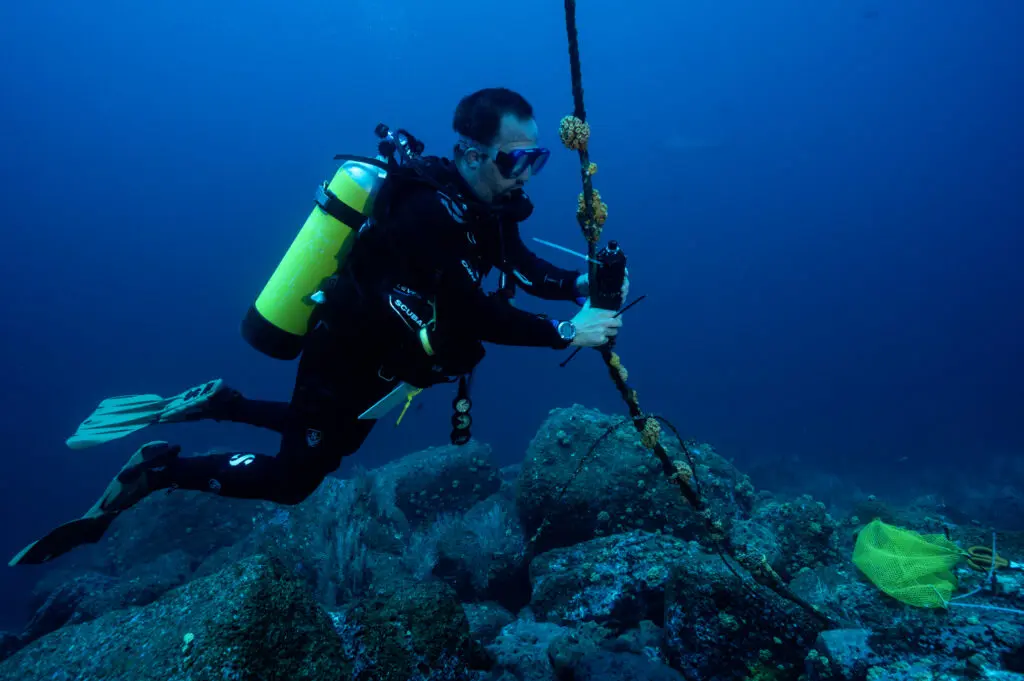
- Charting the Blue (Biodiversity Mapping via eDNA): Traditional marine surveys often rely on visual censuses, which can be time-consuming, expensive, and limited by water visibility or the elusive nature of certain species. Charting the Blue circumvents these challenges by utilizing environmental DNA (eDNA). As marine organisms move through the water, they shed microscopic traces of genetic material—via skin cells, mucus, scales, and waste. By collecting water samples, scientists can sequence this DNA to generate a comprehensive catalog of local biodiversity, ranging from microscopic plankton and invertebrates to elusive sharks, rays, and marine mammals. This allows Hope Spot Champions to establish baseline biodiversity metrics, detect rare or invasive species, and produce irrefutable evidence to justify marine-protected area (MPA) designations.
- Listening to the Ocean (Passive Acoustic Monitoring): Sound is arguably the ocean’s most vital sensory channel. Marine species rely on acoustics to navigate, communicate, locate food, and reproduce. Conversely, anthropogenic noise—from commercial shipping, seismic testing, and coastal development—has drastically reshaped underwater acoustic habitats. Listening to the Ocean deploys long-term passive acoustic recorders to capture the continuous soundscapes of targeted Hope Spots. By analyzing these audio streams over time, researchers can map behavioral patterns, detect seasonal species migrations, evaluate overall ecosystem health, and quantify the creeping footprint of human pressures that traditional visual monitoring frequently misses.
Phase 3: The College of Experts and Collaborative Deployment
To ensure absolute scientific credibility, Mission Blue established the College of Experts. This advisory panel brings together elite marine scientists, ecologists, and conservation policy experts from around the globe. The College provides trusted oversight, peer-reviews methodology, and ensures that the data gathered through Charting the Blue and Listening to the Ocean meets the highest academic standards while directly serving conservation outcomes.
Pilot projects are currently rolling out in select Hope Spots, co-designed by local champions and leading scientific partners to ensure that global scientific standards are tailored to address hyper-local environmental threats.
Supporting Context & Metrics: The Imperative of 30×30
The launch of Mission Blue’s Science Initiative does not occur in a vacuum; it is strategically aligned with overarching global conservation frameworks, most notably the international commitment to achieve at least 30% ocean protection by 2030 (30×30), alongside active restoration initiatives for degraded marine habitats.
The State of the Global Ocean
Despite covering over 70% of the Earth’s surface and producing half of the oxygen we breathe, the global ocean is under unprecedented siege from overfishing, climate change, ocean acidification, plastic pollution, and industrial development. Historically, less than 8% of the ocean has enjoyed any form of legal protection, and a mere fraction of that is classified as fully or highly protected (no-take zones).
Why Data is the Currency of Conservation
For local Hope Spot Champions, convincing national governments to restrict lucrative commercial activities—such as industrial fishing or oil exploration—requires more than anecdotal observations. Governments and regulatory bodies demand rigorous, peer-reviewed, and quantifiable data.
By integrating eDNA mapping and acoustic monitoring into the Hope Spot network, Mission Blue is effectively democratizing advanced marine science. The metrics generated by the Science Initiative provide local advocates with:
- Baseline Verifiability: Scientifically backed proof of what species currently inhabit an area, establishing a baseline against which future recovery can be measured.
- Pressure Quantification: Concrete acoustic data illustrating how human noise pollution disrupts local marine life, making invisible threats visible to policymakers.
- Restoration Tracking: Measurable indicators of ecological rebound following the establishment of protective boundaries.
Official Statements and Expert Perspectives
The formal rollout of the Science Initiative underscores a profound philosophical shift within Mission Blue regarding how modern conservation must operate in an era of rapid environmental decline.
"Science is the essential bridge between knowledge and action," notes the foundational framework of the Mission Blue Science Initiative. "We are not simply collecting data for academic repositories. We are equipping Hope Spot Champions with the evidentiary tools they need to inform policy, strengthen advocacy, guide adaptive management, support active restoration, inspire local communities, and build unshakeable donor confidence."
Dr. Tessa Hempson, leading the charge as Chief Scientist, emphasizes the collaborative nature of the enterprise. By positioning Mission Blue as a connective tissue between isolated marine defenders and global research institutions, the initiative breaks down traditional silos.
Furthermore, the integration of the College of Experts ensures that local conservation efforts are superintended by interdisciplinary minds capable of scaling localized successes into global models. Experts within the advisory panel have repeatedly stressed that marine conservation can no longer afford a disconnect between academic ivory towers and the frontline activists who bear the brunt of environmental defense. By embedding credible science directly into the daily operations of Hope Spot Champions, Mission Blue is creating a repeatable, verifiable blueprint for effective marine stewardship.
Future Outlook: A New Horizon for Global Marine Protection
As the Mission Blue Science Initiative matures, its roadmap points toward rapid expansion across the global Hope Spot network. The immediate future will see the scaling of the Charting the Blue and Listening to the Ocean pilot projects into long-term, standardized monitoring programs.
Standardized Datasets and Global Commitments
One of the most powerful outcomes of the Science Initiative will be the generation of comparable, standardized datasets across vastly different marine ecosystems. Whether comparing a coral reef Hope Spot in the Indian Ocean to a kelp forest off the coast of South America, the use of eDNA and acoustic monitoring will allow scientists and policymakers to analyze global trends using uniform metrics. This data harmonization will be invaluable in tracking progress toward the 30×30 mandate, offering empirical proof of whether designated MPAs are genuinely achieving biodiversity recovery.
Elevating the "Wish–Act–Protect" Continuum
Mission Blue’s long-standing motto—Wish, Act, Protect—finds its most sophisticated expression yet in this Science Initiative.
- Wish represents the visionary identification of Hope Spots spearheaded by Dr. Sylvia Earle.
- Act embodies the grassroots mobilization of local champions and communities dedicating themselves to safeguarding these waters.
- Protect is now supercharged by the Science Initiative, transforming raw passion into legally binding, scientifically validated, and enduring marine sanctuaries.
As the initiative grows its program offerings and expands its institutional partnerships, Mission Blue cements its role as a trusted, authoritative science-to-protection actor on the global stage. By revealing precisely what the ocean needs through rigorous scientific inquiry, Mission Blue is successfully mobilizing the global community to secure the ocean protection it so urgently deserves.