

Executive Overview
In the rapidly evolving landscape of agricultural technology, innovations promising to upend traditional input costs command immediate attention. Among the most buzzed-about developments in sustainable farming is "Green Lightning," a decentralized plasma-based system that uses electricity to oxidize atmospheric nitrogen, dissolving it into water to produce liquid nitrate fertilizer on-farm.
The underlying chemistry is legitimate. By passing electrical arcs through air and water, Green Lightning replicates a foundational industrial process with roots stretching back more than a century—the fixation of atmospheric nitrogen into plant-available forms. For farmers burdened by the volatile costs and heavy carbon footprint of conventional Haber-Bosch fertilizers, the prospect of generating their own nitrogen inputs using renewable electricity is profoundly alluring.
However, a rigorous investigative examination reveals a staggering mathematical and agronomic chasm between what the technology physically produces and what its marketing materials claim it can replace. According to independent mass-balance analyses—such as those detailed in the TFIE Strategy Briefing—the actual quantity of nitrogen atoms fixed by Green Lightning machines falls orders of magnitude short of the conventional fertilizer it is purported to displace.
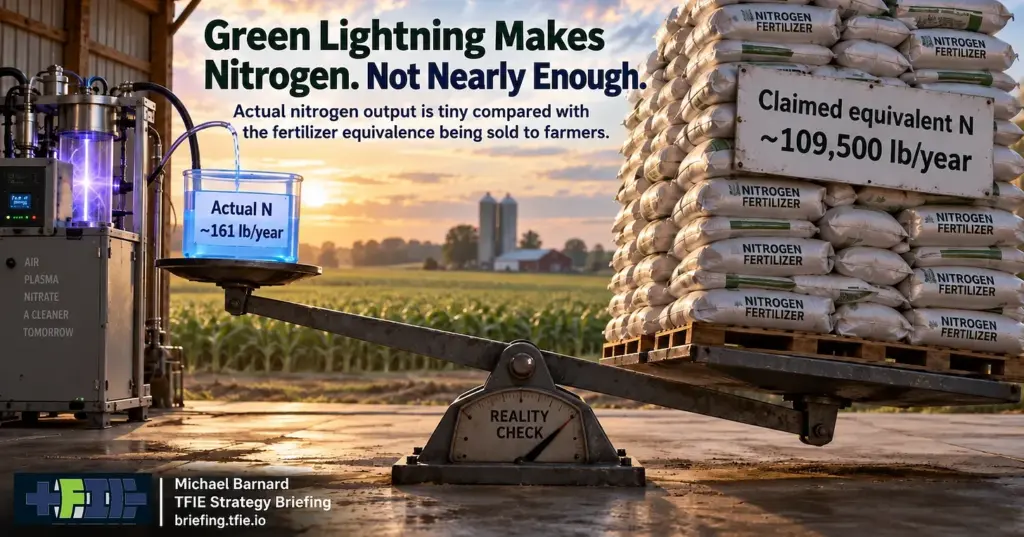
When a standard 100-gallon-per-day machine generates roughly 161 pounds of actual nitrogen annually, yet commercial claims position that same output as equivalent to upwards of 109,000 pounds of conventional fertilizer replacement, a profound accounting anomaly emerges. Crops require physical nitrogen atoms—incorporated into proteins, DNA, and chlorophyll—not mere electro-chemical stimulation. If a system introduces only a fraction of the necessary elemental nitrogen to a field, yet crops maintain or approach normal yields, the deficit must be drawn from pre-existing soil organic matter, residual fertilizer reserves, manure, or biological cycling.
This deep-dive investigation explores the physics, the agronomic math, independent field trial results from 2024, and the broader commercial implications for an industry increasingly vulnerable to exaggerated green-tech claims.
Detailed Chronology: The Evolution and Testing of Plasma-Based Nitrogen
To understand where current expectations diverge from physical reality, it is necessary to trace the developmental timeline of plasma-based nitrogen generation and its recent collision with rigorous agronomic testing.
Early Roots and Modern Resurgence
The concept of fixing atmospheric nitrogen using electrical discharges is not new. In the early 20th century, the Birkeland-Eyde process used electric arcs to fix nitrogen from the air, laying the groundwork for early industrial fertilizer production. However, that energy-intensive method was rapidly eclipsed by the far more efficient Haber-Bosch process, which remains the bedrock of global nitrogen manufacturing today.
In recent years, decentralized clean-tech startups have sought to reinvent atmospheric plasma fixation at a smaller scale. By coupling localized renewable energy sources—such as solar or wind—with compact plasma reactors, companies like Nytro (the developer behind Green Lightning) envisioned a future where farmers could bypass the centralized supply chain, trucking, and heavy emissions associated with urea and urea-ammonium nitrate (UAN).
The 2024 Field Trials: Putting Claims to the Test
As commercial units moved from prototype laboratories into real-world agricultural environments, the demand for empirical field verification intensified. The definitive turning point for independent scrutiny arrived during the 2024 growing season.
- The Precision Planting Trial: In 2024, Precision Planting conducted a rigorous, direct field trial designed to evaluate the complete replacement of a conventional nitrogen program with Green Lightning. Rather than treating the plasma-generated nitrate as a mere supplement, the trial sought to test the core replacement proposition head-to-head against standard agronomic practices.
- Execution and Operational Hurdles: During the trial, the Green Lightning treatment applied 120 gallons per acre spread across six distinct applications. Throughout the season, operators documented notable logistical and mechanical challenges, including complications with hard water scaling and difficulties maintaining a consistent, stable output stream from the equipment.
- Yield Discrepancies: At harvest, the performance gap became quantifiable. The conventional UAN program delivered a robust yield of 280.7 bushels of corn per acre. In contrast, the Green Lightning treatment yielded 235.9 bushels per acre—a substantial deficit of nearly 45 bushels per acre.
While agricultural scientists and equipment evaluators caution that early-generation operational hiccups should not condemn every future iteration of the technology, the 2024 trial provided the first transparent, empirical stress-test of the system’s replacement capabilities. It demonstrated definitively that, under current operating parameters, a 1:1 substitution of conventional nitrogen programs with Green Lightning output fails to sustain baseline productivity.
Supporting Context & Metrics: The Mathematics of Mass Balance
The central debate surrounding Green Lightning is not whether the machine produces nitrate—it does. The controversy rests entirely on a strict accounting of mass balance: the fundamental law of chemistry that dictates you cannot create matter out of thin air without the appropriate inputs of energy and mass.
Dissecting the Output Metrics
To evaluate the marketing claims versus physical reality, agronomists break down the numbers reported by institutions such as the Washington State University Extension alongside manufacturer specifications:
- Physical Nitrogen Fixation: At tested nitrate concentrations, a standard Green Lightning machine operating at a capacity of 100 gallons per day yields approximately 161 pounds of actual, elemental nitrogen ($N$) per year.
- The Equivalence Claim: Marketing and promotional materials for similar plasma systems have frequently framed the output value differently, describing the product as functionally equivalent to roughly three pounds of conventional nitrogen per gallon.
- The Scale Discrepancy: Applying that three-pound equivalence ratio across a 100-gallon-per-day production rate over a year yields a claimed annual conventional-nitrogen replacement value of 109,500 pounds.
When comparing the physical output (161 pounds of actual fixed nitrogen) against the claimed replacement value (109,500 pounds), the result is an astonishing 680-fold difference.
Where Does the Missing Nitrogen Come From?
Proponents of high-efficiency farming often point out—correctly—that modern agronomy can extract superior crop growth from every pound of applied nitrogen through enhanced management. Better timing, precise placement (such as subsurface banding), and split applications drastically reduce volatilization, leaching, and denitrification losses.
However, management practices optimize recovery; they do not create atoms. Nitrogen is a physical building block required in massive quantities to construct plant proteins, nucleic acids, and chlorophyll. A corn crop yielding over 250 bushels per acre requires hundreds of pounds of nitrogen per acre simply to build its biomass and grain.

If a farming operation strips away the vast majority of its conventional fertilizer program while introducing only a trace amount of newly fixed nitrogen via a plasma generator, the crop must acquire its remaining nutrient requirements from pre-existing pools. These pools include:
- Soil Organic Matter: Mineralization of native soil nitrogen, which can deplete long-term soil health and carbon-to-nitrogen ratios if heavily mined.
- Residual Soil Nitrate: Carryover nitrogen left behind from previous fertilizer applications in fertile soils.
- Manure and Organic Amendments: Nutrient reserves built up from historical livestock operations.
- Biological Fixation: Symbiotic or free-living microbial fixation occurring naturally in the rhizosphere.
Relying on soil mining to sustain yields while attributing the crop’s success to a minor plasma-generated input creates a dangerous illusion of efficacy. Over time, sustained negative mass balances will exhaust soil reserves, leading to severe yield stagnation or decline.
Official Statements and Industry Analysis
As the agricultural technology sector grapples with the implications of these findings, developers, independent researchers, and analytical briefings have weighed in on the trajectory of plasma nitrogen systems.
Manufacturer Responses and Technological Iterations
Representatives for Nytro and associated developers have contested overly sweeping dismissals of their technology, pointing to ongoing engineering refinements. Company trials and internal datasets suggest that newer equipment generations are capable of achieving substantially higher nitrate concentrations than older, baseline units.
In public and private communications, manufacturers maintain that these concentration improvements significantly alter the efficiency calculus. They argue that as the parts-per-million (ppm) output of nitrate in water scales upward, the logistical footprint and practical utility of the machines improve commensurately.
Independent analysts, however, emphasize that while higher nitrate concentrations are a welcome engineering milestone, they do not bypass the laws of physics. As noted in the TFIE Strategy Briefing:
"Claims of higher nitrate concentrations do not remove the need for a mass balance or for controlled experiments that establish where the nitrogen in the crop came from. If substantially less nitrogen is being added to the field, researchers have to distinguish the machine’s contribution from nitrogen that the soil was already capable of supplying."
The Energy Sanity Check
Another critical dimension frequently scrutinized in strategy briefings is the thermodynamic and energy efficiency of plasma oxidation. Fixing atmospheric nitrogen requires breaking the exceptionally strong triple covalent bond between nitrogen atoms ($N_2$). Doing so via electrical discharge demands significant energy inputs.
When researchers run energy sanity checks comparing the kilowatt-hours required to power a plasma generator against the electrical grid cost (or localized solar generation capacity) versus the commercial cost of Haber-Bosch manufactured fertilizer, economic viability becomes a tight needle to thread. If a system consumes vast amounts of electricity to produce a negligible mass of nitrogen, its economic and environmental value proposition must be re-evaluated through a holistic lens.
Future Outlook: Bridging the Gap Between Hype and Utility
The commercialization of agricultural technology walks a delicate tightrope between visionary marketing and rigorous, empirical proof. For farmers operating on razor-thin profit margins, capital investments must deliver predictable, measurable returns.
The Danger of Abstract Equivalence
Farmers do not purchase fertilizer-equivalence claims in the abstract; they purchase machinery to replace specific, quantifiable inputs whose costs and performance they thoroughly understand. The fundamental disconnect with Green Lightning lies in the chasm between its role as a supplemental tool versus a total replacement solution.
- As a Supplement: A decentralized plasma generator capable of producing a clean, localized stream of supplemental nitrate—perhaps injected directly into irrigation water (fertigation) to provide precise, timely micro-doses during peak vegetative growth stages—could hold genuine agronomic value. Timely micro-applications can alleviate transient plant stress and improve nutrient uptake efficiency.
- As a Replacement: Claiming that a minor stream of newly fixed nitrogen can substitute for tens of thousands of pounds of conventional bulk fertilizer is a vastly different commercial proposition. Without empirical validation proving that 1:1 or high-ratio substitution maintains long-term soil fertility and yield stability, widespread adoption risks severe economic disappointment.
What the Industry Needs Next
To transition from a polarizing point of debate to a trusted fixture in modern agronomy, developers of plasma-based nitrogen systems must embrace radical transparency and standardized testing protocols:
- Controlled Mass-Balance Studies: Future trials must utilize isotopic tracing or rigorous soil-testing regimes to track exactly where every pound of plant-available nitrogen originates during a growing season.
- Transparent Energy Accounting: Manufacturers must publish transparent metrics detailing the energy-to-nitrogen conversion efficiency under real-world farm conditions, accounting for local climate, water hardness, and power source variability.
- Long-Term Soil Health Tracking: Multi-year studies are essential to determine whether continuous reliance on low-input plasma systems accelerates the depletion of soil organic matter and native fertility reserves.
Conclusion
Green Lightning is a genuine technological innovation grounded in authentic plasma chemistry. It produces measurable, usable nitrate from air and electricity. However, the scientific record—bolstered by mass-balance calculations and independent 2024 field evaluations—demonstrates that the current technology cannot support the sweeping fertilizer-replacement claims attributed to it.
Crops still require fundamental elemental building blocks. Until plasma systems can economically bridge the massive quantitative gap between generated output and crop demand, Green Lightning is best understood not as a wholesale replacement for conventional fertilizers, but as a fascinating supplemental technology searching for its proper, bounded place in the modern agricultural toolkit.



