

Executive Overview
Across the vast tropical islands of Borneo and Sumatra, a climate-fueled humanitarian and environmental disaster is quietly unfolding. For months, parts of Indonesia have been systematically ablaze, victims of an insidious practice deeply entrenched in the country’s agricultural expansion: the illegal use of fire to clear land for palm oil plantations. Known locally and internationally as "slash-and-burn," this cost-saving technique has once again spiraled out of control, amplified by a punishing dry season and the looming arrival of a "super" El Niño weather pattern.
The numbers associated with the current crisis are staggering. Data collected by the Nusantara Atlas reveals that at least 895,657 hectares have been consumed by wildfires nationwide since January—a 34% surge compared to the devastation witnessed in 2019. The emissions generated by these fires are staggering; in the first week of September alone, Indonesian blazes pumped 19.7 million metric tons of carbon into the atmosphere, accounting for over a third of the global total for that period.
Beyond the carbon metrics lies a deeply human tragedy. A thick, sepia-toned haze has choked cities across Central Kalimantan, Sumatra, and the broader region. Schools have been shuttered, emergency departments are overwhelmed with tens of thousands of respiratory patients, and communities live behind sealed doors, breathing in a toxic cocktail of ash and smoke. The crisis is not confined to Indonesian borders. Driven by monsoonal winds, "transboundary haze" has blanketed Malaysia, Singapore, Brunei, and even reached as far north as Manila in the Philippines.
As international pressure mounts and local authorities scramble to contain the subterranean fires burning deep within dried-out peatlands, experts warn that the worst may still be ahead. With September marking the most critical phase of the struggle, the convergence of human greed, historical land degradation, and extreme meteorological conditions has pushed Southeast Asia to the precipice of an environmental catastrophe.

Detailed Chronology: The Anatomy of a Man-Made Disaster
The Spark: Decades of Environmental Degradation
The fires currently consuming Indonesia are not merely the unfortunate byproduct of a hot summer; they are the cumulative legacy of half a century of forest degradation, aggressive deforestation, and the large-scale commercial drainage of tropical peatlands. As the world’s largest producer of palm oil, Indonesia has transformed vast swaths of its biodiverse landscape into monoculture plantations.
To make peatland viable for oil palms, commercial operators and smallholders alike must dig extensive canal networks to drain the waterlogged soil. While this process prepares the ground for planting, it fundamentally alters the hydrology of the ecosystem, turning ancient, carbon-rich peat beds into tinderboxes. When illegal fires are lit as a cheap, rapid method to clear residual brush, they rarely remain contained to surface vegetation.
Escalation: The Arrival of the Haze
By mid-year, the combination of drained peatlands and a strengthening dry season created optimal conditions for disaster. Small-scale agricultural burns quickly breached containment lines, igniting the dry peat beneath.
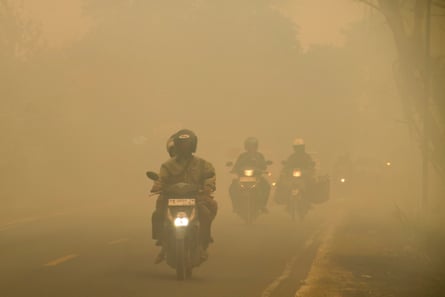
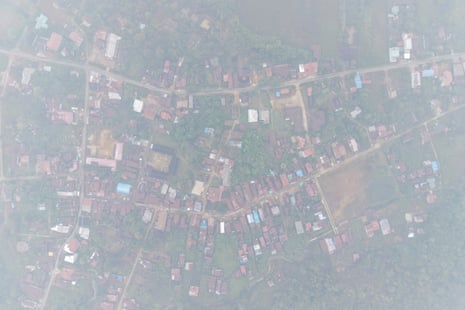
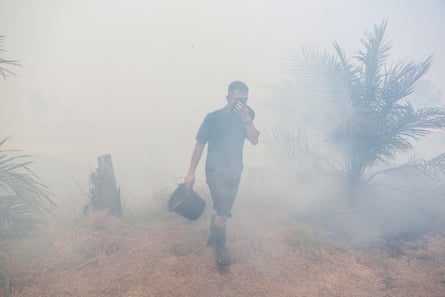
By early September, the situation had deteriorated dramatically. Satellite imagery and drone footage captured the apocalyptic scale of the fires burning in West Kalimantan and South Sumatra. In Palangkaraya, Central Kalimantan, motorcyclists navigated through dense, blinding clouds of particulate matter. In Lanjak village, Kapuas Hulu, heavy smoke choked the horizon, turning midday into a dim, amber twilight.
The psychological and physical toll on residents was immediate. Ely Marlina, a 46-year-old schoolteacher and volunteer firefighter from Kalimantan, described the grim reality of daily life under the haze to the Guardian.
"Ever since the haze hit, we haven’t opened our doors or windows in a long time," Marlina said. "The wind carries smoke from the fires all the way to our porch. Ash and smoke seep directly into the house, and the conditions worsen at night. While we sleep, the whole family is just breathing in the smoke. The physical toll is visceral; eyes are left stinging and weeping daily. It feels like if we keep breathing in this smog, the dizziness will take over and our bodies will just give out."
Regional Spillover: Transboundary Haze
As the fires raged unchecked through the first week of September, the prevailing monsoonal winds caught the colossal plumes of toxic smoke and carried them across international boundaries. The phenomenon of transboundary haze—a recurring diplomatic and environmental friction point within Southeast Asia—rapidly materialized.
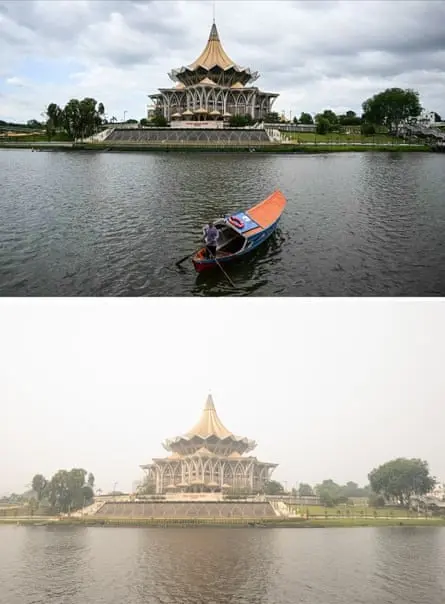
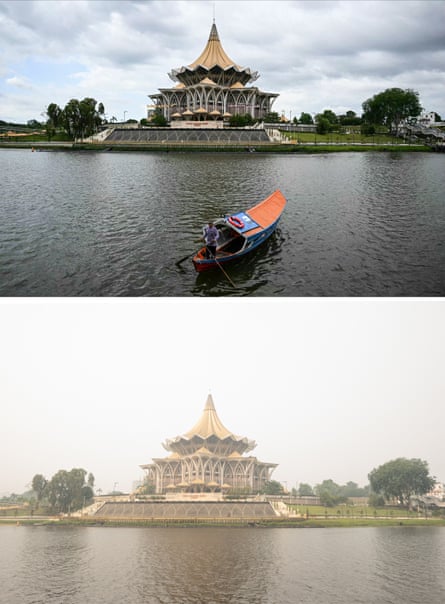
Major urban centers on Malaysian Borneo, such as Kuching, experienced sharp spikes in air pollution. Photographic comparisons of the Sarawak Legislative Assembly building taken in June 2025 versus September 2026 starkly illustrate the transformation from a clear cityscape to one swallowed entirely by an impenetrable gray pall.
The smoke did not stop at Malaysia. Brunei, Singapore, and parts of the Philippines recorded elevated air quality index readings. In Manila, government advisories urged residents to remain indoors and don masks as the Indonesian smoke drifted hundreds of miles across the South China Sea.
Supporting Context & Metrics: The Science of Peat Fires
The "Apex Predator" of Wildfires
To understand why the Indonesian fires are so difficult to control, one must examine the unique nature of the terrain. According to NASA, if there were an "apex predator" among wildfires, tropical peatland fires would be a top contender.
Unlike conventional forest fires that consume surface canopy and underbrush, peatland fires burn both above and below ground. Peat is an accumulation of partially decayed organic matter formed over thousands of years in water-saturated environments. When dried out, it becomes pure carbon fuel.
David Gaveau, a landscape ecologist who directs Nusantara Atlas—an organization tracking deforestation and fire anomalies in Asia—explains the treacherous mechanics of these subterranean infernos.
"They go underground, they resurface somewhere else," Gaveau notes. "And then the more water you give it, the more smoke there is. These fires are really the legacy of 50 years of forest degradation, deforestation, and particularly on peatland."
Because these fires burn deep beneath the surface, standard water-bombing techniques and surface fire-fighting efforts often prove ineffective. They can smolder invisibly for weeks or even months, reigniting long after firefighters believe an area has been secured.
Statistical Overview: By the Numbers
The statistical tracking of the 2026 fire season paints a grim picture of escalating severity:
- Total Area Burned: At least 895,657 hectares have been scorched across Indonesia since January.
- Year-on-Year Increase: The burned area is 34% worse than the corresponding period in 2019, outpacing both 2019 and 2023 trajectories.
- Carbon Emissions: Fire emissions in Indonesia reached 19.7 million metric tons in the first week of September alone, accounting for more than 35% of the global total for that week, according to the EU’s Copernicus Atmosphere Monitoring Service.
- Public Health Impact: In key affected provinces, the number of people suffering from wildfire-related respiratory illnesses more than doubled in a single week, leaping from 50,891 on September 1 to 113,336 by September 9.
- Air Quality Extremes: An Air Quality Index (AQI) rating between 0 and 50 is considered "good" (green), while anything above 300 is deemed "hazardous." In Sampit, Central Kalimantan, the AQI surpassed standard scales, entering the extreme "maroon" category and peaking at an astronomical 1142 on September 10. Local residents have described taking a breath as akin to "smoking a cigarette."
Official Statements and Socio-Political Fallout
Government Crackdown and Enforcement Challenges
In response to public outcry and regional diplomatic pressure, the Indonesian government has mobilized a multi-agency response. The Ministry of Environment and Forestry launched formal investigations into 19 corporate entities suspected of having direct links to the illegal land-clearing fires. Concurrently, the Indonesian National Police arrested 113 individuals accused of intentionally setting fires to clear land.
Despite these enforcement actions, systemic challenges remain. Corruption, complex land-tenure laws, and the high cost of legal land preparation continue to incentivize rogue actors to rely on fire.
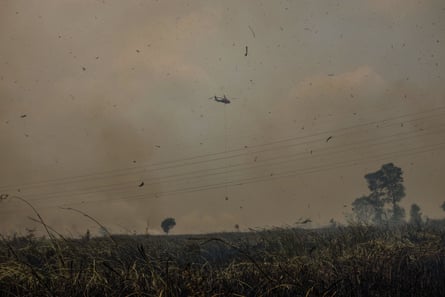
The central government has deployed an array of state resources, including military personnel, specialized water-bombing aircraft, helicopters, and drones to suppress the flames. International assistance has also been integrated into the response framework. Malaysia offered three helicopters, an additional aircraft, and 52 specialized personnel, while Japan contributed firefighting units and aerial assets to bolster local mitigation efforts.
Diplomatic Tensions and Regional Agreements
The recurrence of transboundary haze has reignited diplomatic friction within the Association of Southeast Asian Nations (ASEAN). Malaysia, bearing the brunt of the cross-border smoke alongside Singapore, formally urged ASEAN member states to review and strengthen the 2003 ASEAN Agreement on Transboundary Haze Pollution. Critics of the existing framework argue that it lacks robust enforcement mechanisms, binding dispute resolutions, and penalties for nations failing to curb domestic emissions.
Indonesian Forestry Minister Raja Juli Antoni acknowledged the gravity of the situation during a press briefing, emphasizing that the country is currently navigating its most perilous environmental window.
"We have not yet escaped the threat of El Niño," Minister Antoni stated. "We are not safe from forest and land fires during this El Niño period. September is our month of struggle, our field of struggle."
Grassroots Resistance: The Power of Mama and Oxygen Houses
While governments negotiate and corporations face scrutiny, local communities have taken matters into their own hands. In West Kalimantan and Central Kalimantan, grassroots initiatives have emerged to combat both the fires and the public health crisis.
One notable movement is the "Power of Mama," an all-female firefighting and conservation collective. These women conduct daily patrols, monitor fire hotspots, and engage in direct community outreach—warning villagers of the extreme risks associated with burning and educating them on fire prevention.
Additionally, community volunteers have established "Rumah Oksigen" (Oxygen House) campaigns. Moving door-to-door through smoke-choked neighborhoods, volunteers distribute medical-grade oxygen cylinders to struggling residents, elderly citizens, and exhausted local firefighters who find themselves gasping for clean air on the front lines.
Future Outlook: The Crucial Weeks Ahead
The Super El Niño Factor
As meteorologists and climate scientists monitor oceanic temperatures in the Pacific, the presence of a "super" El Niño has amplified fears of an extended dry season. El Niño acts as a powerful enabler of drought across maritime Southeast Asia, reducing rainfall totals and desiccating vulnerable peat soils.
However, experts like David Gaveau emphasize that climate patterns alone do not tell the whole story.
"El Niño is an enabler. Of course the more powerful it is, the longer and the more intense the drought, and that’s not good news," Gaveau explains. "But you need a match. And we know what that is; it’s people."
The Path to the Rainy Season
The immediate trajectory of the crisis hinges entirely on weather patterns over the coming weeks. Climatological models suggest that the current wave of fires will likely peak through September and potentially drag on through October, before relief arrives with the onset of the annual monsoon rains, traditionally anticipated in November.
Until those rains break the drought, Indonesia and its neighbors remain on high alert. The intersection of unchecked commercial agricultural expansion, climate change, and vulnerable subterranean ecosystems guarantees that unless structural reforms are enacted—such as the permanent restoration and re-wetting of degraded peatlands—this ecological nightmare will return with every dry cycle.
For the millions of citizens currently sheltering behind closed doors, wrapped in masks and breathing through oxygen cylinders, the upcoming weeks represent a tense, breathless vigil waiting for the skies to clear.



