

Executive Overview
As Brazil’s monumental Belo Monte hydroelectric complex marks a decade of commercial operation, it stands at a historic and contentious crossroads. Once heralded as a marvel of engineering capable of supplying clean, renewable energy to millions, the massive infrastructure project in the heart of the Brazilian Amazon is now the epicenter of a fierce national and international debate. As the facility faces its critical environmental license renewal, scientists, Indigenous populations, and traditional riverine communities are demanding a radical reassessment of its operational parameters—most notably, the volume of water discharged back into the Xingu River.
At the core of the controversy is the disruption of the hydrological cycle in the Volta Grande do Xingu (the Great Bend of the Xingu). By diverting and holding back up to 70% of the river’s natural flow, the dam has induced an artificial and severe water scarcity. This ecological transformation has pushed local fishing communities, Indigenous tribes, and endemic river species to the absolute limits of their adaptive capacities.
In this Special Investigation, Mongabay explores the multifaceted disputes surrounding Belo Monte’s water management policies. We examine the profound socioeconomic and cultural impacts on communities living downstream, analyze the compounding threats of climate change on Amazonian river flows, and scrutinize the science underpinning the fight for the survival of the Xingu River.
Detailed Chronology: A Ten-Year Timeline of Controversy
To understand the gravity of Belo Monte’s current licensing crisis, one must trace the turbulent history of the project from its inception on the drawing boards to its turbulent first decade of generation.
Pre-2014: Conception and Resistance
- The 1980s–2000s: Initially conceived during Brazil’s military dictatorship under the name Plano 2010, the dam project—then called Kararaô—sparked fierce international protests led by Indigenous groups, notably the Kayapó people. The outcry successfully shelved the project temporarily.
- 2010–2011: Despite mounting environmental warnings and legal challenges, the Brazilian government under President Luiz Inácio Lula da Silva and later Dilma Rousseff pushed forward. The Brazilian Institute of Environment and Renewable Natural Resources (IBAMA) issued the preliminary license, followed by the installation license in 2011, triggering decades of litigation.
- 2012–2015: Construction commenced amid intense labor strikes, human rights inquiries, and violent clashes between construction consortia, landless workers, and displaced local residents.
2015–2020: The First Decade of Operations
- Early 2016: Belo Monte officially received its partial operating license, and the first turbines began spinning, marking the official integration of the controversial mega-dam into the National Interconnected System (SIN).
- 2019: The controversial Consensus Flow (Vazão de Consenso) was implemented. Designed as a temporary hydrological regime to test the dam’s impacts, it severely curtailed the flow of water into the Volta Grande, immediately sparking alarms among biologists and local fishermen regarding collapsing fish stocks.
- 2020: As the initial operational milestones passed, independent scientific audits revealed that the ecological degradation of the Volta Grande was far more severe than what environmental impact assessments (EIAs) had predicted.
2021–Present: The Licensing Renewal Crisis
- 2023–2024: Scientific panels and federal prosecutors intensified pressure on Norte Energia—the consortium operating Belo Monte—to abandon the Consensus Flow and restore natural seasonal flooding cycles.
- 2026: Ten years after its inaugural operations, Belo Monte faces its mandatory environmental license renewal. The renewal process has transformed into a high-stakes legal battleground where the future ecological integrity of the Xingu River hangs in the balance.
Supporting Context & Metrics: The Anatomy of an Ecological Disruption
The Belo Monte complex is not a single barrier, but a vast network of engineering works designed to harness the immense power of the Amazon basin. However, the geographic realities of the Xingu River make its architecture uniquely destructive to downstream ecosystems.
The Engineering Feat and Its Flaws
Belo Monte relies on a "run-of-the-river" design, which theoretically minimizes the creation of massive reservoirs compared to traditional dams. To achieve this, the project diverts the vast majority of the Xingu River’s water away from its natural channel via a massive artificial canal system leading to the Pimental and Main Powerhouse sites.
However, this design created a 100-kilometer stretch known as the Volta Grande do Xingu, where the natural riverbed is systematically starved of water.
- Water Deprivation: Up to 70%—and during dry spells, even more—of the river’s historical flow is diverted away from the Volta Grande.
- Seasonal Flooding Collapse: River ecosystems in the Amazon depend heavily on predictable annual floods (cheias) to connect the river channel with flooded forests (igapós). These floods are essential for fish to feed, spawn, and migrate. The dam’s manipulation of water levels has essentially severed this biological pulse.
Socioeconomic and Biodiversity Metrics
The consequences of this hydrological starvation are measurable across multiple dimensions:
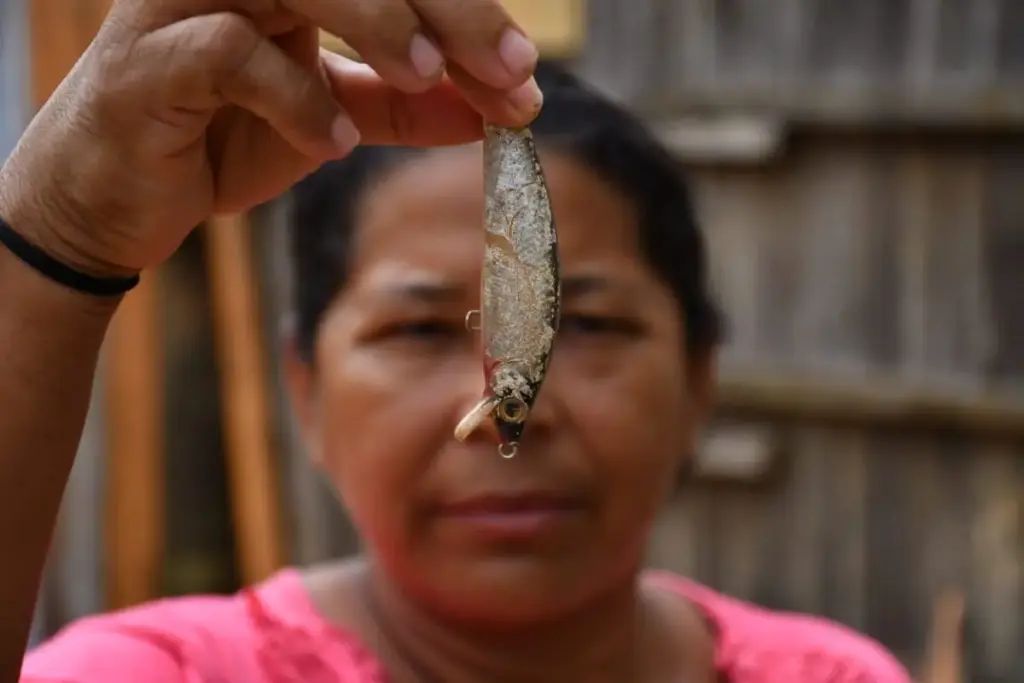
- Fisheries Collapse: Traditional fishing communities in the Volta Grande report drops in fish catches exceeding 80% over the past decade. Species such as the tamuatá and various migratory catfish have seen catastrophic population crashes.
- Endemic Aquatic Life: The Xingu River basin is a global hotspot of aquatic biodiversity, hosting hundreds of species found nowhere else on Earth, including specialized rheophilic (current-loving) fish and unique freshwater stingrays and turtles. The altered flow regimes threaten several of these species with functional extinction.
- Cultural Erosion: Indigenous groups—including the Juruna (Yudjá) and Arara peoples—along with ribeirinhos (traditional riverine populations), have seen their traditional livelihoods, food security, and spiritual connection to the river fundamentally undermined.
Official Statements and Stakeholder Perspectives
As the debate over the environmental license renewal reaches a boiling point, polarized voices from across the political, corporate, and scientific spectrum have staked out uncompromising positions.
Norte Energia and Industry Advocates
Representatives for Norte Energia, the private-public consortium operating the hydroelectric plant, emphasize the critical role Belo Monte plays in Brazil’s energy matrix.
"Belo Monte is a cornerstone of Brazil’s energy security, providing clean, reliable electricity to tens of millions of citizens while operating strictly within the legal frameworks established by federal regulatory bodies," a senior consortium spokesperson stated during a recent energy symposium.
Industry advocates further argue that any sudden, mandated alterations to the current water discharge regime could destabilize national grid operations and lead to skyrocketing energy costs, necessitating a cautious, data-driven approach to any license modifications.
Scientific Community and Environmental Regulators
Conversely, independent scientists and environmental organizations argue that maintaining the status quo is an ecological catastrophe that violates Brazilian and international environmental law. Dr. Helena Rossi, a prominent freshwater ecologist studying the Amazon basin, notes:
"The data collected over the past ten years is unequivocal. The Consensus Flow experiment has failed the river. If IBAMA grants a license renewal without enforcing a return to a naturalized hydrological regime, we will witness the irreversible collapse of the Volta Grande ecosystem within the decade."
Public prosecutors have similarly urged regulatory authorities to prioritize ecological recovery over corporate energy targets, pointing out that the original licensing agreements included clauses for adaptive management—clauses that they argue mandate a dramatic increase in environmental water flows.
Future Outlook: The Next Decade of the Xingu
As Belo Monte enters its second decade, the decisions made in administrative offices in Brasília and federal courts in Pará will dictate the long-term fate of one of the world’s most biologically rich river systems.
The Climate Change Multiplier
Compounding the local impacts of the dam is the intensifying pressure of global climate change. Recent years have brought unprecedented droughts to the Amazon basin, shrinking major tributaries to historic lows. For a modified river like the Xingu, these climate-driven extremes interact dangerously with the dam’s water retention policies, creating compound shocks that push both ecosystems and human populations past their breaking points. Future management strategies must account not only for average historical flows, but for an increasingly volatile and unpredictable hydrological future.
Pathways Forward
The path ahead requires navigating a deeply complex set of trade-offs:
- Rigorous Adaptive Management: Environmental authorities face mounting pressure to condition the new operating license on strict, enforceable targets for increased environmental flows, mimicking natural seasonal pulses rather than maintaining static, low-discharge baselines.
- Fair Reparations and Adaptation: Regardless of regulatory decisions, adequate reparations, infrastructure support, and food security programs must be guaranteed for the Indigenous and traditional communities whose livelihoods have been disrupted.
- Balancing Energy and Ecology: Brazil must ultimately decide how to balance its growing energy demands with its constitutional commitments to environmental preservation and the rights of traditional peoples.
Ten years after the first turbines roared to life, the story of Belo Monte remains unfinished. Whether the next decade will be defined by continued ecological degradation or a hard-earned ecological restoration depends entirely on the outcomes of the current licensing battle—and whether decision-makers are willing to listen to the silent, starving waters of the Volta Grande.



