

Executive Overview
On Earth Day, April 22, 2026, the agricultural landscape witnessed a profound validation of grit, vision, and ecological stewardship. In a joint announcement from Kutztown, Pennsylvania, the Davines Group and the Rodale Institute named Rachel Kulchin, founder of Blue Heron Farm in Bishop, California, as the second annual recipient of The Good Farmer Award U.S.
This prestigious honor, established to champion agrarian pioneers who champion environmental and social progress through regenerative organic practices, highlights a remarkable feat of modern farming. In a hyper-arid high desert region where agricultural infrastructure is notoriously fragile and the vast majority of food is imported, Kulchin has successfully established a thriving, 10-acre agricultural ecosystem.
The recognition places a national spotlight on the Eastern Sierra, proving that regenerative principles—rooted in soil health, biodiversity, and community access—can transform barren landscapes into vibrant, food-secure regions. Selected from a pool of 118 applicants across 25 states, Kulchin’s operation represents the vanguard of a new wave of American farming: small-scale, deeply localized, and fiercely resilient.
Detailed Chronology: The Journey to the 2026 Good Farmer Award
The Genesis of Blue Heron Farm (2025)
Just one year prior to receiving national acclaim, Rachel Kulchin set out to solve a deeply entrenched local vulnerability: the Eastern Sierra’s dependence on imported produce. Operating in a harsh desert climate characterized by extreme temperature swings, minimal rainfall, and poor native soil, Kulchin launched Blue Heron Farm as a 10-acre mixed orchard and vegetable operation.
Her initial goal was deceptively simple yet radically ambitious: to grow nutrient-dense food locally while actively healing the degraded desert earth. By integrating over 1,000 fruit trees with a diverse suite of vegetable crops, she bypassed conventional industrial farming methods in favor of a closed-loop, soil-first methodology.
The First Season Triumph
The gamble paid off with astonishing speed. In its inaugural season, Blue Heron Farm not only survived the punishing high-desert environment but flourished. Kulchin implemented a direct-to-consumer U-Pick model, inviting community members to harvest fresh produce directly from the land. This approach bypassed traditional supply chain logistics and forged a deep emotional and physical connection between consumers and their food source.
During this first hyper-productive year, Kulchin engaged more than 3,000 unique customers and yielded over 47,000 pounds of food. These metrics instantly elevated Blue Heron Farm to the status of the largest diversified fruit and vegetable producer in the region.
The Earth Day 2026 Recognition
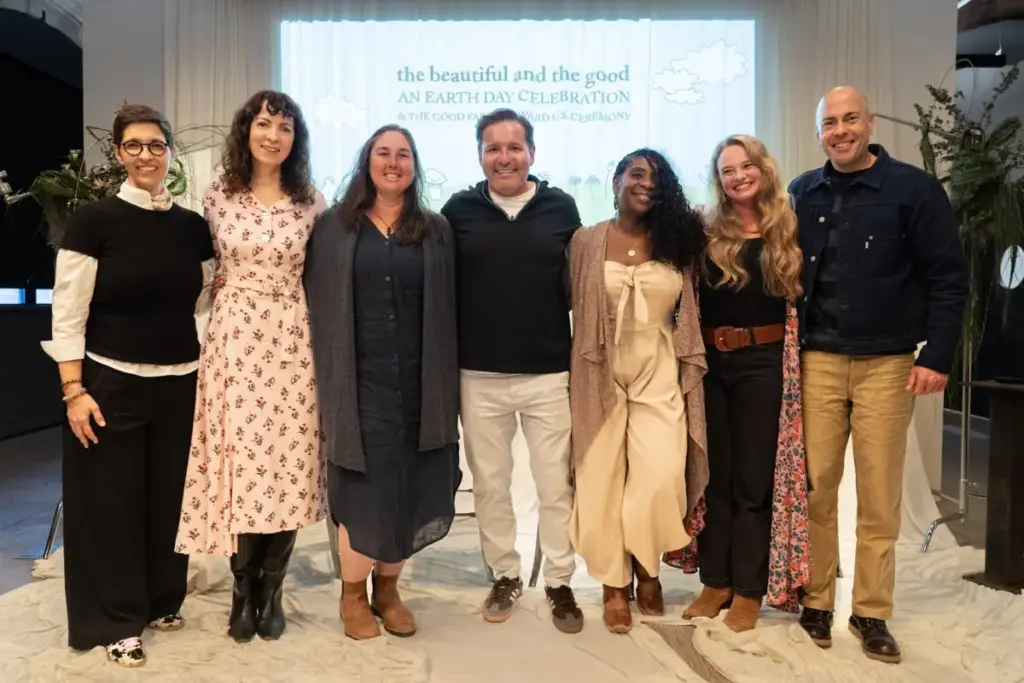
The culmination of this explosive first year was celebrated on April 22, 2026, at an exclusive Earth Day event hosted at the Davines Group House in Brooklyn, New York. Here, Kulchin was formally awarded the Good Farmer Award U.S., accompanied by fellow finalists Nia Kiara Cole of Kin & Flo Farm (North Carolina) and Nailah Marie Ellis of Blessed Up Blooms (Georgia).
As the winner, Kulchin secured a $10,000 infrastructural grant, alongside an all-expenses-paid international exchange to the European Regenerative Organic Center (EROC) in Parma, Italy.
Supporting Context & Metrics: The Anatomy of Desert Regeneration
Meeting the Challenge of Arid Climates
Farming in Bishop, California, presents obstacles that would deter most conventional growers. Water is scarce, evaporation rates are high, and the sandy desert soils lack the organic matter necessary to retain moisture or support robust microbial life.
To overcome these barriers, Kulchin employs regenerative organic techniques tailored specifically to desert microclimates:
- Soil Armor and Composting: Building organic matter rapidly to create a sponge-like soil structure that holds precious moisture.
- Agroforestry and Intercropping: Planting over 1,000 fruit trees alongside diverse vegetable varieties to create microclimates that buffer against wind and extreme heat.
- Targeted Water Management: Maximizing every drop of water through efficient, localized irrigation strategies.
The Power of the Grant: Infrastructure Investment
The $10,000 award package will not merely serve as a symbolic pat on the back; it is strategically allocated to catalyze the next phase of Blue Heron Farm’s evolution:
- 90% ($9,000) Dedicated to Water Conservation: Funds will be funneled directly into upgrading and optimizing orchard irrigation systems, ensuring maximum water-use efficiency in an era of climate unpredictability.
- 10% ($1,000) Dedicated to Education: Resources will support educational signage and on-farm demonstration infrastructure, allowing Blue Heron Farm to act as an open-air classroom for neighboring growers and community members eager to learn desert-adapted agriculture.
The Selection Process and Panel of Experts
The 2026 award program reviewed applications from a highly competitive, culturally diverse pool of 118 farmers across 25 U.S. states. A rigorous judging panel evaluated candidates on three core pillars:
- Biodiversity Enhancement: Practices that actively restore native flora, fauna, and soil microbes.
- Climate Resilience: Strategies that buffer farms against extreme weather, drought, and ecological shocks.
- Environmental Stewardship: A holistic commitment to leaving the land cleaner, healthier, and more productive than it was found.
The distinguished 2026 judging panel included:
- Renée Baran: Dean of Education, Rodale Institute.
- Dario Fornara: Research Director, European Regenerative Organic Center.
- Kegan Hilaire: Farmer/Owner of Blackbird Farms and Small Farms Diversified Vegetable Consultant, Rodale Institute.
- Hayley and Stephanie Painter: Co-Founders, Painterland Sisters (Icelandic Style Skyr Yogurt).
Celebrating the Finalists: National Changemakers
While Kulchin took the top prize, the 2026 runners-up represent vital movements within American agriculture:
- Second Place – Nia Kiara Cole (Kin & Flo Farm, North Carolina): Honored for reclaiming ancestral family land, implementing Afro and Indigenous restorative land practices, training the next generation of BIPOC farmers, and advancing food sovereignty across the North Carolina Piedmont.
- Third Place – Nailah Marie Ellis (Blessed Up Blooms, Georgia): Recognized for establishing a soil-first, community-centered urban farm utilizing direct-to-consumer models to deliver nutrient-dense food and botanical beauty across Atlanta, from Bankhead to Buckhead.
Official Statements: Voices of the Movement
The convergence of global beauty brands, agricultural research institutions, and grassroots farmers underscores a shared realization: the future of cosmetics, health, and human survival is inextricably linked to the soil.
Jeff Tkach, CEO of Rodale Institute:
"Rachel embodies the resilient, systems approach that regenerative organic agriculture demands. In just one year, she has built a thriving 10-acre operation that is not only producing nutrient-dense food and restoring soil health, but also inspiring an entire community to reimagine what’s possible for local food security. Her work proves that small farms can be economically viable and ecologically sound, even in the most challenging climates."Rachel Kulchin, Founder of Blue Heron Farm:
"I am standing behind a belief that feels both stubborn and bold. The recognition through the Good Farmer Award affirms the work we are doing to build something different in the Eastern Sierra. Our goal is not just to grow food, but to demonstrate that regenerative agriculture can thrive in challenging climates and build the resilience our valley desperately needs. This award will be transformational for Blue Heron Farm and for our community."Davide Bollati, Chairman of the Davines Group:
"We are delighted to welcome Rachel to Italy and to guide her through our European Regenerative Organic Center. This year’s award demonstrates why Davines continues to partner with Rodale Institute—not only to source regenerative organic ingredients for our products, but to learn from the Institute’s rigorous research and farmer-first expertise. Rachel’s farm is a living example of building resilient systems with regenerative organic agriculture. By supporting farmers like Rachel, we invest in the future of beauty, agriculture, and the planet."
Future Outlook: A Blueprint for Remote Food Sovereignty
As climate change accelerates desertification, water scarcity, and supply chain vulnerabilities across the globe, models like Blue Heron Farm are no longer charming anomalies—they are blueprints for survival.
By proving that a 10-acre high-desert plot can generate over 47,000 pounds of food in its first year while actively healing the earth, Rachel Kulchin has dismantled the myth that industrialized, long-distance supply chains are the only way to feed isolated rural populations.
Looking ahead, the partnership between the Davines Group and the Rodale Institute continues to expand the horizons of the Good Farmer Award. Since its inception in 2025 in the U.S. (and following its sister program launched in Italy in 2024 with the Sustainable Development Foundation), the initiative has consistently surfaced visionary farmers who operate outside the mainstream agricultural paradigm.
For Blue Heron Farm, the immediate future involves refining water conservation technologies, expanding educational outreach to regional growers, and preparing for Kulchin’s upcoming educational pilgrimage to EROC in Parma, Italy. Beyond the Eastern Sierra, Kulchin’s success sends an unmistakable signal to policy-makers, agronomists, and consumers alike: regenerative agriculture is adaptable, scalable, and—most importantly—capable of blooming anywhere, even in the heart of the desert.



