


Executive Overview
Physical inactivity and muscular atrophy represent two of the most pervasive, yet preventable, public health crises of the modern era. While the clinical benefits of resistance training—ranging from enhanced insulin sensitivity and bone mineral density to mitigated sarcopenia and improved psychological well-being—are indisputably documented, the entry barrier to commercial fitness facilities remains formidable. For the uninitiated, walking into a modern gym can feel akin to navigating an alien landscape characterized by complex biomechanical machinery, intimidating free-weight sectors, and highly specialized social dynamics.
This psychological barrier, colloquially termed "gymtimidation," is exacerbated by a saturated and often contradictory digital fitness landscape. Novices are frequently bombarded with advanced, highly specialized training splits that are entirely inappropriate for their physiological readiness. The consequence is a staggering attrition rate: empirical data suggests that up to 50% of individuals who initiate a new exercise program abandon it within the first six months.
This investigative report serves as an authoritative, science-based blueprint designed to transition the novice lifter from cognitive apprehension to structural autonomy. By deconstructing the biomechanical, physiological, and behavioral pillars of strength training, this guide establishes a clear methodology for long-term adherence, injury prevention, and optimal neuromuscular adaptation.
Detailed Chronology: The Lifecycle of Novice Adaptation
To successfully integrate resistance training into a lifestyle, one must understand the physiological and behavioral timeline of the human body when subjected to novel mechanical loading. This chronology outlines the critical phases a beginner undergoes during their first six months of training.
[Phase I: Weeks 1–4]       -->   [Phase II: Weeks 5–12]       -->   [Phase III: Months 3–6]
Neuromuscular Adaptation         Biomechanical Integration          Autoregulatory Progression
- Motor unit recruitment         - Machine-to-free-weight transition - Systematic progressive overload
- Coordination over hypertrophy  - Stabilization of kinetic chain    - Fatigue management & recovery
Phase I: Neuromuscular Adaptation and Cognitive Mapping (Weeks 1–4)
During the initial four weeks of a strength training regimen, the primary adaptations observed are not hypertrophic (muscle growth) but rather neurological. The human brain is rapidly mapping new motor pathways, learning to recruit motor units more synchronously, and reducing antagonist muscle co-activation.
- The Psychological Hurdle: Novices frequently experience cognitive overload and heightened self-consciousness. Without a structured plan, this phase is characterized by aimless wandering between machines, leading to decision fatigue and eventual dropouts.
- The Physiological Reality: Muscle soreness—specifically Delayed Onset Muscle Soreness (DOMS)—is at its peak during this phase due to micro-tears in unfamiliar muscle fibers. Beginners must understand that early strength gains are almost entirely a result of improved nervous system efficiency rather than increased muscle cross-sectional area.
Phase II: Biomechanical Integration and Stabilization (Weeks 5–12)
By the second month, the nervous system has stabilized basic movement patterns. The body begins to undergo structural remodeling, laying down new myofibrillar proteins and strengthening connective tissues (tendons and ligaments) to support heavier mechanical loads.
- Establishing the Routine: During this window, behavioral patterns solidify into habits. The utilization of structured, predictable workouts reduces the cognitive friction of going to the gym.
- Transitioning Movement Complexity: This is the optimal window to transition from highly stabilized machine exercises to multi-planar free-weight movements, as the stabilizing musculature has developed baseline endurance.
Phase III: Autoregulatory Progression and Long-Term Adherence (Months 3–6)
At the half-year mark, the beginner stage transitions into an intermediate phase. The rapid, linear strength gains experienced initially begin to taper, requiring a shift toward more deliberate progression models and precise fatigue management.
- Overcoming Plateaus: The lifter must learn to implement systematic progressive overload, altering variables such as intensity, volume, and frequency to force continued physiological adaptation.
- Preventing Burnout: The initial novelty of training has dissipated. Long-term adherence now relies on tracking metrics, understanding systemic recovery, and finding intrinsic motivation.
Supporting Context & Metrics: The Science of Strength
To build an effective training program, one must rely on empirical sports science rather than anecdotal gym folklore. Below is an analytical breakdown of the foundational elements required to optimize human performance and safety.
The Physiology of the Warm-Up
Skipping the warm-up is a primary catalyst for acute musculoskeletal injuries. A scientifically sound warm-up prepares the body for intense physical exertion through three distinct physiological mechanisms:
                  ┌──────────────────────────────┐
                  │      Dynamic Warm-Up         │
                  └──────────────┬───────────────┘
                                 │
         ┌───────────────────────┼───────────────────────┐
         ▼                       ▼                       ▼
┌─────────────────┐     ┌─────────────────┐     ┌─────────────────┐
│ Vasodilation &  │     │ Synovial Fluid  │     │ Neuromuscular   │
│ Core Temp Rise  │     │   Lubrication   │     │   Activation    │
└─────────────────┘ └─────────────────┘ └─────────────────┘- Vasodilation and Core Temperature Elevation: Increasing blood flow to active skeletal muscles enhances oxygen delivery and muscle elasticity, reducing the risk of fiber tearing.
- Synovial Fluid Secretion: Joint mobilization stimulates the release of synovial fluid, reducing friction within articular cartilage and preparing joints (especially the knees, hips, and shoulders) for load-bearing activities.
- Neuromuscular Potentiation: Low-intensity movements prime the central nervous system, increasing the rate of force development (RFD) for the upcoming heavier lifts.
A universally effective, streamlined warm-up protocol consists of:
- 5 Minutes of Low-Intensity Cardio: (e.g., rowing, incline walking) to raise core temperature.
- Dynamic Mobilization: Arm circles, leg swings, and bodyweight squats to transition joints through their full range of motion.
- Movement-Specific Warm-up Sets: Performing the target exercise with an empty barbell or minimal weight before attempting working sets.
The Four Foundational Movement Patterns
Human movement, regardless of complexity, can be distilled into four primary patterns. An effective beginner program does not require dozens of isolated exercises; rather, it should revolve around mastering these compound movement categories:
| Movement Pattern | Primary Target Musculature | Key Beginner Exercises |
|---|---|---|
| Squat (Knee-Dominant) | Quadriceps, Gluteus Maximus, Adductors | Goblet Squat, Leg Press, Bodyweight Box Squat |
| Hinge (Hip-Dominant) | Hamstrings, Gluteus Maximus, Erector Spinae | Romanian Deadlift (RDL), Cable Pull-Through |
| Push (Horizontal/Vertical) | Pectoralis Major, Anterior Deltoids, Triceps | Dumbbell Chest Press, Machine Shoulder Press |
| Pull (Horizontal/Vertical) | Latissimus Dorsi, Rhomboids, Trapezius, Biceps | Lat Pulldown, Seated Cable Row, Dumbbell Row |
Focusing on these compound movements ensures maximum hormonal response, high caloric expenditure, and the development of functional, real-world strength.
Demystifying the Gym Floor: Machine Biomechanics
For the novice, the free-weight section can present a high barrier to entry due to the stabilization required. Fitness machines provide a safe, effective alternative, allowing beginners to build baseline strength while minimizing injury risk.
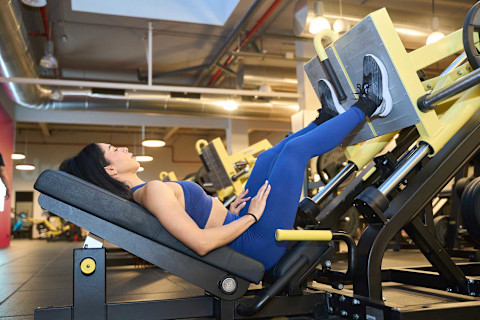
1. The Leg Press (Knee-Dominant Pattern)
- Biomechanical Advantage: Provides external spinal support, eliminating the axial loading (spinal compression) associated with the traditional barbell squat. This allows the lifter to isolate the quadriceps and glutes safely.
- Execution: Sit firmly with the lower back flushed against the pad. Place feet shoulder-width apart on the platform. Lower the carriage under control until knees reach approximately 90 degrees, ensuring the lower back does not round off the seat (butt wink). Press through the mid-foot to return to the starting position, stopping just short of locking out the knees to maintain muscular tension.
      CORRECT FORM (Leg Press)               INCORRECT FORM (Avoid!)

      [Back Flat Against Pad]                 [Lower Back Rounding]
             O                                       O
            /|                                     /|  *Spinal Strain*
           / |                                    / |
   _______/ _|_ _______                   _______/ _|_ _______
  [  Keep knees unlocked ]                [  Locking out knees  ]
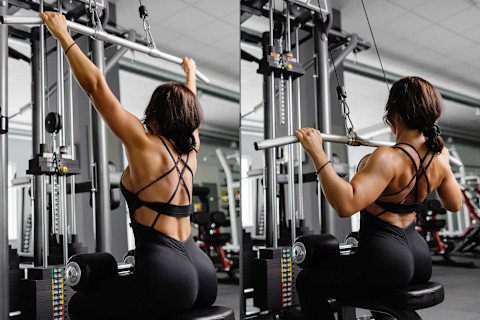
2. The Lat Pulldown (Vertical Pulling Pattern)
- Biomechanical Advantage: Allows the lifter to train the upper back without needing the strength required to lift their entire body weight in a standard pull-up.
- Execution: Secure the thighs under the roller pads. Grasp the bar with a pronated (overhand) grip slightly wider than shoulder-width. Lean back slightly (approximately 10–15 degrees) to clear the face. Initiate the movement by depressing the scapulae (pulling the shoulder blades down) and drawing the elbows down toward the ribcage. Touch the bar to the upper chest before controlling the ascent.
3. The Seated Chest Press (Horizontal Pushing Pattern)
- Biomechanical Advantage: Eliminates the need to balance a barbell, permitting complete focus on pectoral recruitment and arm extension mechanics.
- Execution: Adjust the seat height so that the handles align with the mid-to-lower sternum. Keep the shoulder blades retracted and depressed against the back pad. Press the handles forward to full extension without letting the shoulders roll forward at the end of the movement. Return to the starting position under strict control.
Transitioning to Free Weights
While machines are exceptional for hypertrophy and neurological safety, free weights (dumbbells and barbells) are essential for developing stabilizing muscles and spatial awareness.
Machine Movement                Free-Weight Progression
--------------------------------------------------------------
Leg Press            ====>      Kettlebell Goblet Squat
Seated Chest Press   ====>      Flat Dumbbell Bench Press
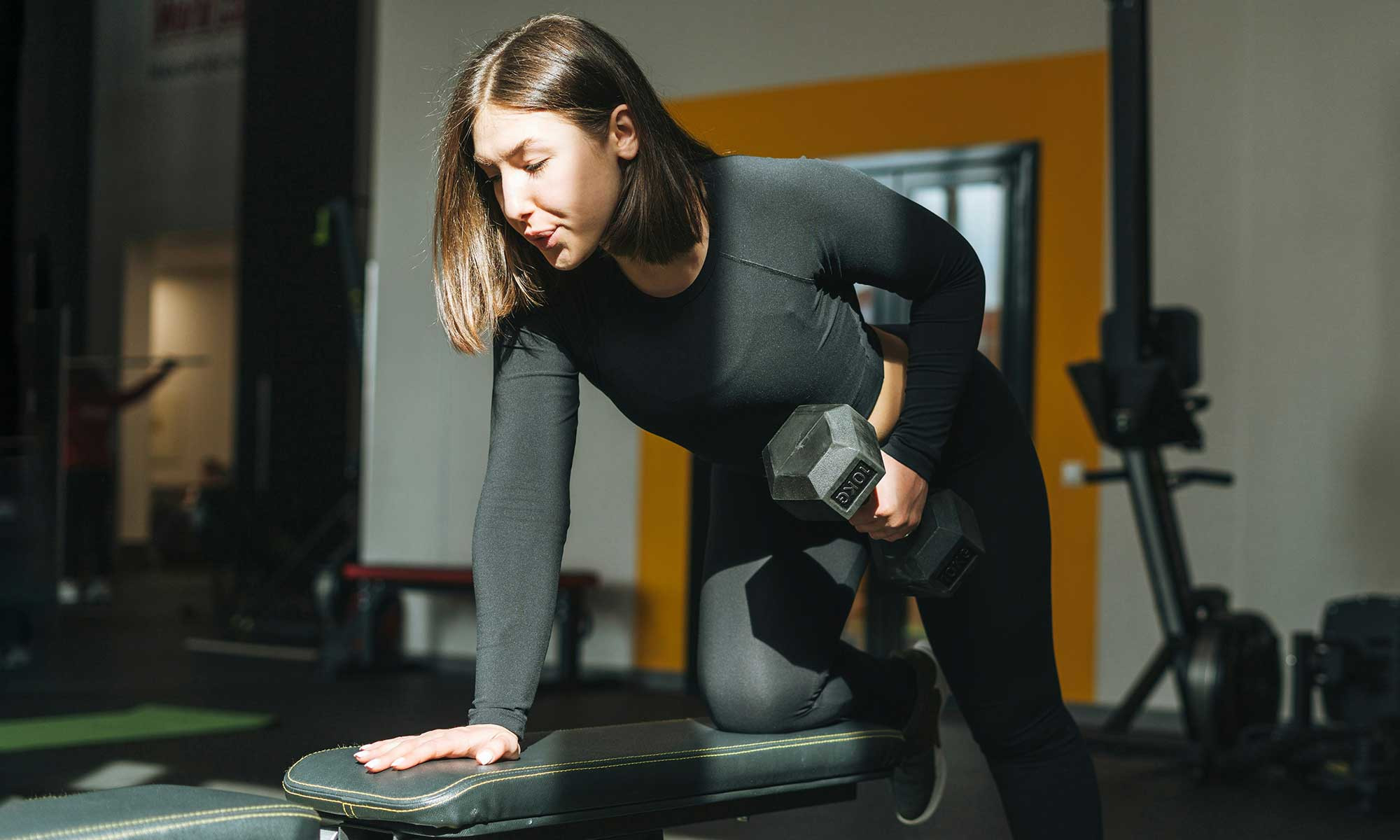
Lat Pulldown         ====>      Three-Point Dumbbell Row
This transition should not be viewed as a graduation but as an expansion of the training toolkit. Utilizing a hybrid model—combining heavy compound free-weight movements with targeted machine exercises—is the strategy employed by elite athletes and sport scientists globally.
Repetitions, Sets, and Rest: The Variables of Adaptation
To elicit specific physical adaptations, training variables must be strictly managed. For beginners, a balanced, evidence-based approach targeting both muscular hypertrophy and strength is recommended:

- Set Range: 3 working sets per exercise.
- Repetition Range: 8 to 12 repetitions per set.
- Rest Interval: 60 to 90 seconds between sets.
The weight selected must be heavy enough that the final 2–3 repetitions of each set are highly challenging (representing a Rating of Perceived Exertion, or RPE, of 8 out of 10), yet light enough that biomechanical integrity is never compromised. If a lifter can complete 12 repetitions with perfect form and feels they could complete several more, the load should be incrementally increased in the subsequent session.
Official Statements and Expert Guidelines
To provide a comprehensive view of beginner fitness onboarding, we look to the consensus of the world’s leading sports medicine and strength authorities.
The American College of Sports Medicine (ACSM)
In its official guidelines for resistance training, the ACSM states:
"For health-related resistance training in healthy adults, progressive health benefits can be obtained with a frequency of 2 to 3 days per week, utilizing a program that targets all major muscle groups. Novices should perform 1 to 3 sets per exercise, with a load corresponding to 60-70% of their one-repetition maximum (1RM) for 8 to 12 repetitions to maximize neuromuscular adaptations."
The National Strength and Conditioning Association (NSCA)
The NSCA emphasizes the primacy of movement competency over load:
"The acquisition of proper motor skills and lifting technique must precede any significant increase in external load. Beginners should focus on multi-joint compound exercises that promote intermuscular coordination. Progressive overload should be applied systematically and conservatively to prevent overuse injuries and ensure long-term structural adaptation of connective tissues."
The Psychology of Behavioral Adherence
Dr. Albert Bandura’s Self-Efficacy Theory is highly applicable to gym onboarding. Clinical psychologists specializing in sports performance emphasize that self-efficacy—an individual’s belief in their capability to execute a specific behavior—is the single greatest predictor of exercise adherence.
By utilizing structured, simple programs and mastering basic movements first, beginners experience early, frequent successes. These micro-successes build psychological resilience, effectively neutralizing gymtimidation and lowering the barriers to long-term lifestyle integration.
Practical Gym Logistics and Etiquette
Entering a commercial fitness facility requires an understanding of the unwritten social contract that governs these spaces. Adhering to these behavioral norms ensures a harmonious environment for all patrons.
The Essential Novice Inventory
You do not need specialized gear to have a highly effective workout. Focus on these practical essentials:
- Appropriate Footwear: Flat-soled, stable shoes (such as minimalist trainers or classic canvas shoes) are highly superior to cushioned running shoes for lifting, as they provide a stable base of support and improve force transfer from the floor.
- Hydration Vessel: A reusable water bottle to maintain hydration and manage intra-workout fatigue.
- Personal Towel: Used to maintain hygiene and keep equipment clean.
- A Physical or Digital Logbook: Tracking exercises, weights, sets, and reps is essential for progressive overload.
The Unwritten Rules of the Gym Floor
- Re-Rack Your Weights: Every dumbbell, plate, and accessory must be returned to its designated storage location immediately upon completing an exercise. Leaving weights on bars or on the floor is a safety hazard and a breach of basic gym courtesy.
- Sanitize Equipment: Use the provided disinfectant wipes or spray to clean any surface your skin has contacted (e.g., benches, handles, machine pads) immediately after use.
- Respect Shared Space: Avoid standing directly in front of the dumbbell rack while performing exercises, as this blocks access for other lifters. Maintain a respectful physical distance from others during their active sets.
- Inquire Respectfully: If a piece of equipment is occupied, it is entirely acceptable to ask, "Excuse me, how many sets do you have left?" Many lifters are happy to let you "work in" (perform your set while they rest between theirs).
- Limit Distractions: Keep phone usage to a minimum while on active equipment. Prolonged resting while scrolling through social media contributes heavily to gym congestion and frustration.
Critical Pitfalls: What to Avoid
       NOVICE TRAP                  CONSEQUENCE                   CORRECTIVE PATH
┌────────────────────────┐    ┌───────────────────────┐    ┌────────────────────────┐
│ Copying Advanced       │ ──>│ Biomechanical Breakdown│ ──>│ Master Simple Compound │
│ Lifters / Influencers  │    │ & Acute Joint Injury  │    │ Movement Patterns First│
└────────────────────────┘    └───────────────────────┘    └────────────────────────┘
┌────────────────────────┐    ┌───────────────────────┐    ┌────────────────────────┐
│ Excessive Training     │ ──>│ Chronic Soreness &    │ ──>│ Limit to 2-4 Sessions  │
│ Frequency & Volume     │    │ Overtraining Syndrome │    │ Per Week; Prioritize   │
└────────────────────────┘    └───────────────────────┘    └────────────────────────┘
┌────────────────────────┐    ┌───────────────────────┐    ┌────────────────────────┐
│ Neglecting Recovery    │ ──>│ Hormonal Imbalance    │ ──>│ Ensure 7-9 Hours Sleep │
│ and Sleep              │    │ & Stalled Progression │    │ & Proper Nutrition     │
└────────────────────────┘    └───────────────────────┘    └────────────────────────┘
1. The Mirror-Neuron Fallacy (Copying Advanced Lifters)
Novices naturally look to the most physically developed individuals in the gym or on social media for guidance. However, copy-pasting the training splits of elite athletes or fitness influencers is a recipe for injury. These individuals have spent years building work capacity, joint integrity, and neurological efficiency. A beginner attempting an advanced, high-volume routine will quickly experience systemic fatigue, compromising their form and risking acute joint or soft-tissue injury.
2. The Intensity Trap (Too Much, Too Soon)
Driven by high initial motivation, beginners often train with excessive frequency and intensity, believing that extreme soreness is a badge of honor. In reality, extreme muscle soreness that impairs daily functioning for several days is a sign of excessive muscle damage. This level of tissue damage hinders consistency and can lead to overreaching. Novices should aim to leave the gym feeling as though they could have performed one or two more clean sets, preserving systemic energy for recovery and subsequent training sessions.
3. Neglecting the Recovery Equation
Muscle tissue is not built during a workout; it is damaged. The adaptation process—supercompensation—occurs exclusively during rest, facilitated by deep sleep and proper nutrition.
[Training Stimulus (Micro-tears)] ──> [Nutritional Support (Protein)] ──> [Deep Sleep (GH Release)] ──> [Supercompensation (Stronger Muscle)]Without 7 to 9 hours of quality sleep and adequate protein intake to support muscle protein synthesis, the body remains in a chronic catabolic state. This stalls progress, increases injury risk, and dampens motivation.
Future Outlook: The Evolution of Gym Onboarding
The fitness landscape is undergoing a massive technological and philosophical shift. The traditional, intimidating commercial gym model is being challenged by innovations aimed at democratizing strength training for beginners.
Artificial Intelligence and Biomechanical Feedback
The integration of computer vision and wearable sensors is changing how beginners learn to lift. Smart mirrors and mobile applications can now analyze a lifter’s form in real-time, providing instant feedback on joint angles, bar path, and tempo. This technology acts as a digital personal trainer, reducing the initial anxiety of not knowing how to perform an exercise correctly.
The Shift Toward Longevity and Healthspan
The fitness industry is moving away from purely aesthetic, bodybuilding-centric marketing toward a holistic focus on longevity, cognitive health, and functional independence. This cultural shift is reframing the gym not as a venue for performance athletes, but as a critical clinical setting for preventative medicine. As healthcare providers increasingly prescribe resistance training to combat chronic diseases, commercial gyms are evolving to offer more welcoming, medically integrated onboarding programs.
Conclusion
Your first few months in the gym are not about moving massive weights or mastering complex training techniques. They are about building familiarity, developing structural integrity, and establishing a consistent, sustainable routine.
Every advanced lifter once stood where you are standing today: feeling uncertain, holding a light weight, and wondering if they belonged. By focusing on structured, compound movement patterns, applying systematic progressive overload, and prioritizing recovery, you will steadily transform apprehension into lasting physical strength and self-efficacy.
The gym is not a closed club for the elite; it is a laboratory for self-improvement. You do not need to know everything to begin. You simply need to take the first step.



