

Executive Overview
Marking the twentieth anniversary of his landmark, Oscar-winning documentary An Inconvenient Truth, former United States Vice-President Al Gore reflects on two decades of relentless climate advocacy. Speaking at a high-profile event in New York City during Climate Week, a reflective yet resolute Gore admitted that he had initially underestimated the durability, malice, and systemic reach of the fossil fuel industry’s political resistance.
Two decades after the 2006 film brought global warming out of specialized scientific journals and into public living rooms, the physical reality of the climate crisis has exceeded even the most alarming projections of the early millennium. Across the globe, record-shattering heatwaves, catastrophic glacial floods, and devastating feedback loops confirm that scientific warnings were not exaggerated, but in many cases, understated.
Yet, despite facing entrenched opposition—including what Gore describes as the shocking infiltration of fossil fuel operatives into top-tier United Nations scientific apparatuses—the former vice-president maintains a staunchly optimistic outlook. Backed by the exponential growth of cheap renewable energy, massive grassroots networks like the Climate Reality Project, and shifting public sentiment, Gore argues that humanity is rapidly approaching a pivotal threshold. The central question facing civilization is no longer whether clean energy will triumph over fossil fuels, but whether that victory will arrive in time to prevent irreversible planetary tipping points.
Detailed Chronology: From the Slideshow to a Global Movement
The Genesis of a Modern Crusade (2000–2006)
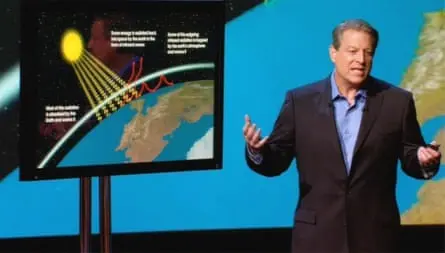
The journey of An Inconvenient Truth began long before cameras rolled on its 2006 release. Following his razor-thin and bitterly contested defeat in the 2000 US presidential election, Al Gore redirected his formidable political energy into an unconventional medium: a multi-media slide presentation detailing the impending planetary crisis. For years, Gore traversed the globe, presenting the data-driven talk to corporate boardrooms, university auditoriums, and community centers.
Recognizing the urgent need to democratize complex atmospheric science, director Davis Guggenheim partnered with Gore to translate the slideshow into a feature-length documentary. Released in the spring of 2006, An Inconvenient Truth shattered expectations for environmental cinema. It grossed nearly $50 million worldwide, won two Academy Awards (including Best Documentary Feature), and fundamentally altered the public lexicon surrounding global warming. Terms like "carbon footprint," "inconvenient truth," and "tipping point" swiftly embedded themselves in everyday global discourse.
Building the Grassroots Infrastructure
Realizing that cultural awareness alone could not dismantle industrial inertia, Gore pivoted immediately toward grassroots mobilization. He founded what would become the Climate Reality Project, an ambitious international initiative designed to train ordinary citizens to become frontline climate communicators.
Over the subsequent two decades, this network expanded exponentially. Today, the Climate Reality Project boasts a cadre of 4.5 million active participants spanning 196 countries. These grassroots advocates have successfully lobbied municipal governments, pushed for regional decarbonization policies, and served as localized counter-weights to corporate disinformation campaigns.
The Turning Tides of the 2020s
As the documentary entered its second decade, the global landscape shifted dramatically. The mid-2020s have been defined by an escalation of acute climate trauma, punctuated by compounding extreme weather events that have forced even the most recalcitrant political leaders to acknowledge systemic shifts. During his anniversary address in New York—delivered in a conversation with veteran television forecaster Al Roker—Gore reflected on this timeline with characteristic wit: “I always say if it hadn’t been for me, we might have a big problem right now,” he joked, before turning to a somber assessment of reality.
Supporting Context & Metrics: Science Vindicated, Resistance Unmasked
The Unforgiving Data of Modern Climate Change
Two decades ago, climate scientists were frequently accused by industrial lobbyists of alarmism. Looking back, Gore noted that the scientific community has been proven "absolutely correct," with reality frequently outpacing theoretical models.
The physical metrics of the mid-2020s underscore this urgency:
- Thermal Anomalies: Consecutive summers of back-to-back, record-breaking heatwaves have swept across Europe, North America, and Asia, directly causing tens of thousands of excess deaths.
- Cryospheric Collapse: Glacial melting has accelerated dramatically. A prominent example includes the catastrophic flooding along the Nepal-Tibet border, triggered by sudden glacial lake outbursts.
- Tipping Points: Scientists have identified terrifying feedback loops, such as the large-scale dieback of the Amazon rainforest—historically a major carbon sink—threatening to transform the vital ecosystem into an arid savanna.
Institutional Capture and the Fossil Fuel Backlash
Perhaps the most striking admission from Gore’s anniversary tour was his surprise at the sheer tenacity of the fossil fuel lobby. Despite overwhelming empirical evidence, oil, gas, and coal conglomerates orchestrated a multi-decade campaign of denial, delay, and strategic obstruction.
Gore pulled no punches when discussing the depth of this political corruption, asserting that the fossil fuel industry has "captured control of too many governments" across the globe. Most alarmingly, he pointed to recent investigative journalism by The Guardian revealing that Saudi oil operatives—specifically linked to state-owned oil giant Saudi Aramco—had successfully insinuated themselves into the drafting processes of high-profile United Nations Intergovernmental Panel on Climate Change (IPCC) reports. Such revelations highlight an institutional capture of top-tier global science apparatuses "to a shocking degree," according to Gore.
Historical Parallels: Drawing Strength from Past Struggles
Confronted with the immense weight of institutional resistance and the psychological toll of climate anxiety, Gore drew inspiration from historical social justice movements. He compared the current fight for planetary survival to the American civil rights movement and the long struggle for women’s suffrage.

"And in all those previous cases, some of the advocates felt despair, and the biographies and diaries are filled with those kinds of expressions," Gore told the New York audience. "But they kept going anyway because, as others have said, courage is not the absence of fear or despair. It’s the decision to go forward in spite of it."
Official Statements: Perspectives from Global Leadership
The milestone anniversary of An Inconvenient Truth coincided with high-level dialogues during Climate Week, culminating in a major UN climate event hosted by outgoing UN Secretary-General António Guterres, a tireless champion of aggressive environmental policy.
António Guterres on Industrial Absurdity
Taking the podium ahead of key international summits, Guterres delivered a scathing rebuke of continued fossil fuel expansion, describing corporate strategies that prioritize short-term extraction over long-term survival as actions that are "defying science, economics, and common sense."
Guterres elaborated on the systemic vulnerability fostered by carbon dependency:
"We have seen how fossil fuel dependence wreaks havoc—driving up costs, draining budgets, squeezing households, and leaving countries at the mercy of conflicts and decisions far beyond their borders."
However, the outgoing UN chief echoed Gore’s underlying notes of pragmatic hope. Pointing to the exponential economic shifts favoring green infrastructure, Guterres emphasized that nations now possess the technological and financial toolkits required to pivot toward a sustainable future.
"Renewables are the cheapest, fastest, and most secure source of new electricity almost everywhere," Guterres stated. "Clean energy has gone from alternative to unstoppable."
Al Gore on the Race Against Time
Reiterating his core thesis, Gore emphasized that while humanity has successfully steered away from the absolute worst-case apocalyptic projections of the late 20th century—such as a catastrophic 4 degrees Celsius warming scenario by 2100—the world is still perilously close to breaching the critical 2C threshold above pre-industrial averages.
The economics, however, have irreversibly shifted. In nearly every major market, utility-scale solar and wind generation, coupled with advanced battery storage, are now routinely cheaper than burning fossilized coal or natural gas. Developing nations still face systemic barriers regarding access to low-cost capital for renewable deployment, but the macro-trend is clear.
"The day is coming when our momentum will overtake the resistance. We’re getting very close now," Gore concluded. "I think we are going to win this. The remaining question is whether we will win it in time to avoid those negative tipping points I talked about."
Future Outlook: The Horizon of the Clean Energy Transition
As the climate movement looks toward the next twenty years, the battle lines have evolved. The era of outright climate denial—championed for decades by conservative think tanks and petroleum PR firms—has largely collapsed under the weight of tangible, visible environmental catastrophes. In its place, opponents of climate action have frequently pivoted to "delayism": promoting false solutions, arguing for prolonged transition periods, or advocating for unproven carbon capture technologies as a blank check for continued oil extraction.
Nevertheless, the structural momentum of the global economy is increasingly misaligned with fossil fuel interests. Financial institutions, sovereign wealth funds, and major insurers are rapidly repricing climate risk, driving capital away from legacy energy assets and pouring trillions of dollars into electrified transport, green hydrogen, grid modernization, and renewable generation.
The legacy of Al Gore’s An Inconvenient Truth is thus twofold. It serves as a historical monument to a time when a lone politician and a slide projector forced the world to look in the mirror, and as a stark reminder that systemic change requires enduring, multi-generational courage. Whether the unstoppable momentum of clean energy can outpace the remaining tipping points of the Earth’s delicate climate system remains the defining question of the twenty-first century.



