Error Warped the UK Conservative Party’s Net-Zero Debate
Executive Overview
In a political landscape where fiscal competence and evidence-based policy are routinely touted as fundamental pillars of governance, a glaring accounting anomaly has exposed a significant flaw in the UK Conservative Party’s official platform on climate policy. A newly published policy booklet titled "The Right Way", designed to establish the opposition party’s post-election ideological trajectory, rests a key critique of decarbonization on a metric that has been inadvertently doubled.
The document claims that the UK’s independent advisory body, the Climate Change Committee (CCC), calculated the total net cost of achieving net-zero carbon emissions at roughly £957 billion. However, an analysis of the primary data reveals that the true figure produced by the CCC in its landmark 2020 modeling was precisely half that amount—£478 billion.
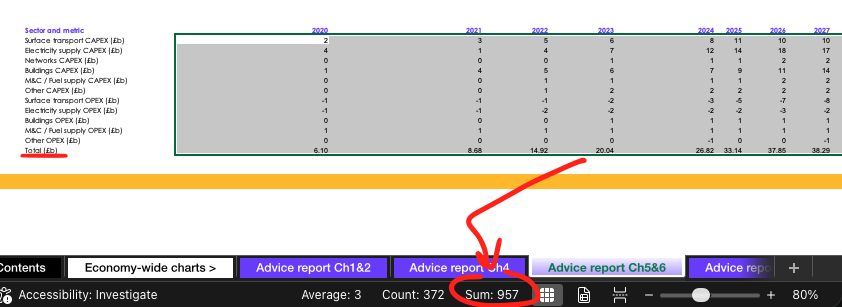
The origin of this £479 billion miscalculation is not a difference in economic interpretation or baseline accounting methodologies, but rather a elementary spreadsheet error. An independent analyst attempting to process the CCC’s publicly available data summed a column that already contained a calculated total line. This effectively counted the net costs and savings of the UK’s green transition twice.
Despite the error originating in early 2026 within fringe policy circles, the inflated figure migrated through right-leaning think tanks, featured in national opinion pieces, and was ultimately adopted by senior Conservative policy strategists as a cornerstone of their argument against UK climate targets.
This analytical failure occurs at a critical juncture in British politics. As debates over the economic feasibility of decarbonization intensify, the circulation of mathematically invalid metrics threatens to distort public discourse, misinform parliamentary deliberation, and undermine the institutional credibility of party policy formulation.
Detailed Chronology: The Anatomy of a Flawed Metric
To understand how an erroneous formula in Microsoft Excel transformed into official opposition policy, one must trace the paper trail across a six-year timeline of policy releases, commentary, and political recycling.
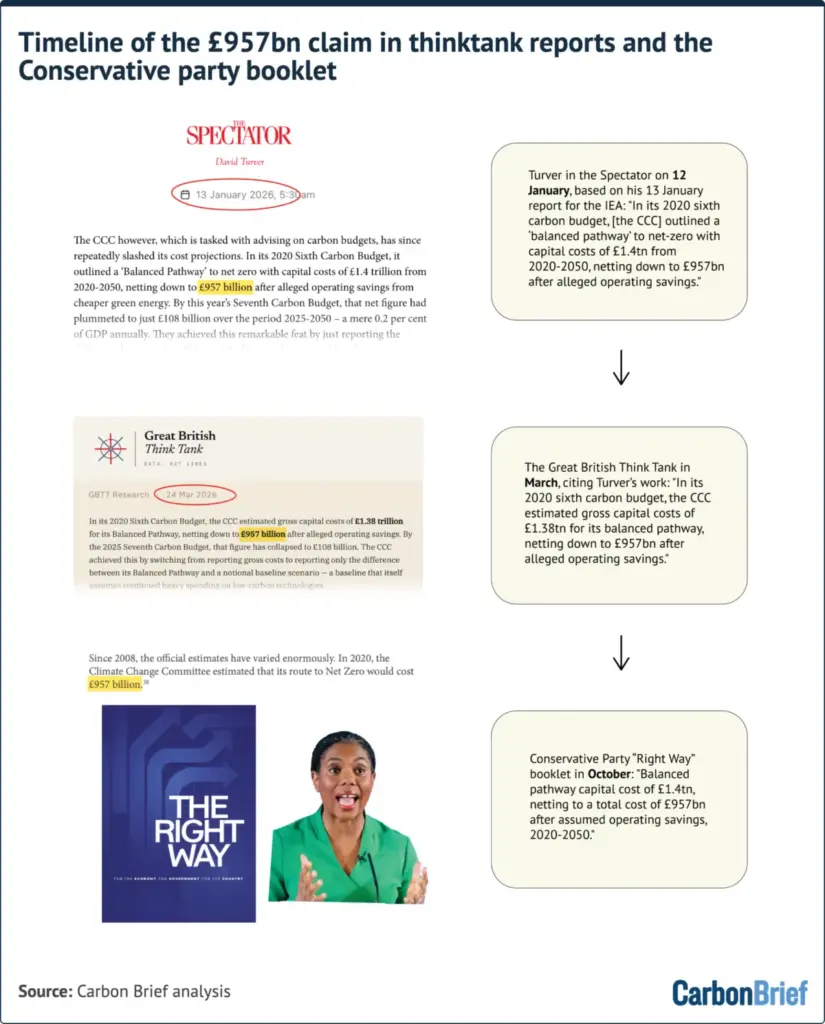
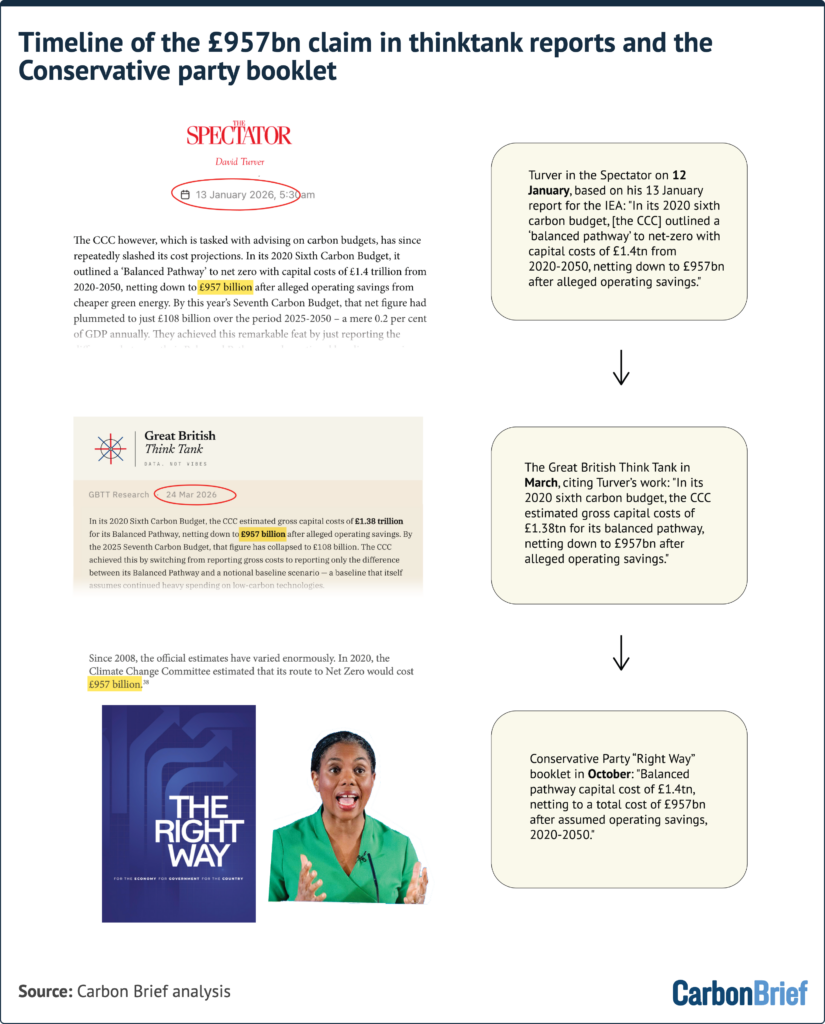
[Dec 2020] CCC releases 6th Carbon Budget Data (£478bn Net Cost)
   │
[Jan 12, 2026] The Spectator publishes article by David Turver (£957bn cited)
   │
[Jan 13, 2026] Institute of Economic Affairs (IEA) publishes Turver report
   │
[March 2026] Great British Think Tank repeats £957bn claim
   │
[October 2026] Conservative Party publishes "The Right Way" including £957bn figure
December 2020: The CCC Baseline
The Climate Change Committee published its recommendations for the UK’s Sixth Carbon Budget, outlining a comprehensive technical roadmap to achieve net-zero greenhouse gas emissions by 2050. Accompanying the core report was an open-access spreadsheet detailing sectoral capital investments and anticipated operating savings from 2020 through 2050.
The dataset established that while substantial upfront capital was required to decarbonize transport, heating, and power generation, these outlays would yield major operational savings over time. The net cumulative cost was modeled at £478 billion over 30 years—representing less than 1% of UK Gross Domestic Product (GDP).
January 12–13, 2026: The Initial Double-Counting
Five years after the original dataset was published, David Turver—a retired engineer and self-described "accidental energy analyst"—authored an article for The Spectator questioning the financial viability of net-zero. In the piece, Turver asserted that the CCC’s own data demonstrated a cost approaching £1 trillion (£957 billion).
The following day, Turver reiterated this statistic in a formal paper released by the free-market think tank, the Institute of Economic Affairs (IEA). Citing Figure 5.3 of the CCC’s 2020 report, Turver claimed to have extracted the raw totals directly from the committee’s published data tables. However, Turver’s calculation had included the yearly sectoral sub-totals alongside the grand total row, aggregating the entire cost matrix twice.
Spring 2026: Amplification and Echo Chambers
Following the IEA publication, the £957 billion figure gained traction across right-leaning media outlets and policy blogs. In March 2026, the "Great British Think Tank"—an organization operating under the banner tagline "data, not vibes"—re-published the figure in a brief on national infrastructure costs. The think tank assured readers that every metric in its publications was directly sourced from official public bodies, failing to conduct basic mathematical verification of the underlying source files.
In parallel, derivative reports derived from Turver’s paper began generating headline figures claiming the total burden of net-zero could reach £7.6 trillion or even £9 trillion. These extreme projections relied on auxiliary assumptions that treated existing fossil fuel imports, internal combustion vehicles, and traditional gas boilers as having zero lifetime cost.
October 2026: Institutional Adoption in "The Right Way"
The political integration of the error reached its zenith when the Conservative Party released "The Right Way", a policy booklet designed to challenge the incumbent government’s economic strategy. The manifesto explicitly stated:
"In 2020, the CCC estimated that its route to net-zero would cost £957bn."
The document cited this figure within a chapter advocating for political judgment over "sophisticated modeling," framing the £957 billion stat as evidence of an intolerable financial burden imposed by technocratic consensus.
Supporting Context & Metrics: Unpacking the Mathematics
The error in question highlights the vulnerabilities inherent in extracting raw data without accounting for structural design in complex economic models.
The Spreadsheet Mechanics
The CCC’s 2020 Sixth Carbon Budget dataset structures the financial transition around two core financial mechanisms:
Capital Expenditure (CAPEX): Upfront investments required for low-carbon infrastructure, such as building offshore wind farms, installing residential heat pumps, reinforcing local power grids, and manufacturing electric vehicles (EVs). Over the 2020–2050 timeframe, gross CAPEX was estimated at £1.38 trillion.
Operational Expenditure Savings (OPEX): The ongoing reduction in running costs derived from shifting away from imported fossil fuels, benefiting from the superior thermal efficiency of heat pumps, and leveraging lower maintenance requirements for electric drivetrain vehicles. Total OPEX savings were calculated at £0.90 trillion.
Subtracting cumulative OPEX savings (£0.90tn) from gross CAPEX (£1.38tn) yields the true cumulative net expenditure: £478 billion.
Metric Category
True CCC 2020 Figure
Double-Counted Figure
Percentage Error
Gross Capital Outlay (CAPEX)
£1.38 Trillion
Included
N/A
Operational Savings (OPEX)
(£0.90 Trillion)
Included
N/A
Net Transition Cost (2020–2050)
£478 Billion
£957 Billion
+100.2%
Percentage of Cumulative GDP
~0.9%
~1.8%
+100.0%
The double-counting occurred because the original Excel workbook contained individual lines for annual CAPEX and OPEX totals per sector, followed by a summary line detailing the net annual balance. By executing a global formula over the entire array (SUM(C2:C20) instead of isolating the annual net balance row), analysts added the net sub-totals to the already-summed gross values, precisely doubling the outcome.
Updated Metrics: The Collapse of Transition Costs
The Conservative Party’s reliance on a flawed 2020 figure is further compounded by its failure to incorporate the CCC’s updated modeling published in 2025.
Between 2020 and 2025, global supply chains, manufacturing scale, and technological efficiencies dramatically altered the cost-benefit analysis of low-carbon tech. The capital cost of battery technology dropped rapidly, accelerating parity between electric vehicles and internal combustion engine equivalents.
CCC Net Cost Projections for UK Net-Zero (2020 vs. 2025 Revisions)

2020 Estimate:  [£478bn Net Cost] ──────────────────────────► (~0.9% of GDP)
2025 Revision:  [£108bn Net Cost] ──► (<0.2% of GDP)
In its revised 2025 projections, the CCC updated its lifetime transition figures for the 2025–2050 window:
Revised CAPEX: Adjusted to £670 billion due to cheaper renewables and lower manufacturing overheads.
Revised OPEX Savings: Calculated at £562 billion.
Revised Net Total Cost: Collapsed to £108 billion over 25 years.
This updated figure places the real-terms net cost of achieving net-zero at less than 0.2% of UK GDP—representing a 77% drop from the 2020 baseline and less than one-eighth of the £957 billion metric cited in "The Right Way".
Official Statements and Political Implications
The publication of the flawed metric has prompted sharp reactions from climate policy analysts, economists, and opposition figures, while highlighting internal contradictions in the Conservative Party’s policy strategy.
The Irony of Policy Framing
The preamble of "The Right Way" stresses the importance of political discipline, asserting that:
"What people ultimately want is a government competent enough to solve the problems for which it takes responsibility."
It further warns against relying blindly on bureaucratic modeling over practical realism. Prominent energy policy analysts were quick to highlight the paradox of demanding administrative competence while failing to verify basic arithmetic in flagship party literature.
A spokesperson for Carbon Brief, the climate policy organization that first identified the paper trail of the error, noted:
"The propagation of this £957bn figure illustrates how easily an uncorrected spreadsheet mistake can move from an online blog post into formal party policy. When political parties bypass official advisory figures in favor of flawed third-party revisions, public debate over the economic realities of net-zero becomes severely compromised."
The Climate Change Committee’s Position
While the Climate Change Committee does not comment directly on political party literature, its official leadership has consistently defended the economic resilience of the net-zero framework. In recent parliamentary briefings, the CCC emphasized that failing to transition exposes the UK economy to acute macroeconomic risks:
Fossil Fuel Volatility: The CCC noted that achieving net-zero would cost less than managing the macroeconomic shocks of a single global gas crisis, such as the energy spike observed in 2022.
Co-Benefits Valuation: The committee’s latest macro-economic assessments indicate that the secondary benefits of net-zero—including improved air quality, reduced health service burdens, and enhanced energy security—are valued at approximately £110 billion per year.
Future Outlook: Implications for Climate Policy and Fact-Checking
The integration of the £957 billion miscalculation into mainstream UK political discourse reflects a broader challenge facing modern climate governance: the increasing weaponization of hyper-complex economic modeling.
[Flawed Think Tank Calculation]
             │
             ▼
 [Echo Chamber Amplification]
             │
             ▼
[Official Political Manifestos]
             │
             ▼
 [Skewed Public & Fiscal Debate]
The Echo-Chamber Pipeline
This incident highlights a well-documented pipeline wherein unvetted calculations produced by ideological think tanks are adopted by political strategists looking to support pre-existing policy positions.
Analytical Misinterpretation: Non-peer-reviewed analysts misinterpret raw, multi-variable datasets published by statutory bodies.
Amplification: Outlets prioritizing sensational metrics amplify the inflated figures without secondary verification.
Political Integration: Policy drafters incorporate the amplified figures into formal manifestos to justify deregulation or target rollbacks.
As the UK approaches crucial milestones established by the Climate Change Act—including the binding seventh carbon budget covering the late 2030s—the integrity of economic data will remain a key battleground.
Economic Realities vs. Ideological Rhetoric
As technology learning curves continue to drive down the operational costs of clean energy, the debate over net-zero is shifting from standard cost-containment to industrial competitiveness. Nations that base their long-term infrastructure planning on outdated or doubled cost estimates risk misallocating capital, delaying grid modernization, and missing out on global green supply chains.
For the UK Conservative Party, rectifying the metrics within "The Right Way" is not merely a matter of correcting a footnote; it is a test of political credibility. As the government proceeds with national infrastructure upgrades, the opposition’s ability to offer meaningful fiscal oversight will depend on whether its critiques are rooted in rigorous financial scrutiny or preventable spreadsheet errors.