
Executive Overview
For decades, the lexicon of the global tourism industry has been saturated with terms like "green," "eco-friendly," "sustainable," and "responsible." While many hospitality brands, tour operators, and destination marketing organizations (DMOs) operate with genuine environmental intentions, the widespread and often casual use of these descriptors has created a marketplace plagued by ambiguity. For travelers attempting to make conscious choices, distinguishing substantive environmental action from superficial greenwashing has become an increasingly arduous task.
This era of unchecked environmental marketing is drawing to a close. Slated to take effect on September 27, 2026, the European Union’s Empowering Consumers for the Green Transition (EmpCo) Directive introduces a rigorous regulatory framework designed to overhaul how businesses communicate their environmental impact. Far exceeding a simple compliance checklist, EmpCo represents a structural pivot toward empirical accountability, demanding that tourism entities empirically demonstrate their ecological footprints rather than simply assert them.
For the travel sector—an industry uniquely vulnerable to consumer skepticism—this legislative turning point requires immediate operational and communicative adjustments. Whether a business is based in downtown Paris, a remote eco-lodge in Costa Rica, or an adventure travel outfit in New Zealand, any organization marketing travel products to consumers within the European Union must align with these new standards. Fortunately, for operators already implementing genuine sustainability practices, navigating the EmpCo Directive is entirely manageable with strategic preparation.
Detailed Chronology: The Road to Regulatory Accountability
To understand the weight of the EmpCo Directive, it is necessary to examine the regulatory trajectory that brought the European Union to this milestone. The journey from voluntary environmental guidelines to legally binding consumer protection measures spans over a decade of shifting consumer habits, mounting academic research, and policy refinement.

- 2020 — The European Commission’s Baseline Study: A comprehensive evaluation by the European Commission sent shockwaves through the corporate world. The study revealed that a staggering 53% of green claims evaluated across various sectors were vague, misleading, or entirely unfounded. Furthermore, nearly half of all green labels lacked any form of verification. This empirical revelation proved that voluntary self-regulation within the sustainability marketing sphere was failing.
- March 2023 — The Legislative Proposal: Building on consumer protection frameworks, the European Commission formally proposed the EmpCo Directive to amend existing Unfair Commercial Practices Directives (2005/29/EC) and Consumer Rights Directives (2011/83/EU). The intent was clear: target deceptive commercial practices that prevent consumers from making truly sustainable purchasing decisions.
- March 2024 — Official Adoption and Entry into Force: Following intensive negotiations between the European Parliament and the Council, the EmpCo Directive was formally adopted and entered into force in the spring of 2024. This initiated a transposition window, giving EU member states time to adapt their national laws and granting businesses a transition period to audit and restructure their marketing assets.
- September 2026 — Enforcement Deadline: By September 27, 2026, member states must begin applying the transposing measures. From this date forward, non-compliant environmental marketing targeting EU consumers will face tangible regulatory penalties, marking the official end of unsubstantiated corporate green claims.
Supporting Context & Metrics: The Crisis of Consumer Trust
The legislative impetus behind the EmpCo Directive is rooted in a profound crisis of consumer confidence. As climate awareness has surged among global travelers, the commercial incentives for brands to position themselves as "green" have grown exponentially. However, this rush to market has severely damaged consumer trust.
According to a benchmark YouGov study, more than half of global consumers are fundamentally skeptical of brand sustainability claims, viewing them as marketing ploys rather than authentic commitments. This sentiment is reinforced by data from Booking.com’s comprehensive 2025 research, which highlights a rapidly growing traveler awareness regarding tourism’s direct footprint on local communities and ecosystems—both domestically and abroad. Modern travelers want to make responsible choices, but they are increasingly fatigued by hollow terminology.
| Metric | Source | Implication for Tourism |
|---|---|---|
| 53% of green claims are vague or unfounded | European Commission (2020) | Highlights the historical prevalence of greenwashing that EmpCo seeks to eradicate. |
| >50% of global consumers are skeptical of claims | YouGov (2023) | Proves that brand trust is eroding; transparency is now a prerequisite for consumer loyalty. |
| 50% of green labels offer weak/no verification | European Commission | Underpins EmpCo’s strict regulations against unverified self-created badges and seals. |
Crucially, industry stakeholders must distinguish the EmpCo Directive from the proposed, yet-to-be-adopted, Green Claims Directive. While EmpCo establishes overarching business-to-consumer (B2C) rules prohibiting misleading practices and unverified labels, the separate Green Claims Directive is expected to introduce even more granular, pre-approval substantiation requirements for environmental claims. For now, mastering EmpCo is the immediate, non-negotiable priority for travel brands.
Official Guidelines: What the EmpCo Directive Requires
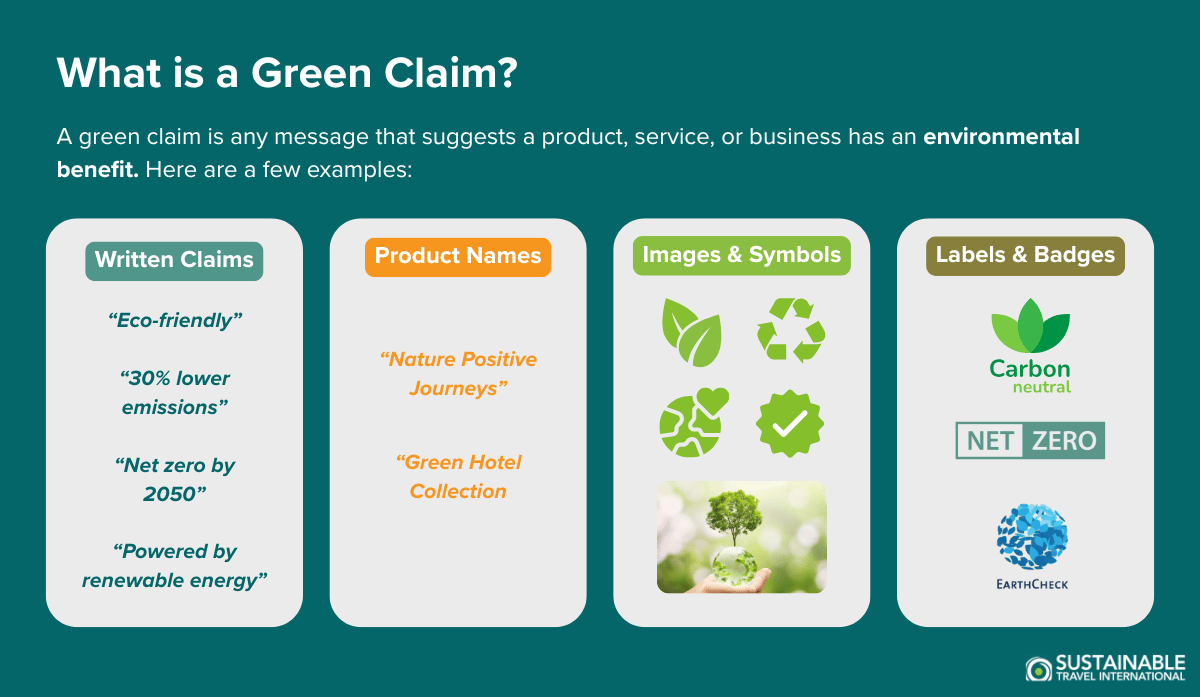
The EmpCo Directive casts a wide net, defining an "environmental claim" not merely as written sentences in a brochure, but as any text, brand name, picture, logo, or symbol that implies a positive or neutral environmental impact. Under these rules, a tour collection branded as "Nature Positive Journeys," a hotel claiming to be "climate-neutral," or a website badge featuring a green leaf icon alongside the words "travel consciously" all constitute formal environmental claims.

To remain compliant, tourism businesses must adhere to several core mandates:
1. Eradicate Vague and Generic Claims
Broad, undefined terms such as "eco-friendly," "green," "sustainable," or "conscious travel" are prohibited unless they are supported by a recognized, high-standard certification (such as the EU Ecolabel for Tourist Accommodation, the Nordic Swan Ecolabel, or the Austrian Ecolabel).
Instead, brands must substitute generic statements with granular, verifiable specifics. For instance, rather than advertising "climate-friendly tours," an operator should state: "We replaced 90% of domestic flights on our itineraries with high-speed rail travel, reducing transportation-related emissions by roughly one-third."
2. Accurately Represent the Scope of Operations
Green claims must precisely reflect the exact boundary of the action taken. If an adventure travel company implements solar panels solely at its headquarters office, it cannot market its entire catalog of international expeditions as being "powered by renewable energy." Similarly, if a hotel eliminates single-use plastic water bottles—a practice that is already legally mandated across many municipal destinations—it cannot present this as a unique corporate sustainability achievement, but rather as standard regulatory compliance.
3. Decouple Offsets from In-Value-Chain Reductions
One of the most consequential shifts mandated by the Directive involves the language surrounding carbon offsets and external climate funding. The law establishes a sharp boundary between reducing emissions within a business’s direct value chain and funding external environmental projects.
- The Old Way: Marketing a hotel stay or a safari package as "carbon-neutral" or "climate-compensated" by purchasing external carbon offsets.
- The EmpCo Standard: This language is no longer permissible. Because purchasing offsets does not physically eliminate or reduce the footprint of a specific trip or hotel stay, marketing cannot suggest that offsets neutralize a product’s direct environmental impact.
Instead, companies must frame carbon offsets accurately: as an investment in global climate action (such as rainforest conservation or renewable energy infrastructure) that operates beyond the emissions reductions achieved internally.
4. Substantiate All Future Commitments
Aspirational sustainability targets—such as pledges to achieve "net-zero emissions by 2050" or transition to "zero waste"—are common across the tourism sector. Under EmpCo, these forward-looking statements must be backed by concrete implementation plans. These plans require measurable, time-bound milestones, dedicated financial resources, and regular independent reviews open to public scrutiny.
5. Validate All Sustainability Badges and Labels
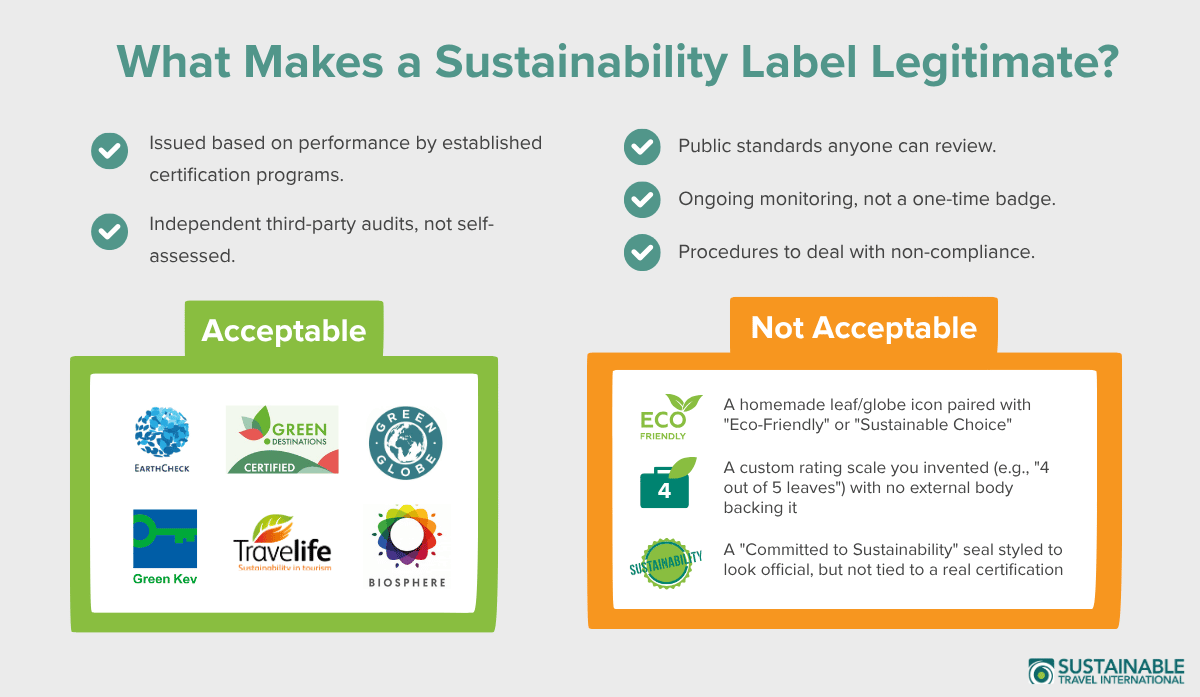
The display of homemade logos, self-awarded seals of approval, or unverified trust marks is strictly banned. Any badge featured on a booking platform or tour website must originate from a recognized public authority or a professional certification scheme featuring published standards and independent, ongoing third-party auditing. In the travel space, established schemes like Travelife, Green Key, Green Globe, EarthCheck, and Green Destinations meet these stringent standards.
Future Outlook: Embracing the Transparent Horizon
As the enforcement date of September 27, 2026, approaches, the tourism industry faces a defining choice. Operators can view the EmpCo Directive as an administrative burden, or they can recognize it as an invaluable catalyst for market maturation.
In a marketplace long distorted by greenwashing, genuine sustainability pioneers have often struggled to stand out against competitors making cheaper, unsubstantiated claims. By establishing a legally enforced playing field where every environmental claim must be backed by data, evidence, and verified certification, the EmpCo Directive clears away the noise.
For travel businesses, preparation should begin immediately. Conducting a thorough audit of all marketing collateral—from website footers and social media graphics to corporate naming conventions and brochure copy—is the critical first step. Organizations must replace broad generalities with precise metrics, align offset messaging with strict regulatory definitions, and ensure all displayed badges are tied to legitimate third-party certifiers.
Ultimately, navigating the EmpCo Directive successfully yields an asset more valuable than clever marketing copy: enduring consumer trust. In an era where travelers increasingly demand authenticity, transparency is no longer merely a regulatory obligation—it is the ultimate competitive advantage.