


Executive Overview
The global energy transition is accelerating at a breathtaking pace, putting unprecedented strain on electrical grids that were originally designed for a bygone era of unidirectional power flow. As utilities scramble to keep up with the soaring electricity demand driven by electric vehicles (EVs), fast-charging stations, energy-hungry AI data centers, utility-scale renewables, and increasingly volatile extreme weather events, a critical technological bottleneck has emerged.
Enter Texture, an innovative grid software startup tackling this structural crisis head-on. The company announced today that it has successfully raised a $12.5 million Series A funding round, co-led by VoLo Earth Ventures and Equal Ventures, with additional participation from prominent investors Lerer Hippeau and Abstract Ventures. This fresh injection of capital brings Texture’s total lifetime funding to approximately $23 million.
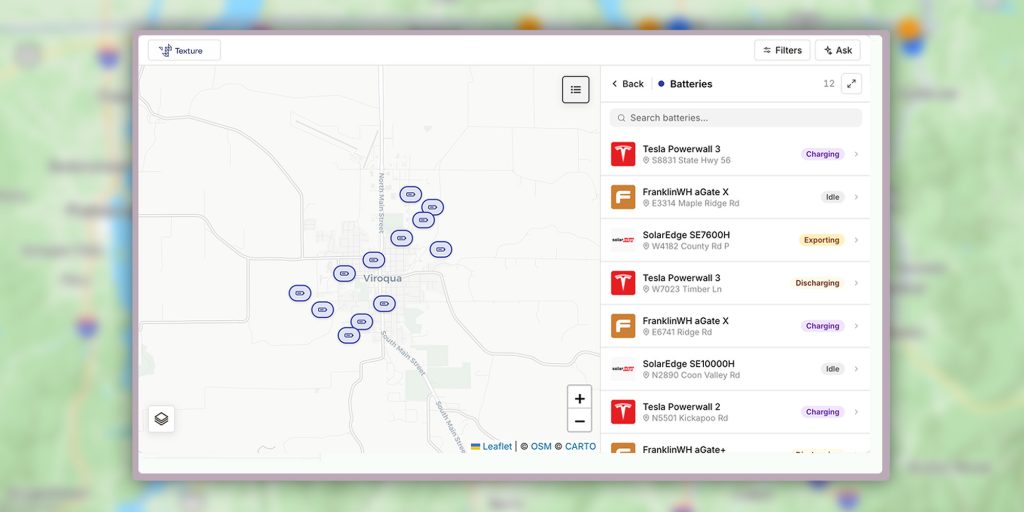
Texture’s core value proposition is deceptively simple yet profoundly impactful: rather than forcing utility operators to juggle a fragmented ecosystem of legacy software tools, Texture unifies real-time grid data into a single, cohesive layer. By seamlessly integrating meters, smart devices, and distributed energy resources (DERs) without requiring expensive infrastructure overhauls or bloated engineering teams, the startup is positioning itself as an indispensable operating system for the modern grid. With early traction among resource-constrained rural utility cooperatives and a newly minted partnership with the National Rural Telecommunications Cooperative (NRTC), Texture is rapidly scaling its footprint to prevent local grid collapses before they happen.

Detailed Chronology: From Concept to Scale
To understand Texture’s rapid ascent, it is necessary to examine how the startup has navigated the complex terrain of utility modernization over recent years. While grid software has traditionally been characterized by multi-year deployment cycles and notoriously rigid legacy architectures, Texture has carved out a distinct niche through rapid deployment capabilities and modular integration.
- Laying the Foundation: Texture was founded to solve a glaring operational disconnect: while consumers and businesses rapidly adopted distributed energy assets like rooftop solar panels, home batteries, and smart thermostats, grid operators remained largely blind to how these assets interacted with local infrastructure in real time.
- Early Validation and Co-op Adoption: Recognizing that major investor-owned utilities (IOUs) moved slowly, Texture smartly targeted utility cooperatives early in its lifecycle. Serving roughly 42 million Americans primarily across rural and suburban landscapes, these co-ops faced the exact same modernization pressures as their larger urban counterparts but possessed a fraction of the budget and staff. By promising software deployment times measured in days rather than years, Texture gained vital early adopters.
- OEM Integrations and Municipal Pilots: Over the past year, Texture systematically built out direct application programming interface (API) integrations with more than 50 original equipment manufacturers (OEMs) and energy companies. This roster includes heavyweights such as Tesla, FranklinWH, Honeywell, Ecobee, SolarEdge, Leap Energy, and WattTime. These integrations enabled innovative municipal rollouts, such as Ann Arbor’s Sustainable Energy Utility deployment of community battery programs across residential homes.
- Strategic Expansion and NRTC Partnership: Texture’s momentum crystallized with its formal partnership with the National Rural Telecommunications Cooperative (NRTC), extending its Distributed Energy Resource Management System (DERMS) software capabilities to an expansive network of 850 utility co-ops nationwide.
- The $12.5M Series A Milestone: Culminating this period of growth, the company secured its $12.5 million Series A financing round. Co-led by VoLo Earth Ventures and Equal Ventures, the capital will directly fuel aggressive hiring initiatives and comprehensive platform scaling to support a rapidly expanding user base.
Supporting Context & Metrics: The Anatomy of Grid Strain
The urgency behind Texture’s software platform cannot be overstated. Electrical grids worldwide are buckling under a multi-pronged convergence of load growth and decentralized generation.
The Shift from One-Way to Multi-Directional Flow
Historically, power grids operated on a predictable, top-down model: large central generation plants (coal, natural gas, nuclear, hydro) pushed electricity down high-voltage transmission lines, through substations, and out via distribution feeders to end-users. Today, that paradigm has been completely inverted. Millions of homes and businesses are now prosumers—feeding surplus rooftop solar energy back into the grid, cycling home battery storage systems, charging high-capacity EVs, and dynamically shifting loads via smart thermostats.
Concurrently, the explosive proliferation of artificial intelligence and cloud computing has driven an unprecedented wave of data center construction, creating localized power demands that rival entire metropolitan areas. When combined with the erratic disruptions of extreme weather events—such as winter freezes and summer heatwaves—grid operators are left flying blind without real-time visibility.
Localized EV Stress Points and the Transformer Crisis
Electric vehicles represent one of the most acute stress points for local distribution grids. Unlike broad seasonal shifts in electricity consumption, EV charging creates sharp, localized spikes in demand, often concentrated in specific residential neighborhoods during evening hours when owners plug in after work.
Texture’s software detects these sudden surges at the individual meter level, mapping how localized load growth impacts downstream transformers and feeders. This early warning capability is critical given the severe hardware supply chain constraints plaguing the utility sector. According to market intelligence firm Wood Mackenzie, global transformer prices have skyrocketed by as much as 95% since 2019, while lead times for acquiring large units can stretch beyond two years. Catching an overloaded transformer through software analytics before it catastrophically fails can save utilities hundreds of thousands of dollars in emergency replacement costs.

Official Statements and Industry Insights
The structural inadequacies of legacy grid management tools have long frustrated industry leaders. Sanjiv Sanghavi, co-founder and chief executive officer of Texture, identified this market gap firsthand through extensive conversations with utility executives.
“Co-ops kept telling me the same thing,” said Sanghavi. “They wanted to run modern grid programs but didn’t have software built for their scale or budget.”
This sentiment underscores Texture’s core design philosophy: to build an interoperable platform that bypasses the friction of traditional enterprise software installations. Rather than demanding that utilities rip out and replace their existing Supervisory Control and Data Acquisition (SCADA) systems or Advanced Metering Infrastructure (AMI), Texture acts as an intelligent overlay. Data streams from smart meters, EV chargers, photovoltaic arrays, and batteries converge into a unified dashboard, giving operators an instant, granular view of network health.

Industry investors have similarly keyed in on the necessity of this middleware approach. Investment leads at VoLo Earth Ventures and Equal Ventures recognized that as virtual power plants (VPPs) and demand response programs multiply, they are frequently hamstrung by a lack of real-time meter access. Without ground-truth data from actual grid conditions, dispatch decisions made by traditional VPP platforms can be sluggish or inaccurate. Texture bridges this critical operational gap.
Future Outlook: The Road Ahead for Grid Intelligence
As Texture absorbs its $12.5 million Series A funding, the startup’s trajectory points toward aggressive market penetration and deeper technological integration. By scaling its team and expanding its software capabilities, the company is positioning itself to capture a significant share of the burgeoning grid modernization market.
The partnership with the NRTC serves as a powerful beachhead, opening doors to hundreds of rural cooperatives that are eager to harness the flexibility of distributed energy resources without breaking their operating budgets. Furthermore, as vehicle-to-grid (V2G) technology matures and the adoption of residential and commercial energy storage accelerates, the need for intelligent, real-time orchestration software will only intensify.

Ultimately, Texture’s success highlights a broader truth about the energy transition: achieving a resilient, decarbonized future requires more than just building new clean energy generation assets—it requires modernizing the digital nervous system that connects them all. If Texture can continue to prove that advanced grid intelligence can be deployed rapidly, affordably, and without legacy friction, it may well become the defining software infrastructure powering the electrical grids of tomorrow.



