

Executive Overview
For decades, the global clean energy transition has treated hydrogen as a manufactured commodity. Historically, the gas has been produced almost exclusively through carbon-intensive industrial processes powered by fossil fuels—predominantly natural gas steam methane reforming. While climate strategists have long envisioned a decarbonized future for hydrogen, previous avenues for clean production have remained stubbornly expensive and logistically complex.
For years, the debate over clean hydrogen focused on a binary choice: green hydrogen generated via water electrolysis powered by renewable electricity, or blue hydrogen relying on traditional fossil-fuel pathways retrofitted with carbon capture and storage (CCS). Yet, both options have struggled to achieve widespread commercial parity due to prohibitively high capital expenditures, conversion inefficiencies, and infrastructural bottlenecks.
Now, a profound paradigm shift is underway. Across the globe, an emerging 21st-century "gold rush" is targeting an entirely different source: geologic hydrogen, also known as white, natural, or gold hydrogen. Rather than manufacturing the gas from scratch, energy explorers are hunting for naturally occurring reservoirs trapped deep within the Earth’s crust.
Recent discoveries spanning Africa, Asia, Europe, Australia, and North America have revealed that our planet continuously generates vast quantities of hydrogen through subterranean geochemical reactions. Major venture capital firms, specialized exploratory startups, and established resource companies are pouring hundreds of millions of dollars into mapping, extracting, and even stimulating these subterranean deposits.
If engineering hurdles regarding storage, transport, and capture can be successfully cleared, naturally occurring hydrogen could fundamentally transform the global energy matrix, offering a genuinely clean, abundant, and economically disruptive primary energy source.
Detailed Chronology: From Fossil-Fuel Hegemony to the Geologic Frontier
To understand the magnitude of the current geologic hydrogen boom, it is essential to trace how the industrial use and production of the gas have evolved over the last century.
The 20th-Century Paradigm: Fossil-Driven Chemistry
Throughout the 20th and early 21st centuries, industrial hydrogen was never viewed as a primary energy carrier for power generation or transportation. Instead, it operated as a critical chemical feedstock. The vast majority of global hydrogen production—measured in tens of millions of metric years annually—has been consumed by two primary sectors: petroleum refining (to hydrotreat and break down heavy crude fractions) and the manufacture of synthetic fertilizers (primarily via the Haber-Bosch process to create ammonia).
Because this production relied overwhelmingly on unabated fossil fuels, it came with a massive carbon footprint, accounting for a significant share of global greenhouse gas emissions.
The False Binary of the 2010s: Green vs. Blue Hydrogen
As international climate commitments tightened through the 2010s, policymakers and investors recognized that cleaning up industrial processes required decarbonizing hydrogen. Two primary pathways emerged:
- Green Hydrogen: Splitting water molecules ($H_2O$) into hydrogen and oxygen using electrolyzers driven by wind, solar, or hydroelectric power. While environmentally pristine, it faced high costs associated with electrolyzer manufacturing, renewable power intermittency, and overall system inefficiencies.
- Blue Hydrogen: Producing hydrogen from natural gas while capturing the resulting carbon dioxide emissions before they enter the atmosphere. This method suffered from high capital costs, leakage risks in carbon transport, and public skepticism regarding the true net-emissions reduction of the process.
The Turning Point: The Discovery of Natural Accumulations
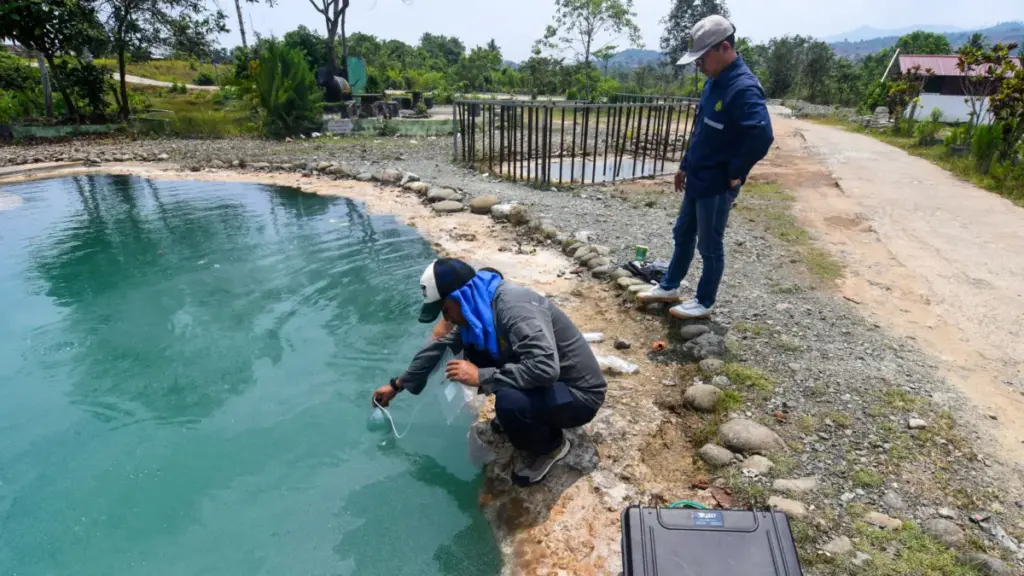
The narrative began to pivot in the early 2020s, accelerating markedly into the mid-2020s. Researchers and independent wildcatters began investigating anomalous historical gas wells and natural seeps where hydrogen was venting freely from the ground—notably in rural Mali, where a local village had been using natural hydrogen to power a generator for over a decade.
Geologists realized that natural hydrogen generation was not a rare geologic anomaly, but a globally pervasive phenomenon driven by serpentinization and radiolytic water-splitting in the Earth’s crust. This realization sparked a wave of international prospecting, transitioning hydrogen from a manufactured industrial input to an extractive natural resource akin to natural gas or petroleum.
Supporting Context & Metrics: Geology, Geography, and Enterprise
The mechanics of geologic hydrogen formation depend heavily on specific tectonic and mineralogical profiles.
The Science of Generation: Serpentinization and Beyond
The primary engine of natural hydrogen production is a geochemical process known as serpentinization. When iron-rich, mafic, or ultramafic rocks (such as olivine-bearing peridotites) come into contact with water deep underground at elevated temperatures and pressures, a chemical oxidation-reduction reaction takes place. The iron in the rock steals oxygen from the water molecules, liberating free hydrogen gas ($H_2$).
$$3Fe_2SiO_4 + 2H_2O rightarrow 2Fe_3O_4 + 3SiO_2 + 2H_2$$
This continuous reaction can proceed over geological timescales, provided there is a steady influx of water and fresh reactive mineral surfaces.
Global Hot Spots and the US Midwest
Geologic hydrogen is truly a global phenomenon. Exploratory companies have identified promising signatures and active seeps across multiple continents:
- Africa & Asia: Emerging exploratory licenses in East Africa and Central Asia.
- Europe: Active sampling programs in France, Spain, and Eastern Europe, where historical mining and industrial boreholes have recorded unexpected hydrogen outgassing.
- Australia: Domestic firms actively securing tenements across sedimentary basins.
- North America: Extensive mapping by federal scientific agencies.
In the United States, the U.S. Geological Survey (USGS) has spearheaded efforts to map national hydrogen prospectivity. Among the most prominent domestic hot spots is the Midcontinent Rift System, an ancient geologic scar winding from Kansas through Iowa and Minnesota up into Lake Superior and Michigan.
Approximately one billion years ago, the North American continent began to split apart. Although the rift ultimately failed, it left behind massive volumes of iron-rich volcanic rock deep underground—the ideal substrate for continuous hydrogen generation when interacting with deep subsurface moisture.
Corporate Investments and Field Metrics
The economic appetite for geologic hydrogen is reflected in massive capital allocations:
- Koloma: Backed by prominent venture capital and energy transition funds, Koloma has secured over $400 million in total funding, making it one of the most heavily capitalized players in the space. The company has aggressively leased mineral rights and initiated exploratory drilling across the US Midcontinent.
- HyTerra: An Australian-listed exploration company targeting natural hydrogen resources in Kansas and Nebraska. Recent sampling programs conducted by HyTerra have yielded astonishing results, capturing gas samples with hydrogen concentrations as high as 96%.
- Quantifying Flux: To understand the viability of extraction, researchers recently examined dozens of abandoned boreholes at a historic mining site in northern Ontario, Canada. Scientific measurements revealed that each individual borehole continuously vented roughly 8 kilograms of hydrogen per year. Multiplied across the site’s network of more than 14,000 boreholes, the aggregate volume points to a massive, untapped natural flux capable of commercial capture.
Official Statements & Industry Innovation: Stimulated Geologic Hydrogen
While wildcatting for naturally accumulated deposits is advancing rapidly, many innovators are refusing to wait for nature to organize the resource. Enter stimulated geologic hydrogen—an approach that borrows techniques from the oil, gas, and geothermal sectors to accelerate subterranean reactions artificially.
Engineering Subsurface Reactions
Rather than hunting for trapped pockets of gas, companies are identifying geological formations rich in iron and water where natural hydrogen production is bottlenecked. By injecting tailored fluids, catalysts, or thermal energy, these firms aim to artificially kick-start or supercharge the serpentinization process.
- Vema Hydrogen: Based in Texas, Vema is pioneering techniques to produce hydrogen directly from subsurface rocks. By drilling targeted wells and injecting water and specific mineral catalysts, the company is actively testing its proprietary stimulation process in wells located in Quebec, Canada, with aspirations to launch full-scale commercial production by 2028.
- Eden GeoPower: Tackling the physical barriers of rock permeability, Eden is utilizing high-voltage electrical energy to fracture hard subterranean rock formations. This creates intricate networks of micro-fractures, vastly increasing the surface area available for water infiltration and rock-water reactions. Notably, this technology has dual-use value, proving equally applicable to enhanced geothermal systems (EGS).
Future Outlook: Engineering, Logistics, and the Road Ahead
Despite the explosive enthusiasm surrounding geologic hydrogen, significant technical and operational hurdles remain before the resource can displace conventional fossil fuels or expensive green hydrogen alternatives.
The Physics of Hydrogen Handling
Hydrogen is the lightest element in the universe. Its tiny molecular weight and minute molecular size make it notoriously difficult to contain. Hydrogen molecules can readily slip through microscopic fissures in rocks that would easily trap larger methane molecules. Consequently, finding an underground reservoir is only half the battle; ensuring that natural seals have successfully trapped the gas over millennia—and that human engineering can capture it without massive fugitive leaks—is a daunting task.
Furthermore, moving and storing hydrogen presents severe logistical challenges. Because of its extremely low volumetric energy density at ambient conditions, hydrogen must either be compressed under immense pressures or cryogenically cooled to liquid form ($–253^circtextC$) to be transported efficiently via pipelines, ships, or tanker trucks.
A New Horizon for Clean Energy
If these engineering hurdles and infrastructural bottlenecks can be surmounted, the emergence of natural and stimulated geologic hydrogen could fundamentally redefine the global energy transition.
By bypassing the high electrical costs of water electrolysis and eliminating the carbon emissions of fossil-reformed hydrogen, subterranean hydrogen extraction promises an abundant, low-cost primary energy source. As exploratory wells push deeper into the Earth’s crust from Kansas to Quebec, the 21st-century gold rush is well underway—bringing humanity one step closer to unlocking the clean energy hidden beneath our feet.



