

Executive Overview
As the global energy transition accelerates, the demand for renewable power generation is running at an all-time high. Yet, the physical expansion of solar infrastructure faces a severe bottleneck: land scarcity. Driven by local community opposition, rigorous regulatory hurdles at federal, state, and municipal levels, and competing commercial real estate pressures, developers are finding prime, unobstructed parcels of land increasingly difficult to secure. This spatial squeeze is particularly acute in densely populated urban and suburban environments where traditional utility-scale solar farms—which often require expansive, flat, contiguous tracts of land—are structurally and economically unviable.
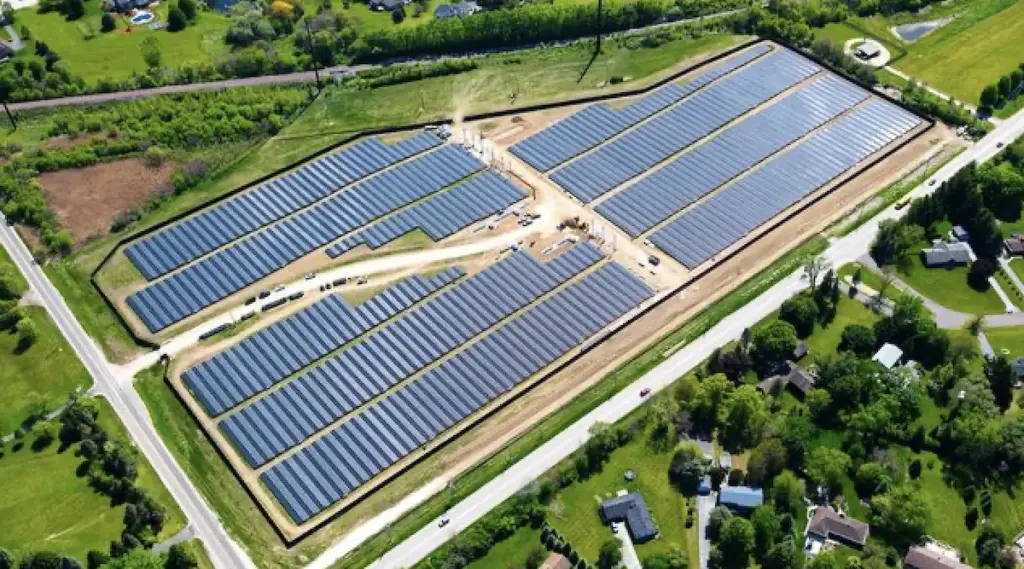
To overcome these barriers, the solar industry is turning to creative, technology-driven engineering. A prime example of this paradigm shift is unfolding in Elgin, Illinois, where renewable energy developer Cultivate Power has successfully brought online an 11-megawatt (DC) solar array. Known as the Bowes Solar project, this installation is a masterclass in spatial optimization. Situated on a complex, irregular 22-acre parcel historically deemed unfit for development, the project relies on a cutting-edge, high-density racking system developed by Planted Solar.
By merging advanced racking software, terrain-following mechanical designs, and a strategic community solar framework, the Bowes project illustrates how developers can bypass traditional land-use constraints. Beyond mere engineering ingenuity, the project serves as a blueprint for equitable energy distribution. It provides tangible economic relief to hundreds of low- and moderate-income (LMI) households, infuses millions of dollars into local municipal tax bases, and contributes significantly to regional educational and environmental non-profits. This report provides an in-depth investigation into the Bowes Solar project, exploring the technologies, logistics, community partnerships, and broader market implications that are redefining the boundaries of modern solar development.
Detailed Chronology: The Making of the Bowes Solar Project
The realization of the Bowes Solar installation was not a matter of conventional deployment, but rather a multi-year exercise in overcoming complex logistical and environmental hurdles. Developing a major renewable energy asset within an intensely fragmented urban footprint requires meticulous planning, iterative engineering, and deep stakeholder engagement.
Phase 1: Site Identification and Constraint Mapping
For years, the 22-acre parcel in Elgin, Illinois—one of the largest cities in the state outside of Chicago—sat idle, bypassed by traditional commercial and residential developers. The site’s liabilities were numerous. Tucked tightly between two established residential subdivisions, the property was bisected and bordered by high-voltage overhead transmission lines and active train tracks. Furthermore, a sensitive wetlands ecosystem occupied a critical corner of the parcel, creating an absolute barrier to conventional heavy-earthwork construction and standard row-by-row solar layouts.
Recognizing the latent potential of the land, Cultivate Power identified the site as a prime candidate for a high-impact community solar installation, provided that spatial and environmental constraints could be surmounted. Traditional solar installations typically demand between five and seven acres of land per megawatt-peak (MWp). Under those conventional metrics, an 11-megawatt plant would have required a sprawling 55- to 77-acre footprint—an absolute impossibility for a restricted 22-acre urban lot.
Phase 2: Architectural and Engineering Redesign
To solve this spatial dilemma, the Cultivate Power development team collaborated closely with Planted Solar to deploy an advanced, software-enabled, high-density racking system. Instead of treating the 22-acre property as a single, homogenous building block, the development team divided the installation into two distinct sub-arrays.
This compartmentalization strategy yielded multiple operational advantages:
- Setback Compliance: Dividing the array allowed engineers to expertly navigate the complex property boundaries mandated by neighboring residential zones, high-voltage easements, and railway corridors.
- Environmental Preservation: The split-array configuration provided the geometric flexibility necessary to completely avoid encroaching upon the corner wetlands, satisfying local ecological protection statutes without sacrificing total generation capacity.
- Low-Profile Aesthetics: To preempt potential community pushback regarding visual aesthetics, the Planted Solar racking system was engineered to sit remarkably low to the ground. Combined with the installation of an opaque perimeter fence and specialized vegetative screening, the panels remain entirely invisible from outside the property lines, preserving the visual integrity of the surrounding residential neighborhoods.
Phase 3: Grid Interconnection and Commercial Operation
With the physical layout finalized and engineered to respect all environmental and structural barriers, Cultivate Power integrated the facility with local utility Commonwealth Edison (ComEd). The 11-megawatt (DC) system was officially brought online to feed clean, locally generated electricity directly into the regional grid. By structuring the project as a community solar array, the developers ensured that the power generated did not simply disappear into a distant corporate grid, but was instead directly funneled back into the immediate Elgin economy, unlocking unprecedented financial savings for local residents, small businesses, municipal infrastructure, and regional institutions.
Supporting Context & Metrics: Breaking the Rules of Solar Land-Use
The success of the Bowes Solar project highlights a broader, industry-wide technological revolution. For decades, solar engineering has been bound by rigid rules of thumb regarding acreage, grading, and slope tolerances. Companies like Planted Solar are rewriting these operational playbooks, opening up vast inventories of previously sidelined land for renewable energy production.
The Land-Use Equation: Squeezing More Power from Less Space
In conventional utility-scale solar projects, fixed-tilt or single-axis tracker systems are spaced generously to prevent self-shading and to allow heavy maintenance machinery to pass between rows. This standard approach consumes roughly 5 to 7 acres per MWp.
Planted Solar’s high-density architecture drastically compresses this footprint, requiring only about 2 acres per MWp. To put this metric into perspective:
- A conventional 5-megawatt community solar project typically demands 40 to 50 acres of land.
- Utilizing high-density racking, that same 5-megawatt facility can be successfully accommodated on a mere 15 acres.
- By scaling this efficiency up, the Bowes project successfully packed 11 megawatts into a restrictive 22-acre parcel—a feat that would have been mathematically and physically impossible using legacy racking methodologies.
Overcoming Topographical Barriers
Beyond acreage constraints, slope and grading requirements have historically disqualified countless parcels from solar development. Conventional wisdom dictates that any site featuring a slope greater than 10% requires extensive, cost-prohibitive land grading. Massive earthmoving operations not only inflate capital expenditures but also trigger prolonged environmental permitting delays and frequently result in the outright cancellation of community-scale projects due to community pushback over soil erosion and habitat destruction.

The Planted Solar racking system bypasses this hurdle through an innovative terrain-following design capable of accommodating existing surface grades of up to 27%. This capability transforms difficult terrain—such as rolling pastures, irregular brownfields, and undulating rural plots—into viable energy assets without the need for destructive grading. Landowners can preserve native vegetation and pastureland, while counties benefit from low-disturbance construction standards that protect local topsoil and watersheds.
Quantifying the Community Impact
While the technological innovations underpinning the Bowes Solar project are impressive, the socio-economic metrics associated with the installation are equally transformative. According to data compiled by local reporting and project developers, the financial impacts are distributed across multiple tiers of the Elgin community:
- Direct Household Savings: The project delivers clean energy credits through ComEd to approximately 580 low- and moderate-income (LMI) households. Subscribers are projected to save an estimated 20% on their monthly electricity charges.
- Long-Term Cumulative Savings: Cultivate Power officials estimate that over the projected 40-year operational lifespan of the Bowes array, local subscribers will collectively save a staggering $13.9 million on their utility bills.
- Institutional and Commercial Participation: In addition to residential consumers, the array supplies discounted power to critical local anchors, including three small business entities, two municipal entities, and a local house of worship.
- Municipal Tax Contributions: Over the next four decades, the project is slated to generate $2.1 million in property tax revenues, providing a reliable, long-term funding stream for the local school district and municipal agencies.
- Philanthropic and Educational Investments: Cultivate Power has supplemented its physical infrastructure investments with direct financial contributions to regional educational and social service organizations, including Elgin Community College, Food for Greater Elgin (a core member agency of the Northern Illinois Food Bank), Friends of the Fox River, We Care Solar, and the Evolve Foundation.
Official Statements and Industry Perspectives
The convergence of high-density engineering, impact investing, and community-centric solar development has drawn praise from key executives and financial stakeholders across the clean energy sector.
Addressing the industry-wide shift toward restricted parcels, Cultivate Power noted in an official statement to energy media:
"Developing solar on constrained parcels is a growing focus for the industry. It’s becoming more important as competitive land use drives solar onto smaller and smaller parcels."
The financial backing for Cultivate Power’s portfolio is spearheaded by major institutional equity investors, including Generate Capital. Highlighting the dual utility of community solar across both densely populated urban centers and rural agricultural landscapes, Generate Capital emphasized how the model bridges gaps that traditional utility structures ignore:
"In a rural farming community like Mercer County, solar savings are out of reach for renters and low- and moderate-income families who are unable to install their own panels. Landowners, meanwhile, face pressure to keep every acre productive. Community solar answers both, extending savings to local subscribers, while giving a working farm stable new income alongside its crops."
This sentiment is underscored by Cultivate Power’s sister project, the Goldenrod Solar installation commissioned in Mercer County, Illinois. Weighing in at 5 megawatts, the Goldenrod facility demonstrates that the community solar model is equally potent in agrarian settings. The project provides energy savings to 850 local subscribers—with LMI households comprising 55% of the subscriber base—while supporting agricultural land-use preservation and channeling financial grants to organizations such as the Black Hawk College Foundation, Sherrard High School, and local Future Farmers of America (FFA) chapters.
Future Outlook: The Next Frontier in Clean Energy Deployment
The successful commissioning of the Bowes Solar array in Elgin signals a watershed moment for the future of urban and constrained-site renewable energy development. As greenfield spaces become scarcer and local zoning boards push back against the sprawling footprint of traditional utility-scale solar farms, the onus is on developers to innovate vertically and spatially.
The Proliferation of High-Density Micro-Siting
The intersection of advanced solar racking software, terrain-following structural engineering, and micro-siting capabilities means that thousands of abandoned brownfields, industrial infill lots, transportation-adjacent easements, and irregular urban parcels can now be converted into high-yielding power plants. Rather than viewing geographical oddities—such as wetlands buffers, railway lines, and utility corridors—as absolute dealbreakers, forward-thinking developers are utilizing these constraints to design compartmentalized, highly optimized arrays.
Strengthening Grid Resilience and Energy Equity
Furthermore, the integration of community solar into urban centers directly addresses long-standing disparities in the energy transition. Historically, rooftop solar and clean energy savings have been the exclusive domain of affluent homeowners capable of financing expensive rooftop installations. By anchoring projects like Bowes within urban utility territories and deliberately allocating a majority of capacity to low- and moderate-income families, developers are proving that decarbonization and economic justice can—and must—go hand in hand.
Conclusion
As institutional investors like Generate Capital continue to inject substantial capital into targeted, community-focused developers like Cultivate Power, and as technology providers like Planted Solar push the boundaries of physical density, the landscape of American energy is undergoing a quiet revolution. The Bowes Solar project in Elgin, Illinois, stands as definitive proof that with enough engineering creativity, even the most constrained, overlooked parcel of land can become a powerhouse of local economic resilience, environmental stewardship, and clean energy progress.



