In late August 2026, a catastrophic Himalayan rock-ice avalanche unleashed violent flash floods across Nepal, taking more than 1,400 lives, leaving thousands missing, and obliterating critical infrastructure. Facing a national emergency, the Nepali government turned to the United Nations’ newly operationalized Fund for Responding to Loss and Damage (FRLD), submitting an urgent application for $20 million in rapid-response assistance.
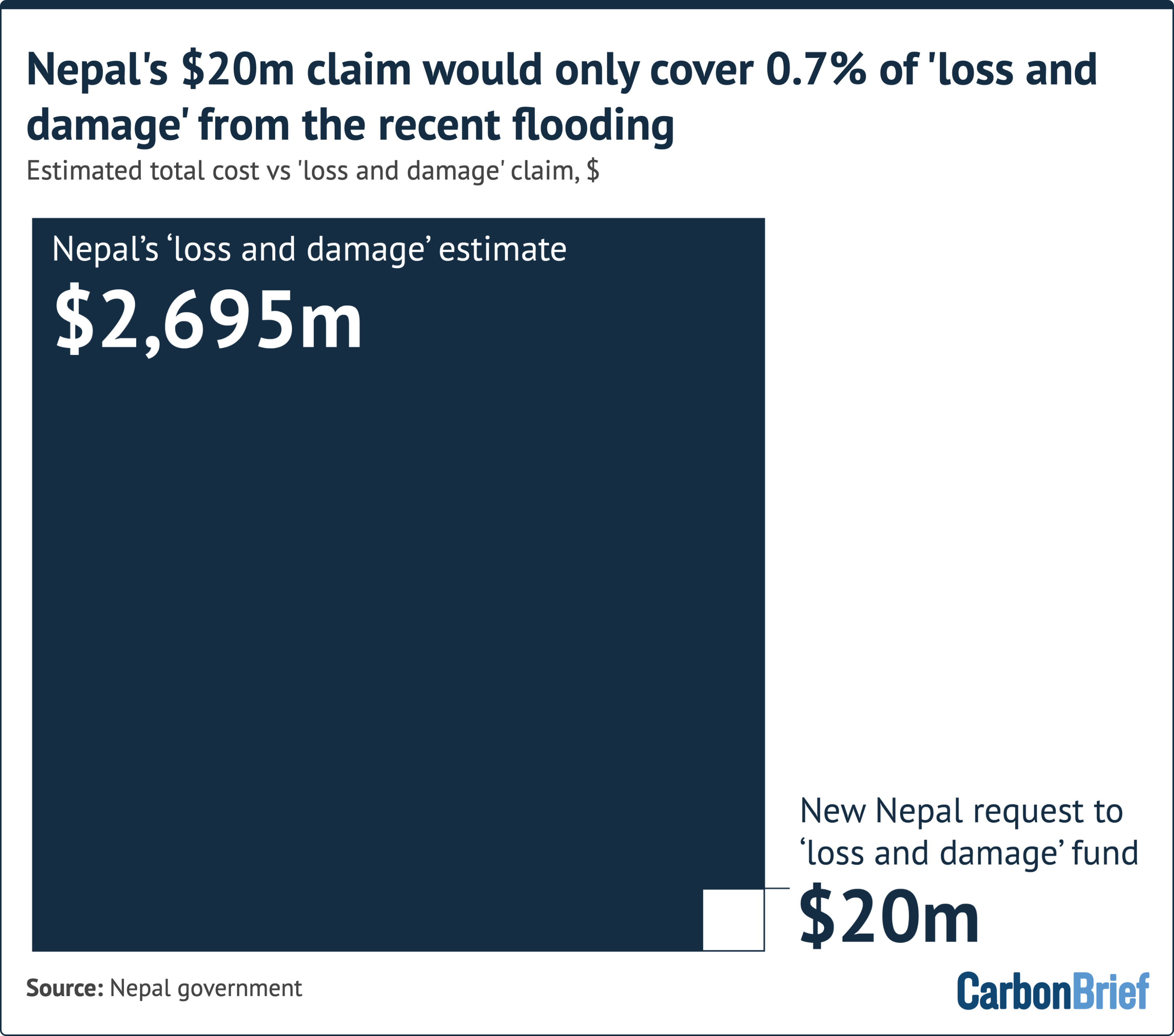
However, a comprehensive analysis of the disaster’s financial footprint reveals a glaring disconnect between climate-driven devastation and the international mechanisms designed to address it. According to assessments from Nepal’s National Disaster Risk Reduction and Management Authority, the $20 million request represents a mere 0.7% of the $2.7 billion in direct physical damage and economic losses caused by the flooding. When factoring in the $4.8 billion required for long-term recovery and climate-resilient reconstruction, Nepal’s request covers just 0.3% of its total financial need.
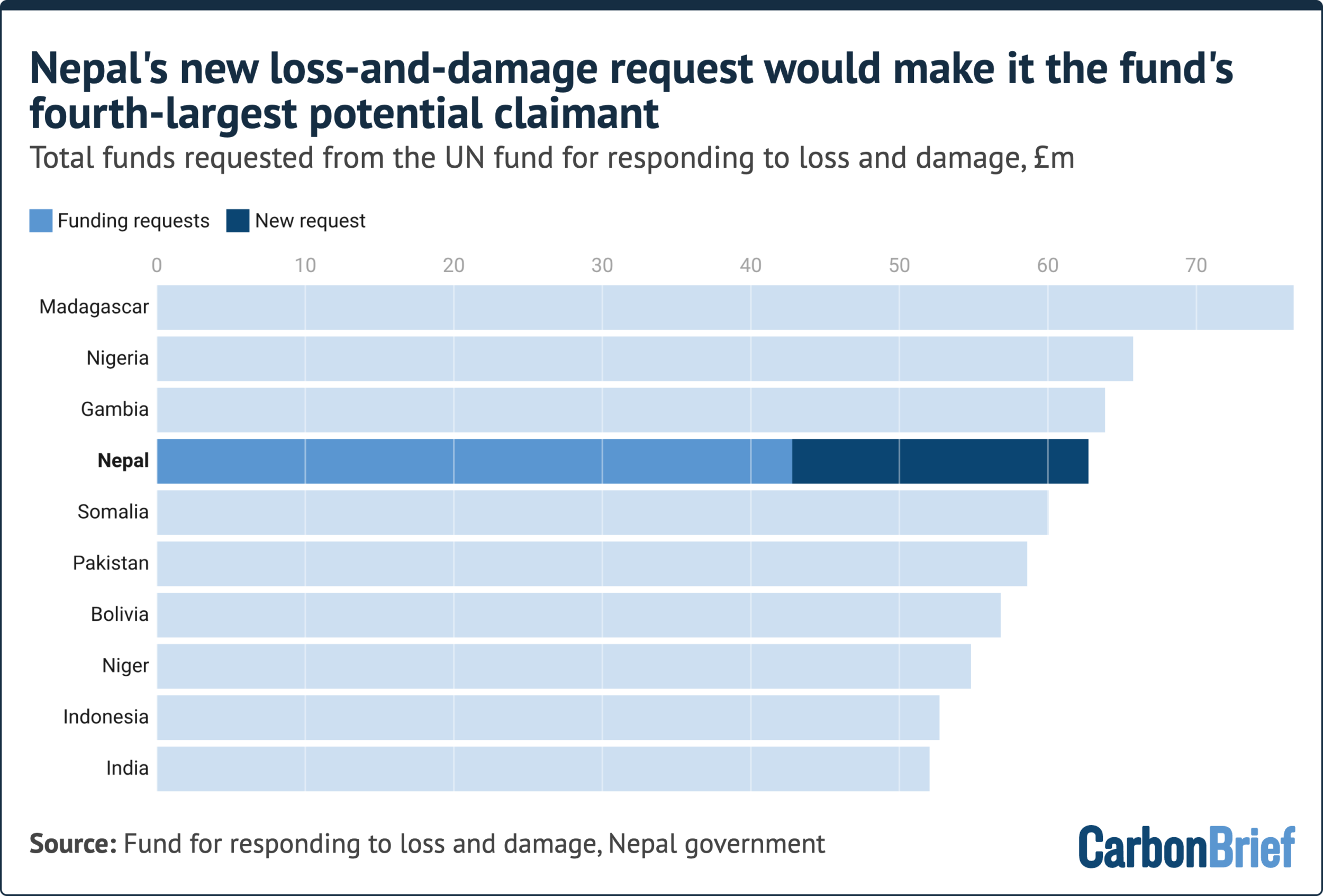
Despite asking for a fraction of its losses, Nepal’s $20 million claim represents the absolute maximum payout currently permitted for a single project under the fund’s guidelines. This cap leaves the nation as the fourth-largest overall claimant to a UN system that is rapidly succumbing to financial paralysis.
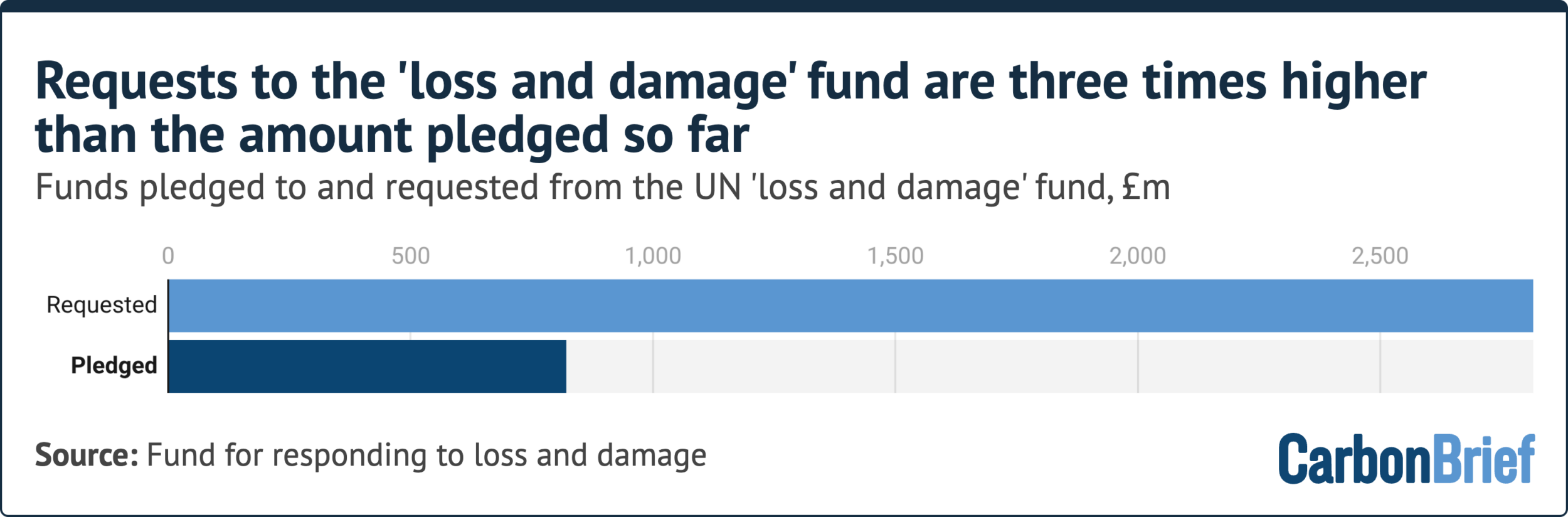
Across the Global South, vulnerable nations have submitted 176 funding requests totaling $2.8 billion to cope with intensifying floods, droughts, and tropical storms. Yet, wealthy industrialized nations—historically responsible for the vast majority of cumulative global greenhouse gas emissions—have pledged only $822 million to the fund, with less than half of those funds actually deposited into UN trustee accounts. Worse still, since its historic establishment at COP28 in 2023, the Loss and Damage Fund has failed to disburse a single dollar in aid to any affected country.
Nepal’s tragic ordeal has transformed from a localized humanitarian crisis into an international flashpoint, exposing structural flaws, bureaucratic delays, and a staggering capital deficit within the UN’s climate finance architecture.
Detailed Chronology
  [Aug 26, 2026] ────> [Aug 31, 2026] ────> [Early Sept 2026] ───> [Sept 14, 2026] ───> [Sept 24, 2026] ───> [Dec 15, 2026]
Himalayan Avalanche    Nepal Appeals to    $20M Request Filed;    Developed Nations      PM Shah Speaks      Next FRLD Board
 & Flash Flooding       UN FRLD Board      Damage Assessed at    Offer Consultation     at UN General          Meeting
  (1,400+ Dead)        for Urgent Aid       $2.7B Direct Loss       Without Pledges       Assembly (UNGA)         Scheduled
August 26, 2026: The Disaster Strikes
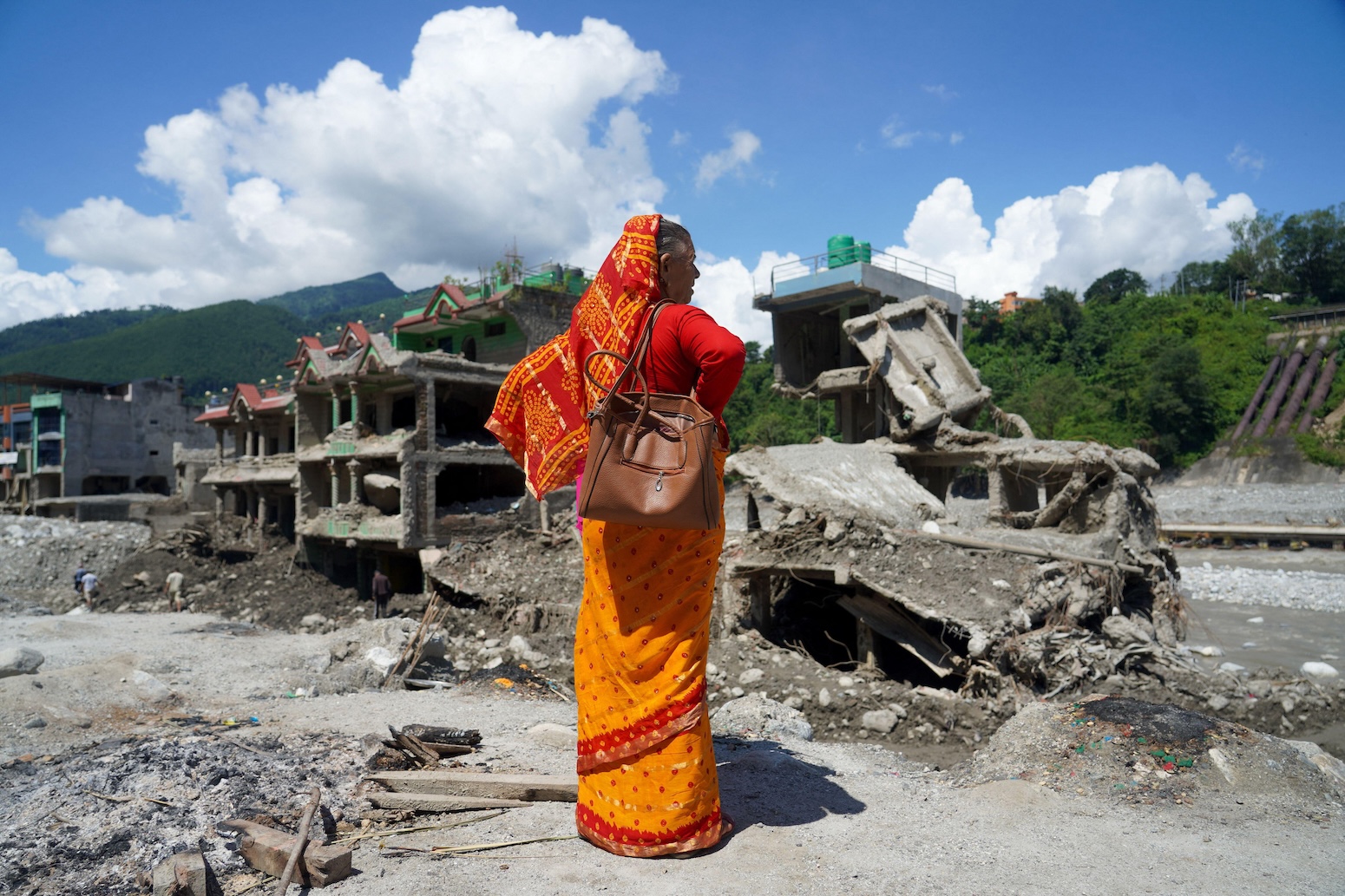
A massive, sudden rock-ice avalanche in the high-altitude Himalayan border region triggers sweeping flash floods downstream along the Bhote Koshi and adjacent river basins. Entire mountain villages, bridges, roads, and hydroelectric installations are washed away. Over 1,400 fatalities are confirmed within days, with thousands remaining unaccounted for beneath toxic mud and debris.
August 31, 2026: An Urgent Diplomatic Appeal
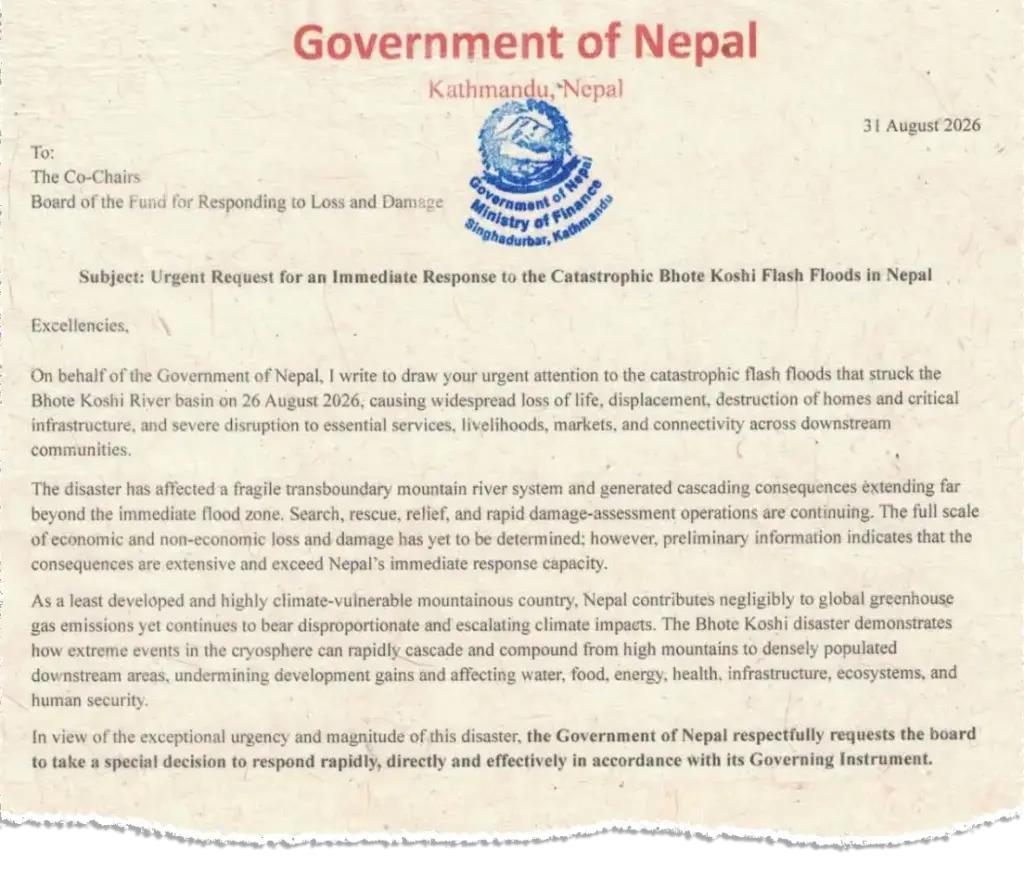
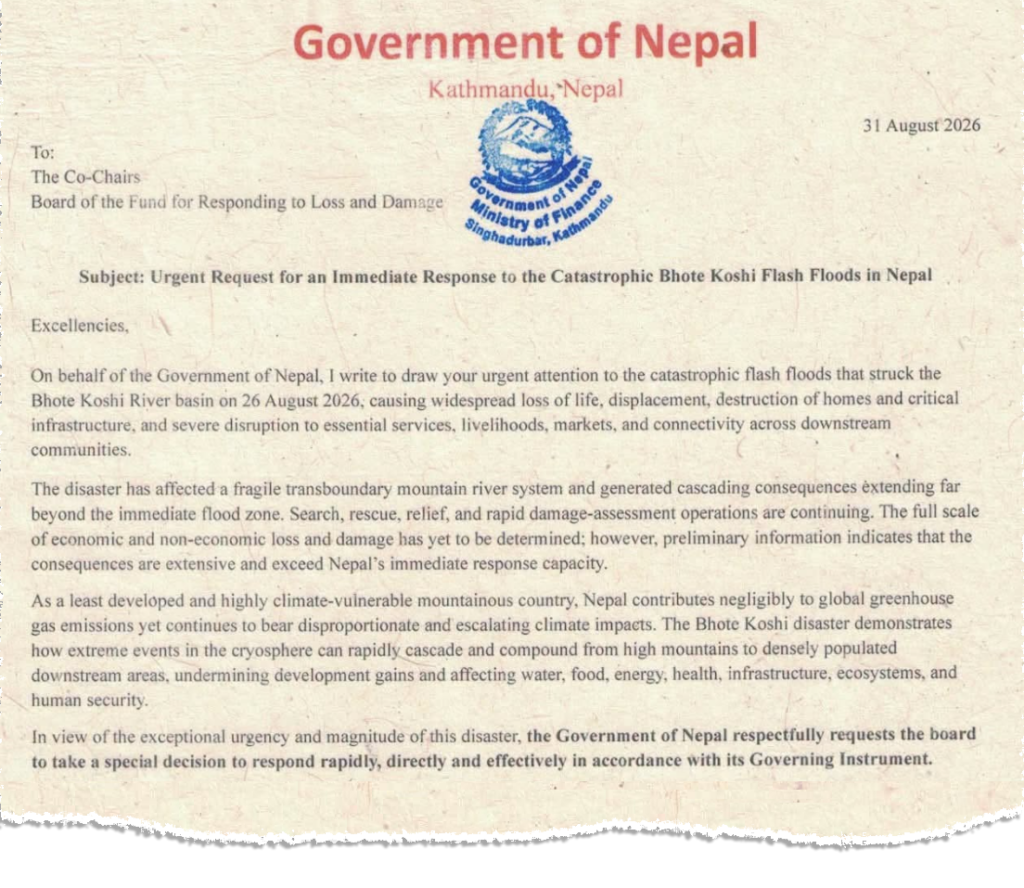
Five days after the disaster, Nepal’s Finance Minister, Dr. Swarnim Wagle, dispatches an official letter to the Board of the UN Loss and Damage Fund. The appeal urges the board to mobilize an immediate, flexible financial response to demonstrate that the international climate finance apparatus can respond with speed and solidarity to sudden-onset climate emergencies.
Early September 2026: Assessment and Formal Claim Submission
Nepal’s National Disaster Risk Reduction and Management Authority publishes its rapid preliminary assessment, calculating direct physical damage and economic losses at $2.7 billion, alongside a $4.8 billion long-term reconstruction need. Nepal formally submits its application for $20 million from the FRLD—the maximum single-project grant allowed under the board’s rules—marking its fourth separate claim to the fund.
Mid-September 2026: Board Factions Divide over Emergency Protocols
Board members representing Asia-Pacific and African nations author a joint motion urging the FRLD leadership to convene an emergency meeting and establish a "provisional set-aside allocation" specifically for rapid-response scenarios like Nepal’s.
September 14, 2026: Northern Nations Stonewall Direct Allocations
Board members from developed nations issue a formal response. While supporting an informal "consultation" regarding Nepal’s plight, they refrain from committing emergency capital or expediting disbursement procedures, treating the disaster as a standard project application subject to long-term review.
September 24, 2026: Global Stage Address
Nepali Prime Minister Balendra Shah addresses the United Nations General Assembly in New York, spotlighting mountain climate vulnerabilities, climate justice, and the unacceptable delays in deploying emergency loss and damage funding.
December 15, 2026: Looming Board Review
The FRLD Board is scheduled to hold its next formal meeting—nearly four months after the disaster in Nepal, and two weeks following the conclusion of the COP31 climate summit in Turkey.
Supporting Context & Metrics
The disparity between Nepal’s immediate climate damages and the capacity of the UN Loss and Damage Fund illustrates a systemic failure across global climate finance mechanisms.
Metric / Parameter
Value / Figure
Context & Implications
Direct Physical & Economic Damage
$2.7 Billion
Immediate destruction of infrastructure, property, and economic output in Nepal.
Recovery & Reconstruction Costs
$4.8 Billion
Long-term investment required to rebuild under resilient standards (Sendai Framework).
Total Estimated Financial Need
$7.5 Billion
Combined immediate losses and long-term reconstruction requirements.
Nepal’s FRLD Funding Claim
$20 Million
The maximum allowable single-project request under current UN rules.
Claim as % of Direct Losses
0.7%
Illustrates the severe inadequacy of maximum UN grant limits relative to disaster scales.
Claim as % of Total Financial Need
0.3%
Highlights that UN aid covers only a fraction of broader recovery efforts.
Global Pipeline of FRLD Applications
176 Applications
Total claims submitted by 118 developing nations between Dec 2025 and July 2026.
Total Global Assistance Requested
$2.8 Billion
Aggregated financial assistance sought by climate-vulnerable states.
Total Global Capital Pledged
$822 Million
Total commitments from developed nations and select non-traditional donors.
Capital Paid into Trustee Account
~$400 Million
Actual cash transferred by donor states into World Bank-administered accounts.
Funds Disbursed to Date
$0.00
Zero dollars delivered to disaster victims since the fund was established in 2023.
The Global Pledging Deficit
The capital structure of the UN Loss and Damage Fund shows a substantial gap between funding requests and financial commitments. While developing countries have lodged $2.8 billion in claims, international donors have pledged just $822 million.
GLOBAL CAPITAL MISMATCH (USD)
─────────────────────────────────────────────────────────────────────────────
Total Requested by Developing Nations ($2,800M) █ █ █ █ █ █ █ █ █ █ █ █ █ █ █
Total Pledged by Donor Nations        ($822M)   █ █ █ █ ▌
Actual Cash Deposited in Fund         (~$400M)  █ █ ▌
Actual Funds Disbursed to Victims     ($0M)
─────────────────────────────────────────────────────────────────────────────
Furthermore, key donor nations—including France, Italy, and the United Arab Emirates—have yet to fulfill substantial portions of their original commitments. Although $342 million was approved for release during an initial funding window in July 2026, administrative delays have prevented any capital from leaving World Bank trustee accounts.
Vulnerability Concentration
Analysis reveals that over 60% of all applications submitted to the fund originate from Least Developed Countries (LDCs) and Small Island Developing States (SIDS). With four independent applications on file, Nepal has become the fourth-largest claimant to the fund worldwide. It trails only countries facing multi-year compounded crises, such as Madagascar—which has submitted six claims following consecutive tropical cyclones and severe droughts—alongside emergency appeals from Suriname, Ecuador, Brazil, and Barbados.
TOP CLAIMANTS TO THE UN LOSS AND DAMAGE FUND
─────────────────────────────────────────────────────────────────────────────
1. Madagascar  [6 Claims]  (Cyclones & Persistent Drought)
2. Suriname    [Multiple]  (Severe Riverine Drought & Ecosystem Collapse)
3. Ecuador     [Multiple]  (Extreme Rainfall & Infrastructure Degradation)
4. Nepal       [4 Claims]  (Himalayan Glacial Cascades & Flash Floods)
─────────────────────────────────────────────────────────────────────────────
Official Statements & Diplomatic Friction
The slow response to Nepal’s emergency claim has exposed deep geopolitical divisions within the 26-member FRLD Board, which is divided equally between developed and developing nations.
In his initial appeal following the flood, Nepal’s Finance Minister, Dr. Swarnim Wagle, emphasized the need for procedural speed:
"We appeal to the board to mobilize an urgent response that signals to the world that this fund is capable of responding with humanity, speed, flexibility, and solidarity when climate-vulnerable countries face losses and damages beyond their capacity to address alone."
Reacting to financial analyses of the crisis, senior Nepali climate negotiator Raju Pandit Chhetri stressed that the $20 million application was designed strictly as a rapid-response stopgap, not a reconstruction plan:
"That money is going to be a peanut if it was to be invested into reconstruction… It’s a shame that, until now, the fund has not been able to give even a penny to developing countries. The event in Nepal demonstrates precisely why this kind of fund is so important for highly vulnerable, poor, developing nations.
If the fund cannot respond in a crisis like this for a country like Nepal—when you have this massive destruction and devastation—then what is the use of the fund itself? That’s why this is a core test for the fund, even if its resources remain limited."
Civil society advocates argue that developed nations are deliberately delaying emergency allocations out of fear of setting an expensive precedent. Harjeet Singh, loss-and-damage expert and global convenor of the Fill the Fund campaign, delivered a sharp critique of Northern board members:
"Developed countries gave a really cold response to Nepal’s request. They have not addressed it because they know that if this happens once, they are going to be under pressure all the time. The board is treating emergency applications like standard, slow-moving development projects rather than active humanitarian catastrophes. This is unacceptable."
While board representatives from Africa and the Asia-Pacific pushed for emergency set-asides to build operational lessons for rapid-response scenarios, representatives from wealthy donor states insisted on adherence to standard review cycles. Their September 14 response offered consultations on process, but made no commitments to expedite financial transfers.
Future Outlook
As Nepal struggles to rebuild torn mountain passes and submerged communities, the nation is turning to climate science to strengthen its legal and moral case.
Scientists from the World Weather Attribution (WWA) group noted that while a full attribution study remains pending, the catastrophic avalanche-flood sequence in the Himalayas bears the clear fingerprints of anthropogenic climate change. Rapid warming across the Himalayan chain has accelerated glacial retreat and destabilized high-altitude permafrost layers, creating conditions for catastrophic natural hazards that exceed local adaptation limits.
Nepal plans to integrate these scientific findings into its diplomatic submissions ahead of the upcoming COP31 UN Climate Summit in Turkey, as well as the FRLD Board’s formal meeting on December 15.
The ongoing deadlock surrounding Nepal’s $20 million request highlights fundamental questions about the future of international climate finance:
Procedural Reform vs. Bureaucratic Inertia: Will the FRLD Board establish a dedicated, fast-track emergency channel capable of disbursing cash within days of a natural disaster, or will claims remain bogged down in multi-month review cycles?
Closing the Capital Deficit: Will developed nations significantly scale up their contributions to match the $2.8 billion in active requests, or will the fund remain undercapitalized relative to global needs?
Liability and Accountability: As climate attribution science advances, will vulnerable nations use empirical data to push for binding compensation frameworks rather than relying on voluntary donations?
If the UN Loss and Damage Fund cannot deliver timely financial support to nations enduring catastrophic, scientifically attributed climate disasters, it risks losing credibility among the vulnerable countries it was created to protect. For the survivors along Nepal’s flooded river valleys, the debate over global climate finance remains an abstract exercise—leaving local communities to bear the heavy costs of a warming world alone.