

In an era of shifting ecosystems and increasing urbanization, the delicate balance of backyard wildlife management is undergoing a significant paradigm shift. Earlier this year, the Royal Society for the Protection of Birds (RSPB) issued critical new guidance regarding supplementary bird feeding, fundamentally altering how conservationists and gardeners approach backyard wildlife support. Driven by rigorous scientific research demonstrating that the highly contagious and often fatal disease trichomonosis can be transmitted rapidly between birds at crowded garden feeders, the conservation charity has introduced a clear, memorable mandate: "Feed Seasonally. Feed Safely."

While supplementary feeding has long been a cherished pastime for millions of homeowners seeking to connect with nature, the RSPB’s latest findings highlight the unintended consequences of human intervention. Artificial feeding stations, if left unmanaged or utilized year-round indiscriminately, can act as vector hot spots for pathogens. Consequently, the conservation blueprint is moving away from continuous, all-season feeding hubs and toward a more holistic, nature-aligned model.

Central to this modern conservation strategy is the integration of wildlife-friendly horticulture. Rather than relying solely on hanging seed dispensers and fat blocks, the RSPB is strongly encouraging gardeners to cultivate natural food webs by incorporating specific flora into their landscape designs. By planting diverse, high-yielding annuals, perennials, shrubs, and trees, property owners can provide a continuous, disease-resilient buffet of seeds, nectar, insects, and berries. To assist gardeners in navigating this transition, experts have compiled a definitive roster of the 26 best plants for feeding garden birds—transforming ornamental borders into vital ecological corridors.

Detailed Chronology
Understanding the evolution of modern bird-feeding guidelines requires examining the timeline of scientific discovery and conservation policy shifts over recent decades.

- Early 2000s: Researchers begin tracking a mysterious decline in certain garden bird populations, notably greenfinches and chaffinches, across the United Kingdom and parts of Europe. Field observations note lethargic behavior, difficulty swallowing, and high mortality rates near residential feeding stations.
- 2005–2006: Pathologists isolate Trichomonas gallinae, a microscopic protozoan parasite, as the primary causative agent behind the outbreak of avian trichomonosis in wild passerine populations. Historically known as a disease primarily affecting pigeons and raptors, its cross-species jump to garden songbirds marks a critical turning point in ornithological surveillance.
- 2010–2015: As epidemiological studies confirm that shared feeding surfaces and damp seed accumulation are major transmission vectors, conservation organizations launch preliminary public awareness campaigns urging stricter hygiene practices. However, feeding recommendations remain largely unstructured regarding calendar-year timelines.
- Early This Year: Following comprehensive, multi-year ecological assessments of bird health and feeding habits, the RSPB synthesizes its findings into a cohesive, modernized advisory framework. The "Feed Seasonally. Feed Safely" campaign is officially launched, establishing strict temporal boundaries for high-fat supplementary feeds and codifying rigorous biosecurity protocols for garden equipment. Concurrently, emphasis shifts toward botanical integration, encouraging the establishment of native and wildlife-supportive garden flora to reduce dependency on artificial stations.
Supporting Context & Metrics
The necessity for revised feeding protocols is underscored by sobering ecological metrics concerning avian health and habitat loss. Urban expansion and intensive agricultural practices have fragmented natural foraging grounds, placing unprecedented pressure on local bird populations. When homeowners step in with artificial feeders, they inadvertently concentrate bird populations into unnaturally dense flocks.

Trichomonosis thrives in these high-density environments. The parasite is transmitted through direct bill-to-bill contact or via contaminated food and water. When multiple birds congregate on flat surfaces or poorly sanitized feeders, the reproduction rate of the pathogen spikes exponentially.

To counteract this, the RSPB’s seasonal framework dictates precise temporal boundaries:

- The Restrictive Window (May 1 to October 31): During these spring and summer months, natural food sources—such as caterpillars, beetles, flying insects, and early seed sets—are abundant. The RSPB advises restricting supplementary energy-dense foods (such as suet, fat balls, and mealworms) to very small, carefully monitored amounts.
- The Open Window (November 1 to April 30): As winter sets in and natural provisions dwindle, the conservation body suggests that peanuts and high-energy seeds can be put out more freely to help birds maintain critical fat reserves through freezing temperatures.
Simultaneously, incorporating botanical infrastructure offers a sustainable solution. By introducing carefully curated flora, gardeners can cultivate an ecosystem that naturally mirrors the seasonal nutritional needs of local avifauna.

Official Statements & Best Practices
The RSPB’s updated guidance is anchored in actionable, evidence-based methodologies designed to mitigate disease transmission while maximizing garden biodiversity.

The Pillars of Safe Feeding
Feeding safely requires a radical departure from passive garden maintenance. Key directives from conservation authorities include:

- Relocation and Rotation: Move feeding stations regularly across the garden landscape to prevent the accumulation of droppings and contaminated waste beneath a single spot.
- Elimination of Flat Surfaces: Avoid flat surface feeders, such as traditional open bird tables, which encourage birds to walk directly over spilled food and waste, accelerating pathogen transmission.
- Immediate Remediation: Promptly clear away any spilt food from the ground to deter scavenging rodents and prevent mold growth.
- Rigorous Hygiene Protocols: When cleaning feeders, operators must exercise careful hygiene precautions. This includes wearing dedicated rubber gloves and protective clothing, washing equipment exclusively outdoors, restricting specialized cleaning tools (such as long-handled brushes) solely to this sanitation task, and washing hands and forearms thoroughly afterward with antibacterial soap.
Future Outlook: The 26 Essential Plants for Garden Birds
To bridge the gap between artificial feeding restrictions and natural foraging, cultivating a rich botanical tapestry is paramount. Below is a detailed look at selected standout species from the RSPB-aligned horticultural guide, categorizing plants that elevate garden aesthetics while serving as powerhouses for wildlife.

1. Sunflower (Helianthus annuus)
- Type: Annual | Wildlife Rating: 4/5 | Beauty Rating: 4/5
- Overview: Sunflowers offer striking summer displays and exceptional autumn utility. Varieties like dwarf ‘Choco Sun’ fit neatly at the front of borders without requiring staking. When left standing, their seedheads become a banquet for blue tits and greenfinches. Note: Ensure you select pollen-bearing varieties, as modern pollenless cultivars fail to set viable seeds.
2. Ornamental Millet (Pennisetum glaucum ‘Purple Baron’)
- Type: Annual | Wildlife Rating: 3/5 | Beauty Rating: 3/5
- Overview: Standing around 90cm tall, this arching grass features deep purple foliage and feathery summer spikes that contrast brilliantly with hot-toned perennials like dahlias and rudbeckias. Once spent, its seedheads attract flocks of seed-eating birds.
3. Cornflower (Centaurea cyanus)
- Type: Annual | Wildlife Rating: 3/5 | Beauty Rating: 4/5
- Overview: Providing airy splashes of blue, pink, and purple, cornflowers—such as compact cultivars like ‘Polka Dot Mixed’—thrive in borders or pots. Their blossoms attract vital pollinating insects for insectivorous birds, while goldfinches prize their mature seeds.
4. Teasel (Dipsacus fullonum)
- Type: Perennial | Wildlife Rating: 3/5 | Beauty Rating: 3/5
- Overview: This statuesque biennial produces bristly white or lavender flowerheads in mid-to-late summer. When left over winter, its architectural seedheads provide an ideal feeding station for goldfinches, who utilize their narrow, pointed beaks to extract the tiny seeds.
5. Knapweed (Centaurea nigra)
- Type: Perennial | Wildlife Rating: 5/5 | Beauty Rating: 5/5
- Overview: Boasting thistle-like purple blooms, knapweed is a magnet for bees and beneficial insects. This insect bounty subsequently draws in insectivorous species like dunnocks, while goldfinches favor the half-ripe seeds.
6. Field Scabious (Knautia arvensis)
- Type: Perennial | Wildlife Rating: 4/5 | Beauty Rating: 4/5
- Overview: Reaching up to 1.5 meters, field scabious produces delicate blue flower heads that support pollinators and provide larval food for moth and butterfly caterpillars. Its post-flowering seedheads are frequented by sparrows and finches.
7. Michaelmas Daisy (Symphyotrichum novi-belgii)
- Type: Perennial | Wildlife Rating: 4/5 | Beauty Rating: 5/5
- Overview: Essential for late-summer and autumn color, these daisies offer prolonged blooms in white, pink, and purple, followed by seed crops that heavily attract goldfinches and other granivorous birds.
8. Self-Heal (Prunella vulgaris)
- Type: Perennial | Wildlife Rating: 4/5 | Beauty Rating: 3/5
- Overview: A resilient low-growing wildflower featuring violet flower clusters from June through October. Thriving in sun or partial shade, its seeds provide an invaluable food source for house sparrows and dunnocks.
9. Coneflower (Rudbeckia fulgida)
- Type: Perennial | Wildlife Rating: 3/5 | Beauty Rating: 5/5
- Overview: Delivering reliable golden-yellow blooms with dark central disks from July to October, coneflowers offer open seed structures that are easily accessible to finches and sparrows.
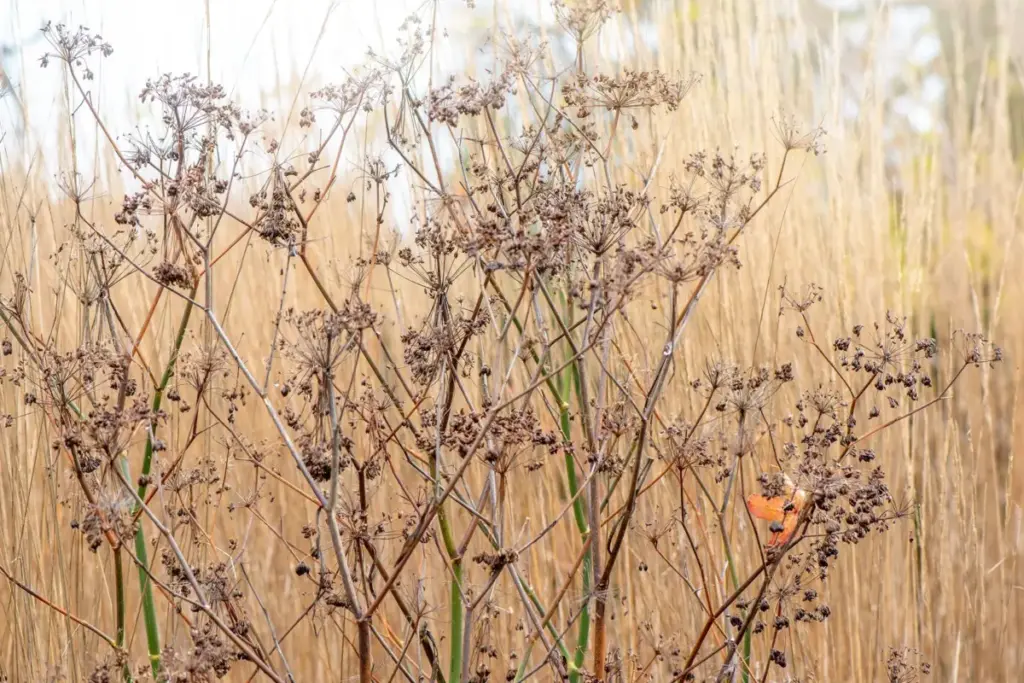
10. Fennel (Foeniculum vulgare)
- Type: Perennial | Wildlife Rating: 4/5 | Beauty Rating: 4/5
- Overview: With its architectural stature and feathery foliage, fennel naturally attracts aphids and small insects, drawing in insectivores like blue tits, while its mature seed umbels feed granivores.
11. Verbena (Verbena bonariensis)
- Type: Perennial | Wildlife Rating: 4/5 | Beauty Rating: 5/5
- Overview: Thriving in full sun, this elegant plant provides sturdy, bouncing stems where sparrows and finches love to perch while foraging for autumn seeds.
12. Chicory (Cichorium intybus)
- Type: Perennial | Wildlife Rating: 4/5 | Beauty Rating: 5/5
- Overview: A drought-resistant plant featuring pale cornflower-blue flowers that support summer pollinators and feed finches once gone to seed.
13. Firethorn (Pyracantha spp.)
- Type: Evergreen Shrub | Wildlife Rating: 4/5 | Beauty Rating: 4/5
- Overview: An exceptional dual-purpose boundary plant whose spring blossoms attract insect-hunting birds, followed by heavy crops of red and orange berries relished by blackbirds, song thrushes, and winter migrants like redwings.
14–26. Extended Horticultural Additions
Rounding out the full 26-plant master list are foundational woody species and climbers: Wild Honeysuckle (Lonicera periclymenum), Ivy (Hedera helix), Mistletoe (Viscum album), Lavender (Lavandula angustifolia), Elder (Sambucus nigra), Guelder Rose (Viburnum opulus), Oregon Grape (Mahonia aquifolium), Hawthorn (Crataegus monogyna), Crab Apple (Malus spp.), Hazel (Corylus avellana), Holly (Ilex aquifolium), Silver Birch (Betula pendula), and Rowan (Sorbus aucuparia).

Together, these perennial woody plants form the backbone of a self-sustaining avian habitat. By shifting our gardening philosophy away from over-reliance on artificial feeding stations and toward diverse, ecologically rich plantings, we can ensure that our gardens remain safe, vibrant, and resilient sanctuaries for local wildlife for generations to come.



