A high-profile policy initiative from the UK’s opposition Conservative Party has ignited an intense national debate over the economic and environmental future of Great Britain’s energy landscape. Drawing on a flagship report titled Powering Britain, published by the centre-right thinktank Onward and backed by modeling from advisory firm Transira Energy, Conservative leadership is pitching a radical departure from the nation’s legally binding 2050 net-zero targets.
The core thesis advanced by Conservative Leader Kemi Badenoch and Shadow Energy Secretary Claire Coutinho asserts that existing climate mandates are "bankrupting" the UK by driving electricity prices to unsustainably high levels. To remedy this, the Conservatives advocate for an "Alternative Policy Pathway" (APP) that abandons state-driven decarbonization targets after the next general election. The proposed strategy pivots toward heavy reliance on unabated natural gas generation and a massive expansion of nuclear power, alongside the complete phase-out of subsidies for renewable energy, heat pumps, electric vehicles (EVs), and long-duration energy storage. The report claims this market-led, fossil-and-nuclear approach would reduce total system expenditures by "over £320 billion" by 2050 while making electricity cheap enough to spur organic, consumer-led electrification.
However, an extensive investigative analysis by energy analysts, academic researchers, and economic forecasters reveals that the Onward report’s conclusions rely on fundamentally flawed assumptions, mathematical contradictions, and selective cost accounting. Independent experts from Imperial College London, Aurora Energy Research, RenewableUK, Energy UK, and the Energy and Climate Intelligence Unit (ECIU) have identified critical systemic vulnerabilities in the proposal:
Net Emissions Escalation: Rather than accelerating decarbonization, the APP scenario adds 524 million tonnes of carbon dioxide ($textMtCO_2$) to the atmosphere between 2030 and 2050—an amount equal to the entire annual carbon output of South Africa.
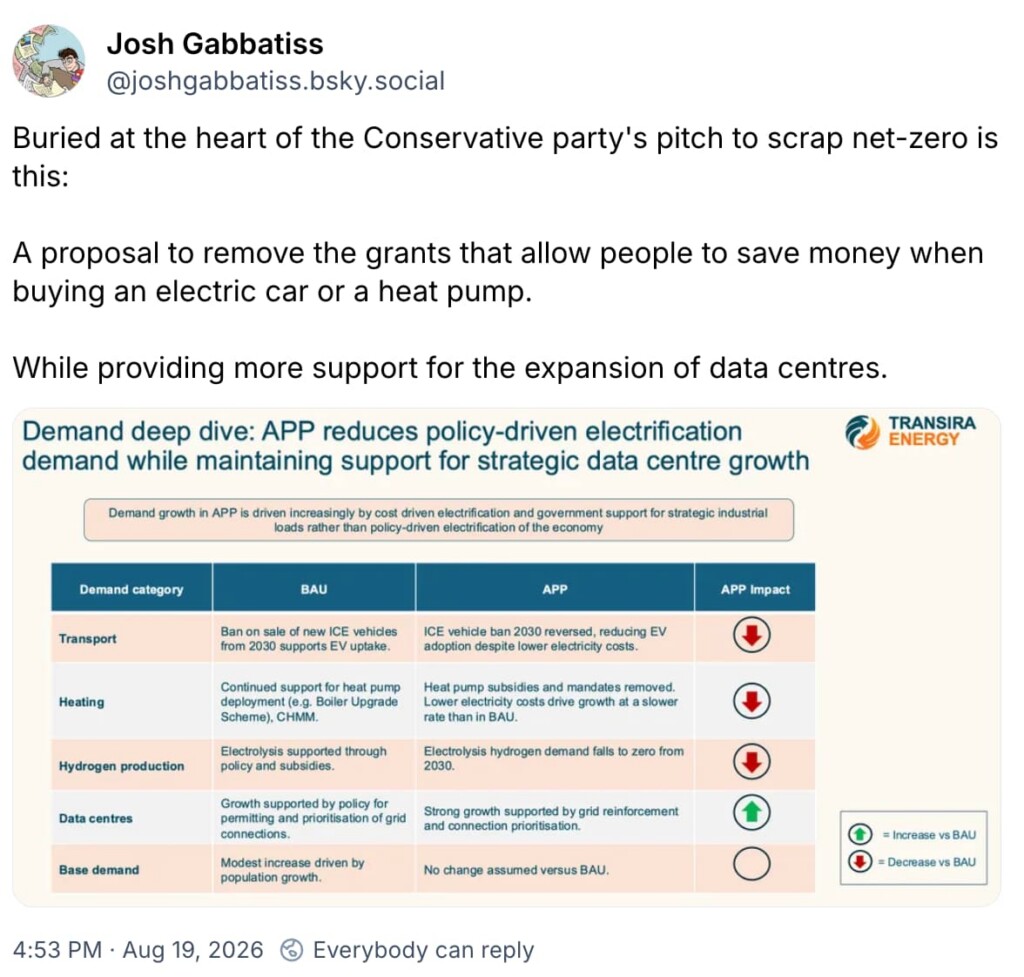
Stalled Demand and Hidden Consumer Expenditures: The plan actually depresses overall national electrification. While claiming to lower power prices to encourage EV and heat pump adoption, it removes vital deployment mandates and purchase subsidies. This results in 7% lower electricity consumption by 2050 and leaves motorists paying an estimated £65–£95 billion in uncounted petrol and diesel fuel bills.
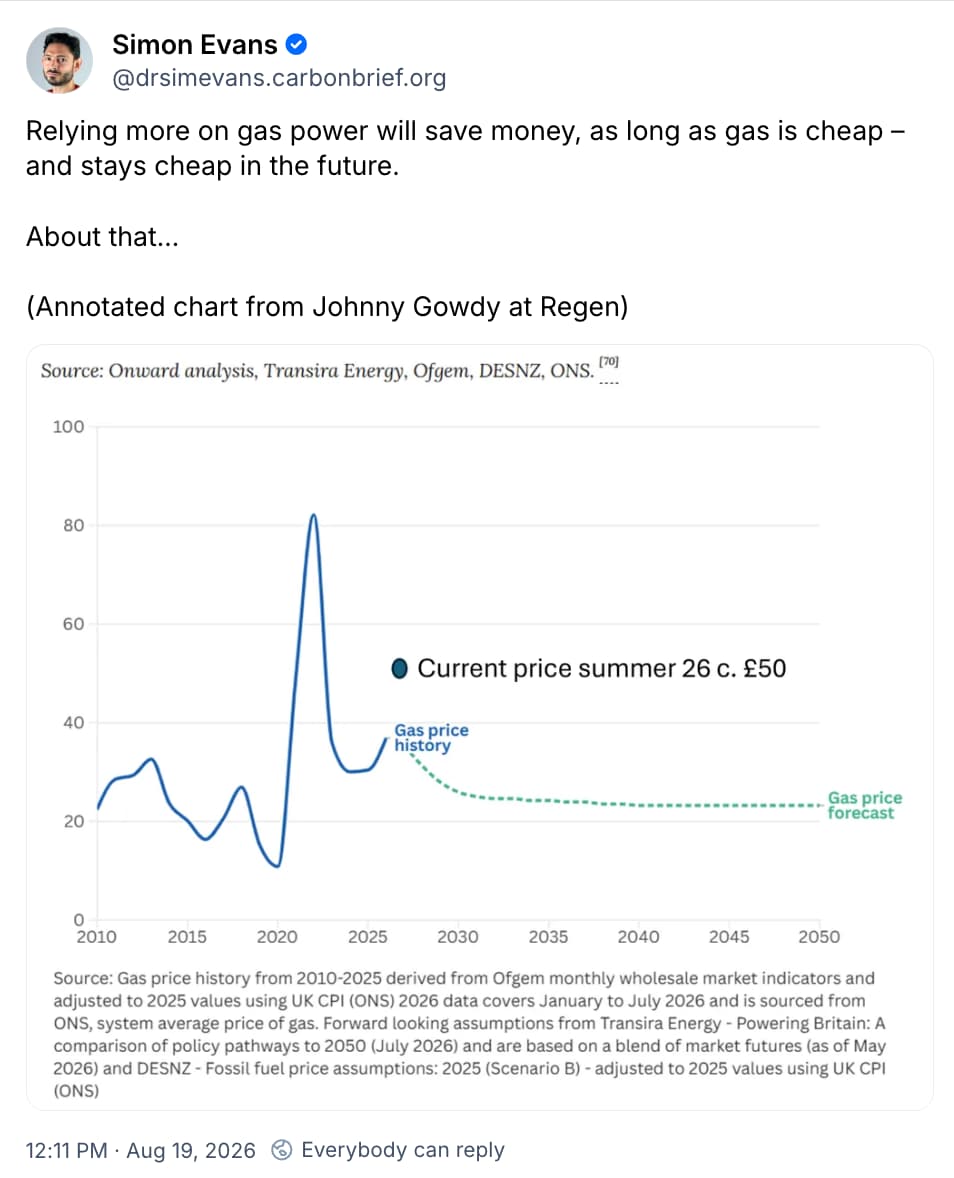
Unrealistic Fuel and Capital Cost Assumptions: The report assumes global natural gas prices will drop to pre-crisis levels and remain low for decades, ignoring geopolitical volatility. Furthermore, it models gas plant construction costs at £650 per kilowatt ($textkW$)—less than half the current global market rate driven by a global shortage of gas turbines.
Grid and Balancing Cost Double-Counting: Onward claims £137 billion in grid network savings alongside £67 billion in lower constraint/balancing fees. Industry analysts point out that curtailing grid expansion dramatically increases balancing costs, making it logically impossible to claim savings on both fronts simultaneously.
Exaggerated Integration Costs for Renewables: The report attributes a staggering £125/MWh system integration cost to new wind and solar assets—nearly five times higher than peer-reviewed academic estimates—by laying the entire historical and future burden of grid modernization onto post-2029 renewable projects.
Regulatory and Legal Disruptions: The plan proposes unilaterally reneging on legacy state contracts for renewables and scrapping carbon pricing via the UK Emissions Trading Scheme (ETS). Economists warn this would severely shatter investor confidence, provoke immediate retaliatory tariffs under the UK-EU Trade and Cooperation Agreement, and expose British power exports to the EU’s Carbon Border Adjustment Mechanism (CBAM).
Detailed Chronology & Policy Debates
The Political Context and the Shift in Conservative Climate Strategy
The debate over the UK’s climate policies has reached a historic inflection point. Following the passage of the Climate Change Act (amended in 2019 to target net-zero emissions by 2050), the UK enjoyed years of cross-party consensus on decarbonization. However, the energy price crisis triggered by post-pandemic demand surges and Russia’s invasion of Ukraine—which cost the UK economy an estimated £183 billion between 2021 and 2025—shifted political focus squarely onto energy bills and grid reliability.
+-----------------------------------------------------------------------------------+
|                        EVOLUTION OF THE UK ENERGY DEBATE                          |
+-----------------------------------------------------------------------------------+
|  2019: Net Zero 2050 Target Enacted into Law (Cross-Party Consensus)              |
|  2021-2024: Global Fossil Price Shock (£183bn UK Impact from Gas Volatility)       |
|  2025: Labour Government Accelerates Clean Power 2030 Strategy                    |
|  2026: Opposition Conservatives Adopt Anti-Net-Zero Platform via "Onward" Report  |
+-----------------------------------------------------------------------------------+
In response to the Labour government’s aggressive push for clean power by 2030, the Conservative opposition reframed net-zero policies as an unaffordable burden. Under Conservative Leader Kemi Badenoch, the party has positioned itself as championing a "common sense" energy policy.
The strategy was formalized through the publication of Onward’s Powering Britain report, based on energy dispatch modeling performed by Transira Energy. The report explicitly frames the climate debate as a trade-off between strict emissions mandates and economic affordability, positing that prioritizing cheap electricity generation above all else will yield superior long-term outcomes.
Business-as-Usual (BAU) vs. The Alternative Policy Pathway (APP)
Transira Energy’s modeling constructs two distinct regulatory and technology trajectories spanning from 2030 to 2050:
Business-As-Usual (BAU) Pathway: A baseline modeling scenario reflecting ongoing net-zero policies. It includes continued offshore wind, onshore wind, and solar auctions via Contracts for Difference (CfD); structural support for long-duration energy storage; heat pump installation grants under the Boiler Upgrade Scheme; the Zero Emission Vehicle (ZEV) mandate; and carbon pricing under the UK ETS. (Notably, the report’s BAU scenario only achieves a fully decarbonized power grid by 2045, significantly trailing the Labour government’s official 2030 target).
Alternative Policy Pathway (APP): A deregulation scenario assuming the UK completely repeals its statutory 2050 net-zero target following an election in 2029. Under the APP:
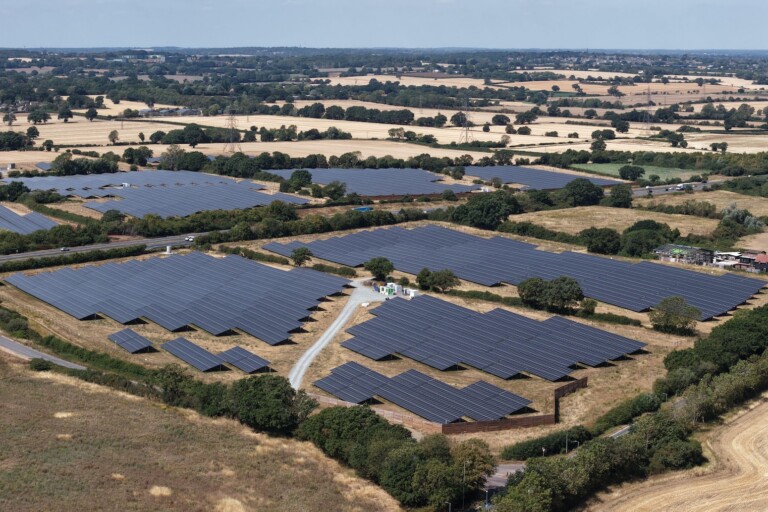
Generation Mix: Support for new renewables is terminated. The UK builds an additional 21 gigawatts ($textGW$) of unabated gas-fired power capacity (a 70% increase over existing capacity) and increases nuclear capacity to 20GW by 2050.
Subsidies and Mandates: CfD auctions for renewables end in 2030. Legacy Renewables Obligation (RO) support is truncated early in 2033 (instead of 2037). Grants for heat pumps and the 2030 ban on new internal combustion engine (ICE) vehicles are abolished.
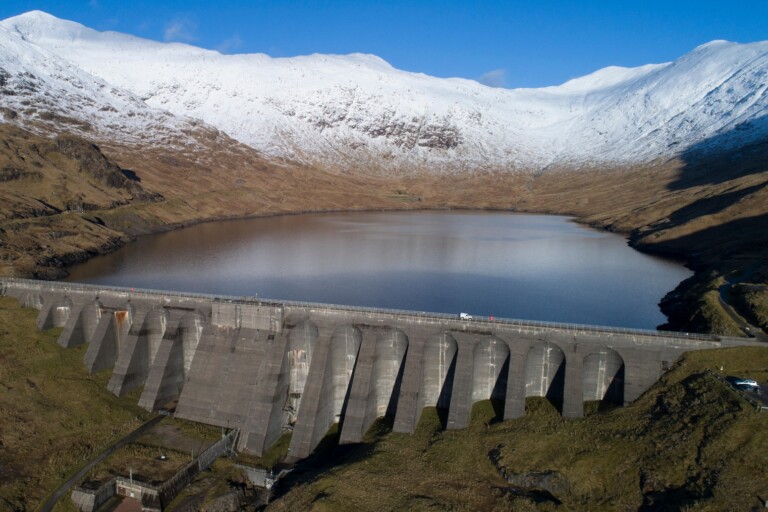
Market Structures: The UK ETS carbon tax on power generators is eliminated in 2031. Grid expansion projects are scaled back by 86%, and state-backed financing schemes for long-duration energy storage are canceled.
Shadow Energy Secretary Claire Coutinho summarized the rationale in the report’s foreword: "If we want those emissions to fall, then we need people to want to use electric cars and electric heating—then our priority should be to make electricity cheap."
Supporting Context & Metrics: Deconstructing the £320bn Claim
To evaluate the validity of the £320 billion in claimed savings under the Alternative Policy Pathway, energy market researchers have subjected the underlying assumptions of the Transira Energy model to rigorous technical scrutiny.
+-----------------------------------------------------------------------------------+
|               BREAKDOWN OF CLAIMED "SAVINGS" IN THE ONWARD REPORT                 |
+-----------------------------------------------------------------------------------+
|  1. Network Infrastructure Expenditure "Savings"  : £137 Billion                   |
|  2. Removal of UK ETS Carbon Taxes on Generators : £94 Billion                    |
|  3. Lower System Balancing & Ancillary Costs    : £67 Billion                    |
|  4. Other Operational / Generation Cost Reductions: £22 Billion                    |
|  -------------------------------------------------------------------------------  |
|  TOTAL CLAIMED SAVINGS                          : £320 Billion                    |
+-----------------------------------------------------------------------------------+
1. The Emission and Electrification Paradox
The headline premise of the APP scenario is that lower wholesale electricity prices will naturally drive adoption of green technologies without the need for state mandates or subsidies. However, the model’s own output directly refutes this hypothesis.
Cumulative Emissions Impact: Because the APP relies on a massive expansion of unabated natural gas capacity, cumulative greenhouse gas emissions from the power and heating sectors increase by 524 million tonnes of $textCO_2$ between 2030 and 2050 relative to the baseline.
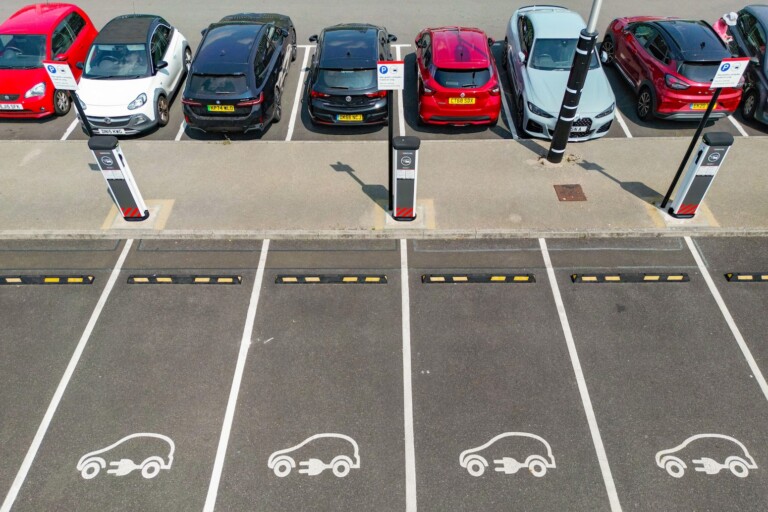
Slower Adoption of Clean Tech: Instead of accelerating electrification, heat pump and EV adoption slows drastically due to the removal of consumer subsidies (e.g., the £7,500 Boiler Upgrade Scheme grant) and regulatory phase-outs for fossil fuel vehicles. Overall national electricity consumption under the APP is actually 7% lower by 2050 than in the net-zero pathway.
The Uncounted Fossil Fuel Burden: Trade body RenewableUK calculated that because EV adoption drops under the APP, British motorists would be forced to purchase petrol and diesel for traditional combustion engine vehicles, resulting in £65 billion to £95 billion in off-balance-sheet fuel costs over two decades. These massive consumer expenses are omitted entirely from Onward’s accounting.
Stagnant Spark Gap: The report highlights Great Britain’s high "spark gap"—the ratio of electricity prices to gas prices—which currently discourages consumers from replacing gas boilers with heat pumps. Yet, analysis by the Energy and Climate Intelligence Unit (ECIU) shows that under the APP, the electricity-to-gas price ratio actually rises in the 2030s and ends up only marginally lower than present-day levels by 2050, offering no meaningful consumer incentive to make the switch.
2. Fossil Price Volatility & Construction Cost Miscalculations
The economic viability of adding 21GW of gas-fired power plants depends heavily on two critical assumptions: the future wholesale price of natural gas and the capital cost to construct new open-cycle and combined-cycle gas turbines.
Gas Price Volatility
The Onward report assumes that global gas prices will quickly drop back to pre-2021 historical averages and remain completely flat through 2050. This assumption stands in stark contrast to forecasts from major energy market analytics firms, including Aurora Energy Research and the International Energy Agency (IEA).
Global gas markets remain highly sensitive to geopolitical disruptions in Eastern Europe and the Middle East. Furthermore, expanding drilling in the UK North Sea—a key pillar of the Conservative energy platform—cannot insulate domestic consumers from global price shocks, as North Sea gas is sold on international wholesale exchanges.
Onward’s own sensitivity appendix admits that a single mid-term gas price spike could instantly add £6 billion in unexpected fuel expenses in 2040 alone.
Capital Costs for Gas Plants
To model the deployment of 21GW of new gas generation, Transira Energy assumes an initial capital expenditure (capex) of just £650 per kilowatt ($textkW$).
Industry benchmark data reveals this figure is severely out of touch with real-world market conditions:
A 2025 study by GridLab showed that new gas plant construction in Western markets routinely costs between $1,116/kW (£819/kW) and $1,427/kW (£1,046/kW) for basic units.
Recent supply-chain bottleneck reports from Bloomberg show that surging global demand for industrial gas turbines—driven largely by the power-hungry artificial intelligence data center boom in the United States—has pushed equipment costs to between $2,000/kW (£1,467/kW) and $2,800/kW (£2,054/kW).
By modeling gas plant construction at a fraction of true market rates, the Onward report artificially understates the capital required to build out its fossil-heavy grid.
+-----------------------------------------------------------------------------------+
|               GAS POWER PLANT CAPITAL COSTS (CAPEX PER KW)                        |
+-----------------------------------------------------------------------------------+
| Onward / Transira Assumed Capex : [£650/kW]                                        |
| GridLab US Market Baseline (2025): [£819 - £1,046/kW]                              |
| Recent Real-World Market Highs  : [£1,467 - £2,054/kW]                             |
+-----------------------------------------------------------------------------------+
3. Nuclear Over-Optimism vs. Project Realities
To provide firm, low-carbon baseload power alongside gas, the APP pathway projects a dramatic expansion of nuclear energy, reaching 20GW of installed capacity by 2050 (up from roughly 6GW today). All new nuclear construction would be funded via the state-backed Regulated Asset Base (RAB) model.
The report acknowledges that nuclear energy represents a major capital expense, but assumes that the levelised cost of electricity (LCOE) for new large-scale nuclear reactors built in the 2040s will drop to between £122/MWh and £138/MWh.
Energy economists point out that this cost reduction is exceptionally optimistic given the UK’s history with nuclear construction:
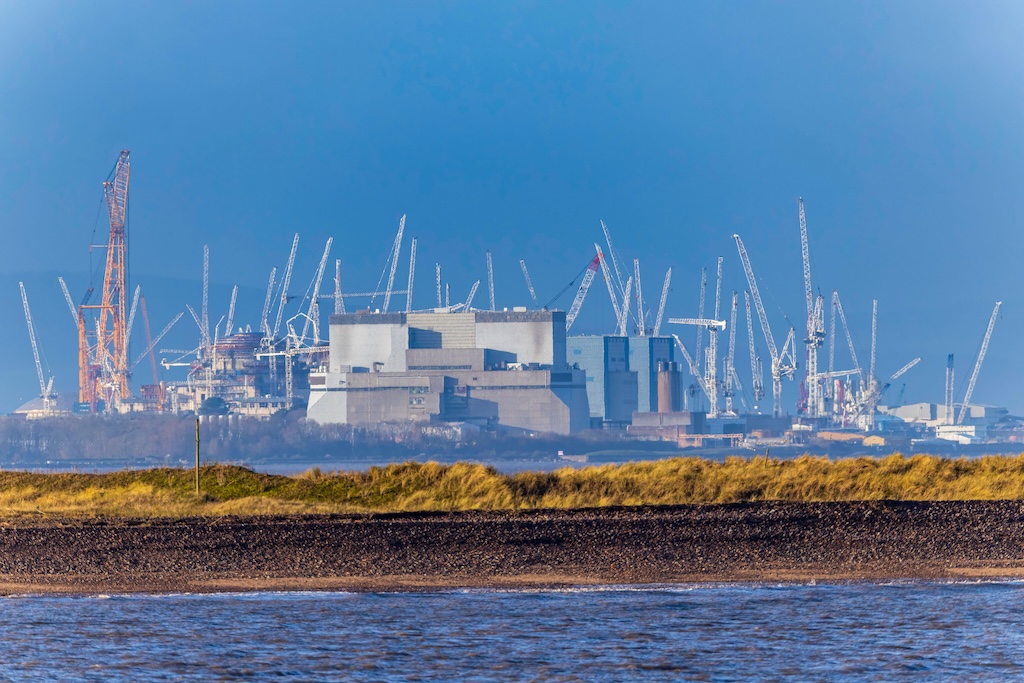
Hinkley Point C: The UK’s flagship flagship twin-reactor project at Hinkley Point C has faced prolonged delays and cost increases. Developers now estimate capital expenditure at £10,736/kW (unadjusted), which swells to approximately £14,724/kW when adjusted for 2026 inflation. Hinkley Point C carries a guaranteed strike price equivalent to roughly £138/MWh in 2030 terms.
Sizewell C: The follow-on project at Sizewell C, which reached a Final Investment Decision (FID) in 2025, operates under an estimated strike price of £150/MWh for commercial operation targeted in 2039.
The Onward model assumes that nuclear capital costs will magically fall by 10% to 20% below the original projections for Hinkley Point C, offering no concrete industrial mechanism for how these savings would be achieved beyond citing regulatory streamlining from the 2025 Fingleton Review. However, the Labour government had already formally committed to implementing the Fingleton Review’s recommendations in full by 2027, making it an invalid justification for performance discrepancies between the baseline and APP pathways.
+-----------------------------------------------------------------------------------+
|                 NUCLEAR POWER GENERATION COST COMPARISONS                         |
+-----------------------------------------------------------------------------------+
| Onward Model Assumed Nuclear LCOE (2040s) : £122 - £138 / MWh                     |
| Hinkley Point C Guaranteed Strike Price   : ~£138 / MWh                           |
| Sizewell C Target Strike Price (2039)     : £150 / MWh                            |
+-----------------------------------------------------------------------------------+
4. Grid Costs, Balancing Fees, and Double-Counting
The largest single chunk of claimed savings in the Onward report comes from scaling back grid infrastructure: £137 billion in reduced transmission buildout, combined with £67 billion in lower system balancing and constraint costs.
The report argues that by placing new gas and nuclear plants closer to major demand centers in southern England—rather than connecting wind farms in northern Scotland and offshore waters—the UK can avoid building expensive high-voltage transmission lines. The APP model budget allocates just £19 billion for grid additions through 2050, representing an 86% cut compared to baseline network investment plans.
Industry analysts have highlighted severe logical errors in this formulation:
Unrealistic Transmission Constraints: Energy experts question whether a minimal £19 billion grid allocation is realistic for a system that must still integrate 32 million electric and hybrid vehicles, 6 million new heat pumps, 45GW of gas plants, 20GW of nuclear power stations, and 62 Terawatt-hours (TWh) of power demand from new AI data centers.
The Balancing Cost Double-Count: The National Energy System Operator (NESO) has repeatedly demonstrated that restricting grid expansion leads to severe transmission bottlenecks. When the grid cannot move power from where it is generated to where it is needed, NESO must pay generators to turn off (curtailment) and pay local gas plants to turn on. NESO estimates that failing to expand grid capacity would drive constraint and balancing costs up to £12.7 billion annually.
By claiming that the UK can cut grid construction capital expenditure by £137 billion while simultaneously saving £67 billion on system balancing, Onward double-counts its financial benefits. Ashutosh Padelkar, Research Lead at Aurora Energy Research, noted: "They’re saying ‘we’re paying both to fix the problem and to have the problem.’ You can have one of the two, but you can’t have both."
5. Integration Cost Inflation and System Integration
To justify curtailing renewable energy deployment, the Onward report argues that wind and solar power possess hidden "system integration costs" that make them far more expensive than their generation costs suggest.
The report asserts that the marginal system integration cost for deploying additional offshore wind, onshore wind, and solar in Great Britain stands at a staggering £125 per Megawatt-hour ($textMWh$).
Energy researchers have heavily criticized this figure:
Peer-Reviewed Academic Baselines: A benchmark study published in Nature Energy calculated that even in an electricity system powered by 80% renewables, total system integration costs average roughly €30/MWh (£26/MWh).
Methodological Flaws: Dr. Callum MacIver of the UK Energy Research Centre (UKERC) explained that Onward arrived at its £125/MWh figure by taking all prospective transmission upgrade expenditures and balancing fees across the entire national energy transition post-2030 and attributing them exclusively to 60GW of new renewable capacity.
Ignoring System Benefits: The model calculates only the cost side of renewable energy while ignoring the wholesale market benefits. Deploying wind and solar displaces expensive fossil fuel generation, avoids carbon tax penalties, and insulates the national economy from international fossil price spikes.
The third major pillar of Onward’s reported savings is £94 billion gained by exempting fossil fuel power plants from the UK Emissions Trading Scheme (UK ETS) starting in 2031.
Because gas-fired power plants set the wholesale market clearing price under Britain’s marginal pricing system, removing carbon fees would immediately reduce wholesale power prices. However, economists point out that this is an accounting trick rather than true economic value creation:
Fiscal Displacement: The £94 billion in carbon fees currently flows directly into HM Treasury. Removing the tax does not save the country money; it simply creates a £94 billion hole in the national budget. The lost revenue would have to be offset by raising taxes elsewhere, increasing public borrowing, or cutting government spending.
Breach of Brexit Trade Agreements: The post-Brexit Trade and Cooperation Agreement (TCA) between the UK and the European Union includes legally binding commitments to maintain equivalent carbon pricing mechanisms. Unilaterally exempting electricity generation from the UK ETS would violate the TCA.
Border Adjustment Tariffs (CBAM): If the UK eliminates carbon pricing on electricity, British manufacturing and energy exports to Europe would face immediate tariffs under the EU’s Carbon Border Adjustment Mechanism (CBAM). Furthermore, it would derail ongoing UK-EU negotiations over linking emission trading systems and managing cross-border power trading via subsea interconnectors.
Official Statements & Expert Critiques
The public presentation of the Onward report and the Conservative Party’s anti-net-zero campaign has drawn sharp criticism from energy scientists, grid analysts, and industrial trade groups.
+-----------------------------------------------------------------------------------+
|                             EXPERT VOICES & QUOTES                                |
+-----------------------------------------------------------------------------------+
|  "tells a good story, [but the modeling] has more holes than a Swiss cheese."     |
|   -- Dr. Iain Staffell, Associate Professor, Imperial College London              |
|                                                                                   |
|  "makes the electricity system cheaper partly by electrifying Britain less --     |
|   while leaving the fuel costs that replace electricity outside the model."       |
|   -- Tara Singh, Chief Executive, RenewableUK                                    |
|                                                                                   |
|  "once these figures are correctly accounted for, renewable energy remains the    |
|   cheapest form of decarbonisation."                                              |
|   -- Ashutosh Padelkar, Research Lead, Aurora Energy Research                     |
|                                                                                   |
|  "That is £94bn no longer going into government coffers... it's just rearranging  |
|   things on a spreadsheet."                                                       |
|   -- Dr. Iain Staffell, Imperial College London                                   |
+-----------------------------------------------------------------------------------+
Academic and Policy Experts
Dr. Iain Staffell, Associate Professor of Sustainable Energy at Imperial College London:
"While the report tells a good story, the modeling underpinning it has more holes than a Swiss cheese… The £94 billion from removing carbon taxes is £94 billion no longer going into government coffers, so it’s not saving the country any money; it’s just rearranging things on a spreadsheet. This lowers electricity bills, but does that get compensated for by higher taxes elsewhere, or do we have to take on a larger national deficit?"
Tara Singh, Chief Executive of RenewableUK:
"APP makes the electricity system cheaper partly by electrifying Britain less—while leaving the fuel costs that replace electricity outside the model… Onward assumes £137 billion of new transmission assets under business-as-usual between 2030 and 2050, but only £19 billion under their plan, even though by 2050 it still has 32 million EVs/hybrids, more than 6 million additional heat pumps, 45GW gas, 20GW nuclear and—particularly strikingly—62 TWh a year of data center demand. Is this grid figure credible?"
Ashutosh Padelkar, Research Lead at Aurora Energy Research:
"Overall, we would expect that once these figures are correctly accounted for, renewable energy would remain the cheapest form of decarbonization. I would even flip the argument around, to say that decarbonization is not a prerogative on its own, but because it achieves the lowest total costs."
Daniela Quiroga, Senior Associate at Copenhagen Infrastructure Partners:
"While this is an interesting scenario to explore, it overlooks potentially important feedback effects—mainly, as electricity prices and the capital costs of electrification technologies fall, uptake would be expected to increase."
Adam Bell, Partner at Stonehaven and former Head of Energy Policy at BEIS:
*"The ‘system costs’ of renewables rests on assuming that all additional network upgrades and balancing costs for a net-zero system after 2029 are attributable to additional renewables