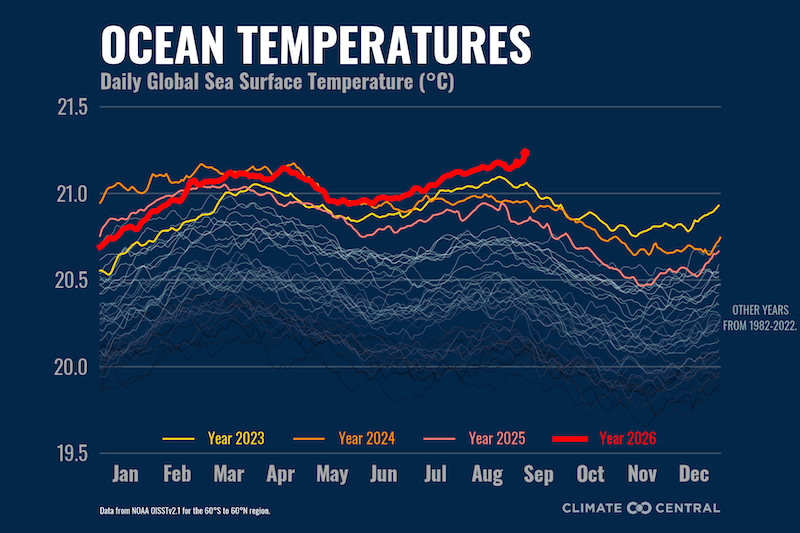
In a grim milestone that underscores the escalating pace of human-induced climate change, the Earth’s global oceans outside of polar regions have sustained a staggering 100 consecutive days of record-high average sea surface temperatures. According to comprehensive data compiled by the Climate Reanalyzer—a premier monitoring platform overseen by the University of Maine’s Climate Change Institute—this unprecedented thermal anomaly persisted unbroken from June 2 through September 10.
Throughout this 100-day window, daily global sea surface temperatures consistently eclipsed records set on the same calendar days in every preceding year since modern satellite and buoy records began in 1982. This relentless marine heat wave is not an isolated weather anomaly; rather, it represents a profound escalation of a long-term, systemic warming trend driven primarily by the relentless burning of fossil fuels and the unchecked accumulation of greenhouse gases in Earth’s atmosphere.
Experts warn that more than 90% of the excess heat trapped by anthropogenic emissions is absorbed directly by the world’s oceans. As this thermal energy penetrates not only the upper sea surface layers (stretching down to 200 meters or 660 feet) but also deeper oceanic strata, the ramifications extend far beyond marine ecosystems. The record-shattering ocean temperatures are fundamentally destabilizing global weather patterns, intensifying coastal heatwaves, threatening global food security, disrupting multi-billion-dollar maritime economies, and presenting direct, compounding hazards to human health across the globe. Compounding this baseline crisis is an intensifying El Niño cycle, which scientists predict will further amplify thermal pressures through the end of the year and into the immediate future.
Detailed Chronology of the 100-Day Thermal Peak
The unprecedented marine heat wave of the mid-to-late year did not materialize overnight, but its trajectory crossed into terrifyingly uncharted territory at the onset of June.
June 2: The baseline threshold was officially breached as global sea surface temperatures (excluding polar regions) climbed past all historical daily maximums recorded since 1982, initiating the unbroken 100-day streak tracked by the University of Maine’s Climate Reanalyzer.
August 22: The European Union’s Copernicus Climate Change Service documented one of the highest daily readings of the period, registering global ocean sea surface temperatures at an alarming 21.10°C (69.98°F).
August 22–27: Pushing the limits of historical measurement, data compiled from the U.S. National Oceanic and Atmospheric Administration (NOAA) via the Climate Reanalyzer recorded an even higher peak plateau, with average ocean sea surface temperatures surging to 21.18°C (70.12°F).
September 10: Marking the culmination of the 100-day consecutive record run, climate scientists and institutional directors convened for a high-level press briefing to dissect the catastrophic data, emphasizing that the streak reflects an accelerating, multi-year destabilization of the Earth’s climate equilibrium.
This unbroken century of record temperatures highlights how rapidly the planetary baseline is shifting. Weather systems crossing these overheated waters encounter thermal fuel unlike anything documented in human history, laying the groundwork for severe meteorological anomalies worldwide.
Supporting Context & Metrics: Quantifying the Ocean’s Burden
To truly comprehend the scale of the crisis, one must look at the staggering quantity of energy the global ocean is forced to absorb. Oceans act as the planet’s primary thermal sponge, buffering humanity from the full extent of atmospheric warming—yet this buffering capacity is reaching a critical breaking point.
The Zettajoule Metric: Energy Equivalencies
An authoritative analysis published in the scientific journal Advances in Atmospheric Science revealed that during the year 2025 alone, the global ocean absorbed an incomprehensible 23 zettajoules of heat. To put this into perspective:
This represents a 43% surge compared to the 16 zettajoules absorbed during 2024.
Twenty-three zettajoules of energy is quantitatively equivalent to the explosive force of roughly 12 atomic bombs detonating in the ocean every single second, twenty-four hours a day, 365 days a year.
Surface-to-Deep Penetration
Zachary Labe, a climate scientist at the U.S.-based nonprofit Climate Central, emphasized during the September briefing that the warming is no longer confined to the upper sunlit layers of the ocean.
"The driver of this record warmth is climate change," Labe stated, noting that over 90% of excess heat from fossil fuel combustion accumulates within marine waters. "It impacts marine ecosystems. It shifts the geographies of all parts of the marine ecosystem food chain. It also impacts our economy—things like fisheries, tourism. It also impacts the physical climate system and weather."
As thermal energy penetrates into deeper layers, it triggers vast changes in ocean stratification, altering deep-water circulation currents that regulate global climate stability.
Official Statements and Expert Insights
The 100-day milestone prompted urgent warnings from international climate researchers, meteorologists, and policy strategists, who outlined the systemic dangers posed by unchecked ocean heating.
The El Niño Catalyst
While long-term anthropogenic climate change provides the foundational heat engine, short-term natural climate variability is currently throwing gasoline on the fire. The onset of a new El Niño phase in June—projected by NOAA to develop into a "very strong" event—is dramatically compounding global thermal anomalies.
The El Niño–Southern Oscillation (ENSO) cycle dictates fluctuations in sea surface temperatures and atmospheric pressure across the tropical Pacific. During an El Niño phase, Pacific trade winds weaken, allowing vast pools of warm water to accumulate along the western coast of South America and radiate heat outward on a global scale. Scientists anticipate that the current El Niño will reach its peak toward the tail end of the year, casting its warming influence well into the subsequent months.
Cascading Impacts on Land: Heatwaves and Wet-Bulb Temperatures
Ocean heat does not stay in the ocean. According to Claire Bergin, a researcher at the ICARUS Climate Research Centre at Maynooth University in Ireland and a contributor to World Weather Attribution, marine heat waves have a direct, causal link to the severity of land-based heatwaves.
"There’s a direct link between increased sea temperatures and the intensity of land-based heat waves," Bergin explained during the briefing. She noted that the punishing heatwaves experienced across Europe over the summer—particularly in vulnerable coastal regions—were severely exacerbated by abnormally high sea surface temperatures.
Furthermore, Bergin highlighted the dangerous rise in wet-bulb temperatures on land. Wet-bulb temperature measures the lowest air temperature achievable exclusively through water evaporation. As high sea surface temperatures pump immense moisture into the air, relative humidity rises, inhibiting human perspiration and drastically reducing the body’s natural ability to regulate internal temperature.
Human Health Impacts: Elevated wet-bulb thresholds present an existential threat to outdoor laborers, elderly populations, and communities lacking advanced climate control infrastructure, turning routine summer conditions into lethal environments.
The Corporate Imperative for Decarbonization
Addressing the root causes of the crisis requires systemic economic transformation rather than localized adaptation. Pickerell, global director of the ocean program at the World Resources Institute and head of the secretariat for the High-Level Panel for a Sustainable Ocean Economy, argued that the burden of emissions reductions must fall squarely on major industrial polluters.
"Ultimately, we need to cut emissions," Pickerell asserted. "That is the key thing here." He emphasized that transitioning away from oil, gas, and coal is not an individual lifestyle choice, but an urgent corporate and governmental mandate for the world’s largest greenhouse gas emitters.
Future Outlook: Navigating the 1.5°C Threshold and Beyond
The timing of this 100-day ocean heat record coincides with increasingly dire warnings regarding global climate targets. The landmark Paris Agreement of 2015 established a critical guardrail: holding global warming to 1.5°C above pre-industrial levels to stave off the most catastrophic, irreversible tipping points of climate breakdown.
However, a sobering report released by the U.N. Environment Programme (UNEP) indicates that global average temperatures are now virtually guaranteed to surpass this 1.5°C threshold within the next few years, pushing Earth’s climate systems into uncharted and highly volatile territory.
As the current El Niño continues to mature, and as cumulative greenhouse gas emissions continue to rise unabated, the world’s oceans will face relentless thermal stress. Marine ecosystems—already battered by unprecedented coral bleaching events, such as the global bleaching crises documented across tropical and subtropical reefs—face an existential struggle. Fisheries that feed hundreds of millions of people, coastal tourism economies supporting local livelihoods, and planetary weather stability hang in the balance.
Without immediate, aggressive, and binding global commitments to phase out fossil fuels and aggressively draw down greenhouse gas emissions, the 100-day record set this year will soon be looked back upon not as an anomaly, but as a relatively cool baseline in a rapidly warming world.