


Executive Overview
Canada stands on the precipice of an unprecedented structural transformation. To achieve its national net-zero commitments and secure a resilient energy future, the country must overhaul its entire industrial, commercial, and residential infrastructure. According to the Climate Dollars analysis by Corporate Knights, putting Canada on a deep-decarbonization pathway through 2050 will require an astronomical $2.17 trillion in capital investment, averaging roughly $86 billion annually.
While public discourse often fixates on gargantuan, multi-billion-dollar megaprojects—such as trans-provincial high-voltage transmission lines, utility-scale wind farms, and vast hydroelectric complexes—the vast majority of the energy transition will look entirely different. It will be built from the ground up, manifesting as heat pumps in urban apartment buildings, advanced thermal insulation, localized solar arrays on rooftops and community lands, an expanding national fleet of electric passenger and commercial vehicles, widespread charging infrastructure, localized battery storage, and sophisticated microgrids binding them all together.
This sweeping decentralization introduces a profound economic question that extends far beyond greenhouse gas reductions: Who will own the assets that this $2 trillion buys, who will finance them, who will perform the labor, and where will the economic returns ultimately flow?
While conventional financial institutions, institutional investors, and chartered banks will provide the bulk of the liquidity, a critical slice of this capital wave opens the door to community finance. By leveraging local equity, community bonds, Indigenous partnerships, and cooperative ownership models, Canadians have a once-in-a-generation opportunity to transform how energy is consumed, paid for, and owned.
Detailed Chronology: The Evolution of Canada’s Decarbonization Roadmap
The Post-War Energy Paradigm and the Need for a New Blueprint
For over a century, Canadian communities operated under a centralized extractive model. Energy was imported, refined, burned, and exhausted. Municipalities, rural townships, and Indigenous nations spent billions of dollars annually on consumable fossil fuels—coal, natural gas, gasoline, and diesel—money that left local economies entirely once the fuel was burned.
The 2020s: The Shift Toward Distributed Assets
As federal and provincial climate policies tightened through the early 2020s, the physical realities of energy generation began to shift. The fossil-fuel economy, defined by point-source extraction and long-distance pipelines, started giving way to a decentralized renewable energy grid. Wind and solar resources required harvesting energy over vast geographic areas; residential and commercial buildings transformed from passive energy sinks into active generation and efficiency assets; and electric vehicles (EVs) emerged not merely as transit options, but as mobile storage units capable of feeding power back into the grid (Vehicle-to-Grid or V2G).
The Current Landscape: Unlocking the $1.2 Trillion Local Horizon
Corporate Knights’ modelling identifies more than $1.2 trillion in investments through 2050 tied to asset classes where some degree of local or community participation is not only possible, but economically advantageous. These asset classes include:
- Distributed wind and solar generation
- Comprehensive building decarbonization and retrofits
- Vehicle-to-grid charging infrastructure
- Local electricity distribution systems and microgrids
This figure does not imply that all $1.2 trillion will be funded through grassroots community bonds or cooperative shares. Conventional corporate capital, mortgages, and regulated utility balance sheets will continue to shoulder heavy lifting. However, this vast valuation defines the operational territory where community finance can successfully take root.
Supporting Context & Metrics: The Economics of the Clean Transition
To understand the financial mechanics of the transition, one must examine the staggering scale of Canada’s current energy expenditures juxtaposed against future capital assets.

Shifting from Consumable Fuel to Durable Capital
Canadians currently spend approximately $235 billion per year on energy, with $179 billion dedicated strictly to natural gas and petroleum products. While heavy industry, agriculture, and long-haul freight account for a massive share of this consumption, residential heating, personal vehicles, commercial buildings, and local service fleets are deeply embedded in community life.
- Personal and Commercial Transport: Canadian households spend more than $41 billion annually on fuel for personal vehicles. When light- and medium-commercial trucks—such as delivery vans, contractor trucks, and municipal service fleets—are factored in, the total climbs to roughly $65 billion annually. For a benchmark population-equivalent community of 50,000 residents, this represents a recurring annual energy bill of roughly $83 million.
- The Low-Carbon Dividend: Under the Corporate Knights low-carbon scenario, as these vehicle fleets are systematically electrified, the comparable annual energy expenditure drops to approximately $19 million.
While transitioning requires upfront capital—purchasing electric vehicles, installing chargers, and hardening local distribution grids—the foundational economic mechanism is radically altered. A liter of gasoline is purchased, burned, and gone forever. In contrast, capital invested in charging infrastructure, solar arrays, battery banks, and building envelopes creates enduring assets that deliver services for decades.
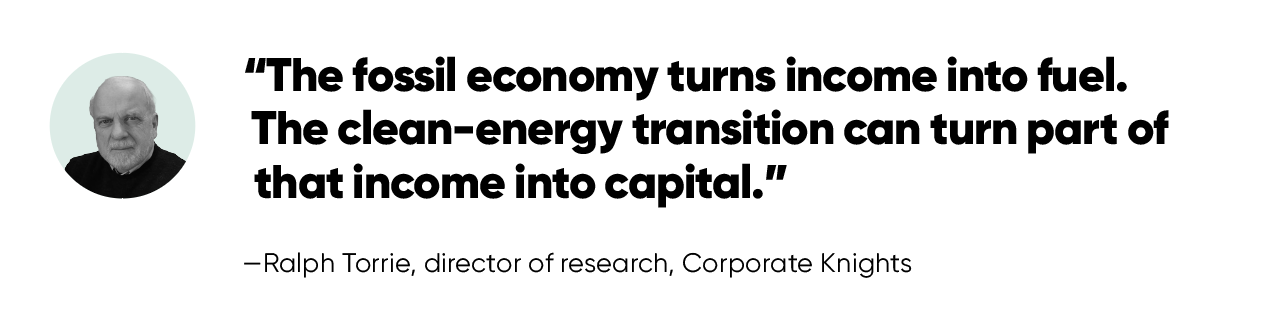
"The fossil economy turns income into fuel. The clean-energy transition can turn part of that income into capital."
Building Decarbonization: Millions of Micro-Projects
Buildings represent an even greater financial frontier. Decarbonizing Canada’s residential building stock requires an estimated $183 billion in incremental capital through 2050, while commercial buildings add another $191 billion, pushing the total building sector investment to approximately $374 billion.
Physically, however, there is no single "$374 billion building project." There are millions of discrete interventions: detached homes, high-rise apartment blocks, rural schools, community centers, health clinics, retail shops, and warehouses. These projects cannot be outsourced or automated remotely. An insulation contractor in New York cannot seal a building envelope in Sudbury, nor can an electrician in Shenzhen install a residential heat pump in Regina. The labor, project management, and maintenance must happen locally, turning the transition into a powerful engine for grassroots economic activity.
Expert Perspectives & Official Analysis
Industry researchers, economists, and energy sector analysts emphasize that bridging the gap between macro-level capital markets and micro-level community projects requires specialized financial plumbing.
Reducing Transaction Costs Through Aggregation
Conventional financial institutions are uniquely optimized for large, standardized transactions. However, a distributed energy transition presents the opposite operational challenge: thousands or millions of small-scale projects involving heterogeneous owners, varied technologies, and diverse local conditions. To a centralized bank, this variation looks like prohibitive transaction costs.
Local and community institutions solve this friction through aggregation. While financing a single residential building retrofit can be inefficient for a major financial institution, packaging 20, 50, or 500 retrofits together diversifies risk and drastically reduces administrative overhead. The same aggregation principle applies to affordable housing portfolios, multi-unit residential building (MURB) chargers, rooftop solar arrays, and community battery banks.
The Power of Ownership
According to Ralph Torrie, Director of Research at Corporate Knights, ownership is the ultimate determinant of where economic value resides once construction crews finish their work:
"A wind farm produces the same electrons and roughly the same construction employment whether it is owned by a multinational corporation, pension fund, municipality, Indigenous nation, or local cooperative. But ownership determines who receives the returns after the construction crews leave."
When communities hold equity stakes via municipal ownership, Indigenous partnerships, or community bonds, residents transition from being passive consumers or wage-earning workers to active equity investors. Surplus revenues generated by these assets can be reinvested locally into public services, infrastructure, or community development funds.
Furthermore, empirical research into renewable energy development demonstrates that local ownership dramatically alters public perception. Communities with meaningful financial participation experience clean energy infrastructure not as an imposition—something happening to them—but as a collective enterprise they are actively building and controlling.
Future Outlook: Rebuilding Canada’s Financial Architecture
As Canada marches toward 2050, the success of its climate ambitions will rely heavily on its willingness to modernize its financial toolkits. Community finance is not a silver bullet, nor is it a wholesale substitute for institutional capital; rather, it is an indispensable complement.
The Four Pillars of Community Finance
For community finance models to succeed, four core criteria must align:
- An Investable Asset: A physically sound, productive clean-energy installation (e.g., rooftop solar, microgrid, municipal wind stake).
- A Credible Issuer: A legally sound cooperative, municipal entity, non-profit, or Indigenous nation.
- A Dependable Repayment Stream: Predictable cash flows derived from power purchase agreements, utility savings, or municipal backing.
- Meaningful Ownership Opportunity: Genuine equity participation or bondholder rights for local stakeholders.
Conclusion: Think Globally, Invest Locally
For over a century, Canadian communities functioned as downstream consumers in a centralized fossil-fuel pipeline, perpetually buying consumable commodities. The emerging clean-energy architecture demands a complete inversion of this paradigm: it is far more capital-intensive upfront, vastly less fuel-intensive over time, and inherently distributed across the landscape.
An energy system that is becoming increasingly distributed across communities requires a financial architecture capable of matching that dispersion. By aligning local capital with local ownership, Canada can ensure that the $2.17 trillion energy transition does not merely decarbonize the atmosphere, but actively enriches the communities where Canadians live, work, and build their futures.



