

Executive Overview
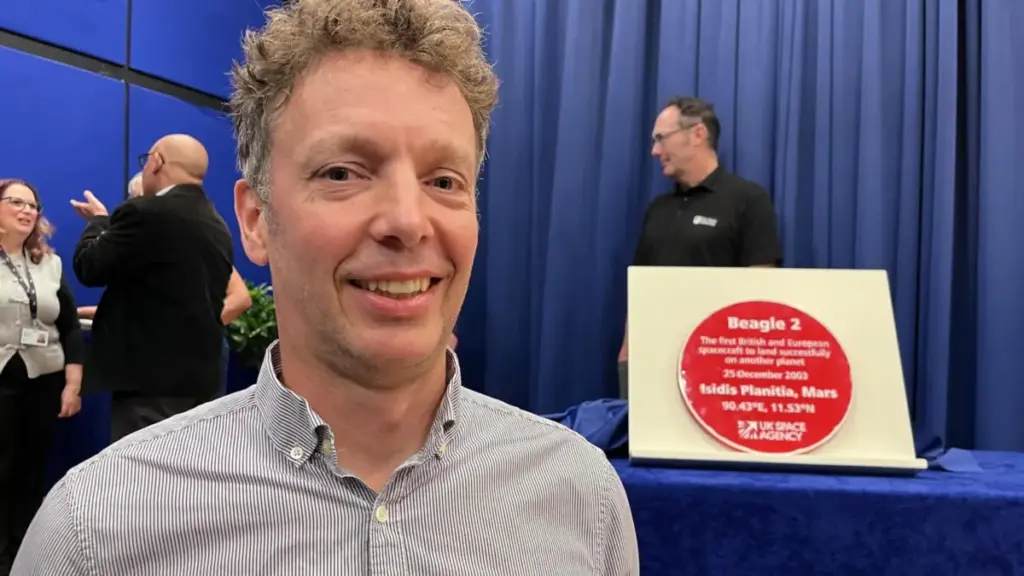
Two decades after a silent Christmas on the red plains of Mars cast a long shadow over British space aspirations, a nationwide wave of commemorative plaques has begun to reframe the legacy of Beagle 2. Long written off as a quintessential example of high-profile British hubris and technical failure, the mission that once symbolized the heartbreak of a lost spacecraft is undergoing a profound historical reassessment.
At the center of this narrative is Professor Colin Pillinger, a charismatic, unorthodox planetary scientist whose mutton-chop sideburns, West Country lilt, and fierce public advocacy turned an audacious interplanetary gamble into a cultural phenomenon. Operating on a shoestring budget of roughly £50 million—a fraction of the billions spent by superpowers like NASA—Pillinger and his team accomplished what many thought impossible: they built the UK’s first spacecraft to reach another world.
Though Pillinger passed away in 2014 believing his life’s work had ended in total failure, high-resolution imagery captured by NASA months later revealed the poignant truth. Beagle 2 had made it to the surface, successfully executed its complex atmospheric descent, and crashed softly into the Martian dust. Only a jammed solar panel, which trapped the onboard antenna, prevented it from sending its historic call-sign home. Today, as commemorative plaques go up across the UK, historians, scientists, and the public are finally celebrating Beagle 2 not as a failure, but as a monumental milestone in British scientific ingenuity.
Detailed Chronology: From Concept to the Martian Surface
The Genesis of an Impossible Dream (1980s–1999)
The journey of Beagle 2 began far from the sterile cleanrooms of major aerospace contractors. Born in Kingswood near Bristol and educated at Swansea University, Colin Pillinger established his scientific credentials through groundbreaking lunar research before joining Cambridge University to analyze Antarctic meteorites believed to originate from Mars. By the 1980s, he had co-founded the Planetary and Space Sciences Research Institute at The Open University in Milton Keynes, cementing his reputation as an elite analytical chemist.

However, the idea for a British Mars lander was born out of both scientific ambition and geopolitical frustration. At the time, deep-space exploration was the exclusive playground of superpowers with bottomless state budgets. Britain possessed no dedicated national space agency, forcing Pillinger to think laterally.
His solution was ingenious: Beagle 2 would hitch a ride aboard the European Space Agency’s (ESA) Mars Express orbiter, which was already scheduled for a 2003 trajectory to the red planet. In 1999, the ESA approved the piggyback arrangement, though it came with a daunting caveat—no guaranteed funding or logistical safety net. Pillinger would have to secure the resources himself.
Capturing the Public Imagination (1999–2003)
Recognizing that traditional bureaucratic funding channels would not suffice, Pillinger weaponized public enthusiasm. He became a ubiquitous media figure, famously wheeling a scale model of the lander in a supermarket trolley across an Open University car park to demonstrate its compact dimensions to television crews. The footage, later lampooned on satirical programs like Have I Got News for You, achieved its true purpose: making space exploration a topic of kitchen-table conversation across Britain.
Pillinger understood that science needed cultural capital. He persuaded Britpop icons Blur to compose a distinctive acoustic call-sign that Beagle 2 would transmit upon a successful landing. Renowned artist Damien Hirst contributed a spot painting to serve as the onboard camera’s calibration target.

Through sheer force of will, political lobbying, and private sponsorship, Pillinger scraped together the necessary funds. Built for a remarkably modest £50 million, Beagle 2 was a triumph of frugal engineering, even if it looked unorthodox resting on a lawn during early press calls.
The Silent Christmas (December 2003)
On June 2, 2003, Mars Express launched successfully into the cosmos, carrying its precious British cargo toward an anticipated Christmas Day rendezvous.
By Christmas Eve, the atmosphere at The Open University’s London headquarters was thick with champagne, excitement, and nervous anticipation. Celebrities, politicians, and scientists gathered in festive spirits; band members from Blur sipped mulled wine, and singer Myleene Klass distributed jelly babies as the clock ticked toward the moment of truth.
The signal never arrived.

As hours turned into days, the chilling realization set in: Beagle 2 was mute. Subsequent official inquiries by the UK government and the ESA laid bare the project’s financial strains and managerial friction, casting a pall over the mission. Pillinger’s subsequent proposal for a Beagle 3 was summarily rejected by the ESA in 2004, seemingly closing the chapter on British planetary landing attempts.
The Vindication from Orbit (2015)
Colin Pillinger died in May 2014 following a brain haemorrhage, carrying to his grave the heavy conviction that his life’s defining project had smashed uselessly into the Martian soil.
Yet, cosmic justice moves on its own timeline. Eight months after his passing, high-resolution imagery returned by NASA’s Mars Reconnaissance Orbiter spotted a curious, glinting anomaly resting in the red dust of Isidis Planitia, just five kilometers from its intended landing target.
Analyses of the photographs confirmed the unthinkable: Beagle 2 had landed successfully.

The intricate sequence of heat shields, parachutes, and shock-absorbing airbags had all deployed precisely as engineered. The spacecraft sat almost entirely intact on the surface of another world. The mission’s failure was agonizingly mechanical rather than catastrophic: one of the lander’s petal-like solar panels failed to open fully, blocking the radio frequency antenna and sealing its acoustic fate.
Supporting Context & Metrics
To fully appreciate the scale of the Beagle 2 achievement, financial and structural metrics provide vital perspective:
- The Cost Disparity: While NASA’s legendary Apollo program consumed an estimated $25 billion during the 1960s (adjusting for modern inflation, a vastly greater sum), Beagle 2 was constructed on an ultra-lean budget of approximately £50 million.
- The Mass Constraint: The entire operational lander weighed a mere 33.2 kilograms, including its scientific payload designed to hunt for signs of past or present life.
- The Proximity Milestone: Beagle 2 touched down within 5 kilometers of its targeted landing ellipse—an astonishing navigational feat given the primitive telemetry constraints and the chaotic nature of Martian atmospheric entry at the time.
- The Human Network: While Pillinger acted as the flamboyant frontman, the project was powered by an extensive coalition of academic institutions, industrial contractors, and engineering teams spread across the United Kingdom.
Official Statements and Reflections
The posthumous rehabilitation of Beagle 2 has brought profound emotional closure to the scientific community and the Pillinger family alike.
Reflecting on the discovery of the lander and the nationwide rollout of commemorative plaques, Nic Pillinger shared his thoughts on his father’s legacy:

"My dad always spoke of himself as being the frontman to the band that was behind this. It wasn’t just a one-man project. It was a huge number of people working across different institutions coming together to make it happen."
Addressing the bittersweet reality that his father did not live to witness the photographic proof of the landing, Nic added:
"This is an achievement that had been on ice for many years, and it can finally take its rightful place in history. There’s nobody in the UK he didn’t reach."
Pallab Ghosh, the BBC science correspondent who initially arrived in Milton Keynes to report on a skeptical venture involving "a bloke sending a spaceship to Mars from a lawn," noted how public perception transformed over the decades:

"Colin took something deeply complex, expensive, and remote, and he made it feel personal to the British public. Even when the odds were stacked against him, he created a collective stake in the stars."
Future Outlook: A Legacy Cast in Bronze and Stardust
The unveiling of the new plaque series across the UK is far more than a sentimental nod to past endeavors; it marks a cultural turning point for British space exploration. In the years since Beagle 2, the UK has established a formal national space agency, nurtured a booming commercial satellite manufacturing sector, and become a central partner in major international planetary sample-return initiatives.
Yet, the ghost of Beagle 2 remains the spiritual bedrock of modern British astrobiology. It proved that a nation does not need a superpower’s checkbook to spark a revolution in interplanetary ambition—it requires vision, resilience, and a touch of maverick brilliance.
As generations pass and rovers continue to roam the arid, rust-colored expanses of Mars, the silent, petal-stuck lander resting in Isidis Planitia stands as a monument to human determination. Colin Pillinger may have viewed himself merely as the frontman, but the melody he played has permanently altered the symphony of British science.



