A landmark global attribution study has revealed a profound intergenerational and geographic divide in exposure to the impacts of global warming: more than 44% of children under the age of ten—amounting to approximately 583 million children worldwide—are now subjected to at least 20 additional "heat-stress days" every year as a direct consequence of anthropogenic climate change.
The study, published in Science Advances by an international team of researchers, combines high-resolution climate modeling with global demographic data to map age-specific exposure to compound extreme heat and high humidity. The findings establish that children aged nine and younger currently face greater exposure to climate-attributed humid heat than any other age bracket on Earth.
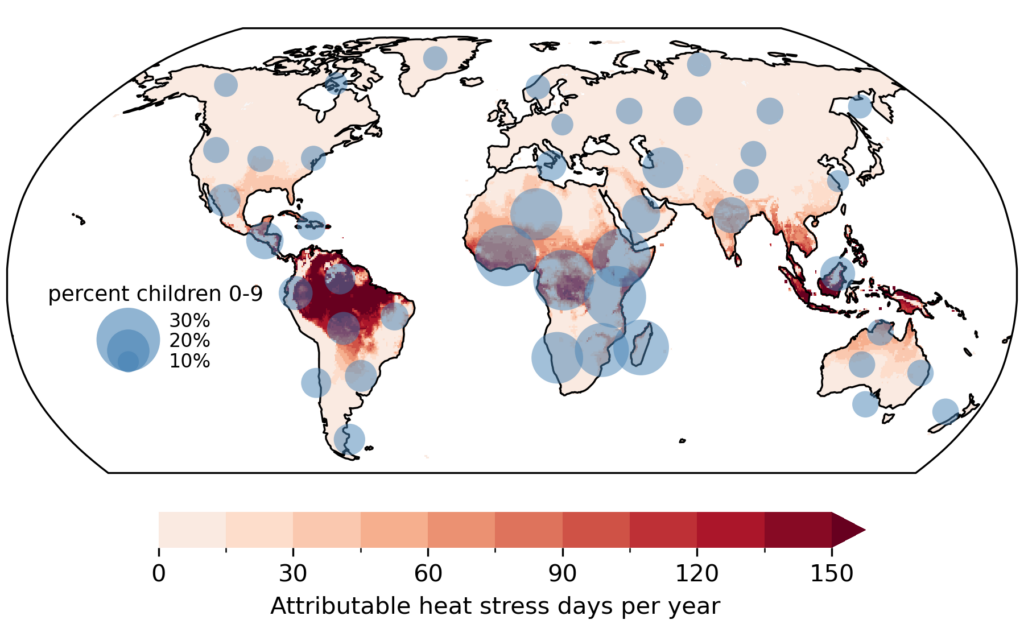
The crisis is heavily concentrated in the tropics and low-latitude regions of the Global South—most notably across South Asia, Southeast Asia, and West Africa. These areas combine high baseline climatic vulnerability with rapid demographic growth, resulting in an unprecedented concentration of young populations on the frontlines of dangerous heat. As global mean temperatures continue to rise, scientists warn that this exposure gap will widen, placing an uneven burden on young populations in developing nations who have contributed virtually nothing to historical greenhouse gas emissions.
Detailed Chronology & Scientific Methodology
The Evolution of Youth Climate Risk Modeling
This latest investigation builds upon a growing body of climate attribution science focused on lifetime exposure to extreme events.
2021 Landmark Assessment: A foundational study demonstrated that children born in the 21st century would face an unprecedented frequency of extreme weather events—including heatwaves, droughts, and crop failures—compared to their parents and grandparents.
2025 Cohort Tracking: Subsequent research focused on the 2020 birth cohort, determining that over half of children born that year—roughly 62 million individuals—would experience "unprecedented lifetime exposure" to severe heatwaves, even under an optimistic mitigation scenario limiting global warming to 1.5°C above pre-industrial levels.
Latest Science Advances Findings: The newest research expands this framework by incorporating compound humid heat and present-day demographic distributions, proving that the disproportionate impact on young children is not merely a future projection, but an active, measurable reality today.
       CHRONOLOGY OF YOUTH HEAT EXPOSURE RESEARCH
 ┌────────────────────────────────────────────────────────┐
 │ 2021: Baseline studies prove 21st-century youth faces │
 │       unmatched lifetime extreme weather events.       │
 └───────────────────────────┬────────────────────────────┘
                             │
 ┌───────────────────────────▼────────────────────────────┐
 │ 2025: Follow-up study reveals >50% of 2020 cohort      │
 │       faces unprecedented heatwave exposure at 1.5°C.  │
 └───────────────────────────┬────────────────────────────┘
                             │
 ┌───────────────────────────▼────────────────────────────┐
 │ LATEST: Science Advances study identifies 583M children│
 │         under 10 already facing ≥20 extra heat days/yr.│
 └────────────────────────────────────────────────────────┘
The Mechanics of Humid Heat Measurement
To evaluate heat stress accurately, the authors utilized the indoor Wet-Bulb Globe Temperature (WBGT), a metric that accounts for the combined effects of air temperature, humidity, and thermal radiation.
While extreme dry heat poses severe risks, high humidity amplifies physiological danger. The human body relies on the evaporation of sweat from the skin to dissipate heat and regulate core body temperature. As ambient humidity increases, the rate of evaporation slows significantly, reducing the body’s natural cooling mechanism.
In this framework:
Heat-Stress Threshold: A "heat-stress day" is defined as any day where the indoor WBGT exceeds 28°C (82.4°F), the recognized international threshold for "moderate heat stress."
Simulated Baselines: Using advanced climate models, the authors evaluated global temperature and moisture patterns for a present-day climate baseline (represented by 2023, where human activities have driven approximately 1.3°C of warming above pre-industrial levels).
Counterfactual Comparison: The team then executed parallel simulations representing a counterfactual pre-industrial climate devoid of human-induced greenhouse gas emissions.
By comparing the frequency of heat-stress days between the present-day simulations and the pre-industrial baselines, the researchers calculated the net number of "extra" or "attributable" heat-stress days directly caused by global warming.
Supporting Context & Geographic Metrics
Geographic Disparities in Heat Exposure
The study highlights a stark divide between low-latitude tropical nations and high-latitude temperate regions. Tropical regions experience far more background humidity and sustained heat, meaning even incremental warming pushes local conditions past critical safety thresholds for long periods.
Region / Country
Present-Day Annual Heat-Stress Days
Climate Change Attributable Share
Dominant Demographic Profile
Côte d’Ivoire
~112 days / year
~50% (Approx. 56 extra days)
Rapidly growing, young population
West Africa (Regional)
High (>60 days average)
High (>40% attributable)
High proportion of children under 10
South & Southeast Asia
High (>50 days average)
High (>40% attributable)
High absolute child population
Germany
~0.1 days / year
~100% (Infrequent, extreme spikes)
Aging population, low youth proportion
For instance, residents of Côte d’Ivoire currently endure an average of 112 heat-stress days annually, with roughly half of those days directly attributable to human-driven climate change. Conversely, Germany averages just 0.1 heat-stress days per year under present climate conditions.
The stark imbalance in age-specific heat exposure stems from two intersecting global trends:
Absolute Population Structure: Globally, there are roughly 1.3 billion children under the age of 10, compared to approximately 600 million adults aged 60 to 69.
Geographic Distribution: Developing nations across tropical sub-Saharan Africa and Asia exhibit high fertility rates and young demographic profiles. In contrast, higher-latitude regions in Europe and North America feature older, stagnant, or declining populations.
Because the regions experiencing the greatest climate-driven increases in humid heat are also those with the youngest populations, young children bear a disproportionate share of the global heat burden.
       GLOBAL AGE EXPOSURE TO ≥20 ATTRIBUTABLE HEAT-STRESS DAYS

       Children Under 10 │ █ █ █ █ █ █ █ █ █ █ █ █ █ █  44% (583 Million)

       Adults Aged 60-69 │ █ █ █ █ █ █ █ █ █  30% (190 Million)
Globally, 583 million children under 10 (44% of their global demographic) endure at least 20 attributable heat-stress days annually. In contrast, 190 million adults aged 60 to 69 (30% of their demographic cohort) face an equivalent exposure level.
Escalating Risks: Projected Impacts Under 1.5°C and 2°C Pathways
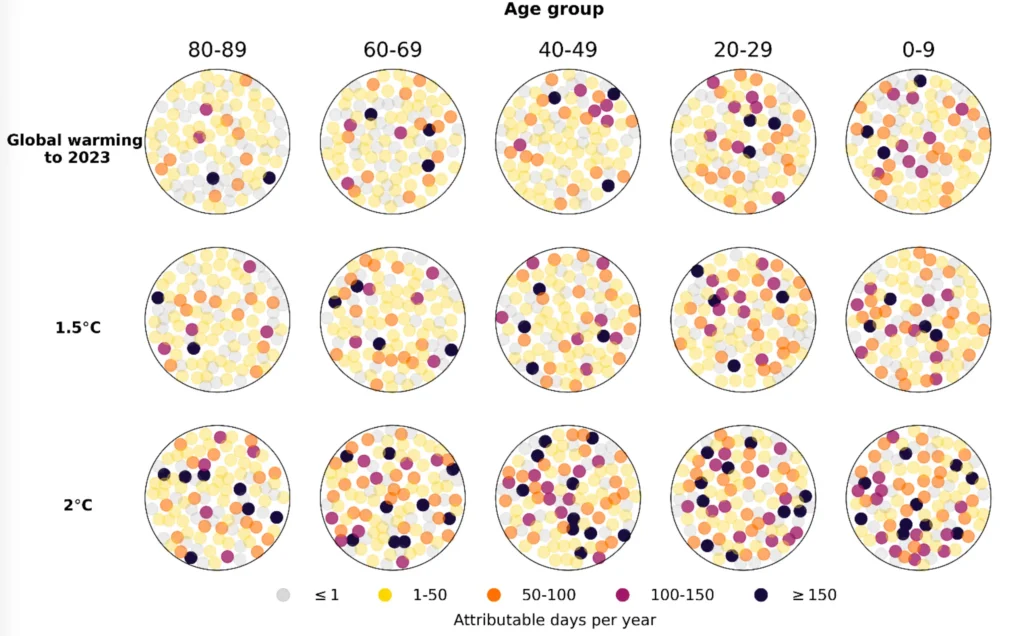
To evaluate future risk, the researchers projected exposure scenarios under 1.5°C and 2.0°C global warming targets, aligning their calculations with the Shared Socioeconomic Pathway 2 (SSP2) demographic projections. Under SSP2, the global population is expected to peak above nine billion in the second half of the century, with population growth heavily weighted toward sub-Saharan Africa and low-latitude Asia.
Projected Exposure to Extreme Heat Load (≥100 Attributable Heat Days/Year)
The findings demonstrate a steep rise in severe exposure as global temperatures increase:
Present-Day Climate (1.3°C Warming):
Children Under 10: 11% experience 100 or more attributable heat-stress days annually.
Adults Aged 60–69: 6% experience 100 or more attributable heat-stress days annually.
1.5°C Global Warming Scenario:
Children Under 10: Exposure rises to 13%.
Adults Aged 60–69: Exposure rises to 9%.
2.0°C Global Warming Scenario:
Children Under 10: Exposure surges to 23% (nearly one in every four children worldwide).
Adults Aged 60–69: Exposure rises to 17%.
    PERCENTAGE OF COHORT EXPOSED TO ≥100 EXTRA HEAT DAYS/YEAR

   30% ┌─────────────────────────────────────────────────────────┐
       │                                                         │
   20% │                                                [23%]    │
       │                                       [13%]      █      │
   10% │                              [11%]      █        █      │
       │                                █        █      [17%]    │
    0% └────────────────────────────────█────────█────────█──────┘
                                     Present   1.5°C     2.0°C
                                     (1.3°C)   Target   Limit

                                     █ Children Under 10
                                     █ Adults Aged 60-69
These projections emphasize that failing to cap global warming at 1.5°C will more than double the proportion of young children forced to live through more than three months of added heat stress every year.
Official Statements & Expert Commentary
Lead Author Insights: Equity and Metric Refinement
Rosa Pietroiusti, a doctoral researcher at Vrije Universiteit Brussel and lead author of the study, emphasized the climate justice implications of the findings:
"Children in developing nations have contributed the least to historical greenhouse gas emissions, yet they are sitting on the frontlines of this expanding thermal envelope. Our findings demonstrate that the climate crisis is fundamentally an intergenerational rights issue."
Addressing the study’s analytical parameters, Pietroiusti noted that while indoor WBGT is a well-established metric for human heat stress, it was not originally developed specifically for pediatric physiology:
"A crucial next step for the research community is to forge deeper integrations between climate modeling and pediatric health sciences. We need heat metrics tailored specifically to children’s physiological thresholds, learning capacities, and development."
Pietroiusti also pointed out key limitations in current data modeling, noting that global global-scale climate resolution does not fully capture local urban microclimates:
"Our data does not explicitly resolve the urban heat island effect, which means thermal stress locally within dense cities is likely underestimated. Furthermore, global disaster databases like EM-DAT suffer from systematic underreporting of heatwaves across Africa due to limited news coverage and formal monitoring infrastructure. Climate attribution modeling provides a crucial path forward to close these knowledge gaps."
Dr. Qinqin Kong, a postdoctoral fellow in medicine and health policy at Stanford University who was not involved in the study, praised the paper’s quantitative rigor, but urged caution against overly simplistic comparisons between children and the elderly:
"This paper provides timely quantitative evidence for discussions surrounding climate justice, children’s rights, and intergenerational equity. However, it may understate the operational burden borne by older populations.
Children frequently benefit from direct caregiver oversight, organized school environments, and adult intervention. Conversely, many older adults live in isolation, suffer from severe mobility constraints, and encounter major socio-economic barriers to accessing artificial cooling or emergency medical support during acute heat events."
Dr. Kong also underscored the vulnerability of mid-latitude populations across Europe and North America:
"Populations in mid-latitude regions show a higher relative mortality risk during sudden heat extremes because they are physiologically unacclimatized, urban architecture is rarely designed for heat dissipation, and residential air conditioning adoption remains comparatively low."
Dr. Daniel Vecellio, a climate and thermal health researcher at the University of Nebraska, highlighted both challenges and adaptive mechanisms among young cohorts:
"Children remain an understudied group within thermal physiology and epidemiological literature. Yet, there is reason for cautious optimism: young people are often dynamic behavioral adapters when given appropriate environments to seek shade and hydration. Furthermore, populations chronically exposed to warmer regimes may develop biological and operational acclimatization mechanisms over time."
Future Outlook & Policy Implications
The findings published in Science Advances carry significant policy implications for international climate negotiations, regional urban planning, and global public health frameworks.
1. Re-Evaluating Loss and Damage Allocations
The research provides empirical backing for international climate finance mechanisms, including the United Nations Framework Convention on Climate Change (UNFCCC) Loss and Damage Fund. By documenting how climate-driven heat disproportionately affects children in low-emission, low-income countries, the study offers a clear scientific foundation for prioritizing adaptation funding and healthcare grants for pediatric services in sub-Saharan Africa and Southeast Asia.
2. Pedagogy and Infrastructure Adaptation
School systems across tropical and subtropical regions face severe operational disruptions due to extreme heat. Sustained exposure to high wet-bulb temperatures impairs cognitive development, reduces learning outcomes, and increases school absenteeism. Urban planners and education authorities will need to prioritize passive cooling infrastructure, urban canopy expansion, and localized climate-resilient school architecture to protect young populations.
3. Integrating Physiological Specificity into Early Warning Systems
Current municipal heat action plans and early warning systems predominantly rely on general adult physiological thresholds. Integrating child-specific health metrics into regional heat wave protocols will be vital to safeguard vulnerable cohorts as global temperatures approach key climate tipping points.
The study underscores a clear reality for the global community: without rapid reductions in fossil fuel emissions and targeted adaptation investments in vulnerable regions, hundreds of millions of children will spend their formative years navigating an increasingly unlivable climate regime.