Between 11 million and 16 million years ago, during the middle Miocene period when global sea levels were dramatically higher, the evolutionary precursors to the Indus River dolphin forged into the warm, turbid waters of what is now the Indus Basin. Over eons, these mammals underwent profound, singular physiological adaptations to their new freshwater domain. They evolved a sophisticated echolocation system to navigate their murky surroundings while progressively and completely losing their eyesight.
Today, these functionally blind cetaceans—scientifically designated as Platanista minor and locally revered as the bhulan, or the "Queen of the Indus River"—are living evolutionary marvels. To navigate the shallow, dry-season currents of their shrinking home, they swim distinctively on their sides, slicing through the water using their specialized flippers. Yet, their prehistoric mastery of the Indus River system offers little defense against the relentless, modern transformation of their habitat by human hands.
Fragmented by a sprawling, intricate grid of industrial dams, water diversion canals, and irrigation barrages, the historical range of the Indus River dolphin has been slashed by approximately 80%. Once numbering an estimated 10,000 individuals in the late 19th century, the species faced an catastrophic bottleneck, plummeting to just 617 known individuals by 2001.
However, a wave of concerted conservation interventions, stringent legal frameworks, and ongoing scientific monitoring has sparked a fragile recovery. A landmark 2025 study published in Endangered Species Research (ESR) documented a resilient metapopulation rebound, placing total numbers at an estimated 1,987 individuals—reflecting a 19.4% population increase between 2011 and 2017.
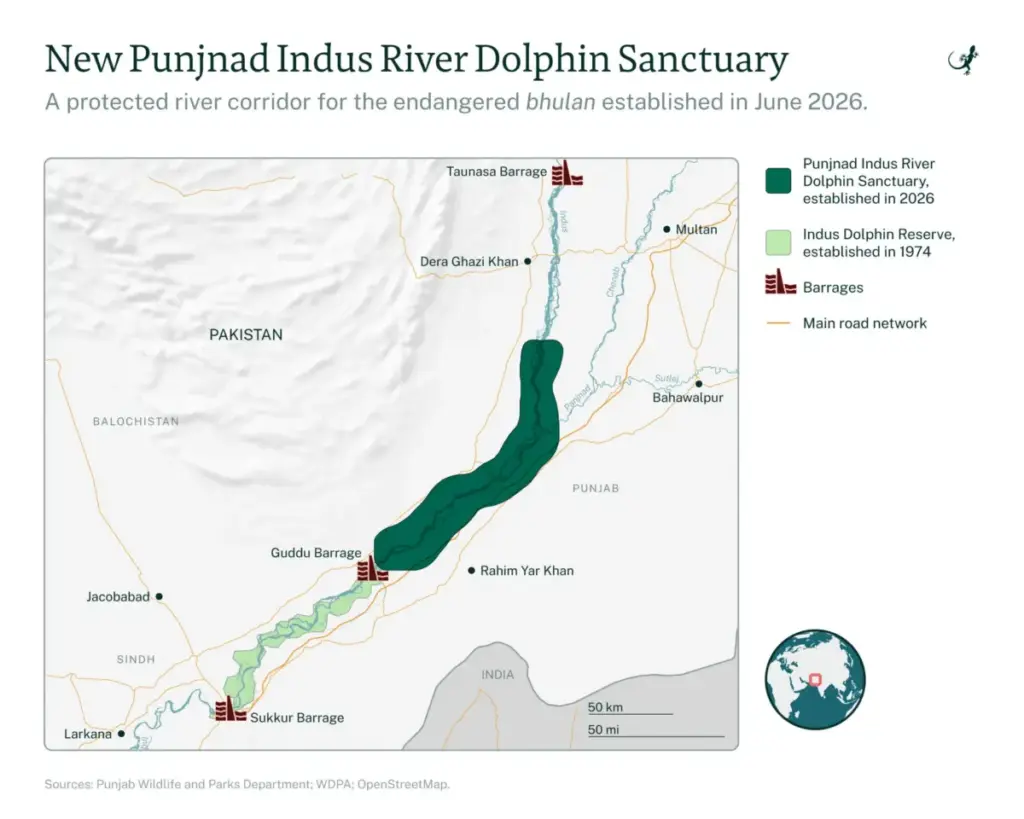
Bolstering these hard-won gains, the Pakistani government officially established the Punjnad Indus River Dolphin Sanctuary in June 2026. Safeguarding nearly 200 kilometers (123 miles) of the Indus River in Punjab province, this newly minted sanctuary links seamlessly with an existing protected area in neighboring Sindh province. Together, they create a contiguous, legally protected corridor spanning 400 kilometers (249 miles)—providing a desperately needed lifeline for one of the rarest, most endangered freshwater cetaceans on Earth.
Detailed Chronology: From Miocene Origins to Modern Sanctuary
To understand the precarious existence of the bhulan, one must trace its deep history alongside the geological evolution of the Indian subcontinent.
The Evolutionary Odyssey
During the Miocene, as tectonic plates collided and shifting seas retreated, proto-dolphins became landlocked within the ancestral river systems of South Asia. Isolated from marine relatives, these ancestral cetaceans adapted to life in a dynamic, highly turbid fluvial ecosystem. Without the evolutionary pressure to maintain sight in light-starved, silt-laden waters, their eyes degenerated into rudimentary lenses capable of sensing only the direction of light, while their auditory and echolocation faculties experienced hyper-development.
For millennia, the bhulan reigned supreme over a vast, unobstructed aquatic highway. Historical accounts from the 19th century indicate that the species roamed freely across the entire Indus River network, stretching from the foothills of the Himalayas down through the plains of Punjab and Sindh, all the way to the Indus Delta and tributaries like the Beas River in northwestern India.
The 20th-Century Bottleneck
The mid-to-late 20th century, however, brought unprecedented ecological disruption. Driven by agricultural demands in a burgeoning region, engineers carved the Indus River basin into a compartmentalized network of barrages and canals. These concrete behemoths severed the river’s continuity, splitting the dolphin population into isolated, vulnerable subpopulations and cutting them off from historical feeding and breeding grounds.
Simultaneously, commercial hunting, unregulated fisheries, and systemic water extraction took a devastating toll. By 2001, intensive surveys recorded a terrifying low of just 617 surviving individuals, pushing the species to the absolute brink of extinction and securing its spot on the IUCN Red List as Endangered.
Policy Milestones and the 2025 ESR Study
Recognizing the impending loss of an irreplaceable national heritage, conservationists and regional governments began fighting back. In the 1970s, the Government of Sindh took a monumental step by outlawing dolphin hunting and establishing the Indus Dolphin Reserve between the Guddu and Sukkur barrages.
Decades of localized rescue operations, community outreach, and habitat monitoring slowly began to bend the curve. These efforts were scientifically validated by the landmark 2025 Endangered Species Research study, led by researcher Hamera Aisha and co-authored by prominent conservation biologists. The study revealed that the metapopulation had climbed to 1,987 individuals. Crucially, the data demonstrated that nearly 99% of all surviving Indus River dolphins are now concentrated within a single, critical 690-kilometer (430-mile) stretch of the river, cradled between the Chashma barrage in Punjab and the Sukkur barrage in Sindh.
The June 2026 Declaration
Capitalizing on the momentum of the 2025 study, the Pakistani government formalized the creation of the Punjnad Indus River Dolphin Sanctuary in June 2026. By bridging the governance gap in Punjab and tying into Sindh’s pre-existing protected zone, this action transforms fragmented regional conservation efforts into a unified, national strategy.
Supporting Context & Metrics
The survival of the bhulan is an issue of profound global significance, carrying distinct scientific, ecological, and geographical implications.
A Global Responsibility
Because the Indus River dolphin is endemic exclusively to the Indus River system, its survival rests almost entirely on the shoulders of Pakistan.
"The Indus River dolphin is endemic to the Indus River system, and the overwhelming majority of the remaining global population occurs in Pakistan, with only a very small remnant population now left in the Beas River in India," explained Hamera Aisha, lead author of the 2025 ESR study, in an interview with Mongabay. "This also means that if these populations were lost from the Indus, there is no comparable population elsewhere that could secure the future of the species. This gives Pakistan a unique global responsibility for the species."
Key Statistical Metrics at a Glance
Geological Origin: 11 to 16 million years ago (Middle Miocene period).
Historical Range Loss: Approximately 80% reduction from historical boundaries.
Population Trough (2001): 617 individuals.
Population Rebound (2025 Study): 1,987 individuals (a 19.4% increase between 2011 and 2017).
Concentration Zone: ~99% of the population lives within a 690-km (430-mi) stretch between Chashma and Sukkur barrages.
New Sanctuary Scope: Nearly 200 km (123 miles) of protected river in Punjab province.
Total Protected Corridor: ~400 km (249 mi) of contiguous legally protected habitat across Punjab and Sindh.
Primary Cause of Documented Mortality (2008–2023): Gillnet entanglement, accounting for 52% of recorded deaths.
Official Statements & Expert Insights
Safeguarding the bhulan requires active collaboration among provincial wildlife departments, federal agencies, international NGOs, and local fishing communities.
The Threat of Commercial Fishing
While legal protection halts intentional hunting, indirect human pressures remain severe. Gillnets deployed by commercial fisheries pose an existential threat.
"The river section in Punjab holds the second largest population of the Indus river dolphin," noted Dr. Uzma Khan, a field biologist with the World Wildlife Fund (WWF) and co-author of the 2025 study. "Punjab auctions fishing contracts for commercial fishing, which means that a contractor would take as much fish as possible to make the contract economically feasible. This is detrimental to dolphins as mortality due to entanglements in fishing gear is one of the leading threats to river dolphins globally."
Between 2008 and 2023, data shows that gillnet entanglement was responsible for an alarming 52% of all documented dolphin mortalities within the Indus Basin.
Provincial Collaboration and Legal Legacies
Javed Mahar, conservator of the Sindh Wildlife Department, highlighted the historical context of dolphin protection and praised the cross-provincial expansion.
"Earlier, before construction of barrages and dams on rivers, it was found from Attock to the Indus delta, but its habitat shrinkage took place," Mahar explained. "The Government of Sindh during 1970 extended legal protection to this iconic species and declared the Indus Dolphin Reserve between Guddu and Sukkur Barrage. Similar steps were required from the other two provinces, including Khyber Pakhtunkhwa (KPK) and Punjab."
Mahar views the new Punjab sanctuary as a vital extension of Sindh’s pioneering conservation legacy. With organizations like WWF-Pakistan acting as a bridge between provincial jurisdictions, coordinated management is finally becoming a reality.
Bridging Protection vs. Ecological Connectivity
While the new sanctuary establishes legal continuity, experts are quick to clarify that it does not instantly solve the physical fragmentation of the river. Barrages continue to obstruct natural migration, and seasonal irrigation demands frequently pull dolphins away from the main channel and into treacherous, shallow canals.
"Stranding of dolphins is a more serious issue further downstream in Sukkur," Uzma Khan noted.
For over two decades, specialized WWF rescue units have patrolled these canals, capturing stranded, high-stress dolphins and trucking them back over rough roads to release them into the main river channel. While removing the barrages is logistically and economically impossible, conservationists argue that barrage operations must increasingly incorporate ecological flows to prevent animals from straying into lethal irrigation networks.
Future Outlook: Navigating the Road Ahead
The establishment of the Punjnad Indus River Dolphin Sanctuary is a monumental victory for conservation, but experts emphasize that it is not a finish line. To ensure the long-term survival of the bhulan, stakeholders must navigate a complex matrix of emerging and compounding environmental threats.
Combating Pollution and Climate Change
Beyond fishing gear and concrete barriers, the Indus ecosystem is buckling under systemic environmental degradation. Gold mining operations along parts of the river utilize toxic chemical agents such as mercury and cyanide, contaminating aquatic food webs. Furthermore, escalating municipal, agricultural, and plastic pollution degrades water quality for both dolphins and the fish populations they rely on.
Simultaneously, climate change is fundamentally altering hydrological cycles. Accelerated melting of Himalayan glaciers, erratic monsoon patterns, and severe water abstraction threaten to destabilize natural river flows.
"Maintaining sufficient river flows and habitat quality is critical," Hamera Aisha stressed. "Dolphins depend on adequate water depth, connected channels and deep pools, and healthy fish populations. Water abstraction and altered flow regimes are therefore directly relevant to dolphin conservation. Pollution from agricultural, municipal and industrial sources and now the plastic pollution also needs greater attention because it affects both dolphins and their prey."
Empowering Local Communities
No conservation strategy can succeed in a working river without the active buy-in of the people who depend on its waters for their daily survival. Traditional subsistence fishing has increasingly given way to aggressive commercial operations, alienating local fishers and escalating tensions over resource use.
"Communities are pivotal to the success of any conservation initiative," Dr. Uzma Khan said. "Over years we have seen that traditional fishers have taken other jobs and sustenance fishing has been replaced by commercial fishing. This new protected area intends to encourage community-based sustainable fishing and we will see new rules gradually shape up to ensure community involvement to provide that livelihood support."
Science-Based Management and International Standards
Moving forward, conservationists advocate for the implementation of rigorous, science-based management plans tailored to local communities. Frameworks such as the Conservation Assured | River Dolphin Standards (CA|RDS) offer international guidelines to balance human economic needs with cetacean protection. In a working river where agriculture, industry, energy, and biodiversity intersect, relying purely on punitive enforcement is destined to fall short.
The bhulan has survived millions of years of shifting climates, geological upheavals, and evolutionary trials. Today, the fate of the Queen of the Indus rests not on ancient adaptations, but on human stewardship, trans-provincial cooperation, and the unyielding commitment to protect the waters she calls home.
Cite this Article
Talal, Muhammad. (2026).Saving the Queen of the Indus: Pakistan Expands Protected Habitat as Endangered River Dolphins Stage a Fragile Comeback. Mongabay Conservation News. DOI: https://doi.org/10.66709/news-330706