


Executive Overview
Global carbon dioxide ($CO_2$) emissions from fossil fuels are projected to fall by approximately 0.5% in 2026 relative to 2025 levels, according to an extensive analysis published by Carbon Brief. This unexpected contraction in global emissions comes in the wake of severe geopolitical volatility, primarily triggered by the US-Iran war and the subsequent crisis surrounding the Strait of Hormuz.
As a crucial maritime choke point for international energy trade, prolonged disruptions in the Strait have ignited a global energy crisis. Soaring international oil and natural gas prices have sent economic shockwaves across both developed and emerging economies. Each consecutive month of supply chain paralysis—compounded by secondary regional conflicts, including escalated violence in Yemen—has intensified economic pressures on energy-importing nations, driving urgent efforts to transition toward alternative fuel sources.
       2026 GLOBAL FOSSIL-FUEL EMISSIONS IMPACT (ESTIMATED)
       ----------------------------------------------------
       Fossil Fuel Component    Demand Trajectory    CO2 Impact
       ---------------------    -----------------    ----------
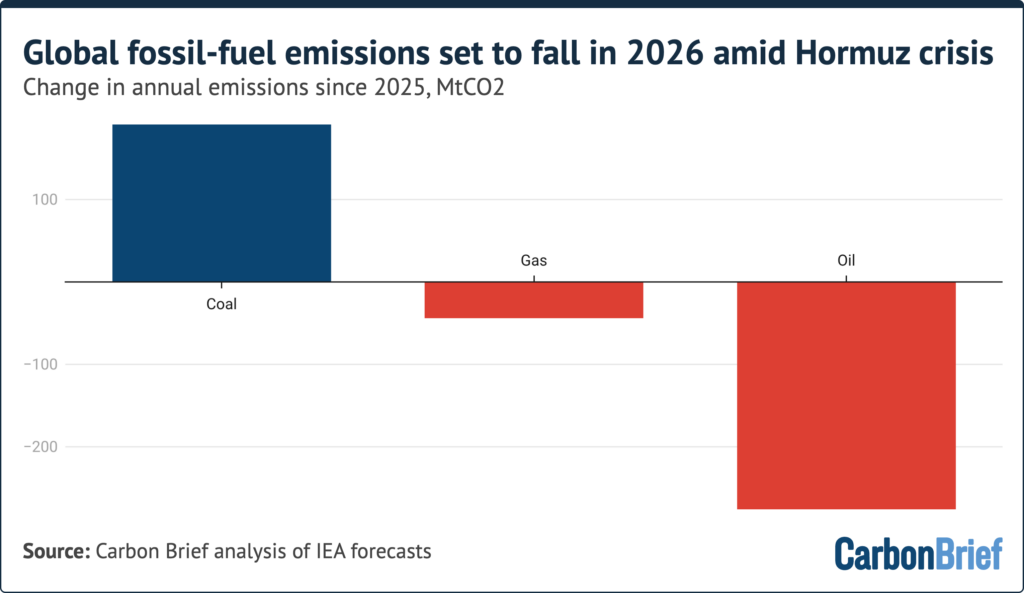
       Oil Demand               -2.4% (-2.5m bpd)    Major Drop
       Natural Gas Demand       -0.6%                Moderate Drop
       Coal Demand              +1.2%                Moderate Rise
       ----------------------------------------------------
       NET TOTAL EMISSIONS:     -0.5% Net Reduction
The crisis has created a complex dynamic across global energy markets. Squeezed natural gas supplies have forced a temporary resurgence in coal consumption, with global coal demand now forecast to rise by 1.2% in 2026. This upward tick has fueled widespread media narratives regarding a global "return to coal." However, Carbon Brief’s quantitative modeling demonstrates that the emissions surge from increased coal burn—much of which is driven by climate factors and power grid constraints unrelated to the Hormuz blockade—will be more than offset by dramatic drops in global oil and natural gas consumption.
Given that fossil fuels account for roughly two-thirds of all global greenhouse gas emissions, a 0.5% annual decline represents a meaningful detour from previous growth trajectories. Rather than being driven by top-down international climate agreements, this decline stems from market-driven demand destruction and an accelerated shift toward domestic clean energy sources sparked by national security and affordability concerns.

Detailed Chronology of the 2026 Energy Shift
The trajectory of global energy forecasts throughout 2026 illustrates how rapidly geopolitical conflict can reshape global emissions baselines.
+-------------------------------------------------------------------+
| 2026 FORECAST TIMELINE: FROM BASELINE TO CRISIS REVISION          |
+-------------------------------------------------------------------+
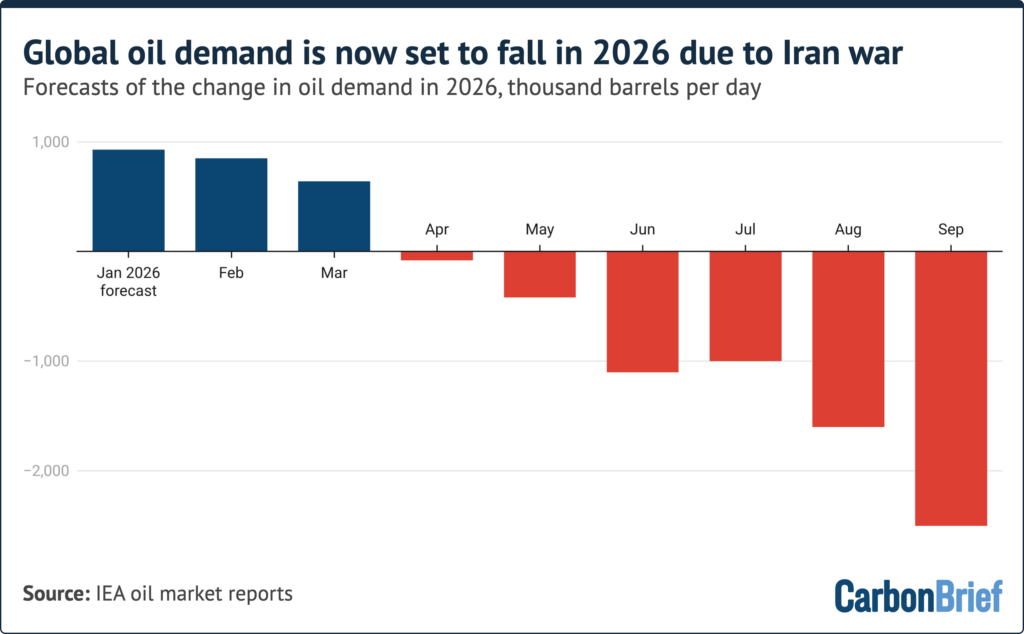
| JAN 2026 | IEA Projects:                                          |
|          | • Oil Demand: +930,000 bpd                             |
|          | • Gas Demand: +2.0%                                    |
|          | • Coal Demand: Slight Decline                          |
+----------+--------------------------------------------------------+
| MID 2026 | US-Iran War Escalates / Hormuz Disruption             |
|          | • Oil & Gas Prices Spike Globally                      |
|          | • Secondary Conflicts Spurt (e.g., Yemen Flashpoint)  |
+----------+--------------------------------------------------------+
| JUL 2026 | IEA Gas Market Report Revision:                       |
|          | • Gas Demand Forecast Revised down to -0.6%            |
+----------+--------------------------------------------------------+
| AUG 2026 | DNV Analysis Highlights Risk of Permanent Oil          |
|          | Demand Destruction                                     |
+----------+--------------------------------------------------------+
| SEP 2026 | Major Revisions Published:                             |
|          | • IEA Oil Demand: Revised to -2,500,000 bpd (-2.4%)   |
|          | • Morgan Stanley Consensus: -2,415,000 bpd              |
|          | • IEA Coal Update: Revised to +1.2%                    |
|          | • Carbon Brief Analysis: Net CO2 set to fall by ~0.5%  |
+-------------------------------------------------------------------+
1. Early 2026 Baseline Expectations
In late 2025 and early January 2026, baseline projections from the International Energy Agency (IEA) pointed toward continued expansion in global hydrocarbon consumption:
- Oil: The IEA’s January Oil Market Report anticipated a demand expansion of 930,000 barrels per day (bpd) for 2026.
- Natural Gas: The IEA’s Q1 Gas Market Report estimated a 2.0% expansion in global natural gas consumption, supported by post-industrial recovery and expanding liquefied natural gas (LNG) infrastructure.
- Coal: The agency’s annual coal assessment, released in mid-December 2025, projected a slight global contraction in coal use. Analysts calculated that rapid decarbonization and falling coal demand in China would easily override pro-coal regulatory revisions implemented in the United States under President Donald Trump.
2. Spring and Summer Disruptions: The Conflict Outbreak
The outbreak of the US-Iran war and the blockage of the Strait of Hormuz upended these foundational market assumptions. As energy shipments through the strait ground to a halt, crude oil and LNG prices spiked on spot markets worldwide.
By July 2026, energy price pressures had begun systematically dampening global gas consumption. The IEA revised its full-year natural gas demand forecast down from a 2.0% increase to a 0.6% contraction.
3. Late-2026 Revisions: Severe Oil Contraction and Coal Surge
By September 2026, sequential data updates confirmed a structural divergence across different fossil fuels:
- Oil Demand Collapse: In its September update, the IEA drastically lowered its oil projection, forecasting a staggering demand reduction of 2,500,000 bpd for 2026—a 2.4% drop compared to 2025 levels.
- Coal Forecast Reversal: Conversely, the IEA’s mid-year Coal Market Update in September reversed its prior calls for a decline, projecting a 1.2% rise in global coal burn for 2026.
- Emissions Synthesis: Carbon Brief synthesized these updated sectoral assessments, determining that the combined drop in high-carbon oil and gas consumption comfortably exceeded the increase in coal emissions, driving a net ~0.5% reduction in global fossil-fuel $CO_2$ output.
Supporting Context & Sectoral Metrics
The Oil Market Contraction and Electric Vehicle Penetration
The dramatic drop of 2.5 million bpd in global oil demand represents one of the steepest single-year declines in modern history outside of global recessions. Institutional research supports this finding; a mid-September research note from Morgan Stanley identified an industry consensus forecasting a demand drop of 2,415,000 bpd for 2026.
  2026 GLOBAL OIL DEMAND PROJECTIONS (CHANGE FROM 2025)
  =====================================================
  Initial IEA Forecast (Jan 2026) : +930,000 bpd
  Morgan Stanley Consensus (Sep)   : -2,415,000 bpd
  Revised IEA Forecast (Sep 2026)  : -2,500,000 bpd (-2.4%)
This contraction in transport fuel usage has been particularly pronounced in major economies like China, where $CO_2$ emissions dropped significantly during the second quarter of 2026 due to plummeting oil demand.
A major structural driver behind this oil demand collapse is the accelerated adoption of electric vehicles (EVs). Squeezed pump prices for traditional petrol and diesel have spurred record-breaking EV market shares across diverse geographies:
- Established Markets: EV adoption reached historic highs across Europe (where EV market share topped 25% in mid-summer, driven by strong growth in France and Germany), as well as in China and Australia.
- Developing and New Markets: High fuel costs spurred rapid vehicle electrification outside traditional Western strongholds. In July 2026, EV sales nearly doubled year-on-year in developing car markets, including notable market share gains in Indonesia and Thailand.
The Coal Resurgence and Fuel-Switching Constraints
While the 1.2% surge in coal demand sparked commentary regarding a broad return to fossil-heavy energy generation, detailed analysis reveals that this rebound is constrained by both structural and environmental factors:
                  2026 COAL DEMAND DRIVERS
                  ========================
  +-----------------------+   +-----------------------+
  | Gas-to-Coal Switching |   | El Niño Weather       |
  | High LNG prices force |   | High cooling demand + |
  | power generation swap |   | lower hydro output    |
  +-----------------------+   +-----------------------+
                                 /
               v                 v
            +-----------------------+
            | +1.2% COAL DEMAND     |
            | RISE IN 2026          |
            +-----------------------+
                        ^
                        |
  +---------------------------------------------------+
  | Renewable Integration Challenges                  |
  | Increased wind and solar curtailment in China     |
+---------------------------------------------------+- Gas Price Substitution: Extreme price spikes in natural gas pushed utility providers with dual-fuel capacity to prioritize coal-fired generation where possible. However, the operational ceiling for this switch remains low; very few countries maintain the infrastructure required to execute large-scale, immediate fuel switches from natural gas back to coal.
- El Niño and Extreme Weather: Global weather patterns played a major role in driving up coal demand. A powerful El Niño event amplified global cooling requirements, pushing electricity demand for air conditioning to record levels. Simultaneously, altered precipitation patterns depressed hydroelectric output in key regional power markets, forcing utilities to make up shortfalls with base-load coal generation.
- Renewables Integration Deficits: In China, short-term operational hurdles led to elevated levels of "wasted" (curtailed) wind and solar energy, temporarily requiring local power grids to rely more on legacy coal plants to meet peak load demand.
Developing Nations and the LNG Backlash
The global natural gas crisis has forced a strategic reassessment across emerging Asian economies that had previously planned to base their long-term power strategies on imported LNG.
Facing a collective gas import bill of $9.4 billion as a direct consequence of the Hormuz crisis, several developing nations in Southeast and South Asia have begun scaling back their long-term LNG exposure. Countries like Bangladesh are actively shifting national policy away from volatile international gas markets, choosing instead to accelerate domestic renewable deployment or retain legacy coal plants longer than originally planned to safeguard energy security.
Official Statements and Institutional Analyses
Industry leaders, multilateral organizations, and financial analysts have emphasized that the short-term market disruptions seen in 2026 could leave a lasting mark on global energy infrastructure.

In a late August analytical report regarding global energy trajectories, Sverre Alvik, Vice President at energy consultancy DNV, pointed out the long-term impact of extended conflict on fossil fuel consumption:
"For every month the conflict lasts, the probability of permanent [oil] demand destruction increases."
Analysis from the International Energy Agency echoes this assessment. Beyond detailing the immediate revisions for 2026, the IEA noted that medium-term projections for 2027 are undergoing fundamental shifts:
- Flatlining Oil Demand: The IEA originally anticipated that global oil demand would rebound strongly in 2027 to levels well above 2025. Updated projections now indicate that global oil consumption will remain essentially flat for two consecutive years.
- Gas vs. Coal Interdependence: The IEA stated in its mid-year coal assessment that the 2027 outlook for coal and natural gas remains deeply intertwined. Should natural gas prices remain elevated, coal demand may stay elevated; conversely, if gas prices normalize, coal consumption could drop back quickly.
Future Outlook: Permanent Demand Destruction or Temporary Dip?
The convergence of geopolitical conflict, price volatility, and climate factors in 2026 raises critical questions about whether the observed drop in fossil fuel emissions represents a temporary crisis-driven anomaly or the start of a permanent structural decline.

       GLOBAL OIL DEMAND PEAK FORECAST REVISION
       ----------------------------------------
       Oct 2025 Projection : Demand Peak Expected ~2030
       Sep 2026 Posture    : Peak Brought Forward Due to
                             Demand Destruction & Flat 2026-2027
Re-evaluating the "Peak Oil" Timeline
As recently as October 2025, official IEA projections indicated that global oil demand would not reach its peak until roughly 2030. However, the combination of a 2.4% drop in oil demand in 2026 and expectations of flat consumption through 2027 puts a significant question mark over that timeline. The rapid acceleration of EV sales in non-traditional car markets, combined with persistent fuel price volatility, suggests that the global peak in oil demand may be brought forward well ahead of previous expectations.
Structural Redirection of Energy Investments
The 2026 crisis has accelerated two divergent energy security strategies:
- Clean Energy Acceleration: High fossil fuel prices and supply chain vulnerabilities have prompted governments to direct capital toward domestic renewable power generation, energy storage, and transport electrification. This trend is visible in markets like India, where power-sector emissions have flatlined for two consecutive years due to a rapid surge in domestic clean energy capacity.
- Coal Asset Retention: To avoid overreliance on expensive, volatile foreign gas imports, several developing economies are extending the operating lives of existing coal assets. While this creates localized carbon headwinds, it limits long-term growth in global gas infrastructure.
Climate and Emissions Pathway Implications
From a broader climate perspective, the projected 0.5% reduction in global fossil-fuel $CO_2$ emissions in 2026 underscores how tightly connected energy security, geopolitics, and decarbonization pathways have become.
While the circumstances behind the 2026 emissions drop stem from severe geopolitical instability rather than planned climate action, the resulting structural shifts—particularly the permanent demand destruction in transport oil and the strategic retreat from imported LNG—could permanently lower global emission trajectories, keeping long-term climate targets within reach.



