

Executive Overview
The transition to a decarbonized global electrical grid relies on finding reliable, scalable, and economically viable ways to store energy. While lithium-ion battery energy storage systems (BESS) have rapidly matured into standard utility infrastructure, alternative storage concepts continue to capture the imagination of investors, policymakers, and media outlets. Among these, solid-mass gravity storage has emerged as a conceptually simple solution: pull up massive weights when electricity is abundant and cheap, and lower them back down to generate power when demand peaks.
To test this proposition under the most favorable conditions possible, Energy Vault partnered with Chinese construction and energy firms to build its flagship 25 MW / 100 MWh gravity-storage system in Rudong, China. This location provided an ideal proving ground, removing the logistical and supply-chain excuses often cited for delayed or over-budget clean-tech initiatives. Rudong benefited from deep domestic supply chains for concrete, steel, motors, and power electronics, alongside robust government backing, grid coordination, and experienced local construction partners.
Yet, a thorough examination of the Rudong project reveals a sobering engineering and economic reality: for the exact same four-hour utility service, Energy Vault’s gravity tower requires a vastly greater expenditure of capital, land, machinery, and construction-related carbon emissions than a contemporary Chinese BESS. While the project is an undeniable structural engineering achievement, it highlights a fundamental paradox in modern energy transition strategy—the creation of an extraordinary amount of complex industrial machinery to deliver a fairly ordinary amount of electricity storage.
Detailed Chronology & Project Evolution
From Cranes to Enclosed Towers
Energy Vault’s corporate trajectory mirrors the shifting fortunes of the broader clean-technology sector over the past decade. The company initially gained market attention with an exposed, multi-arm crane concept designed to lift concrete blocks arranged in a circular array. However, operational and logistical critiques regarding environmental exposure, wind loads, and mechanical wear led the company to pivot toward its enclosed EVx architecture.
Capitalizing on the clean-tech SPAC (Special Purpose Acquisition Company) boom, Energy Vault successfully went public, securing substantial funding to scale its operations globally. Yet, shortly after its public market debut, the company began diversifying its portfolio by announcing conventional lithium-ion battery projects.
Today, Energy Vault operates primarily as an over-capitalized battery-storage integrator with an executive compensation structure heavily weighted toward traditional corporate metrics. Solid-mass gravity storage now occupies only a fractional role in its broader project portfolio, which spans standard BESS installations and complex, highly debated initiatives like hybrid battery-hydrogen microgrids.
The Rudong Milestone
The construction of the Rudong facility in China was intended to answer a foundational question: could solid-mass gravity storage be engineered at true utility scale?

- 2023: Full grid interconnection was initially anticipated by the end of the year, marking the transition from construction to commercial operation.
- Ongoing Commissioning: Despite years of development and high-profile milestone announcements, Energy Vault’s own official project documentation continues to describe the Rudong system as undergoing commissioning phases.
While Rudong successfully proved that a massive mechanical gravity tower could be built and operated within an industrial grid network, it simultaneously exposed the heavy economic and material burdens inherent to the architecture. The project transitioned from a bold theoretical concept into a real-world benchmark, allowing energy analysts to draw direct comparisons against standardized electrochemical alternatives operating in the exact same economic environment.
Supporting Context & Metrics: Gravity vs. BESS
To evaluate whether gravity storage makes sense for modern grids, analysts must measure it against incumbent technologies operating under identical market and supply-chain conditions. In China, four-hour battery storage is no longer an emerging technology; it is routine, highly commoditized infrastructure procured through standardized industrial markets.
Physical Footprint and Material Intensity
The scale of the Rudong facility is staggering when compared to an equivalent battery installation:
- Power and Duration: Rated at 25 MW with a 100 MWh capacity, Rudong provides four hours of full-output discharge.
- Mass and Machinery: The structure towers approximately 148 meters high. It houses more than 12,000 individual blocks (each nominally weighing 25 tons), 96 heavy-duty lifts, and thousands of deep-bored structural piles to support the immense vertical load.
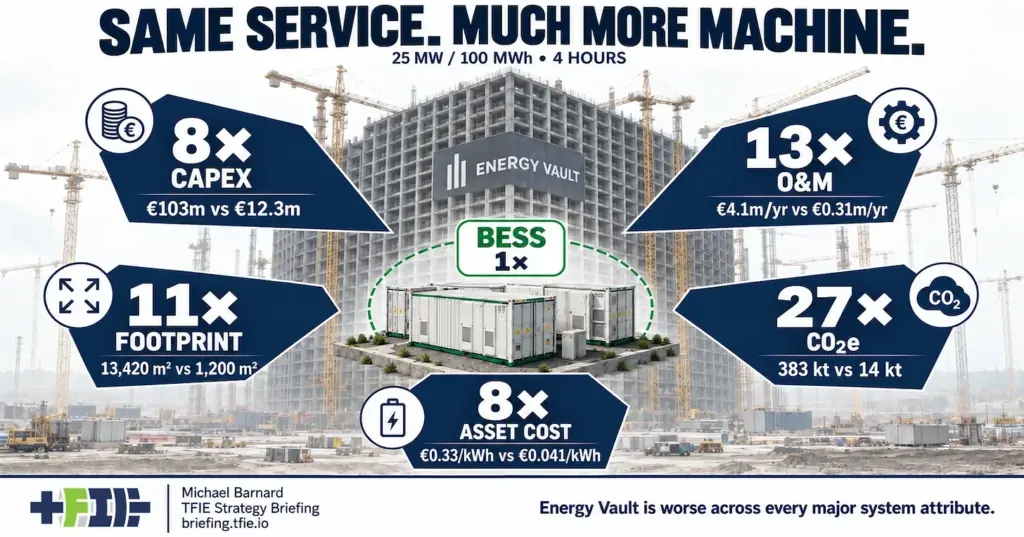
- Footprint Disparity: The tower footprint alone encompasses an area roughly eleven times larger than a contemporary Chinese BESS delivering the exact same 100 MWh capacity. For instance, a comparable installation utilizing Sungrow’s PowerTitan 2.0 architecture packs 5 MWh of batteries and 2.5 MW of power conversion into compact 20-foot AC blocks, requiring a mere 1,200 square meters of land.
Capital and Carbon Accounting
Public economic evaluations and strategic briefings reveal stark contrasts in financial and environmental debt:
- Capital Expenditure (CapEx): The central capital estimate for the Rudong gravity tower is roughly eight times higher than that of an equivalent contemporary Chinese BESS facility.
- Operating & Maintenance (O&M): Mechanical complexity introduces significantly higher projected ongoing maintenance and component replacement costs compared to solid-state electronics.
- Embodied Carbon Debt: While the storage medium itself (often fabricated from low-value mineral waste or local fill materials, protected by steel plates and coatings) boasts a low initial carbon footprint, the massive civil engineering campaign required to support it tells a different story. The extensive concrete foundations, steel reinforcement, complex lifting machinery, and heavy transport infrastructure generate an embodied carbon debt per kilowatt-hour comparable to that of natural gas generation.
Component Advantages vs. System Realities
Energy Vault is fundamentally correct on a narrow technical point: the heavy blocks themselves do not suffer from electrochemical degradation, are immune to thermal runaway (the risk of fire associated with lithium-ion batteries), and can theoretically endure for decades.
However, a static pile of inexpensive mass provides zero value to an electrical grid until it is integrated into a complex mechanical ecosystem. To harness gravity, an operator must build and maintain:
- Deep structural foundations and a towering enclosure.
- Doomed high-capacity lifts and horizontal material-handling equipment.
- High-torque motors, generators, mechanical brakes, transmissions, and precision sensors.
- Sophisticated power electronics and grid-synchronization controls.
The apparent simplicity of the foundational concept—raising blocks when power is cheap and lowering them when demand spikes—dissolves into mechanical complexity once thousands of multi-ton objects must move reliably on command for decades in all weather conditions.

Industry Perspectives & Expert Analysis
Energy industry stakeholders, financial analysts, and engineering experts continue to debate the long-term viability of mechanical storage alternatives in a market dominated by plunging battery costs.
Independent energy strategists emphasize that the primary challenge facing gravity storage is not whether it can be built, but why utilities should purchase the immense structural complexity it demands. As energy market analyst briefings point out:
"Rudong answers the easy question: block gravity storage can be engineered at utility scale. The harder question examines what the gravity-density, machinery, maintenance, and lifetime economics look like when the artificial mountain is compared on the same service basis with a Chinese battery plant."
Proponents of mechanical storage argue that diversification in long-duration energy storage (LDES) is vital to hedge against supply-chain bottlenecks for critical battery minerals like lithium, cobalt, and nickel. They point to the theoretical permanence of mechanical systems as a hedge against the eventual degradation and required repowering cycles of electrochemical cells.
Conversely, utility operators remain highly risk-averse regarding moving parts. Rotating machinery, steel cables, mechanical brakes, and high-frequency elevator operations in extreme weather environments introduce points of failure that flat-pack battery modules simply avoid. Furthermore, because battery manufacturing continues to benefit from aggressive learning curves and global economies of scale, the cost gap between custom civil-engineering projects and modular BESS units is widening rather than narrowing.
Future Outlook & Market Implications
The trajectory of the Rudong project and Energy Vault’s corporate pivot offer critical lessons for the future of clean-tech deployment:
- The Dominance of Modular Electrification: For short-to-medium duration storage (four hours is currently the economic sweet spot for most grid balancing applications), modular BESS architecture has established an almost insurmountable lead in cost, speed of deployment, and land efficiency.
- The Niche for Long-Duration Storage: Solid-mass gravity storage, pumped hydro, and thermal storage will likely find their viability tested primarily in ultra-long-duration applications (exceeding 10 to 12 hours) where daily cycling frequency is lower and the energy-to-power ratio demands massive energy volumes that make batteries economically prohibitive. Even then, competing technologies face steep hurdles against compressed air energy storage (CAES) and advanced flow batteries.
- Scrutiny of Corporate Capital Allocation: For investors, the Rudong project serves as a case study in distinguishing between engineering capability and commercial viability. Capital-intensive civil engineering projects face severe headwinds when competing against fast-scaling, factory-built electronics.
Ultimately, Rudong is not an engineering failure—erecting a 148-meter structure and synchronizing dozens of heavy lifts is a genuine technical feat. However, as global energy markets prioritize rapid decarbonization, capital efficiency, and operational simplicity, utilities and investors are increasingly asking whether building an artificial mountain is necessary when manufactured battery modules can deliver identical services with a fraction of the land, capital, and carbon footprint.



