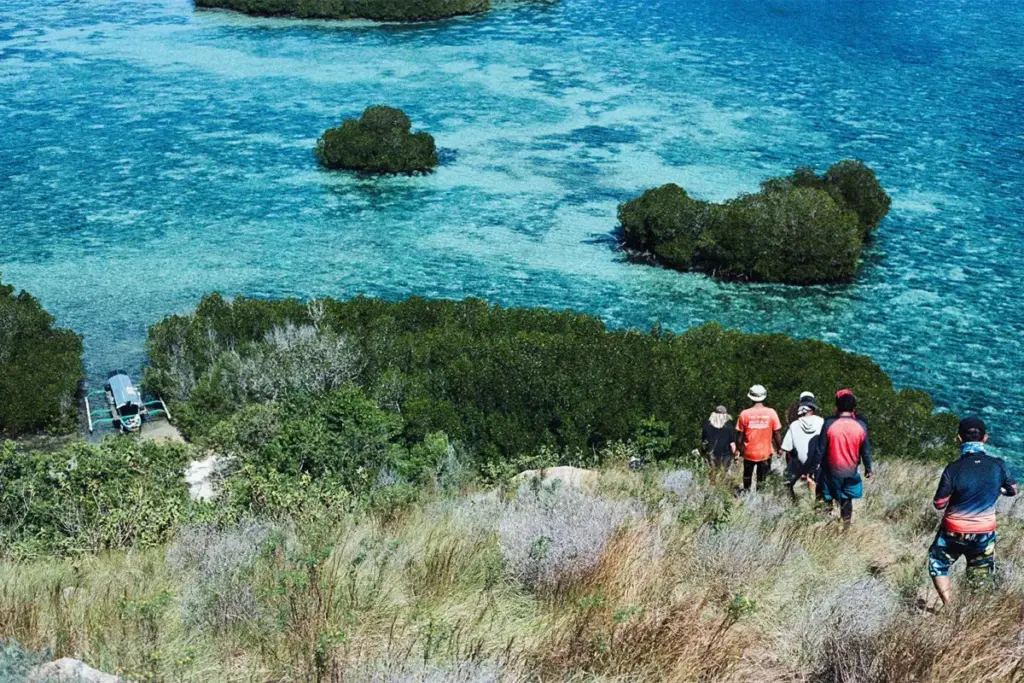
Off the sun-drenched coast of Poto Tano, a small fishing village on Indonesia’s Sumbawa Island, a quiet revolution is taking place beneath the waves. Mahari, the ketua (leader) of a local collective of Bajau octopus fishers, sits at the bow of a wooden boat, a cigarette in hand as he reads the ocean. Beneath him lies a complex ecosystem that has sustained his people for centuries. Yet, this marine paradise has spent recent decades standing on the precipice of ecological collapse and human tragedy.
Driven by the economic pressures of modern markets, many Bajau fishers abandoned their traditional, low-impact freediving methods in favor of compressor diving—a notoriously dangerous practice utilizing improvised surface-supplied air hoses. While compressors allowed fishers to remain submerged for hours, diving deeper and chasing higher yields, the physical toll was devastating. Decompression sickness, chronic paralysis, and untimely deaths ravaged the community.
Today, however, a powerful paradigm shift is underway. Through a partnership with local conservation groups like the Jari Foundation and the establishment of the community-led fishery group PELITA (Persaudaraan Nelayan Gurita, or Octopus Fishermen Brotherhood), Poto Tano’s Bajau fishers are turning back the clock. By coupling ancestral ecological knowledge with modern rights-based fisheries management, marine conservation, and ecotourism, these sea nomads are reclaiming their heritage, healing their bodies, and transforming into frontline stewards of Indonesian marine biodiversity.
Detailed Chronology: From Ancestral Waters to the Compressor Crisis
The Heritage of the Sea Nomads
The Bajau people—an Indigenous ethnic diaspora spanning the maritime borders of Indonesia, Malaysia, and the Philippines—have long held a mythical reputation as "sea nomads." Historically living out their lives on houseboats, the Bajau developed an intimate, physiological, and cultural relationship with the ocean. Ethnographic and scientific studies have documented their remarkable genetic and physical adaptations for freediving, including enlarged spleens that store oxygen-rich red blood cells.
For generations, Bajau children were introduced to the sea within weeks of birth. They learned to navigate vast marine expanses without the aid of modern GPS, relying instead on a sophisticated reading of the stars, wind, air pressure, and ocean currents. Harvesting marine resources meant sustainable freediving, a method that imposed natural limits on catch volume and left fragile coral reefs largely undisturbed.
The Siren Song of the Compressor
As commercial demands escalated and rural families faced mounting financial strains, traditional methods began to lose ground against the allure of high-yield modern fishing gear. Enter compressor diving—a makeshift, hazardous technique where fishers breathe air pumped down from gasoline-powered industrial compressors mounted on their boats.
While not explicitly named in early national legislation, compressor diving spread rapidly across Indonesian coastal communities, including West Nusa Tenggara. It allowed divers to plunge 20 to 30 meters deep and stay submerged for extended periods.
For sole breadwinners facing the daily pressures of poverty, the temptation was irresistible. More time underwater meant more octopuses; more octopuses meant more cash. Yet, this shortcut came at an exorbitant physical price. Improvised systems lacked safety gauges, proper gas mixes, or decompression schedules. Fishers returned to the surface suffering from severe air embolisms, neurological damage, and decompression sickness—locally known as the "bends."
The Breaking Point and the Regulatory Ban
The human cost of compressor diving eventually became impossible to ignore. In Poto Tano, veterans like Well and Wandra watched helplessly as friends and relatives suffered permanent paralysis or death. Well endured month-long bouts of paralysis on three separate occasions. Mahari estimates he suffered minor to severe paralysis nearly 30 times, utilizing makeshift recompression chambers only to return immediately to the compressor to support his family.
Recognizing the escalating crisis, the West Nusa Tenggara provincial government enacted a strict regional regulation in 2020 explicitly banning compressor diving. However, laws on paper proved difficult to enforce on the open water. Illegal compressor diving simply shifted to the dead of night, slipping past maritime surveillance under the cover of darkness.
Realizing that top-down government bans alone could not curb the practice without addressing underlying economic survival, community advocates realized a localized, culturally resonant solution was urgently needed.
Supporting Context & Metrics: The Mechanics of Tradition and Conservation
To understand the scale of the transition happening in Poto Tano, one must examine the specific tools and management systems governing the local octopus fishery.
The Art of the Pocong
Depending on ocean visibility and currents, Bajau fishers deploy two primary methods for catching day octopuses (Octopus cyanea). In murky waters or strong currents, they trail a weighted "shell" tool adorned with hooks behind a moving boat. However, when conditions permit, master fishers utilize the pocong—an Indigenous tool whose literal Indonesian translation is "ghost."
The pocong is a life-size wooden decoy meticulously carved and adorned with strips of felt designed to mimic the flowing movement of an octopus’s legs. Using advanced freediving skills, elite fishers—numbering only around 10 in the Poto Tano community—dive 15 to 20 meters (50–65 feet) down to the reef. They dangle the decoy to trigger a territorial "friend-or-foe" response from hiding octopuses. When the curious animal emerges, the fisher must spear it or grab it by hand with lightning speed. If the octopus makes physical contact with the wooden body of the pocong, it instantly detects the ruse and vanishes into the reef.
PELITA and Rights-Based Management
To replace the illicit economy of compressor diving, the Jari Foundation—spearheaded by founders Hani Nusantari and Boen—collaborated with local fishers to establish PELITA (Persaudaraan Nelayan Gurita). Representing a traditional oil lamp that once illuminated coastal homes, PELITA serves as a guiding light for sustainable marine stewardship.
PELITA currently unites roughly 40 octopus fishers who have completely abandoned compressor diving. Their approach is rooted in Rights-Based Fisheries Management (RBFM), a model successfully deployed in nations like Australia and Canada, where local communities are granted legal authority and stewardship over adjacent waters.
Rotational Closures: PELITA fishers actively practice rotational management, temporarily closing two to three reef zones for months at a time to allow fish stocks and coral ecosystems to regenerate.
Size Limits: Undersized octopuses encountered during freediving expeditions are released back into the wild unharmed.
Catch Quotas: Bound by traditional ethics of sufficiency rather than industrial greed, fishers cap their daily hauls to match actual community needs.
In December 2025, these efforts achieved a monumental milestone when local authorities approved a village-level legal framework granting Poto Tano self-governance over its marine resources.
Official Statements & Community Perspectives
The transformation in Poto Tano is driven by a deep dialogue between Indigenous knowledge holders, local activists, and women leaders who view marine conservation as synonymous with cultural preservation.
"With compressor diving, you can stay underwater for much longer," explains Well, a PELITA fisherman who survived multiple bouts of paralysis. "If you get more octopus, you get more money. There’s a temptation. We’re human, right? But the younger generation has seen how others have been impacted by the compressor, so they don’t want to pursue it anymore."
Hani Nusantari of the Jari Foundation emphasizes that the transition cannot succeed through prohibition alone; it requires restoring pride in Bajau heritage.
"Recognizing the long-term impacts this practice was having on their health, they chose to return to traditional freediving methods while also becoming actively involved in marine conservation initiatives and ecotourism," Hani notes. "PELITA represents a guiding light for coastal communities, bringing people together to care for the sea, strengthen solidarity among fishers, and ensure that marine resources continue to support future generations."
To broaden this community ownership, Hani founded Women for Marine Conservation (WMC) in 2022. Recognizing that marine stewardship extends beyond the men on the boats, WMC members now lead critical initiatives in fisheries data collection, environmental education, community organization, and ecotourism ventures.
Mahari, the community ketua, highlights the philosophy driving the movement forward:
"The Bajau people are in the sea every day. We suggest ecological management, so limits on catch and size. Everything is enough for everybody. The problem is when there are greedy people who take more than what they need."
Future Outlook: Safeguarding Heritage and Reefs for Tomorrow
As Poto Tano steps into this new era of community-based management, the road ahead presents both challenges and profound opportunities. Fully reversing the physiological and psychological reliance on industrial compressors takes time, and night-time surveillance remains a hurdle against rogue commercial operators from outside the village.
Nevertheless, the cultural renaissance taking root is undeniable. Plans are underway to establish a dedicated Bajau museum in Poto Tano to preserve oral histories, traditional navigational techniques, and ecological lore for youth who have grown disconnected from their roots. Young community members—including Mahari’s niece, who is currently pursuing a university degree in marine science—are actively blending ancestral wisdom with formal scientific monitoring.
By transforming ancient freediving skills into the cornerstone of modern marine protected areas, the Bajau of Sumbawa are proving that Indigenous communities are not relics of the past, but indispensable architects of a sustainable maritime future. Through networks like PELITA and WMC, the sea nomads of Poto Tano are ensuring that their ancient bond with the ocean will endure, lighting a path forward for coastal conservation across the Indonesian archipelago.