ARBOREK, West Papua, Indonesia — “Rockhead fish, salamander fish, starfish, and coral.”
When asked to name the vibrant yellows and oranges embedded in their natural surroundings, this is what a gathering of children from Arborek—a tiny, picturesque island nestled within Indonesia’s globally celebrated Raja Ampat archipelago—instantly rattled off. For these young residents, marine life is not a distant concept found in textbooks, but a daily companion encountered while swimming, playing, and growing up in the heart of the Coral Triangle.
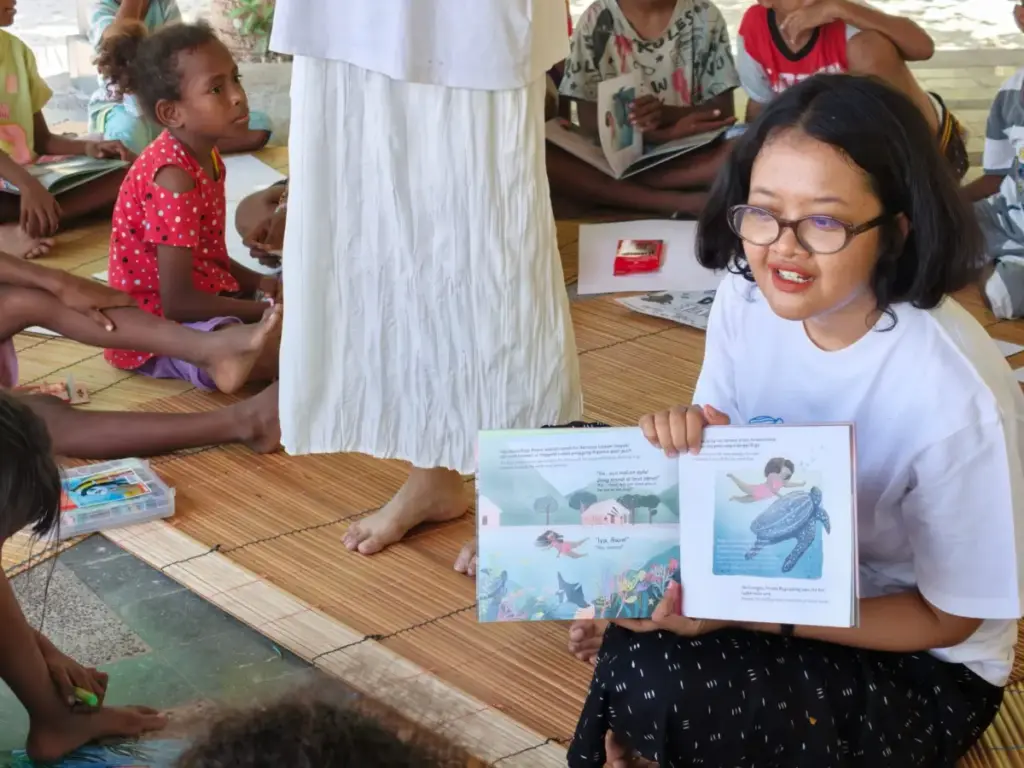
This intimate ecological literacy took center stage during a special reading of Luka-Luka Pulau Kecil (The Wounds of Small Islands), a children’s book addressing the acute threats posed by industrial nickel mining to the pristine ecosystems of Raja Ampat. The reading served as a poignant centerpiece for a three-day Indigenous gathering on Arborek Island. Bringing together representatives from 20 Indigenous subtribes across Raja Ampat alongside delegates from other parts of Indonesia and abroad—and organized by Greenpeace Indonesia in collaboration with the local NGO Institut USBA—the summit aimed to fortify solidarity among traditional custodians dedicated to protecting their ancestral lands, sacred waters, and irreplaceable biodiversity.
As Indonesia commands the global stage as the world’s leading producer of nickel—driven largely by the green energy transition and surging demand for electric vehicle (EV) batteries—its mineral rush has increasingly turned its sights toward ecologically fragile, biodiverse frontiers. In Raja Ampat, where local livelihoods depend intimately on sustainable ecotourism, fisheries, and enduring cultural traditions, the pushback against extractive industries is taking on a profound intergenerational dimension. Through storytelling, indigenous wisdom, and community mobilization, the defenders of Raja Ampat are striving to ensure that the ecological and cultural wealth of their islands is neither commodified nor silenced.
Detailed Chronology & Narrative
The Roots of Storytelling and Ecological Literacy
The intimate connection between the children of Arborek and their environment is far from accidental. Research consistently demonstrates that children growing up in close contact with complex natural ecosystems develop a sophisticated, highly contextual understanding of their surroundings. For instance, a landmark 2014 study examining communities across 22 villages in Indonesian Borneo revealed that local children possessed a remarkably nuanced comprehension of the dynamic relationships binding forests, rivers, wildlife, and broader environmental changes.
Consequently, Sekar Bestari, the illustrator of Luka-Luka Pulau Kecil, was hardly surprised by the precocious answers offered by the Arborek youth. “Most of the time when we read books to children, they understand them, so don’t underestimate children’s knowledge,” Bestari reflected following the reading. “We’re not surprised anymore today.”
This deep-seated environmental awareness manifests in surprising, highly localized ways. Titah Asmaning Winedar, the author of the book, recalled an encounter with a young girl named Esther, who casually explained a traditional method for calling sea turtles to the shore: “You just split open a coconut and leave it in the sea.”
For both Winedar and Bestari, capturing and validating this innate ecological knowledge is the core mission of their work. They hope the book will encourage children to deeply value their heritage, eventually inspiring them to document and share their own stories. “When they see that a Raja Ampat story has been made into a book like this, our hope is that they feel, ‘Oh, my story is important too,’” Winedar noted.
Luka-Luka Pulau Kecil: A Parable of Color and Loss
Central to Luka-Luka Pulau Kecil is the concept of color as a vital indicator of ecosystem health. The narrative follows Pin, a young child residing in a stilt house surrounded by blinding white sands and turquoise waters, who loves swimming in the sea. Pin’s fascination with rainbows stems from their rich array of colors—a palette she believes the rainbow borrows entirely from its radiant surroundings.
According to Winedar, the kaleidoscope of colors found in Raja Ampat represents much more than mere aesthetic beauty; it is a living barometer of biodiversity and ecosystem vitality. While developing the book, Winedar collaborated with Greenpeace volunteers from Raja Ampat to catalog the indigenous flora, fauna, and atmospheric phenomena characteristic of the region, such as frequent rainbows and vibrant hibiscus blooms.
Raja Ampat contains roughly 75% of the world’s known coral species, anchoring the Coral Triangle as the epicenter of global marine biodiversity. The book translates this biological richness into a stark visual warning of what stands to be lost if heavy industry invades.
In the story, Pin’s idyllic days are suddenly shattered by a deep, ominous rumbling from the sea—a giant barge bearing heavy industrial excavators. The following day, the sky’s rainbow loses its red hue, obscured by thick plumes of mining smoke. Concurrently, real-world symptoms of ecological collapse manifest: a red hibiscus flower wilting, a bird-of-paradise growing frail, and red coral bleaching and dying. As mining operations expand throughout the narrative, the colors of the rainbow—and the species they symbolize—vanish one by one.
When Sekar asked the children gathered in Arborek whether they would feel sad if marine animals disappeared, the response was unanimous and immediate: “Very sad.”
Supporting Context & Metrics: The Nickel Crucible
The fictional perils depicted in Luka-Luka Pulau Kecil mirror an escalating real-world crisis. Raja Ampat has increasingly found itself at the epicenter of a fierce national debate regarding Indonesia’s aggressive nickel expansion.
As the global push for decarbonization and electric vehicles accelerates, nickel has evolved into one of Indonesia’s most fiercely guarded commodities. According to data from the U.S. Geological Survey (USGS), Indonesian nickel mine production skyrocketed from approximately 130,000 metric tons in 2015 to a staggering 2.2 million metric tons by 2024, cementing the nation’s status as the undisputed global titan of nickel supply.
While the vast majority of Indonesia’s nickel extraction has historically concentrated in Sulawesi and North Maluku, mining conglomerates have increasingly targeted the pristine, remote islands of Western and Southwestern Papua.
Public anxiety regarding industrial encroachment reached a boiling point in 2025, when circulating social media imagery exposed severe forest clearing and coastal sedimentation in Raja Ampat. The ensuing public outcry forced the Indonesian government to take emergency action, temporarily suspending operations and ultimately revoking four out of five controversial nickel mining permits in the region.
Despite these regulatory interventions, the threat remains active. The state-owned enterprise PT Gag Nikel continues active extraction operations on Gag Island within a vast 13,136-hectare concession area—a designated global biodiversity hotspot that serves as a sanctuary for rare and endangered flora and fauna. Furthermore, investigative research published by Greenpeace highlights ongoing corporate maneuvers seeking new permits, including projects targeted at eastern Waigeo—Raja Ampat’s largest island—as well as separate fossil fuel ventures in Misool.
Waigeo Island represents an irreplaceable evolutionary reservoir, serving as the native habitat for iconic endemic species such as:
Wilson’s bird-of-paradise (Cicinnurus respublica)
The Waigeo brushturkey (Aepypodius bruijnii)
The Waigeo spotted cuscus (Spilocuscus papuensis)
Official Statements & Community Perspectives
Local communities and environmental advocates argue that any industrial mining activity—regardless of regulatory oversight—poses an existential threat to the interdependent web of marine and terrestrial life that sustains the archipelago.
Benoni Watem, a 43-year-old Arborek resident and homestay operator, voiced the overwhelming sentiment of local residents who categorically reject industrial mining. He emphasized that the region’s economic survival is entirely predicated on ecological preservation rather than resource extraction.
"The beauty of Raja Ampat is what brings tourists here," Watem noted. "Pero, if mining comes in, the environment that we have protected will be damaged by mining, and then the beauty will disappear."
Watem expressed deep concerns over toxic mining runoff infiltrating the ocean currents, which would devastate vulnerable marine megafauna. Arborek sits in close proximity to world-renowned manta ray diving and snorkeling sanctuaries. Because manta rays suffer from characteristically slow reproductive rates and face mounting anthropogenic pressures, pollution and habitat degradation could spell disaster for the species.
"Manta rays might become uncomfortable. If waste enters the sea, their food will disappear," Watem warned. "When there are manta rays, guests get excited and happy."
This sentiment extends far beyond economics into the preservation of living cultural heritage. During the Arborek summit, anthropologist George Mentansan underscored that environmental degradation directly threatens Raja Ampat’s rich cultural diversity. For generations, Indigenous communities have cultivated sophisticated resource management frameworks, including complex ecological calendars, sacred marine areas protected by customary law (sasi), and strict seasonal restrictions on harvesting specific marine species.
Future Outlook & Intergenerational Resilience
As the three-day Indigenous gathering drew to a close, the dialogue between the authors and the children of Arborek crystallized the core objective of the entire movement: grassroots awareness as a bulwark against environmental destruction.
During an interactive Q&A session following the book reading, the children demonstrated an acute understanding of their geopolitical reality:
“Are there islands in Raja Ampat that have been damaged?” the authors asked.
“Yes,” the children responded in unison.
“Why were they damaged?”
“They were mined.”
Crucially, the children also recognized that combating industrial threats requires solidarity that transcends individual villages. In Luka-Luka Pulau Kecil, the protagonist Pin cannot halt the mining barge alone; she must rally allies from neighboring islands. When Winedar posed the question, “If the mining comes again, what should we do?” the children’s answer was instantaneous:
“We have to protect Raja Ampat together.”
This collective ethos mirrors the broader mandate established by the Indigenous gathering in Arborek. Protecting the archipelago’s delicate ecosystems and ancient cultural traditions is a multi-generational responsibility that cannot be shouldered by any single community or demographic alone.
By validating local ecological knowledge and anchoring conservation messaging in children’s literature, advocates like Titah Asmaning Winedar and Sekar Bestari are helping to arm the next generation with the intellectual and cultural tools necessary to defend their homelands. As industrial pressures on Indonesia’s eastern frontiers continue to mount, the stories told by the children of Arborek—and the shared resistance of Raja Ampat’s Indigenous peoples—serve as a powerful reminder that some places are simply too precious to lose.