

Executive Overview
On June 17, 2015, Philippine law enforcement executed a raid on a nondescript warehouse in the remote island province of Palawan, uncovering a staggering environmental crime. Hidden within suffocating, damp cement tanks were thousands of wild-caught animals destined for the illicit international pet and traditional medicine markets. Among them were more than 3,800 Palawan forest turtles (Siebenrockiella leytensis), locally known as the bakoko. Piled up to a dozen deep, many were suffering from agonizing shell ulcers, open wounds on their feet, and bite marks inflicted by desperate, overcrowded companions.
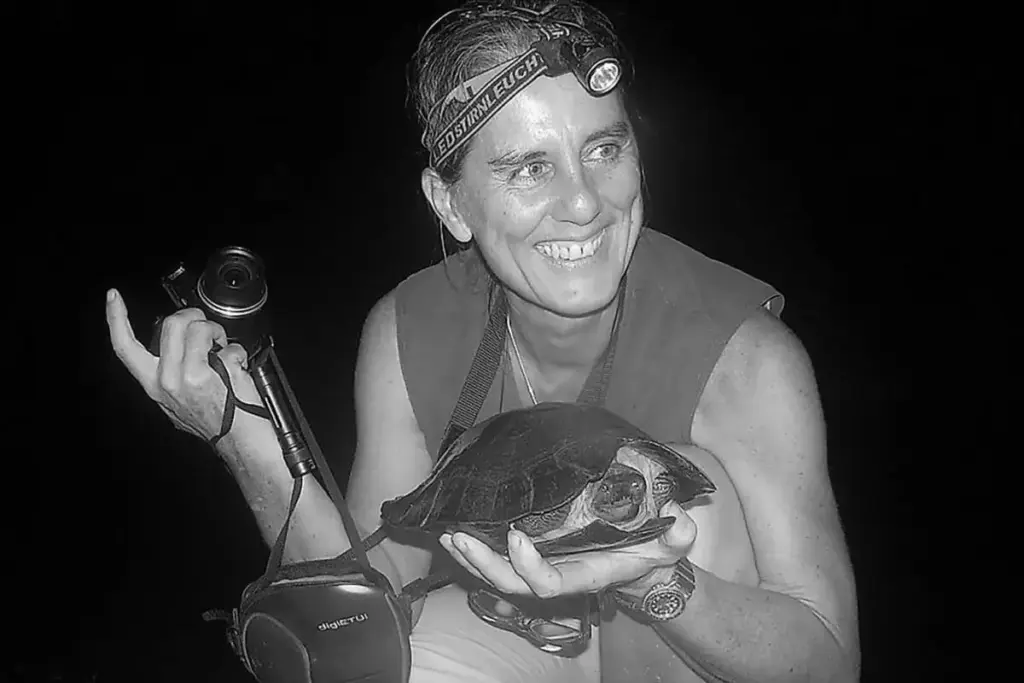
At the epicenter of the crisis was Dr. Sabine Schoppe, a German-born biologist whose life’s work transformed the conservation landscape of Southeast Asia. Schoppe spearheaded a grueling, around-the-clock emergency rescue mission that mobilized local students, international veterinarians, and global turtle specialists. What followed was a masterclass in wildlife crisis management, turning what could have been a catastrophic extinction event for the bakoko into a testament of hope, resilience, and scientific dedication.
Schoppe’s passing on September 13, at the age of 63, marked the end of an era for chelonian conservation. Just weeks before her death, she was named the recipient of the 2026 Behler Turtle Conservation Award—widely regarded as the Nobel Prize of her field. Though illness prevented her from traveling to Mexico to accept the honor personally, her legacy remains indelibly etched into the lush rainforests, meandering creeks, and protected reserves of Palawan. This is the definitive account of her monumental life, the harrowing 2015 crisis, and the enduring battle to save one of the world’s rarest reptiles from the brink of oblivion.
Detailed Chronology: From the German Academy to the Heart of Palawan
Roots in Research and Early Discoveries
Sabine Schoppe’s journey to becoming a titan of wildlife conservation began far from the tropical archipelago of the Philippines. Having completed her doctorate in biology in Germany, Schoppe made a life-altering decision in 1995: she packed her bags and relocated to the Philippines.
Initially, her academic focus centered on avian surveys and coastal resource management in the Visayas region. However, her intellectual curiosity and profound dedication to field biology soon drew her to the State Polytechnic College of Palawan (now Western Philippines University). Serving as a guest professor of aquatic and marine biology, Schoppe immersed herself in the island’s hyper-biodiverse ecosystems. Her commitment to rigorous science also found an outlet in her role as an associate editor of The Palawan Scientist, where she helped champion peer-reviewed local research.
Unraveling the Mystery of the Bakoko
To understand the magnitude of Schoppe’s later work, one must understand the enigmatic history of the Palawan forest turtle. For decades, the species was a ghost in the scientific literature. It was first scientifically described based on specimens purportedly originating from the neighboring Philippine island of Leyte. Tragically, those foundational specimens were reduced to ash during the devastating bombing of Manila in World War II.
For generations, scientists operated in the dark, entirely unsure where the species naturally occurred or if it even still existed. It wasn’t until populations were rediscovered on Palawan that researchers finally gained access to the living animal.
The bakoko is uniquely adapted to its environment, inhabiting burrows along quiet creeks and small rainforest rivers. However, this specialized habitat makes them painfully vulnerable. Poachers can easily track and dig them out of their subterranean retreats. Furthermore, unlike hardier reptile species, the bakoko is notoriously difficult to maintain in captivity. Solitary by nature, they are exceptionally prone to severe stress, skin ailments, and fatal shell rot when crowded into artificial environments.

Founding the Katala Foundation and Forging Protected Reserves
Recognizing the urgent threats facing Palawan’s endemic wildlife, Schoppe co-founded the Katala Foundation, a Philippines-based nonprofit dedicated to biodiversity conservation. In 2007, she established the organization’s freshwater turtle program, quickly followed by a pangolin conservation initiative in 2008.
Under Schoppe’s visionary leadership, the Katala Foundation achieved monumental milestones:
- Infrastructure Development: Constructed a dedicated, state-of-the-art turtle rescue and rehabilitation facility.
- Habitat Protection: Successfully established the world’s first protected area specifically designated for the conservation of the Palawan forest turtle.
- Captive Breeding Breakthroughs: Pioneered successful captive breeding protocols for a species notoriously difficult to propagate under artificial conditions.
This meticulous, long-term preparation proved to be the literal difference between survival and extinction when disaster struck in the summer of 2015.
Supporting Context & Metrics: The 2015 Palawan Turtle Heist
The Anatomy of a Crisis
The warehouse raid on June 17, 2015, exposed the terrifying scale of the illegal wildlife trade targeting Southeast Asian reptiles. The numbers recovered from the concrete holding tanks were staggering:
- Total Chelone Confiscated: Over 3,800 endangered Palawan forest turtles.
- Warehouse Conditions: Piled up to 12 turtles deep in dry, barren cement tanks.
- Immediate Pathologies: Severe dehydration, emaciation, shell ulcers, traumatic foot wounds, and systemic bone and eye infections.
With no existing government or municipal infrastructure capable of housing, feeding, or treating thousands of stressed aquatic reptiles, a humanitarian—and zoological—disaster loomed.
Mobilizing the Emergency Response
Sabine Schoppe immediately took command of the chaotic situation. With zero bureaucratic hesitation, she rallied a makeshift coalition. Local students were recruited to construct makeshift shade canopies and emergency shelters under the blistering tropical sun. In a stroke of logistical ingenuity, a disused crocodile enclosure was rapidly converted into a massive emergency recovery pond.
Veterinary professionals and international chelonian specialists flew in from around the globe to join Schoppe’s around-the-clock triage units. Despite their heroic efforts, the physical toll on the animals prior to rescue was catastrophic. More than 300 turtles succumbed to their injuries and systemic illnesses within the first few weeks of captivity.
Reflecting on the psychological whirlyboard of the ordeal, Schoppe captured the emotional duality of conservation work in a poignant dispatch to colleagues:

"Yesterday [defined] by sadness and work, now by hope."
Pioneering Post-Release Monitoring
The ultimate goal of the 2015 rescue operation was always repatriation. Through rigorous health screenings and rehabilitation protocols, Schoppe and her team successfully returned approximately 2,200 of the surviving turtles to their natural riverine habitats.
However, over 1,000 individuals remained permanently or semi-permanently under human care due to permanent disabilities resulting from their time in the poachers’ warehouse. For those animals that were released, Schoppe insisted on accountability. She helped build and manage one of Asia’s very first large-scale, long-term post-release monitoring programs for freshwater turtles—tracking survival rates, health metrics, and behavioral adaptation in the wild.
Official Statements and Tributes
The global conservation community responded with profound grief and soaring admiration following Dr. Schoppe’s passing on September 13 at the age of 63, just weeks after her inability to travel to Mexico to receive the 2026 Behler Turtle Conservation Award.
- The Turtle Conservancy: In celebrating her selection for the 2026 Behler Award—the highest distinction in the international turtle conservation community—representatives lauded her unyielding tenacity, describing her as "a fierce guardian of Palawan’s biodiversity who bridged the gap between rigorous academic science and boots-on-the-ground rescue operations."
- The Turtle Survival Alliance: Following her passing, allied organizations noted that Schoppe’s methodologies in emergency chelonian triage and post-release monitoring set a new global benchmark for wildlife rescue operations. A longtime colleague who accepted the Behler Award on her behalf in Mexico remarked that her spirit remains alive in every bakoko swimming freely in Palawan’s pristine streams.
- Palawan Local Authorities & Media: Tributes poured in from regional outlets, including Palawan News, mourning her as a "champion of Palawan’s threatened wildlife" whose tireless grassroots efforts permanently altered the trajectory of environmental protection in the province.
Future Outlook: Safeguarding the Bakoko Without Its Champion
Dr. Sabine Schoppe’s passing leaves an undeniable vacuum in the conservation architecture of the Philippines. Yet, the institutional frameworks she helped construct—most notably the Katala Foundation and its specialized rescue and breeding facilities—ensure that her life’s work endures.
Ongoing Challenges for Siebenrockiella leytensis
Despite the triumphs of the 2015 rescue and subsequent enforcement victories, the Palawan forest turtle remains profoundly vulnerable. The challenges ahead include:
- Habitat Degradation: Deforestation, slash-and-burn agriculture (kaingin), and illegal mining continue to fragment the freshwater ecosystems upon which the bakoko depends.
- Persistent Poaching Pressures: Driven by lucrative black-market demand in international pet trade hubs across East Asia, illicit collection rings continually test the vigilance of local rangers.
- Climate Vulnerability: Changes in regional precipitation patterns directly impact the seasonal water levels of the creeks and streams utilized by the turtles for burrowing and foraging.
The Path Forward
The blueprint left behind by Schoppe emphasizes that saving species like the Palawan forest turtle requires an integrated, multi-layered approach: empowering local communities through education, maintaining robust veterinary rescue capabilities, enforcing stringent anti-poaching laws, and committing to long-term scientific monitoring.
As the forests of Palawan continue to echo with the sounds of rushing creeks and rustling undergrowth, the survival of the bakoko stands as a living monument to Sabine Schoppe. Her transition from grief to hope during humanity’s darkest hours with the species continues to inspire a new generation of biologists, ensuring that the guardian of Palawan’s waters will never truly be forgotten.



