

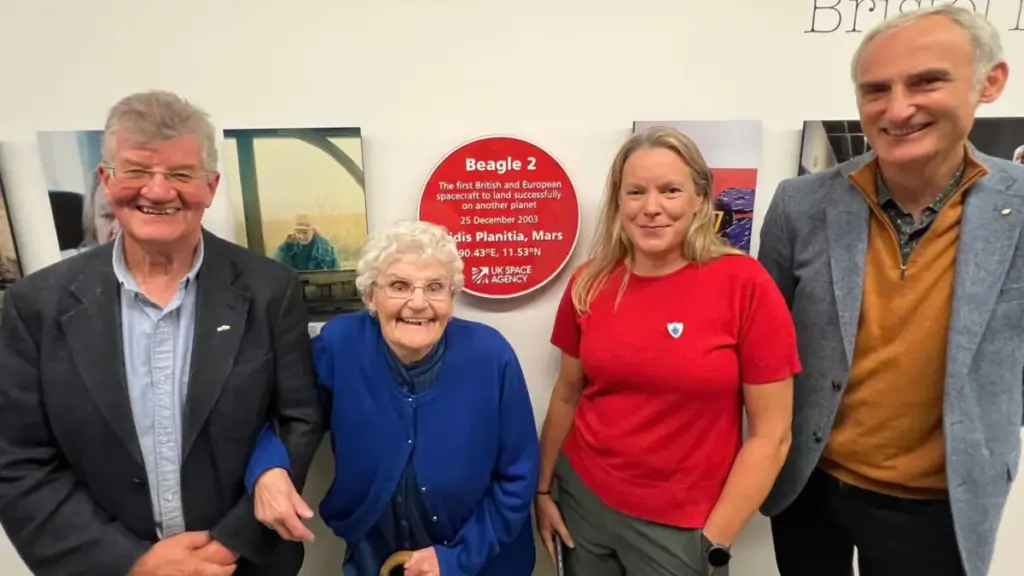
BRISTOL, UK — Two decades after a small, disc-shaped British spacecraft plunged through the thin Martian atmosphere to make history on Christmas Day, the visionary scientist behind the endeavor has received a permanent, heartfelt tribute in his home city.
A newly unveiled museum plaque at Bristol’s M Shed museum now honors the late Professor Colin Pillinger, the charismatic, sideburned planetary scientist whose indomitable will and infectious enthusiasm spearheaded the Beagle 2 probe. The spacecraft earned the distinction of becoming the first British- and European-built lander to reach the surface of another planet.
Yet, the journey of Beagle 2—from a rogue, fiercely independent British science project to a symbol of national technological ambition—was as fraught with human drama, heartbreak, and eventual vindication as any Hollywood script. As space agencies around the world prepare for the next generation of life-hunting rovers, the legacy of Colin Pillinger looms larger than ever, marking the moment the United Kingdom truly looked to the stars and believed it could touch them.
Executive Overview
The ceremonial unveiling at the M Shed’s People Gallery on Monday was attended by Professor Pillinger’s family, including his sister, Doreen Lindegaard, and his daughter, Shusanah Pillinger. The red memorial plaque bears the coordinates of the Martian landing site, serving as a permanent local anchor to a globally significant chapter of space exploration.
For decades, the narrative surrounding Beagle 2 was defined by a painful anti-climax: the eerie silence that followed its scheduled touchdown on December 25, 2003. Lacking a signal, the mission was widely written off as an unmitigated failure, a bitter pill for a British scientific community that had pinned its interplanetary hopes on Pillinger’s unorthodox creation.
However, history has since rewritten that verdict. High-resolution orbital imagery discovered years after Pillinger’s death in 2014 revealed that Beagle 2 did not crash, nor did it burn up. It executed a textbook landing on the Martian surface. Its solar panels deployed—just not quite completely enough to free its radio antenna—robbing humanity of the triumphant signal it so desperately craved.
Today, aerospace historians and former colleagues view Beagle 2 not as a failed mission, but as the foundational catalyst that transformed the UK from a peripheral player into an essential architect of modern planetary exploration.
Detailed Chronology: From Concept to the Red Planet
To understand the magnitude of Beagle 2, one must look back at the underdog culture of late-1990s British space science. While superpowers like the United States and Russia routinely launched multi-billion-dollar interplanetary missions, British space endeavors were often sidelined due to political hesitancy and stringent funding constraints.

The Genesis of an Underdog
Enter Colin Pillinger, a planetary scientist at the Open University born and raised in Kingswood, Bristol. Pillinger was cut from a different cloth than the stereotypical, reserved academic. Sporting distinctive mutton-chop sideburns and possessing a blunt, working-class tenacity, he was a master communicator who understood that space exploration needed public captivation to survive.
Named after HMS Beagle—the ship that carried Charles Darwin on his epochal voyage—Beagle 2 was conceived as a low-cost, high-science biological laboratory. Its primary objective was breathtakingly ambitious: to search for signs of past or present life on Mars.
To build the probe, Pillinger tapped into the UK’s rich aerospace heritage, collaborating heavily with engineering hubs in Filton, Bristol, which had long served as a epicenter for advanced aviation and spacecraft component manufacturing.
Christmas Day, 2003
Carried to Mars aboard the European Space Agency’s (ESA) Mars Express orbiter, Beagle 2 was released on December 19, 2003, hurtling toward the Martian surface. On December 25, the tiny lander entered the atmosphere of the Red Planet, utilizing a combination of heat shields, parachutes, and massive pneumatic airbags to cushion its impact.
Across the UK, families gathered around Christmas television sets awaiting the magic words: Signal received.
Instead, there was only silence.
Repeated attempts by the Jodrell Bank Observatory and NASA orbiters to ping the lander yielded nothing. Hopes dwindled, and the mission was officially declared lost. Critics labeled the project overly ambitious and plagued by corner-cutting. Pillinger, who had staked his professional reputation and immense personal energy on the project, faced intense scrutiny. Though he remained defiant to the end, he passed away in 2014 without ever knowing the true fate of his mechanical child.
The Vindication
Just one year after Pillinger’s death, justice arrived from the heavens. Analyzing images captured by NASA’s Mars Reconnaissance Orbiter, scientists identified Beagle 2 sitting intact on the surface of Isidis Planitia.

The photos laid bare the bittersweet reality: the probe had deployed three of its four solar panels, but the final petal remained stuck. Tragically, that blocked panel was the one housing the radio frequency antenna. Beagle 2 had landed successfully, survived the descent, and opened its eyes—it simply couldn’t phone home.
Supporting Context & Metrics: The UK’s Aerospace Renaissance
While the public narrative initially branded Beagle 2 a casualty of the space race, industry insiders understood its profound technical triumphs. Building a functional planetary lander on a shoestring budget—a fraction of what NASA spent on contemporary missions—was an unprecedented engineering feat for the UK sector.
- Financial Constraint: Beagle 2 was executed on a lean budget of roughly £50 million, heavily supplemented by private sector sponsorships, including contributions from British rock band Blur, who composed a calibration test tone for the probe’s cameras.
- Scientific Payload: Despite weighing a mere 33 kilograms (with only 11 kilograms allocated for scientific instruments), the lander carried a sophisticated ‘mole’ device designed to burrow into the Martian soil and analyze subsurface samples for organic carbon.
- Industrial Legacy: The techniques, engineering standards, and risk-management frameworks developed during the Beagle 2 build laid the groundwork for the UK’s subsequent participation in monumental ESA missions.
"Beagle 2 started the UK down the line of being able to do planetary missions and knowing it could engineer them," reflects Professor Mark Sims, who served as the mission manager.
In the wake of Beagle 2, British aerospace institutions transitioned from auxiliary contributors to mission-critical partners in elite international projects, including:
- The Rosetta Mission (2014–2016): The historic European mission that successfully chased and orbited Comet 67P/Churyumov–Gerasimenko, deploying the Philae lander.
- The James Webb Space Telescope (JWST): For which UK engineers and scientists designed and built key optical components like the Mid-Infrared Instrument (MIRI).
Official Statements and Tributes
The unveiling of the M Shed plaque drew poignant tributes from those who stood shoulder-to-shoulder with Pillinger during the frantic years of development.
Chris Lee, a former Filton space crew contributor who later became chief scientist for the UK Space Agency, recalled Pillinger’s magnetic leadership style:
"He was exceptional. He managed to get everybody excited about space exploration. We were at the time the principal place for space exploration in the UK, and Colin came to us because of our experience. He was always very positive, one of those can-do figures. Where we would see problems, he would see solutions."
Philip Walker, Head of Culture for Bristol City Council, emphasized the deep civic pride surrounding Pillinger’s roots in Kingswood and his indelible mark on global science:

"It’s great to be able to celebrate his contribution to the city. Colin and his team dared to dream big, and their work fundamentally changed the trajectory of British involvement in space."
For Pillinger’s family, the plaque serves as a physical manifestation of a life dedicated to curiosity and exploration. As his daughter Shusanah and sister Doreen unveiled the red memorial marker, onlookers were reminded that while machines can fail or fall silent, human ingenuity and passion outlast the stars.
Future Outlook: Carrying the Torch to 2028 and Beyond
The spirit of Beagle 2 is far from confined to museum exhibits and history books; it is actively driving the next wave of interplanetary exploration.
The most direct ideological descendant of Pillinger’s vision is the European Space Agency’s ExoMars Rosalind Franklin Rover, scheduled for launch in 2028. Constructed in Stevenage, UK, the rover is designed to drill up to two meters beneath the Martian surface—a direct conceptual evolution of Beagle 2’s subterranean ambitions—to search for biomarkers and ancient microbial life.
If all goes according to plan, the Rosalind Franklin rover will touch down on Mars around 2030, equipped to answer the exact questions Colin Pillinger set out to solve over a quarter-century ago.
As humanity looks toward crewed missions to Mars and deep-space habitation, the plaque hanging in Bristol’s M Shed stands as a testament to the fact that great leaps forward are rarely born in comfort. They are forged by tenacious visionaries who look at an insurmountable barrier, roll up their sleeves, and find a way through.



