

Executive Overview
In a milestone victory for global conservation and indigenous land stewardship, the government of Mozambique has officially granted formal protection to Mount Mabu, a globally significant biodiversity hotspot nestled within the Lugela district of the country’s northern territory. Home to the largest continuous block of medium-altitude rainforest left in southern Africa, this lush ecological sanctuary spans 9,341 hectares (23,082 acres) of steep ridges, hidden valleys, and breathtaking canopies.
The legal designation, formalized through a decree published on August 24 by the Ministry of Agriculture, Environment and Fisheries, establishes the Mount Mabu Community Conservation Area. Crucially, the governance framework explicitly honors the generations of local communities who have preserved the forest, granting direct stewardship of the land to the indigenous people who have safeguarded the ecosystem long before modern science recognized its profound value.
Renowned globally as the "butterfly forest"—a moniker popularized by legendary naturalist David Attenborough during his 2013 documentation of the site—Mount Mabu is a theater of evolutionary wonder. It hosts more than 200 species of butterflies, rare amphibians, reptiles, and mammals, alongside flora and fauna found nowhere else on Earth. While the region faces emerging pressures from small-scale agricultural encroachment and localized logging, this new decree provides a vital legal shield, anchoring ecological preservation in community empowerment and traditional knowledge.
Detailed Chronology: From Hidden Wilderness to Global Conservation Milestone
The journey of Mount Mabu from an obscure local woodland to a globally celebrated protected area is a tale of persistent scientific exploration, accidental discoveries, and decades of grassroots advocacy.
The Scientific Awakening (2005–2008)
Though local communities had inhabited the region and treated the forest as a sacred site for generations, Mount Mabu remained largely invisible to the international scientific community until the mid-2000s. In 2005, ecologist Dr. Julian Bayliss began utilizing satellite imagery to scan remote corners of southern Africa for undiscovered pockets of forest. His digital prospecting revealed a dense, hidden canopy atop a 1,700-meter (5,577-foot) peak in northern Mozambique.

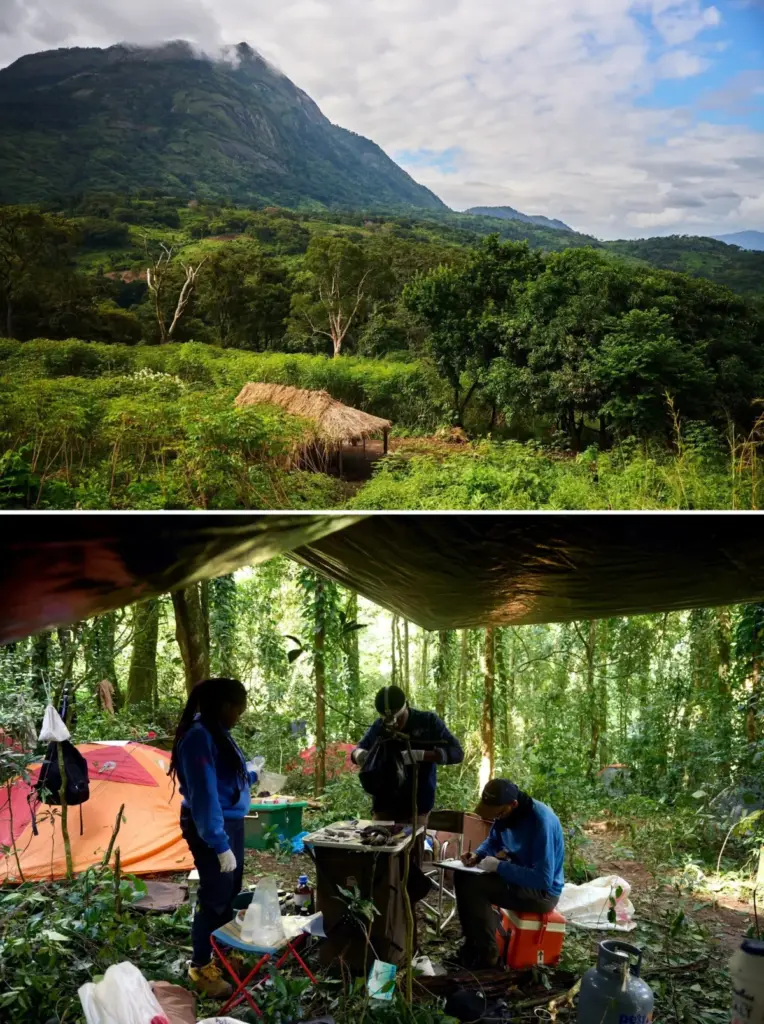
This initial digital discovery sparked a series of intensive scientific expeditions led by Bayliss and international research teams. What they uncovered surpassed all expectations. The complex topography of steep ridges and deep valleys created unique microclimates, fostering an explosion of endemism.
In 2008, Bayliss led an expedition that yielded a stunning discovery: a new-to-science cobalt-blue butterfly, subsequently named Iolaus mabuensis. To date, only a single specimen of this striking insect has ever been collected, underscoring the extreme rarity of Mabu’s endemic inhabitants. Just a year later, in 2009, Bayliss made another unforgettable discovery—and nearly stepped on one in the process. While navigating the dense undergrowth, he encountered the Mount Mabu forest viper (Atheris mabuensis), a venomous snake new to science, uniquely adapted to the damp leaf litter of the high-altitude rainforest.
Media Spotlight and Global Prominence (2013)
As biological surveys continued to reveal staggering numbers of new species, Mount Mabu caught the attention of world-renowned naturalist and broadcaster Sir David Attenborough. In October and November, the mountain’s 1,700-meter summit plays host to a breathtaking natural phenomenon known as "hilltopping." Hundreds of species of butterflies gather in massive swarms on the mountaintop during the morning hours to mate.
In 2013, Attenborough documented this rare behavior for a major BBC wildlife production, casting a global spotlight on the mountain and cementing its nickname: the "butterfly forest." The exposure transformed Mount Mabu from a regional scientific curiosity into a conservation priority on the international stage.
The Path to Legal Protection (2024–Present)
Following years of biological surveys, community mapping, and advocacy led by environmental organizations like ReGeCom alongside local communities, the formal groundwork for protection accelerated. By 2024, comprehensive conservation proposals were compiled and reviewed, detailing the urgent need to shield the rainforest from external pressures.

The culmination of these decades of labor arrived on August 24, when the Ministry of Agriculture, Environment and Fisheries published the official decree establishing the Mount Mabu Community Conservation Area. This legal framework not only safeguards the environment but institutionalizes the rights of the indigenous population as the primary guardians of the land.
Supporting Context & Metrics: The Biological Treasures of Mount Mabu
To understand the gravity of Mozambique’s new conservation decree, one must examine the extraordinary metrics of biodiversity that characterize Mount Mabu.
An Irreplaceable Ecological Stronghold
- Total Protected Area: 9,341 hectares (23,082 acres) of pristine medium-altitude rainforest.
- Geographical Significance: The largest continuous block of medium-altitude rainforest remaining in the entirety of southern Africa.
- Elevation: The forest reaches a summit of 1,700 meters (5,577 feet), creating vertical stratification and diverse microclimates.
A Haven for Endemic Species
- Butterfly Diversity: Scientists have officially recorded more than 200 butterfly taxa on Mount Mabu. However, due to the vast and rugged terrain, researchers estimate that further comprehensive surveys could push this number to 250 species.
- New Discoveries: Since exploratory surveys began in 2005, more than 30 species new to science—encompassing frogs, chameleons, bats, and various insects—have been formally discovered within the forest’s boundaries.
- Iconic Endemics:
- Iolaus mabuensis (Cobalt-blue butterfly): Discovered in 2008 by Julian Bayliss’s team, representing one of the rarest butterfly species on Earth.
- Atheris mabuensis (Mount Mabu forest viper): Described in 2009, a distinct arboreal/terrestrial viper adapted exclusively to the forest’s microclimate.
The Phenomenon of Hilltopping
The ecological crown jewel of Mount Mabu remains its annual butterfly migration and mating ritual. Every year, during the shoulder months of October and November, environmental conditions trigger a massive convergence. Hundreds of butterflies ascend from the surrounding valleys to the windy, open summit every morning. This concentrated gathering—hilltopping—provides scientists with a rare window to study insect behavior, population health, and evolutionary genetics in a pristine setting.
Official Statements and Local Perspectives
The formal protection of Mount Mabu has been met with profound relief and cautious optimism from the scientific community and local civil society organizations who have dedicated decades to the cause.
Dr. Julian Bayliss, the ecologist whose visionary satellite searches and subsequent fieldwork initiated the push for conservation, reflected on the milestone in an interview with Mongabay:

"It’s a great relief. These forests are very important because they’ve got high levels of endemism. The terrain has steep ridges and valleys, which create microclimates and isolated flora and fauna that evolved over millions of years into a plethora of species found in few other places, and in some cases nowhere else in the world."
Crucially, the governance model of the newly minted conservation area leans heavily on the indigenous populations who have maintained a symbiotic relationship with the forest for centuries. José Monteiro, executive director of ReGeCom—an environmental organization that works closely with local communities in Mabu—emphasized that the decree is, above all, a tribute to local stewardship:
"All of this effort is a recognition of the community that protected the forest. The community, over a long time, kept the forest standing."
Future Outlook: Challenges, Management Plans, and Next Steps
While the publication of the August 24 ministerial decree marks a monumental legal victory, conservationists emphasize that the work to secure Mount Mabu’s future has only just begun.
Threat Mitigation
Despite being largely well-conserved due to its remote topography and cultural taboos that treated the area as sacred, the forest is increasingly vulnerable to external pressures. Chief among these threats are the gradual encroachment of small-scale agriculture and illegal logging. As populations grow in the surrounding Lugela district, the fertile soils on the lower slopes of the mountain present a tempting target for slash-and-burn farming and timber extraction. The new legal boundary provides law enforcement and community rangers with the authority to deter and prosecute unauthorized activities.

Developing the Community Management Plan
According to the terms of the decree, the 9,341-hectare land is officially dedicated to the protection, conservation, and sustainable use of natural resources by local communities. However, the specific regulatory restrictions, zoning laws, and operational frameworks governing human activity within the reserve have yet to be finalized.
Over the coming months, stakeholders including the Mozambican government, ReGeCom, and local community leaders will collaborate to draft and implement a comprehensive Community Management Plan. This plan will dictate how sustainable resource use—such as non-timber forest product harvesting and ecotourism initiatives—can be balanced against strict ecological preservation.
A Blueprint for Regional Conservation
The success at Mount Mabu serves as a potential blueprint for other isolated biodiversity hotspots across Mozambique and the broader southern African region. By centering indigenous rights and traditional ecological knowledge within a formal legal framework, the Mount Mabu Community Conservation Area proves that modern conservation is most effective when it honors the people who kept the wild alive.
As researchers plan future expeditions to uncover the remaining secrets hidden within Mabu’s mists—ranging from undiscovered insects to uncataloged botanical wonders—the "butterfly forest" stands ready to face the future, legally protected and locally anchored.



