Executive Overview
In the global fight against climate change, organic waste diversion has emerged as one of the most accessible and impactful municipal strategies. According to data from the U.S. Environmental Protection Agency (EPA), food waste constitutes approximately 24 percent of municipal solid waste sent to landfills. Once buried under tons of refuse, this organic matter decomposes anaerobically, generating fugitive methane—a greenhouse gas with a warming potential dozens of times greater than carbon dioxide over a 20-year horizon. In fact, the EPA estimates that food waste is responsible for an astonishing 58 percent of all fugitive methane emissions released from municipal landfills.
To combat this environmental crisis, municipalities across North America and Europe have aggressively scaled up curbside organic waste collection programs, commonly referred to as "green bin" initiatives. A nationwide survey by BioCycle revealed that access to curbside food waste collection in the United States surged to 14.9 million households in 2023, marking a 49 percent increase from just two years prior.
However, a stark divergence has emerged between infrastructure availability and actual citizen compliance. While some progressive urban centers boast near-universal compliance, participation rates in many suburban and metropolitan districts languish below 30 percent. Investigative analysis reveals that this participation gap is rarely driven by ideological opposition to recycling. Instead, it is stymied by a highly visceral, unglamorous barrier: the "yuck factor."
Without intervention, organic waste carts quickly devolve into hotbeds for foul odors, condensation, flies, maggots, and pest infestations. For many households, the recurring, unpleasant chore of scrubbing liquefied organic residue from deep within a plastic utility cart eventually overrides their environmental altruism. This investigative report examines the structural failures of current organic collection models, the behavioral economics of municipal waste compliance, and how simple mechanical innovations—such as the BagEZ suspension frame—are offering a highly scalable solution to keep households committed to the green bin.
Detailed Chronology: The Evolution of Organic Waste Diversion and the Friction of Household Compliance
[Phase 1: Regulatory Push] ──> [Phase 2: Infrastructure Expansion] ──> [Phase 3: The Behavioral Bottleneck]
  - State/Local Mandates         - Rollout of Curbside Bins            - Low Sustained Participation
  - Landfill Diversion Goals     - BioCycle: 14.9M Households (2023)    - The "Yuck Factor" & Maintenance
Phase 1: The Regulatory and Infrastructure Push (2010–2020)
Over the past two decades, waste management policies underwent a fundamental shift. Landfill space constraints, combined with tightening municipal carbon-accounting standards, prompted legislative bodies to target organic waste. States like California (via Senate Bill 1383), Vermont, and Massachusetts enacted strict organic waste bans, forcing municipal authorities to rapidly build out composting and anaerobic digestion pipelines.
Phase 2: The Physical Rollout and the Illusion of Access (2021–2023)
During this period, cities distributed millions of heavy-duty rolling plastic carts to suburban and urban households. Whether designated as Toronto’s "Green Bin," New York City’s brown carts, or generic "organics carts" elsewhere, the physical infrastructure of collection was successfully established. The BioCycle 2023 survey confirmed that municipal access was expanding at an exponential rate, jumping from 10 million households in 2021 to nearly 15 million in 2023.

Phase 3: The Behavioral Bottleneck (Present Day)
As municipal programs matured, waste managers confronted a frustrating plateau. While residents initially accepted the bins, long-term compliance began to decay. Field surveys and waste-characterization studies indicated a high rate of silent abandonment. Households simply wheeled their green bins to the side of the garage and stopped using them.
When investigators and municipal outreach teams interviewed lapsed participants, the feedback was remarkably consistent. The primary driver of abandonment was not confusion over sorting rules, but rather the physical reality of maintaining the bin. Organic waste breaks down rapidly, particularly in summer months, releasing highly acidic, foul-smelling liquid runoff (colloquially termed "bin juice"). This liquid attracts vectors—flies, maggots, raccoons, and rodents—turning a well-intentioned ecological habit into an ongoing sanitation hazard.
Supporting Context & Metrics: Quantifying the Waste Crisis and Behavioral Economics
To understand why traditional interventions fall short, one must analyze the raw data of household waste generation and the economics of municipal waste management.
The Real Volume of Household Food Waste
A common misconception among municipal planners is that households require massive liners to match their oversized 32- to 64-gallon curbside carts. However, empirical data paints a very different picture.
The MITRE-Gallup study—the largest and most comprehensive household food waste survey conducted in the United States to date—tracked the waste habits of nearly 10,000 diverse households. The findings revealed that the average household generates only 6.2 cups of food waste per week. When accounting for non-edible scraps such as fruit peels, vegetable cores, and bones, that figure rises to approximately 8.8 cups per week—a volume slightly exceeding half a gallon.
Average Household Weekly Food Waste:
[████████░░░░░░░░░░░░░░░░] 8.8 Cups (Approx. 0.55 Gallons)
Typical Curbside Bin Volume:
[██████████████████████████████████████████████████] 32 to 64 Gallons
This data highlights a massive structural mismatch:

- Municipalities distribute large, industrial-sized rolling carts to accommodate automated truck-lifters.
- Households generate a microscopic fraction of that volume in food waste each week.
- Attempting to line a giant cart with custom-fit, heavy-duty compostable liners is highly cost-prohibitive for the average family, costing upwards of $2 to $4 per bag.
- Conversely, leaving the small volume of scraps loose in a massive bin guarantees that they will rupture, smear across the walls, and pool at the bottom.
The British Case Study: The Power of Liner Subsidies
In 2023–24, the Essex County Council in the United Kingdom conducted a year-long, highly controlled empirical study under their Food Recycling Project. Recognizing that the mess of food recycling was a key barrier to entry, the council designed a multi-pronged behavioral intervention for over 375,000 households.
The intervention package included:
- An informational campaign leaflet.
- A highly visible reminder sticker affixed directly to the general refuse bin.
- A free roll of certified compostable food waste liners.
The results were immediate and statistically significant. In the first three months following the delivery of the packages, food recycling tonnage rose by an average of 21 percent compared to a strictly monitored control group that received no intervention. This performance more than doubled the council’s original 10 percent target.
The Essex County trial provided definitive empirical proof of a key behavioral economic concept: reducing friction directly correlates with increased compliance. When residents were given a free, seamless tool to keep the mess contained, their willingness to participate skyrocketed. However, the study also highlighted a fiscal limitation: continuous public subsidization of free liners is financially unsustainable for most municipal budgets over the long term.
Official Statements & Engineering Solutions: Addressing the "Yuck Factor" at the Source
To understand how the market is responding to this behavioral bottleneck, we look to the engineering principles of waste containment. The central engineering challenge is preventing the condensation and anaerobic decomposition that occurs when organic waste is trapped in airtight, unventilated spaces.
The Physics of the "Yuck Factor"
"Produce is largely water," notes Sean Rana, founder of BagEZ, a Canadian clean-tech firm specializing in waste-containment hardware. "As organic material breaks down, that moisture is liberated. When a standard compostable bag rests flat against the plastic floor or walls of a curbside bin, it creates a cold-contact surface. Moisture condenses on the outside of the bag and has nowhere to go. It pools at the bottom, degrades the bag, and creates an anaerobic, foul-smelling soup."

Traditional Bin Dynamics vs. BagEZ Aerated Suspension:

[ Traditional Bin ]
┌─────────────────────────┐
│  [Compostable Bag]      │ <--- Rests flat against cold plastic walls
│         │               │
│         ▼               │
│   (Wet condensation)    │ <--- Moisture pools at the bottom
│   (Anaerobic soup)      │ <--- High odor, fly larvae attraction
└─────────────────────────┘

[ BagEZ Suspended Bin ]
┌─────────────────────────┐
│  ┌─[BagEZ Frame]─┐      │ <--- Rigid steel frame suspends bag
│  │               │      │
│  │ [Suspended]   │      │ <--- 360-degree air circulation
│  │   [Bag]       │      │
│  └───────────────┘      │ <--- Condensation evaporates; bin stays dry
│                         │
└─────────────────────────┘
This moisture buildup is the primary vector for pest attraction. Flies are highly sensitive to the volatile organic compounds (VOCs) released by anaerobic liquid. They lay eggs in the moisture pools, leading to maggot infestations. Raccoons and rodents, hunting almost exclusively by smell, are similarly drawn to the pungent odors escaping the bin’s lid.
The Suspension Solution: A Mechanical Intervention
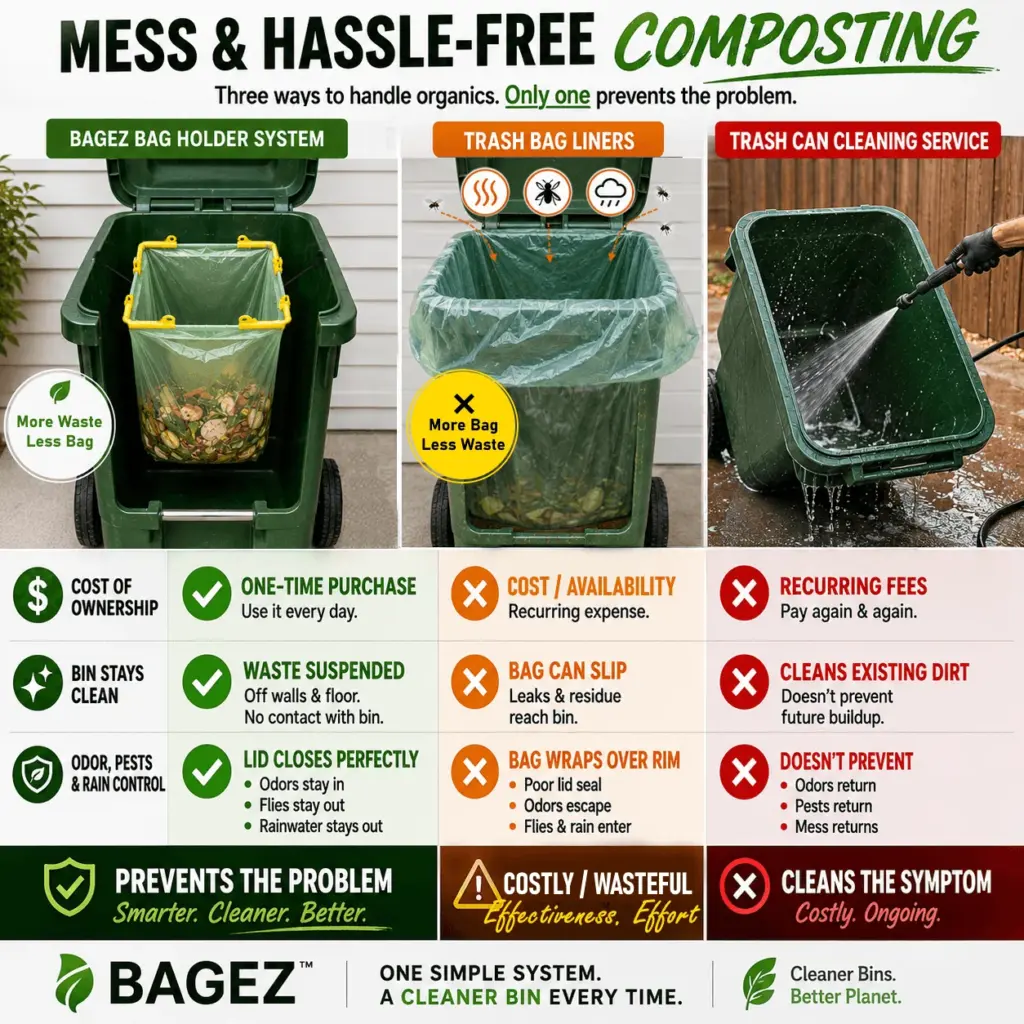
To solve this without recurring municipal subsidies or expensive bin-cleaning contracts, Rana designed BagEZ—a reusable, folding heavy-duty steel frame equipped with secure locking clips. The device mounts directly onto the rim of any standard curbside cart, holding a standard-sized bag (from 13 gallons up to 49 liters) open and completely suspended in mid-air inside the bin.
By suspending the bag, the design leverages thermodynamics and airflow to eliminate the conditions that cause odors and decay:
- 360-Degree Air Circulation: Because the bag never touches the bottom or sides of the utility cart, air moves freely around all surfaces of the bag.
- Evaporative Drying: Condensation that forms on the exterior of the bag evaporates into the moving air rather than pooling at the bottom of the cart. The interior of the bin remains entirely dry.
- Volumetric Efficiency: Instead of buying expensive, oversized liners designed to fit a 30- or 64-gallon bin, households can use highly affordable, standard 13-gallon kitchen-sized compostable bags. This size is perfectly aligned with the weekly food waste volumes identified in the MITRE-Gallup study.
"The goal was to create a one-time hardware purchase that changes the physical environment inside the bin," says Rana. "If the bin stays bone-dry and clean, you eliminate 90 percent of the reasons people quit the program. You don’t need to drag out the garden hose every week, you don’t get maggots, and you don’t attract wildlife."
Navigating Municipal Regulatory Frameworks
A critical caveat for any household looking to optimize their organic recycling is the highly localized nature of waste management regulations. Across North America, municipal rules regarding liners vary widely:
- Certified Compostable Only: Many commercial composting facilities require bags certified to ASTM D6400 standards to ensure they break down completely during the high-heat thermophilic composting process.
- Paper-Only or Loose Scraps: Some older facilities or municipal programs forbid plastic-like compostable bags entirely, requiring residents to use paper yard bags, newspaper wrapping, or to deposit scraps loose in the cart.
- Anaerobic Digester Limitations: High-tech anaerobic digesters often use mechanical depackaging systems that rip open bags and send them to landfills anyway, meaning the type of bag used must match their processing machinery.
To avoid cart rejection or load contamination, residents are advised to verify local guidelines. Databases such as Earth911’s recycling search provide zip-code-specific clarity on what materials are accepted in regional waste streams.

Comparative Analysis of Organics Management Methods
To help municipal managers and sustainability coordinators evaluate their options, the following matrix compares the three primary approaches to curbside organic waste maintenance:
| Feature / Metric | Reactive Bin Washing Services | Full-Size Heavy-Duty Liners | Suspended Bag Frames (e.g., BagEZ) |
|---|---|---|---|
| Primary Mechanism | High-pressure hot water washing after the bin gets dirty. | Large, thick compostable liners that cover the entire cart interior. | Rigid steel frame that suspends standard bags in mid-air. |
| Financial Model | High, recurring monthly or quarterly subscription fees. | Ongoing weekly cost for specialized, large-format bags. | One-time hardware purchase; works with standard, inexpensive bags. |
| Moisture Control | None. Moisture pools and decays between scheduled washes. | Poor. Large bags sweat against cold plastic walls, causing tearing. | Excellent. Continuous 360-degree airflow prevents condensation pooling. |
| Pest Mitigation | Moderate. Odors build up between wash cycles, attracting pests. | Moderate. Tears in large bags lead to localized decay and larvae. | High. Dry environment prevents fly breeding and minimizes animal-attracting odors. |
| Resource Efficiency | Low. Consumes significant volumes of water and energy per wash. | Low. Requires large amounts of compostable material per week. | High. Maximizes use of small, appropriately sized bags. |
Future Outlook: Sustaining the Circular Economy Through Behavioral Design
As urban centers march toward ambitious "zero-waste" and carbon-neutrality deadlines, the focus of waste management must shift from macro-infrastructure to micro-behavior. Providing trucks, processing plants, and green bins is no longer enough; municipalities must actively design out the friction of household compliance.
      [ Traditional Infrastructure Model ]
      High Capital Expenditure (Trucks, Plants, Carts)
                        │
                        ▼
      [ Behavioral Friction (The "Yuck Factor") ]
                        │
                        ▼
      High Abandonment Rates & Low Participation
                        │
                        ▼
      [ Future Behavioral Design Model ]
      Low-Cost Hardware Interventions (Suspended Frames, Airflow)
                        │
                        ▼
      Sustained, Clean, and Habitual Compliance
The future of municipal organic waste management will likely be defined by three key trends:
- Integration of Behavioral Nudges into Public Policy: Following the success of trials like the Essex County project, progressive cities will increasingly bundle hardware solutions with educational campaigns. Rather than simply telling residents why they should compost, cities will focus on providing the physical tools to make the process sanitary and painless.
- Strict Enforcement of Organic Landfill Bans: As landfill capacities dwindle and global temperatures rise, voluntary organic recycling will transition to mandatory participation. Fines and non-collection policies for contaminated or non-participating households will become standard, raising the stakes for residents to find sustainable, clean household systems.
- Optimized Hardware Solutions: The era of throwing loose food scraps into giant, unlined plastic bins is coming to an end. The integration of mechanical suspension systems, designed to keep bins clean and dry without ongoing public subsidies, represents a vital evolution in residential waste management.
By resolving the unglamorous, everyday hurdles of household sanitation, communities can finally bridge the gap between environmental policy and human behavior. When keeping a green bin clean requires no more effort than taking out the standard trash, the circular economy will transition from a civic ideal into an effortless, universal habit.