

Executive Overview
In the wake of a catastrophic natural disaster that swept through the Himalayan region, the government of Nepal has formally demanded $20 million in climate compensation from the United Nations’ Loss and Damage Fund. The unprecedented flash floods and landslides—triggered by the partial collapse of a rapidly melting glacier in late August—have resulted in a staggering human toll, leaving over 1,300 people confirmed dead and more than 5,500 missing after 12 grueling days of search and rescue operations.
Speaking exclusively to the international press, Nepal’s Foreign Minister, Shisir Khanal, issued a passionate and forthright call to action, urging the world’s major industrial economies to "wake up" and accept shared historical responsibility for the accelerating climate crisis. Khanal described the disaster not as a routine seasonal monsoon event, but as a terrifying glimpse into a destabilized future—a phenomenon he likened to a "mountain tsunami."
While the initial request of $20 million has been submitted through a joint letter by Nepal’s Ministries of Finance and Environment, government officials readily concede that this figure is merely a fraction of the actual economic devastation. Independent assessments estimate total structural and infrastructural damages to exceed $5 billion, with upwards of 20,000 homes destroyed, vital highways obliterated, and entire riverside communities rendered uninhabitable.
This disaster has thrust the volatile intersection of geopolitics, global carbon emissions, and climate justice into sharp international focus. Producing less than 0.1% of global greenhouse gas emissions, Nepal finds itself on the suffocating frontline of a crisis engineered primarily by the world’s most heavily industrialized nations. As the international community grapples with profound financing gaps within the UN Loss and Damage Fund, Nepal’s urgent plea serves as a bellwether for vulnerable, low-emitting nations facing existential threats from a warming planet.
Detailed Chronology: Anatomy of a Himalayan Disaster
The catastrophe that unfolded across the rugged terrains of Chinese-controlled Tibet and Nepal in late August was months—if not decades—in the making, catalyzed by the unrelenting progression of global heating.
The Trigger: Glacial Destabilization
Scientific analysis indicates that the disaster originated high in the Himalayas, where a fragile, receding glacier partially fractured under the weight of sustained atmospheric warming. For months prior to the collapse, regional temperatures had outpaced global averages, aggressively degrading the structural integrity of the ice formations. On the day of the disaster, the compromised glacier gave way, unleashing a catastrophic cascade of ice, water, and loose moraine rock.
The Wave of Destruction
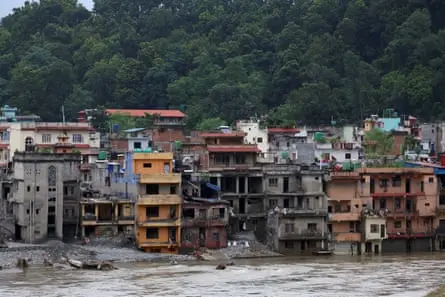
The sudden release of millions of cubic meters of water transformed local river systems into violent torrents of slurry. According to eyewitnesses and government officials, the resulting flash flood behaved less like a standard river overflow and more like an inland tsunami.
- Velocity and Force: Rushing down steep mountain gradients, the debris flow achieved speeds approaching 180 kilometers per hour.
- Devastating Impact: The wall of water, mud, and boulders reached heights of 60 to 70 feet, completely overwhelming narrow mountain valleys.
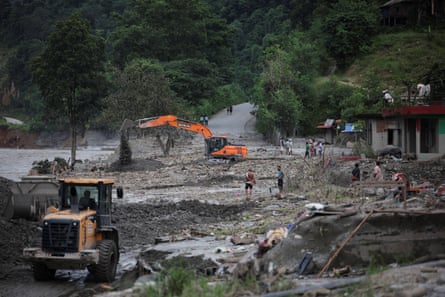
- Wiped-Out Infrastructure: Entire villages, bridges, and critical arteries such as the highway running near the Trishuli River were instantly erased. Remote communities remain entirely cut off from outside assistance, severely hampering logistical supply lines.
The Search and Rescue Phase
As the floodwaters subsided, the scale of human tragedy became terrifyingly clear. Emergency services, augmented by international specialists and local volunteers, initiated a massive search and rescue operation. For 12 continuous days, rescue workers scoured mudbanks, debris fields, and swollen riverbanks for survivors. Despite heroic efforts—such as the recovery of two individuals alive late in the second week—hopes for the thousands still missing have steadily diminished. With over 6,000 individuals either confirmed dead or missing, the disaster stands as one of the deadliest climate-induced events in modern South Asian history, rivaling the sheer societal trauma of the devastating 2015 earthquake.
Supporting Context & Metrics: The Vulnerable Roof of the World
To fully comprehend the magnitude of Nepal’s grief and anger, one must examine the stark geopolitical and environmental imbalances governing the Himalayan region.

The Asymmetry of Emissions
Nepal’s contribution to global greenhouse gas emissions is statistically negligible, accounting for less than 0.1% of the planetary total. Conversely, its immediate neighbors and global superpower economies—most notably China and India—rank among the world’s most prolific carbon emitters. Despite bearing virtually no responsibility for the historical accumulation of atmospheric greenhouse gases, Himalayan nations are paying a disproportionate and lethal price.
Accelerated Warming and Ice Loss
The mountain ranges of the Himalayas are warming at a rate nearly 50% faster than the global average. This accelerated thermal shift has had catastrophic consequences for regional cryosphere stability:
- Glacial Retreat: A landmark 2023 United Nations report revealed that Nepal’s mountain glaciers had lost close to one-third of their total ice volume in a span of just over 30 years.
- Permafrost Degradation: As sub-surface permafrost thaws, mountain slopes lose their structural cohesion, dramatically increasing the frequency and severity of landslides, rockfalls, and glacial lake outburst floods (GLOFs).
The Economic Reality Check
While Nepal’s official submission to the UN Loss and Damage Fund requests a modest $20 million, economic analysts and domestic planners estimate that the real cost of reconstruction will eclipse $5 billion. Rebuilding over 20,000 destroyed homes, restoring impassable national highways, and executing complex infrastructural relocations for vulnerable riverside communities will require multi-year, multi-billion-dollar international investments. Furthermore, entire settlements must now be relocated to higher, structurally sound terrain to mitigate the inevitability of recurring climate disasters.
Official Statements and Diplomatic Friction
The political fallout from the disaster has catalyzed intense debates regarding international accountability, burden-sharing, and the mechanics of climate reparations.
Foreign Minister Shisir Khanal’s Appeal
In his interview with international media, Foreign Minister Shisir Khanal articulated a profound sense of abandonment by the international community. Rejecting the notion that the disaster was an isolated freak occurrence, Khanal positioned it as an urgent warning for humanity.
"This felt like a tsunami that was coming from the Himalayas," Khanal stated. "We experienced waves as high as 60, 70 feet, which were mixed with debris, mud, stones, rocks, and came at the speed of almost 180km per hour. Towns, villages and highways were completely wiped out and there are some areas still disconnected."
Emphasizing the principle of climate justice, Khanal underscored that major economies built on fossil-fuel extraction must shoulder the financial burdens inflicted on the Global South.
"We have contributed so little to climate change," he noted. "It is imperative for those in the global community who benefit from larger, much more polluting economies, and whose historical contribution to greenhouse gases is much bigger than ours, to accept a shared responsibility. This affects all of humanity."
Navigating Geopolitical Sensitivities
Initially, Khanal’s remarks drew sharp focus toward regional neighbors India and China, while conspicuously omitting direct critique of the United States—historically the world’s largest cumulative greenhouse gas emitter. Recognizing the potential for diplomatic friction, Khanal later recalibrated his stance to emphasize collaborative multilateralism over adversarial finger-pointing.
"It is not just about shifting the blame to one or the other country," Khanal clarified, "it’s about us all working together."
On the specific issue of transboundary data sharing, Khanal defended Beijing against allegations of withholding critical hydrological warnings. He maintained that scientific networks in both Nepal and China were caught entirely unawares by the sheer unpredictability of the glacial fracturing.
"With the benefit of hindsight, we can now see that this glacier was fragile and had been receding in the past six months," Khanal admitted. "But before the floods hit, there was no knowledge on our part, or on the part of Chinese scientists, that this particular collapse was imminent. I do not believe any of us had any idea of the threat until it happened."
Confronting Skepticism
Addressing international political hurdles—including climate denialism and resistance from wealthy nations regarding mandatory compensation structures—Khanal remained unyielding. Drawing a sharp parallel, he remarked, "Yes, there always will be people who may not agree to our perspective or deny there is climate change, but there are also people who deny that the Earth is round."
Future Outlook: The Global Loss and Damage Crisis
Nepal’s formal invocation of the UN Loss and Damage Fund exposes systemic vulnerabilities within the global climate finance architecture established at COP27 under the Paris Agreement.
The Structural Financing Gap
The UN Loss and Damage Fund was heralded as a historic breakthrough for climate justice, designed to channel financial assistance to developing nations reeling from unavoidable climate impacts. However, the mechanism is currently paralyzed by a severe funding deficit:
- Overwhelming Demand: The fund has received formal requests totaling $2.8 billion from roughly 119 climate-vulnerable countries.
- Inadequate Contributions: Total international pledges and disbursements hover at a meager $400 million.
- Major Power Deficits: The United States—having experienced political turbulence regarding international climate agreements, notably under former President Donald Trump—has contributed a mere $17 million to date.
Shifting Paradigms: From Relief to Resilience
Minister Khanal and international policy experts argue that financial frameworks must evolve past reactive emergency response. Aid must be systematically earmarked for preemptive adaptation, climate-resilient infrastructure development, and advanced early-warning systems tailored for high-altitude glacial environments.
As global temperatures continue to climb, Nepal’s tragedy serves as a grim preview of the cascading crises awaiting mountain regions worldwide. Without robust, adequately capitalized mechanisms for loss and damage, the roof of the world will continue to crumble—taking thousands of lives and centuries of cultural heritage with it, while exposing the profound disconnect between global polluters and those forced to bear the ultimate cost.



