Executive Overview
The global transition toward maritime decarbonization is currently caught in a tug-of-war between high-visibility technological theater and unglamorous, scalable infrastructure. Hydrogen systems consistently capture the imagination—and the media headlines—through striking demonstrations involving fuel cells, floating barges, and complex chemical conversions.
However, a closer examination of actual energy flows and port economics reveals a different reality. Scalable maritime electrification relies heavily on the quieter, less photogenic backbone of electrical grids, stationary battery storage, and routine charging stations.
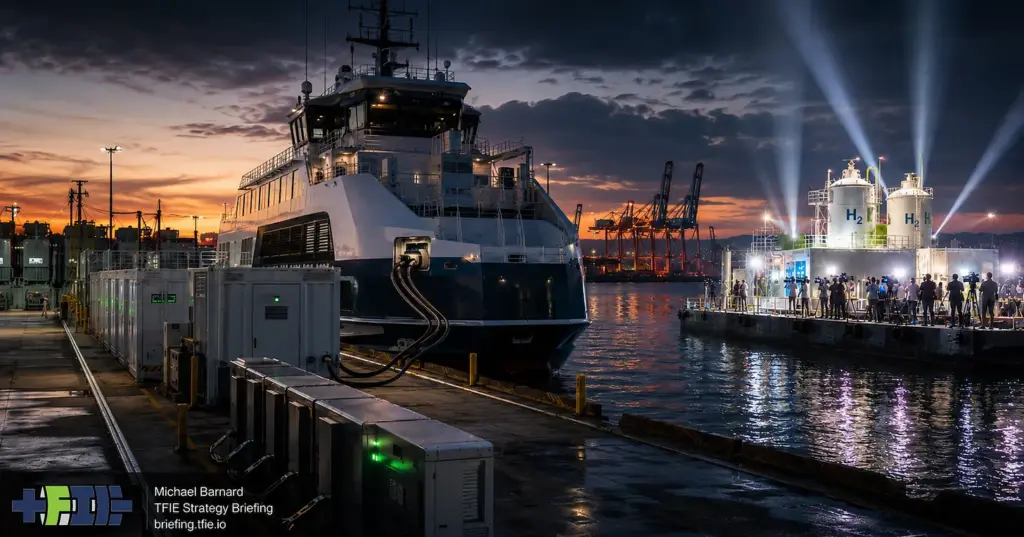
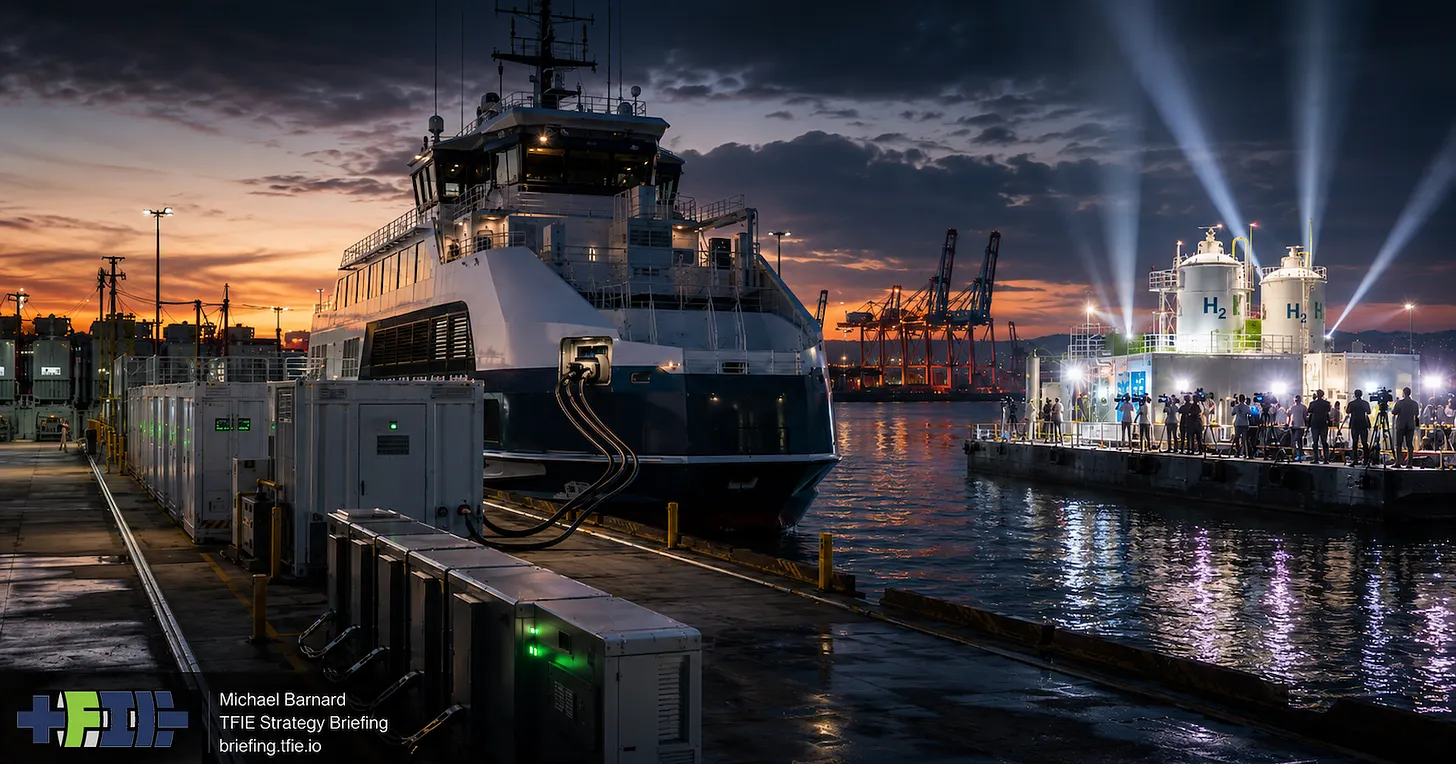
A recent demonstration at the Port of Tilbury on the River Thames offers a clear case study. GeoPura deployed a hydrogen power unit mounted on a floating platform to charge a commercial electric vessel using 300 kW delivered via five Ballard fuel cells. While visually compelling and rich in public relations value, the underlying vessel was not hydrogen-powered; it was a battery-electric ship. The demonstration proved that hydrogen can be converted back into electricity to charge a battery. Yet, it also highlighted a fundamental question facing maritime engineers and port authorities: why introduce a complex, inefficient hydrogen loop into an energy pathway that could be served directly by standard grid infrastructure and stationary storage?
This report provides a comprehensive analysis of maritime charging challenges, evaluating the thermodynamic efficiency penalties of hydrogen versus the economic and operational practicality of grid-tied battery architecture. By exploring port power constraints, deployment economics, and the psychological appeal of technological "firsts," we examine what it will truly take to decarbonize the global shipping sector.
Detailed Chronology: The Tilbury Demonstration and the Hydrogen Loop
To understand the friction between hydrogen hype and battery reality, it is necessary to examine how modern clean-tech demonstrations are constructed, executed, and perceived by the market.
The Port of Tilbury Deployment
At the Port of Tilbury, GeoPura positioned one of its hydrogen power units (HPUs) on a floating barge. The unit utilized five Ballard fuel cells to output 300 kW of power, successfully feeding a commercial electric vessel tied up at the berth.
From a marketing and public relations perspective, the arrangement was a masterclass in visual storytelling. It combined a marine environment, an industrial floating platform, advanced hydrogen equipment, and an operational ship. The resulting photographs, live demonstrations, and industry headlines underscored the versatility of hydrogen fuel cells in remote or marine off-grid scenarios.
Unpacking the Energy Chain
Beneath the photogenic surface, however, the engineering mechanics reveal a circuitous route for energy. The vessel being charged was entirely battery-electric. The hydrogen system did not propel the ship directly via combustion or onboard fuel cells; instead, it acted as a chemical intermediary.
Renewable electricity was first used to produce hydrogen via electrolysis. That hydrogen required compression, storage, and physical transport to the port. Once on the floating platform, the HPU’s fuel cells converted the hydrogen back into electricity. This electricity was then conditioned and fed through a conventional charger into the vessel’s onboard battery storage system.
The Efficiency Penalty
This multi-step transformation introduces severe thermodynamic losses. According to standard industry metrics and GeoPura’s own published efficiency figures, the round-trip energy penalty of the hydrogen loop is substantial. Roughly 3.1 megawatt-hours (MWh) of initial renewable electricity consumed during electrolysis yields only about 1 MWh of usable electricity after conversion back through a fuel cell.
This efficiency loss—hovering around 65% to 70% lost in translation—does not automatically render hydrogen equipment obsolete. For temporary construction sites, remote off-grid industrial facilities, and emergency response operations where grid connections are physically impossible, replacing diesel generators with zero-emission hydrogen power units is a logical and necessary step. However, applying this same energy-intensive loop to a port berth, where high-power battery charging is the ultimate end-goal, creates unnecessary economic and operational friction.
Supporting Context & Metrics: Port Power Constraints and Battery Architecture
Ports represent uniquely difficult nodes within the modern electrical grid. Understanding why ports struggle with power delivery illuminates the mismatch between grid capacity and vessel demands.
The Port Electrical Dilemma
A typical commercial berth faces severe instantaneous power constraints. When a modern electric or hybrid vessel docks, it may require anywhere from several hundred kilowatts to multiple megawatts of power over a relatively short turnaround window.
Local distribution networks are rarely designed to support such massive, sudden spikes in demand. Upgrading substation infrastructure, running new underground cables through congested industrial zones, and trenching port quays require years of regulatory approvals, significant capital expenditure, and disruptive civil engineering works. Furthermore, a ship might demand massive amounts of power for a single hour during hoteling operations, while requiring virtually no power during the remainder of the day. Upgrading the grid connection to meet that absolute peak load is economically inefficient for utilities and port operators alike.
The Stationary Battery Solution
This operational challenge is precisely what stationary battery energy storage systems (BESS) are engineered to solve. Instead of relying on an upgraded grid connection capable of supporting peak vessel loads instantly, a port can install a stationary containerized battery behind the quay.
- Slow Charging, Fast Discharge: A modest, existing grid connection can continuously charge the stationary battery at a slow, steady rate throughout the day between ship arrivals.
- Peak Shaving: When a vessel docks and plugs in, the stationary battery discharges stored energy at the high C-rates required by the ship, bridging the gap between grid limitations and vessel demand.
- Load Smoothing: The local electrical network experiences a smooth, predictable load profile, avoiding costly demand charges and capacity upgrades.
- Container Swapping: Where vessel schedules and port logistics permit, containerized batteries can be physically swapped out on the quay, completely decoupling battery charging time from vessel turnaround schedules.
Comparative Metrics: Hydrogen vs. Direct Electrification
| Metric / Parameter | Hydrogen Power Units (HPUs) | Grid-Tied Stationary Battery Systems |
|---|---|---|
| Round-Trip Efficiency | ~30% – 35% (Electrolysis to Fuel Cell) | ~85% – 90% (Grid to Storage to Vessel) |
| Infrastructure Footprint | Requires fuel storage, delivery trucks, HPU barges | Substations, transformers, containerized BESS |
| Grid Interaction | Independent of grid (off-grid capable) | Buffers grid loads, prevents peak demand spikes |
| Primary Application | Remote sites, construction, temporary events | Fixed port infrastructure, high-frequency charging |
| Visual / Media Appeal | High (novelty, complex mechanical systems) | Low (unobtrusive transformers and cabinets) |
Official Industry Perspectives and System Economics
The debate between hydrogen and direct electrification ultimately hinges on the transition from isolated technological demonstrations to scalable commercial systems.
Demonstrations vs. Commercial Systems
Industry analysts note a critical divergence in the clean tech sector between proving that something can be done and proving that a system should be deployed at scale.
A demonstration is designed to showcase engineering capability. It highlights innovation, secures grant funding, and generates media coverage. However, a scalable maritime charging system operates under entirely different economic imperatives. It requires:

- Repeat Customers: Operators who return day after day, year after year.
- High Utilization: Infrastructure that remains active for significant portions of the day to justify capital expenditure.
- Workable Tariffs: Electricity pricing structures that make commercial shipping economically viable.
- Symbiotic Infrastructure: Assets that compound in value as more vessels, electric trucks, and port handling equipment plug into the local microgrid.
The Psychology of "Firsts"
The maritime sector is currently saturated with press releases celebrating technological "firsts." Every time a new fuel cell is married to a different hull or a mobile generator is placed on a barge, it triggers a wave of public relations announcements.
This phenomenon occurs largely because infrastructure electrification is inherently unglamorous. A transformer cabinet, a buried conduit, and a lithium-iron-phosphate battery container behind a concrete quay do not generate headlines. They look ordinary, and they operate quietly. Yet, this ordinariness is the hallmark of success. When clean energy infrastructure begins to look mundane, it means it has transitioned from an expensive experiment into an accepted utility.
Conversely, an over-reliance on constant "firsts" without subsequent fleet-wide adoption can signal underlying commercialization challenges. If an innovative technology requires bespoke engineering for every single deployment, it fails to achieve the economies of scale necessary to drive down costs across the global shipping industry.
Future Outlook: What the Maritime Transition Will Actually Look Like
As regulatory pressures from organizations like the International Maritime Organization (IMO) tighten, ports and shipping lines are forced to make long-term capital allocation decisions.
The Death of Technological Theater
The future of maritime decarbonization will look decidedly less glamorous than current trade show floors suggest. We are moving away from an era defined by bespoke technological novelties and toward a period defined by standardization, predictability, and operational rigor.
In the coming decade, successful ports will not be judged by how many experimental hydrogen barges they parade past the cameras. Instead, they will be evaluated based on metrics that matter to commercial operators:
- Megawatt-Hours Delivered: The sheer volume of clean energy transferred to working vessels annually.
- Turnaround Speed: How quickly a container ship or ferry can dock, recharge, and depart without disrupting tight maritime schedules.
- Cost Parity: The per-kilowatt-hour cost of delivered electricity compared to traditional bunker fuels.
- Replication Rates: Whether other ports look at the economic data and independently invest in identical infrastructure packages.
Conclusion
Hydrogen will undoubtedly retain vital niches in the future energy economy. It holds immense promise for deep-sea shipping molecules (such as green ammonia or e-methanol derived from hydrogen) where dense chemical energy carriers are unavoidable, as well as for remote off-grid industrial applications.
However, for shore-side port charging of battery-electric vessels, inserting hydrogen into the energy chain introduces unnecessary efficiency penalties, capital costs, and logistical complexity. As the maritime energy transition matures, the spotlight will inevitably shift away from the noisy, photogenic theatre of hydrogen generators and settle squarely where it belongs: on the quiet, efficient, and scalable power of grids and batteries.