Executive Overview
Beneath the turquoise waters of Tela, Honduras, a silent ecological war is being waged. The Mesoamerican Barrier Reef—a vibrant, complex aquatic ecosystem teeming with marine biodiversity—faces an unprecedented threat from an unlikely and formidable adversary: the lionfish (Pterois).
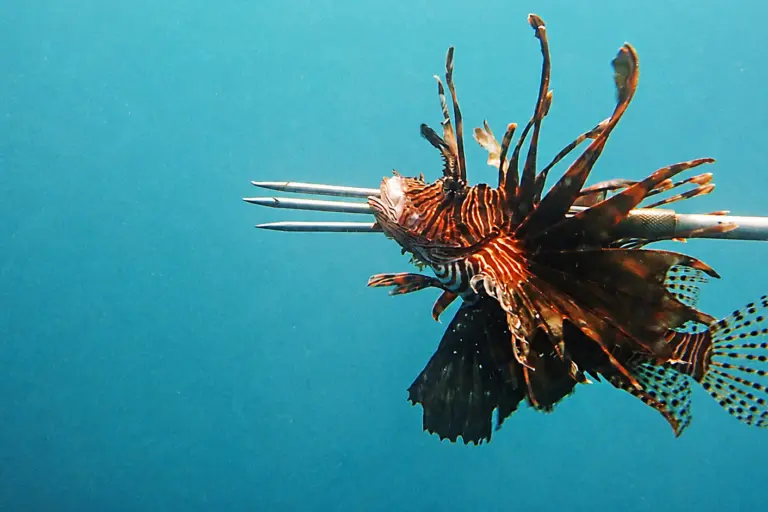
Native to the warm tropical waters of the Indo-Pacific, this striking yet devastatingly destructive predatory fish has established a relentless foothold across the wider Caribbean and Gulf of Mexico. Believed to have been introduced via the aquarium trade in the late 20th century, the lionfish possesses no natural predators in its adopted Atlantic habitats. Armored with venomous dorsal spines and boasting a voracious appetite that spares virtually no juvenile reef species, the lionfish has rapidly ascended to the role of an apex ecological disruptor.
Enter Mario, an engineer by training and a conservationist by calling. Having fallen in love with the underwater world off the coast of Tela, Mario founded the local dive center, Tela Divers, not merely as a commercial venture, but as a gateway to marine stewardship. Confronted with the escalating degradation of his favorite local reefs, Mario never intended to become a full-time hunter of invasive species. Yet, faced with the stark reality of ecological collapse, he stepped up.
What began as an individual initiative using custom-engineered spears has since blossomed into a robust, community-wide movement. Today, Tela’s divers, fishers, and restaurateurs are locked in a daily battle to keep invasive populations in check. Through innovative community derbies, specialized hunting expeditions, and a burgeoning market for lionfish cuisine, this coastal Honduran town is offering a masterclass in grassroots marine conservation. However, as Mario and his peers quickly discovered, managing an invasive species is not a problem with a definitive end date; it is an enduring war of attrition requiring constant vigilance, cultural adaptation, and unwavering community engagement.
Detailed Chronology: From Accidental Introduction to Grassroots Resistance
The Silent Invasion: Tracing the Spread
To understand the gravity of the work being done in Tela, one must first trace the trajectory of the lionfish crisis. Marine biologists believe the invasion began in earnest during the 1980s and 1990s, likely catalyzed by the aquarium trade in Florida. Whether intentionally released by hobbyists weary of the voracious predators or washed into the open ocean during coastal hurricanes—most notably Hurricane Andrew in 1992—a small handful of lionfish found themselves in the Atlantic Ocean.
Free from the ecological checks and balances of their native Indo-Pacific ecosystems, where native predators and specialized diseases keep populations regulated, the fish found paradise. A single female lionfish can release up to two million eggs per year, spawning every few days. These eggs float on ocean currents, allowing larvae to disperse rapidly across thousands of miles of open water. Within a couple of decades, the invasion had swept through the Bahamas, the entire Caribbean basin, Central America, and parts of South America.
By the time the vanguard of the invasion reached the shores of Tela, Honduras, the warning signs were already blaring from neighboring countries. However, knowing a storm is coming and watching it wash away your livelihood are two entirely different realities.
The Awakening at Tela Divers
For Mario, the turning point was personal. As an engineer, he was naturally inclined toward problem-solving, structural analysis, and systematic execution. When he established Tela Divers, his primary focus was sharing the breathtaking underwater topography of Tela’s coral formations with tourists and locals alike. But over successive diving seasons, a troubling pattern emerged.
The reefs were changing. Familiar species of juvenile parrotfish, snappers, groupers, and damselfishes—crucial players in maintaining the health of the coral—were disappearing. In their place, hovering motionlessly near coral heads with their fan-like, venomous spines flared, were increasing numbers of lionfish.
Recognizing that waiting for governmental or international intervention would take too long—and recognizing that marine ecosystems do not have the luxury of bureaucratic timelines—Mario took matters into his own hands. Armed with basic gear and a structural engineer’s intuition, he began experimenting with the design of specialized hand spears. These tools needed to be lightweight, highly accurate, and lethal upon impact to minimize stress to the fish and prevent accidental damage to the delicate surrounding coral structures.
Scaling Up: The Birth of Community Derbies
An individual diver, no matter how dedicated, can only harvest so many fish in a single breath of compressed air. The math of the invasion is stark: lionfish reproduce faster than a single person can hunt them. If the intervention was to have any meaningful ecological impact, the effort had to scale.
Mario and his colleagues at Tela Divers realized that public awareness and active participation were the force multipliers they needed. They pivoted from isolated hunts to community-driven initiatives, introducing the concept of lionfish derbies to Tela.
These events transformed what could have been a grim environmental chore into an engaging, high-energy community festival. Local dive teams, fishers, and ocean enthusiasts gathered to compete across categories such as catching the largest lionfish, the smallest specimen, and, most importantly, the greatest cumulative total. By gamifying the eradication process, Tela Divers successfully captured the public imagination. Local residents who had previously viewed the ocean through a purely transactional lens—or simply as a scenic backdrop—became active participants in its defense.
Supporting Context & Metrics: The Ecological and Economic Stakes
The Biological Weaponry of Pterois
Why is the lionfish such an effective invader? The answer lies in its evolutionary adaptations.
- Voracious Generalist Predation: Lionfish are opportunistic carnivores. Studies examining stomach contents have revealed over 70 species of fish and invertebrates inside a single lionfish. They consume herbivores like parrotfish, which are critical because they eat the algae that would otherwise smother and kill coral reefs. By eating the herbivores, lionfish indirectly accelerate coral degradation.
- Venomous Defenses: The lionfish’s striking appearance—characterized by bold red, white, and brown stripes and a mane of venomous dorsal, pelvic, and anal spines—acts as an effective deterrent to local predators like sharks, large groupers, and moray eels. These native predators have not evolved alongside lionfish and generally do not recognize them as prey.
- High Reproductive Output: As noted, continuous year-round spawning combined with millions of buoyant eggs ensures rapid population replenishment, easily outpacing natural mortality rates.
+-----------------------------------------------------------------+
|                     THE ECOLOGICAL CASCADE                      |
|                                                                 |
|  [ Lionfish Invasion ]                                          |
|         │                                                       |
|         ▼                                                       |
|  [ Consumption of Herbivores ] (e.g., Parrotfish)               |
|         │                                                       |
|         ▼                                                       |
|  [ Unchecked Algae Growth ]                                     |
|         │                                                       |
|         ▼                                                       |
|  [ Coral Smothering & Reef Death ]                              |
|         │                                                       |
|         ▼                                                       |
|  [ Collapse of Local Fisheries & Coastal Protection ]           |
+-----------------------------------------------------------------+
The Sisyphean Challenge of Eradication
Despite the immense success of Tela’s community derbies, the battle against the lionfish is a textbook example of a Sisyphean task. Marine ecologists emphasize that complete eradication of the lionfish from the Atlantic is virtually impossible given current technologies and geographic scale.

Instead, conservation management has shifted from eradication to suppression—keeping local population densities below the threshold where they cause irreversible ecological damage.
Mario notes the frustrating reality of this dynamic: divers can sweep a specific reef site clean during a weekend derby, feeling a profound sense of accomplishment, only to return a few weeks later and find the exact same site repopulated by juvenile lionfish drifting in on ocean currents or migrating from deeper, untargeted mesophotic zones (deep reefs beyond the reach of standard recreational scuba diving).
This constant influx means that sporadic cleanups are insufficient. Survival of the reef requires permanent, institutionalized pressure on the invasive population.
Official Statements and Community Voices
The frontline of marine conservation is rarely manned by academic scientists in pristine laboratories; it is sustained by people whose daily lives and cultural identities are entwined with the health of the sea.
"We didn’t set out to become warriors against an ecological invasion," reflects Mario, speaking from the docks of Tela. "As an engineer, you look at a system, you identify the stress points, and you look for structural solutions. The reef is our home, our livelihood, and our heritage. When we saw it being systematically dismantled by an invader from across the world, standing by was simply not an option."
Marine conservation experts working along the Mesoamerican Barrier Reef echo Mario’s sentiments, highlighting the vital role of decentralized, community-led initiatives. Traditional top-down environmental regulations often move too slowly to address fast-moving biological invasions. By empowering local dive operators, fishers, and hospitality workers, communities like Tela create an adaptive defense network that responds in real-time.
Local artisanal fishers, once initially skeptical of targeting a fish known primarily for its toxic sting, have increasingly joined the cause. Through educational outreach led by dive centers, fishers have learned how to safely remove the venomous spines using kitchen shears or specialized pliers. Once the spines are trimmed, the lionfish is revealed to be safe, delicate, and exceptionally flavorful—possessing a white, flaky meat often compared to snapper or grouper.
Future Outlook: Building a Sustainable Economy Around the Invader
As Tela looks toward the future, the strategy for controlling the lionfish population is evolving from purely recreational hunting to permanent economic integration. The goal is to turn the invader into a commodity, creating a market-driven incentive for its continuous removal.
From Pest to Plate
One of the most promising avenues for long-term population control is encouraging local restaurants, hotels, and seafood markets to feature lionfish prominently on their menus. By creating a commercial demand for the fish, Tela aims to incentivize local artisanal fishers to target lionfish during their regular fishing trips, effectively turning hundreds of commercial fishers into day-to-day conservation agents.
+-----------------------------------------------------------------+
|                  THE CIRCULAR CONSERVATION MODEL                |
|                                                                 |
|      [ Regular Fishing & Targeted Spearing ]                    |
|                         │                                       |
|                         ▼                                       |
|          [ Safe Processing & Spine Removal ]                    |
|                         │                                       |
|                         ▼                                       |
|             [ Local Restaurants & Markets ]                     |
|                         │                                       |
|                         ▼                                       |
|     [ Consumer Demand Creates Economic Incentive ]              |
|                         │                                       |
|                         └───────────── (Repeats) ───────────────┘
+-----------------------------------------------------------------+
Culinary workshops and chef-led demonstrations are currently underway to teach local culinary workers how to prepare lionfish safely and creatively—ranging from traditional ceviche to pan-seared fillets. When tourists and locals order lionfish at a Tela restaurant, they are not just enjoying a meal; they are directly contributing to the preservation of the Mesoamerican Barrier Reef.
Expanding Beyond Recreational Depths
Another frontier for future research and intervention is addressing the deep-water population reservoir. While recreational divers operating within standard limits (typically above 30 meters or 100 feet) can effectively manage shallow reefs, lionfish thrive at much greater depths, down to several hundred feet on mesophotic reefs. These deep zones act as nurseries and safe havens, continuously restocking the shallow reefs that divers routinely clear.
Conservationists in Tela and across the broader Caribbean are exploring the use of innovative technologies, such as remotely operated vehicles (ROVs) and specialized deep-water traps, to target lionfish in these inaccessible zones. Integrating deep-water suppression with shallow-water community hunting could provide the comprehensive pressure needed to keep the invasion truly at bay.
A Blueprint for Coastal Resilience
Ultimately, the story of Mario and the community of Tela, Honduras, transcends the biological specifics of the lionfish. It is a powerful testament to community resilience and grassroots environmentalism in an era of global ecological change.
While the war to protect the Mesoamerican Barrier Reef is far from over, Tela has proven that ordinary citizens—armed with passion, ingenuity, and a collaborative spirit—can fundamentally alter the trajectory of an environmental crisis. As Mario continues his work beneath the waves, each dive serves as a reminder that safeguarding our natural world is not a task left exclusively to tomorrow’s generations, but a profound responsibility demanded of us today.