Executive Overview
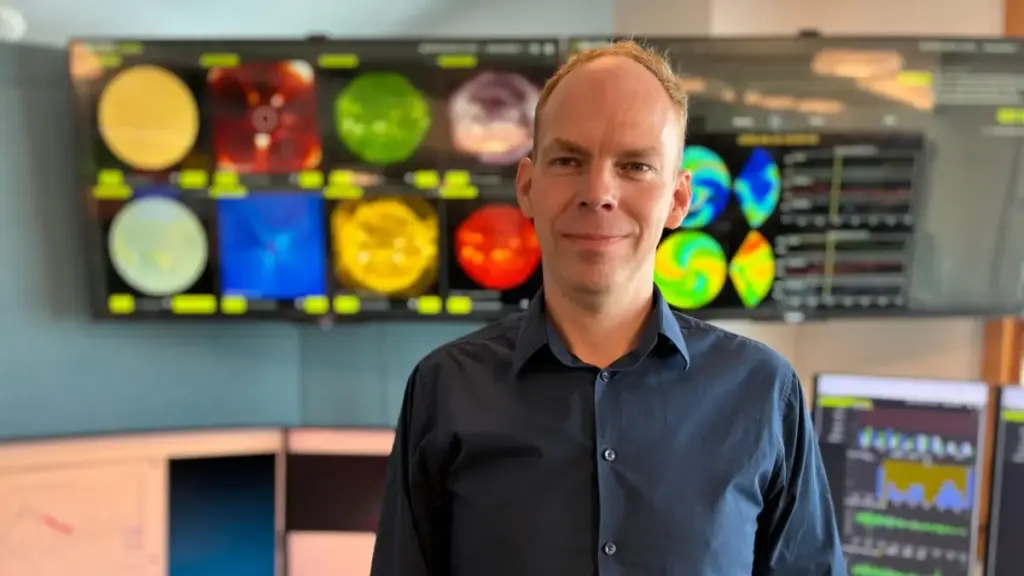
Deep inside the Met Office headquarters, a specialized control room operates around the clock, 365 days a year, keeping a relentless watch on the closest star to our planet: the Sun. This dedicated space weather prediction team is one of only a handful of its kind worldwide, tasked with monitoring invisible, highly volatile forces that possess the capacity to fundamentally disrupt modern human civilization.
While conventional meteorology tracks rain, wind, and temperature in the Earth’s troposphere, space weather concerns itself with the dynamic, often violent conditions of the interplanetary medium. Driven almost entirely by solar activity—ranging from high-speed solar winds and coronal mass ejections (CMEs) to intense bursts of radiation known as solar flares—these cosmic events interact directly with the Earth’s magnetic field and upper atmosphere.
The stakes could not be higher. Vital infrastructure upon which modern society relies—including Global Positioning System (GPS) navigation, power grids, aviation routes, and orbital satellites—remains acutely vulnerable to severe geomagnetic fluctuations. Recognizing the gravity of this modern threat, the UK government has formally classified severe space weather as a top-tier hazard on its National Risk Register. Economic projections underscore this vulnerability: a comprehensive 2025 estimate by Lloyd’s of London indicates that an extreme, unmitigated space weather event could inflict a staggering $2.4 trillion in damage on the global economy over a five-year period.
To bridge critical gaps in current detection capabilities, the Met Office has forged a strategic partnership with a consortium of leading academic institutions led by Aberystwyth University, alongside Northumbria, Durham, and Reading universities. Together, researchers and forecasters are striving to refine predictive models, providing critical early warnings to safeguard infrastructure operators before solar storms strike.

Detailed Chronology: From the Carrington Event to Modern Operations
The 1859 Carrington Event: The Historical Benchmark
To understand the true destructive potential of space weather, scientists frequently look back to the historical benchmark known as the Carrington Event of September 1859. Named after English amateur astronomer Richard Carrington—who famously observed a massive white-light solar flare while projecting images of the Sun through a telescope—the event remains the most powerful geomagnetic storm ever recorded in human history.
The consequences were profound and global. Vivid auroras, or northern and southern lights, illuminated skies as far south as the Caribbean and Rome, glowing so brightly that miners in the Rocky Mountains woke up and began preparing breakfast, mistaking the crimson night sky for dawn. More critically, the storm overwhelmed the nascent global telegraph network, which had only begun commercial operations in the preceding decade.
Richard Stone, a forecaster from the Met Office space weather team, highlights the sheer electrical power injected into the Earth’s crust during the event. "During the Carrington Event, even telegraph wires were heard to hum and crackle, and operators were able to run their telegraph systems without any battery power at all because the incoming electrical current from the atmosphere was so high," Stone explains.
While the 1859 event caused localized fires and widespread communication blackouts, its societal impact was relatively limited due to humanity’s low reliance on electricity at the time. Today, however, experts warn that a recurrence of a Carrington-class storm without adequate mitigation would paralyze modern interconnected power grids, obliterate satellite communications, and collapse global financial markets.

The Evolution of UK Space Weather Forecasting (2014–Present)
Recognizing these mounting technological dependencies, the Met Office established its operational space weather forecasting capability in 2014. Over the past decade, the agency has worked closely with key national infrastructure operators to deliver actionable intelligence, blending ground-based observations with deep-space satellite telemetry.
Despite these advancements, space weather forecasting remains a nascent discipline compared to traditional terrestrial meteorology. Observational coverage is notoriously sparse. When a solar storm erupts from the surface of the Sun, instruments can spot the event approximately three days before its shockwave reaches Earth. However, once the CME leaves the Sun’s immediate corona, it essentially vanishes from direct observation until it crosses paths with deep-space satellites positioned roughly one million miles away at the Lagrangian Point 1 (L1).
This creates a nerve-wracking observational blackout window. "It’s like seeing a storm form off the east coast of America and then having zero observations or tracking data until it suddenly arrives in Ireland," Stone remarks. Consequently, forecasters are often left with a mere one-hour window after satellite detection to precisely model the storm’s trajectory, calculate its magnetic orientation, and issue targeted warnings to vulnerable industries.
Supporting Context & Metrics: The Sun’s 11-Year Cycle
Space weather is not entirely random; it is governed by the Sun’s approximately 11-year magnetic activity cycle, known as the solar cycle. During the solar minimum, the Sun is relatively calm, producing few discernible space weather events. As magnetic fields twist and intensify over the years, activity ramps up toward a chaotic climax known as the solar maximum.

The Sun officially reached the peak of its current cycle—Solar Cycle 25—in 2024. This heightened period of activity is the primary reason why millions of people across mid-latitudes were treated to rare, dazzling displays of the Aurora Borealis. However, behind the breathtaking celestial lights lies a period of intense solar bombardment.
During the solar maximum, the Sun can unleash multiple powerful flares and CMEs per day. Yet, thanks to the continuous monitoring and advance warnings provided by the Met Office to technology companies and power operators, the general public has experienced virtually no major disruptions despite the Sun’s aggressive behavior. Mitigation actions—such as re-routing high-frequency radio communications, shifting satellite orientations into safe modes, and balancing electrical loads on national power grids—prevent widespread crises before they can manifest.
Official Statements and Academic Partnerships
To overcome the challenges posed by sparse observation and complex physics, the Met Office has partnered with a prominent academic consortium headed by Aberystwyth University. Professor Huw Morgan, Head of Space Physics at Aberystwyth University, is spearheading the initiative alongside researchers from Northumbria, Durham, and Reading universities.
"This pre-warning is a monumental mitigation of the danger posed by space weather," Professor Morgan states. "For example, it gives the National Grid an adequate window to reconfigure networks and avoid catastrophic cascading power cuts. Similarly, commercial airlines can divert polar or high-latitude trans-oceanic flights down to safer, lower latitudes where the Earth’s magnetic field offers greater shielding against radiation."

Despite these collaborative successes, Professor Morgan emphasizes the scientific hurdles that remain. "Compared to forecasting normal weather on Earth—which benefits from dense sensor networks, radar, and decades of refined data—space weather forecasting is a deeply developing field. It is yet to mature to the point where we can provide exact, localized forecasts with the same precision as a rain shower."
Human Impact Beyond Earth: Astronauts and Deep Space Radiation
The threats posed by space weather are not restricted to the surface of the Earth. Orbiting astronauts face acute, unshielded exposure to cosmic radiation that presents severe biological hazards.
Dr. Helen Sharman, who in 1991 became the first British astronaut to travel into space during an eight-day mission to the Soviet Mir Space Station, recalls being thoroughly briefed on emergency shelter protocols in the event of a sudden solar particle storm. During her mission, Dr. Sharman experienced firsthand the eerie visual phenomenon caused by high-energy particles penetrating the spacecraft hull.
"These galactic cosmic rays and solar particles come straight through the heavy shielding materials that spacecraft are made of," Dr. Sharman explains. "They pass right through an astronaut’s skin, and we notice them because we frequently see little bright flashes of light on our retinas. These high-energy particles punch through the spacecraft, through our skin, and through our eyes, stimulating the optic nerves in a surreal way."

Dr. Sharman notes that while astronauts operating in low Earth orbit (LEO) remain partially sheltered beneath the protective umbrella of the Earth’s intrinsic magnetic field, future deep-space exploration changes the equation entirely. "The higher up you are, and the further away you travel from the Earth’s magnetic shield—such as crewed missions heading to the Moon or eventually to Mars—the more vulnerable you become. We must seriously consider how we can engineer advanced shielding to protect human explorers from relentless space radiation."
Future Outlook
As humanity becomes increasingly reliant on satellite constellations, global communication networks, precision agriculture, and electrified transportation grids, the socioeconomic imperative for accurate space weather prediction will only intensify.
The ongoing collaboration between the Met Office and academic powerhouses like Aberystwyth University represents a critical step forward in national resilience. By integrating advanced machine learning models, improving deep-space observational assets, and refining real-time data assimilation, scientists hope to shrink the dreaded "observational blind spot" between the Sun and Earth.
While the raw fury of the Sun cannot be stopped, the fusion of continuous 24/7 monitoring and cutting-edge academic research ensures that Earth remains forewarned, well-prepared, and shielded from the invisible tempests of space.