

Executive Overview
The North American renewable natural gas (RNG) sector is undergoing a profound structural realignment, marked by high-profile asset divestments, shifting regulatory timelines, and aggressive private equity maneuvers. In a definitive retreat from its broad multi-state portfolio strategy, Idaho-based Sevana Bioenergy has offloaded the vast majority of its remaining assets. The centerpiece of this transaction is the sale of the high-capacity Rialto Bioenergy Facility in Southern California to Berq RNG, a subsidiary backed by Connecticut-based private equity firm Lotus Infrastructure Partners.
This strategic exit comes just over two years after Sevana initially rescued the embattled Southern California plant out of Chapter 11 bankruptcy. The transition follows closely on the heels of another major asset drop: California Bioenergy’s acquisition of Sevana’s stake in South Dakota Biogas LLC, a joint venture originally designed to construct a vast network of dairy manure digesters across the state. With these consecutive transactions finalized, Sevana Bioenergy—once heavily capitalized by a landmark $250 million commitment from the Ontario Teachers’ Pension Plan Board—is left with a single operational anaerobic digester in Idaho.
The rapid dismantling and redistribution of Sevana’s portfolio underscore the volatile economic realities plaguing the advanced waste-to-energy sector. While the promise of decarbonizing agricultural waste and municipal organic streams has attracted billions of institutional dollars, operationalizing these complex facilities has consistently run headfirst into regulatory delays, feedstock supply chain bottlenecks, and protracted timelines to profitability.
For the Rialto Bioenergy Facility—historically touted as the largest food waste diversion and energy recovery project of its kind in North America—the transition to Berq RNG represents yet another chapter in a turbulent operational history. As new municipal waste-diversion contracts loom on the horizon in Los Angeles, industry observers are closely watching whether Berq RNG can finally unlock the facility’s dormant potential and steer the massive bio-refinery into sustained profitability.
Detailed Chronology: From Grand Ambitions to Asset Consolidation
To fully understand the current shakeup at Sevana Bioenergy and the acquisition of the Rialto facility, it is essential to trace the trajectory of the companies and regulatory frameworks that shaped the modern RNG landscape.
2017–2023: The Rise of Sevana and Institutional Backing
Founded in 2017, Sevana Bioenergy steadily built a reputation as a competent developer and operator of agricultural and organic waste digester projects. By leveraging deep technical expertise, the company amassed a track record of deploying more than 20 digester tanks across agricultural settings in Oregon, Idaho, and South Dakota.
The turning point for the firm arrived in 2023, when the powerful Ontario Teachers’ Pension Plan Board stepped in, acquiring a majority stake in Sevana Bioenergy. Alongside this acquisition, the pension fund pledged an impressive $250 million capital commitment designed to supercharge the development of RNG projects across North America. At the time, the partnership was hailed as a validation of industrial-scale agricultural and municipal biogas infrastructure, positioning Sevana to capitalize on aggressive state and federal clean energy mandates.
2020–2024: The Rialto Facility’s Path Through Bankruptcy
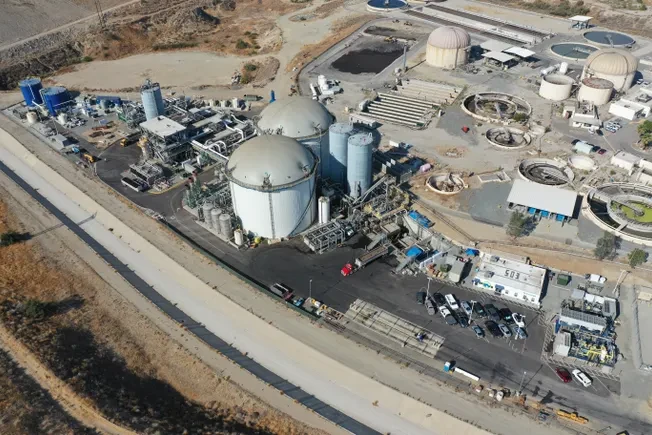
Concurrently, the Rialto Bioenergy Facility was charting a far more precarious course. Designed by clean tech engineering firm Anaergia and opened in 2020, the facility was engineered with staggering ambitions. Located in San Bernardino County, it was built to process up to 1,000 tons of organic material per day, positioning it as the premier food waste diversion and energy recovery anchor in North America.
However, the facility’s business model was inextricably linked to California’s landmark Senate Bill 1383 (SB 1383), legislation designed to drastically reduce organic waste disposal in landfills. Anaergia and project developers built the plant in anticipation of a guaranteed, mandatory influx of source-separated organic waste generated by residents and businesses across the Los Angeles metropolitan area.
Those regulatory guarantees, however, hit a wall of municipal implementation delays. RecycLA, the administrative agency overseeing Los Angeles commercial waste franchise contracts, delayed the rigorous enforcement and rollout of the required waste-diversion protocols. Consequently, the Rialto facility was starved of its primary economic engine: steady, predictable volumes of organic feedstock.
The financial strain proved insurmountable. In 2023, Anaergia spun off the struggling facility into a dedicated LLC, which promptly filed for Chapter 11 bankruptcy protection. While Anaergia acknowledged that the financial distress stemmed directly from a slow operational ramp-up and starved feedstock channels, the company maintained operations throughout the restructuring proceedings.
2024–2025: Sevana’s Brief Stewardship and the Berq RNG Takeover
Sensing an undervalued asset with immense upside should California’s regulatory enforcement eventually catch up, Sevana Bioenergy stepped in during 2024, acquiring the Rialto site out of bankruptcy for $20 million. Under Sevana’s ownership, Anaergia continued to operate the plant, while Sevana committed an additional $5 million to clear out deferred maintenance and execute vital operational upgrades.
Despite these capital infusions and climbing throughput rates—reaching a peak run rate of approximately 70% of capacity under Sevana’s watch—the facility continued to operate at a financial loss. The prolonged timeline required to achieve break-even operations tested the patience and capital reserves of Sevana and its institutional backers.
This financial strain precipitated the rapid unravelling of Sevana’s broader portfolio. Last week, California Bioenergy announced it had acquired Sevana’s stake in South Dakota Biogas LLC. Now, with the definitive announcement of the Berq RNG transaction, Sevana’s expansive footprint has been almost entirely dissolved, leaving CEO Steve Compton confirming that the firm retains just a single operational digester in Idaho.
Supporting Context & Metrics: Navigating Feedstock Realities and Financial Hurdles
The challenges that ultimately forced Sevana Bioenergy to divest its crown jewel provide a case study in the friction between environmental policy design and industrial execution.
The Feedstock Equation and the Los Angeles Market
Anaergia’s chief operating officer, Yaniv Scherson, shed light on the structural cash-burn issues that plagued the Rialto facility during Sevana’s tenure. "They bought a site that was not making money, and they probably had a budget of how much capital they were willing to invest until profitability," Scherson observed. "It must have taken longer than their plan."
A primary culprit behind the sluggish path to profitability has been the fractured supply chain for organic waste. When the plant originally came online, Anaergia sought to secure supply by selling specialized organics extrusion machines to major waste haulers, including Waste Management (WM) and Universal Waste Systems (UWS).
Since 2020, WM has reliably operated its extrusion unit, processing local organic waste and piping the resulting organic slurry to the Rialto facility. However, adoption across other partners has experienced frustrating delays. While UWS brought its extrusion machine online in late 2024, it has been forced to idle a secondary machine while waiting for final municipal hauling contracts to clear the bureaucratic hurdles of the City of Los Angeles.
Production Capacities, Offtake Agreements, and Regulatory Milestones
Despite these logistical bottlenecks, the physical asset itself remains a heavyweight in the bioenergy space. The facility boasts the engineering capacity to produce up to 1 million mmBtus of renewable natural gas annually—a massive volume capable of decarbonizing heavy-duty commercial transport or injecting utility-grade gas directly into regional grids.
Adding a layer of future financial security, the facility holds a strategic gas offtake agreement with Southern California Gas (SoCalGas). However, as of early 2025, this agreement is still awaiting final regulatory approval. Securing this authorization represents a critical regulatory milestone that will fundamentally alter the facility’s cash-flow profile once greenlit.
Furthermore, broader macroeconomic and municipal shifts offer legitimate reasons for optimism. RecycLA has scheduled the phase-in of new commercial waste franchise contracts for the first half of next year. These updated contractual obligations are widely expected to force commercial entities and haulers to ramp up food waste diversion aggressively.
"That event should be a catalyst for more feedstock incremental to the market," Scherson noted. "Pero how much, of course, is speculative." If the anticipated wave of municipal feedstock finally materializes, it could transform Rialto from a capital-draining restructuring project into a highly lucrative renewable energy engine.
Official Statements and Industry Perspectives
The transition of the Rialto Bioenergy Facility to Berq RNG has elicited measured optimism from key stakeholders across the renewable energy and waste management sectors.
Bas van Berkel, Chief Executive Officer of Berq RNG, emphasized his firm’s strategic focus on operational optimization and community integration. In a formal statement accompanying the acquisition announcement, van Berkel stated:
"We look forward to applying our operating expertise to optimize performance at Rialto, working closely with the City of Rialto, our feedstock partners and the local community."
Berq RNG brings a seasoned pedigree to the table. Backed by the robust financial muscle of Lotus Infrastructure Partners, Berq has a demonstrated track record of scaling clean infrastructure. The firm has successfully developed and subsequently divested landfill-gas-to-RNG projects across Kentucky and New York, and recently secured a massive $110 million in municipal bond financing in Michigan to construct four state-of-the-art dairy manure digester projects. This deep experience in navigating both landfill gas and agricultural anaerobic digestion positions Berq uniquely to tackle the complex operational nuances of a massive urban food-waste facility.
Meanwhile, Anaergia intends to maintain its operational footprint at the site, ensuring continuity of technical management under the new ownership. Yaniv Scherson confirmed that Anaergia’s operating teams will continue running the plant alongside Berq RNG, preserving institutional knowledge built since the facility’s inception.
For Sevana Bioenergy, leadership has adopted a pragmatic silence regarding the company’s long-term corporate pivot, though CEO Steve Compton expressed genuine satisfaction in seeing the Rialto facility land with a well-capitalized operational owner capable of carrying the torch forward.
Future Outlook: The Next Phase of North American RNG
The consolidation and sale of Sevana Bioenergy’s portfolio signal a broader maturation—and potential cooling—of the speculative "land grab" era in North American renewable natural gas.
During the initial legislative gold rush following the enactment of aggressive state-level low-carbon fuel standards (LCFS) and organic waste bans, institutional capital flowed freely into biogas developers. Billions of dollars were deployed under the assumption that regulatory timelines would translate seamlessly into immediate operational margins.
The reality, as demonstrated by the Rialto facility’s journey through Chapter 11 bankruptcy and Sevana’s subsequent retreat, is considerably more grueling. Success in the RNG sector requires not only deep pockets for capital expenditure and maintenance, but also immense institutional stamina to weather multi-year regulatory bottlenecks, localized permitting fights, and fragmented feedstock supply chains.
Moving forward, the spotlight turns squarely to Berq RNG and Lotus Infrastructure Partners. By taking over an asset that has already absorbed tens of millions of dollars in restructuring, debt clearing, and physical upgrades, Berq enters the fray at a uniquely advantageous juncture. With SoCalGas offtake approvals pending and Los Angeles poised to finally enforce stricter commercial waste diversion mandates via RecycLA next year, the structural tailwinds that eluded Sevana may finally break in Berq’s favor.
If Berq RNG can successfully bridge the gap to full-capacity feedstock utilization, the Rialto Bioenergy Facility may yet fulfill its original, headline-grabbing prophecy: serving as the premier, profitable blueprint for municipal organic waste recovery in North America. If, however, operational friction and feedstock scarcity persist, it will serve as a stark reminder that in the heavy industrial world of renewable energy, policy mandates on paper do not automatically guarantee profit on the balance sheet.



