

By Global Aerospace and Defense Correspondent
Published: October 2023
Executive Overview
In an eventful culmination of private-sector aerospace engineering, SpaceX’s massive Starship transportation system completed a controlled splashdown in the remote waters of the Pacific Ocean, successfully wrapping up an intensive, albeit truncated, orbital flight test. The mission, which was originally projected to stretch across a grueling 10-hour window to test long-duration orbital coasting and advanced thermal management, was intentionally cut short by mission controllers roughly 90 minutes into the flight.
Despite the compressed timeline, the mission achieved several monumental milestones that signal a seismic shift in global telecommunications and heavy-lift rocketry. Most notably, the spacecraft successfully deployed a batch of 26 "next-generation" Starlink V3 satellites directly into low-Earth orbit (LEO). These advanced payloads represent a quantum leap forward in orbital bandwidth, drastically increasing the data throughput and global coverage capabilities of SpaceX’s burgeoning internet constellation.
While the sudden curtailment of the 10-hour flight plan initially sparked concern among casual observers, aerospace analysts and SpaceX engineers have lauded the test as an overwhelming success. By gathering critical telemetry data during the high-stress ascent, orbital maneuvers, and atmospheric reentry phases, SpaceX continues to refine the architecture of the world’s first fully reusable, deep-space transportation system. This comprehensive report delves into the intricate chronology of the flight, the technical specifications of the Starlink V3 payloads, the regulatory and safety implications of the Pacific splashdown, and what this pivotal test means for the future of interplanetary human flight.
Detailed Chronology of the Mission
To fully comprehend the scope and execution of the Starship flight, one must examine the meticulous sequencing of events from ignition to ocean touchdown. While spaceflight is inherently unpredictable, SpaceX’s rigorous automation protocols ensure that every millisecond of flight is pre-programmed, monitored, and adjusted in real time.
Pre-Launch Preparations and Liftoff
The countdown proceeded through a series of automated checks at SpaceX’s Starbase facility in Boca Chica, Texas. Fueled by thousands of tons of liquid oxygen (LOX) and super-chilled liquid methane—the propellant combination chosen for its high performance and potential for in-situ resource utilization on Mars—the fully integrated Starship vehicle stood on the orbital launch mount as a towering monument to modern engineering.
At T-minus zero, the cluster of Raptor engines ignited, producing a staggering output of thrust that easily eclipsed any rocket in operational history. The sheer acoustic energy and brute force required to lift the combined Super Heavy booster and Starship upper stage were visibly captured by spectators and remote sensors alike.
Stage Separation and Orbital Insertion
Following a nominal ascent through Max-Q (the point of maximum aerodynamic pressure), the vehicle executed its critical hot-staging maneuver—a complex choreography where the upper-stage engines ignite while the booster is still in the process of separating. This technique preserves valuable momentum and maximizes payload capacity, a design philosophy central to SpaceX’s cost-reduction model.
Once clear of the booster, Starship’s array of Raptor vacuum engines fired, driving the vehicle into its designated orbital trajectory. During this phase, the spacecraft maintained high-speed telemetry links with mission control in Hawthorne, California, as well as tracking stations distributed globally.
The Decision to Curtail: 90 Minutes In
The mission plan was ambitious: a 10-hour endurance test designed to evaluate the spacecraft’s avionics, life-support precursors, attitude control systems, and propellant transfer capabilities under prolonged space-weather conditions. However, roughly 90 minutes into the flight—shortly after the successful deployment of the Starlink V3 satellites—mission telemetry indicated that certain onboard parameters were approaching predefined operational boundaries.
Rather than pushing the prototype into uncharted regimes of risk during a secondary testing phase, SpaceX flight directors made the authoritative decision to execute an early de-orbit burn. This decisive action transformed what could have been an uncontrolled contingency into a controlled, highly valuable engineering test of the emergency return profile.
Atmospheric Reentry and Pacific Splashdown
Starship’s descent offered a breathtaking demonstration of high-mach aerodynamics. Equipped with large, actuating aerodynamic flaps, the stainless-steel vehicle oriented itself at a high angle of attack to manage the intense thermal plasma generated during atmospheric entry. This "belly-flop" maneuver, unique to the Starship architecture, effectively bleeds off immense kinetic energy in the upper atmosphere.
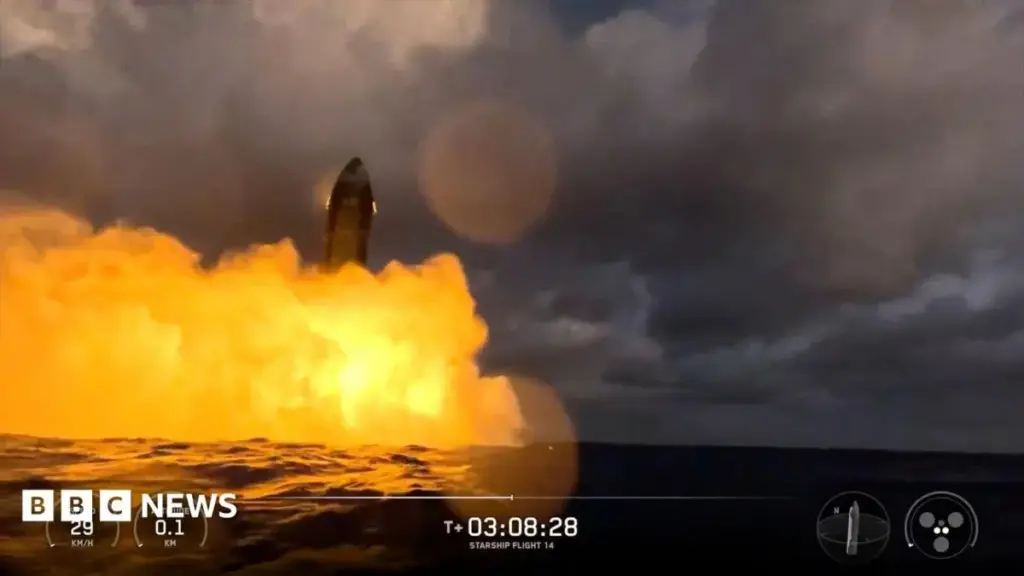
As the vehicle neared the surface of the Pacific Ocean, it executed a daring "flip-and-burn" maneuver, reigniting its Raptor engines to transition from a horizontal glide to a vertical orientation. Moments later, the spacecraft touched down gently on the ocean surface, bringing a dramatic end to a flight that was short in duration, yet immensely rich in technical data.
Supporting Context & Metrics
To appreciate the scale of this mission, one must examine the raw metrics and the broader technological ecosystem within which Starship operates.
The Starship Architecture Metrics
- Total Height: Approximately 121 meters (397 feet) fully integrated.
- Payload Capacity: Designed to carry up to 150 metric tons fully reusable, and up to 250 metric tons expendable to low-Earth orbit.
- Propellant Capacity: Over 4,500 metric tons of liquid methane and liquid oxygen.
- Engine Configuration: Powered by up to 33 Raptor engines on the Super Heavy booster and 6 Raptor engines (3 sea-level, 3 vacuum-optimized) on the Starship upper stage.
Starlink V3: Redefining Global Broadband
The deployment of 26 "next-generation" Starlink V3 satellites marks a critical evolution in satellite internet delivery. Previous generations of Starlink satellites relied on smaller form factors and limited phased-array antennas. The V3 iteration introduces several profound advancements:
- Massive Bandwidth Multipliers: V3 satellites boast significantly larger solar arrays and higher-capacity digital transponders, allowing a single satellite to handle terabits of data per second.
- Direct-to-Cell Capabilities: Equipped with advanced cellular hardware, these satellites are engineered to bridge the gap between traditional cellular networks and remote wilderness, eliminating dead zones without requiring specialized user terminals.
- Orbital Efficiency: Optimized for deployment via Starship’s expansive payload bay, the V3 batch demonstrates that Starship can deploy entire sub-constellations in a single launch, fundamentally altering the economics of space-based communications infrastructure.
Official Statements and Industry Analysis
In the wake of the splashdown, aerospace executives, regulatory bodies, and independent analysts weighed in on the implications of the flight.
SpaceX Leadership Perspective
While Elon Musk and senior SpaceX engineering VPs maintain a continuous stream of iterative development—where "failure is just data"—the official corporate stance emphasized the unprecedented nature of the achievements realized during the shortened flight window.
"Every flight test of Starship is an accelerated learning loop," a senior SpaceX propulsion engineer noted during post-flight debriefings. "By shortening this specific mission, we not only protected our valuable flight hardware from unforeseen thermal or software anomalies, but we also successfully validated the exact mechanism we would need to abort a crewed mission in the future. Deploying 26 Starlink V3s while proving our rapid de-orbit capability is a monumental win."
Independent Aerospace Commentary
Industry analysts have highlighted the strategic importance of the Starship program to both commercial entities and government contractors, particularly NASA, which relies on a Human Landing System (HLS) variant of Starship for the Artemis lunar missions.
Dr. Aris Thorne, an independent aerospace consultant based in Washington, D.C., remarked:
"What the public often misinterprets as a ‘shortened’ flight or a ‘failure’ is, in reality, standard agile hardware development applied to heavy rocketry. Traditional aerospace takes a decade to build a single rocket and fears anomaly; SpaceX flies prototypes frequently, pushes them to their limits, and learns more in 90 minutes of flight than competitors learn in five years of computer simulations. The successful deployment of Starlink V3 proves that Starship is transitioning from a theoretical heavy-lift concept to a commercially viable workhorse."
Future Outlook: The Road to Reusability and Interplanetary Flight
The successful Pacific splashdown serves as a critical stepping stone toward SpaceX’s ultimate vision: establishing a fully and rapidly reusable transportation system capable of carrying humans to the Moon, Mars, and beyond.
Upcoming Milestones
- Tower Catch Architecture: While ocean splashdowns provide a safe data-gathering environment for early prototypes, SpaceX’s ultimate goal for the Super Heavy booster—and eventually the Starship upper stage—is to catch the descending vehicles using the mechanical arms ("chopsticks") of the launch tower at Starbase. Future flights will increasingly test precision guidance to achieve this feat.
- Orbital Refueling Demonstrations: A cornerstone of NASA’s Artemis program and future Mars missions is ship-to-ship propellant transfer in low-Earth orbit. Starship must demonstrate the ability to store cryogenic propellants in space for extended periods and transfer them seamlessly between vehicles. The initial 10-hour plan for this mission was designed to test precursor technologies for this exact capability, which will be prioritized in subsequent flight profiles.
- Regulatory and Environmental Clearances: As flight frequencies increase, SpaceX continues to work closely with the Federal Aviation Administration (FAA) and environmental agencies to ensure that launch cadences scale safely without adverse ecological impacts on the South Texas coastline and global splashdown zones.
Conclusion
The premature termination of Starship’s endurance flight does little to diminish its historic achievements. By successfully executing complex orbital maneuvers, deploying a fleet of high-performance Starlink V3 broadband satellites, and executing a controlled, data-rich splashdown in the Pacific Ocean, SpaceX has once again redefined the boundaries of what is possible in commercial spaceflight. As the data from this flight is digested and applied to the next generation of prototypes, humanity moves one step closer to a truly spacefaring civilization.



