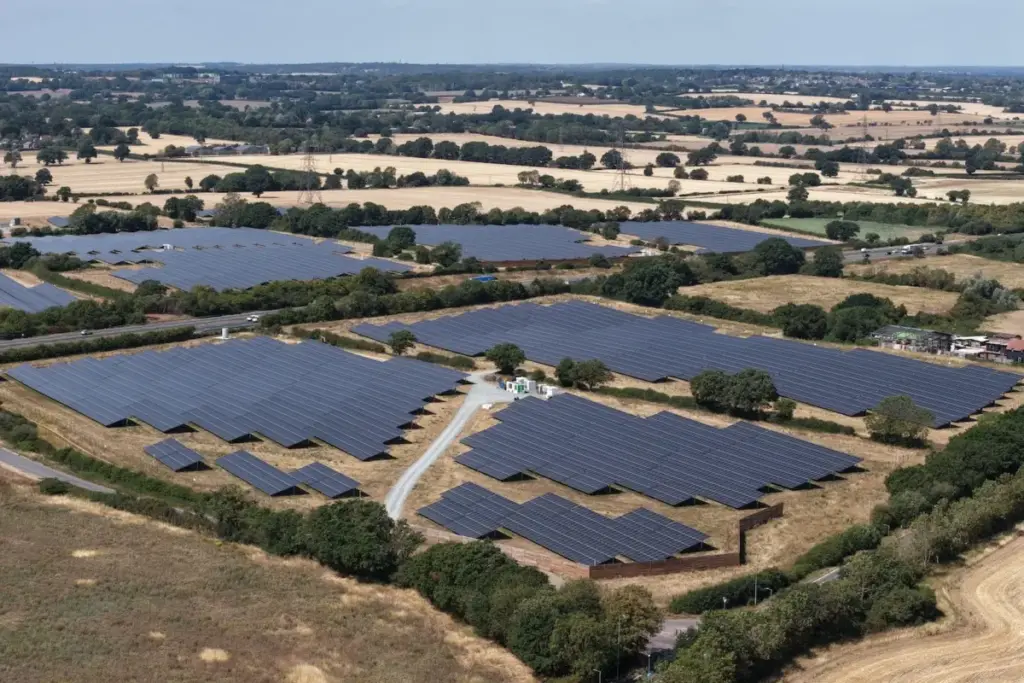
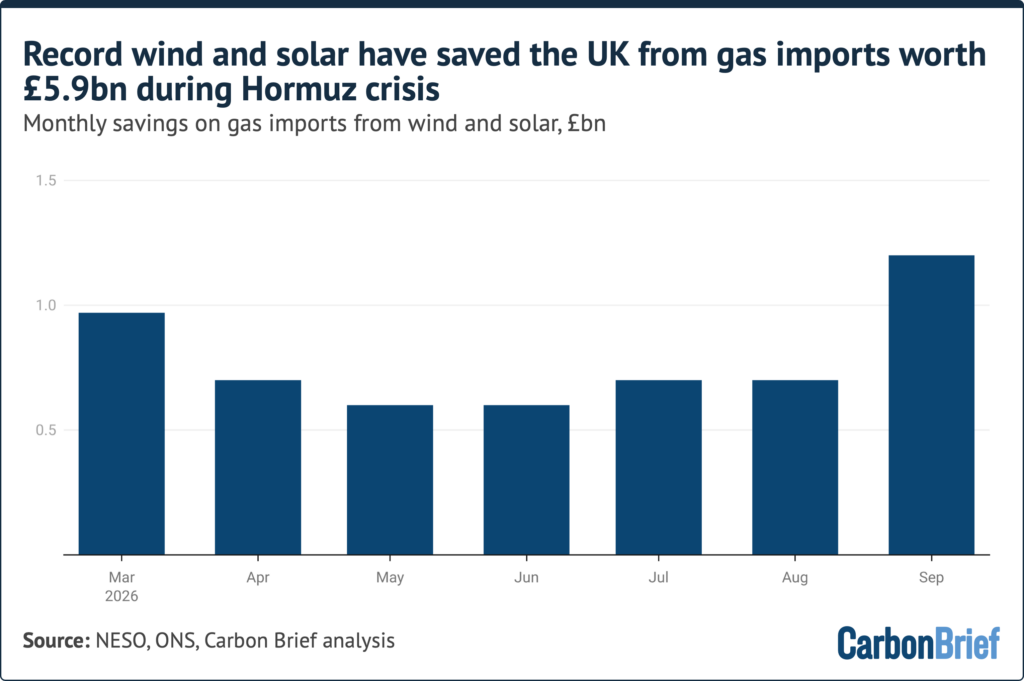
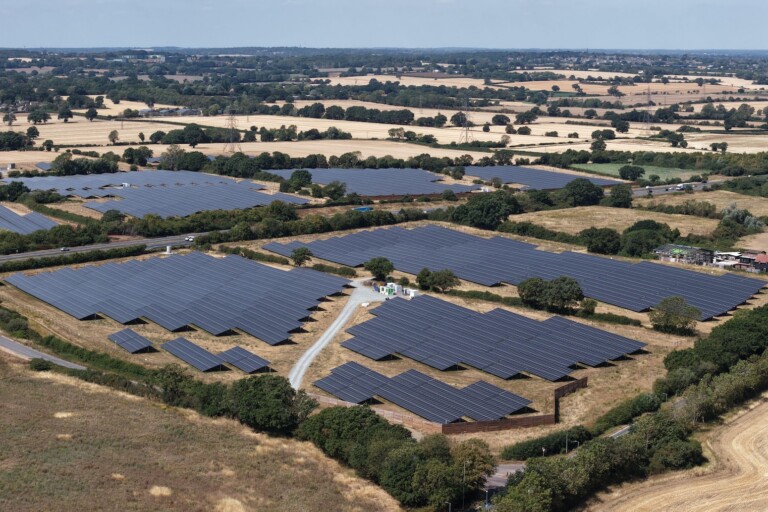
As a major geopolitical crisis in the Middle East throttles international fossil fuel supplies and drives wholesale energy costs to levels not seen since the 2022 post-invasion price shock, the United Kingdom’s expanding renewable energy fleet has performed a critical macro-economic stabilizing role. According to a comprehensive analysis by Carbon Brief, unprecedented electricity output from domestic wind and solar assets has spared the UK from importing an estimated £5.9 billion worth of natural gas since the onset of the conflict in early 2026.
This massive displacement of imported fossil fuels highlights a structural pivot in the nation’s energy mix. Driven by a 14% year-on-year surge in combined wind and solar output, clean technology generated a record 41% of the UK’s total electricity needs through late 2026, substantially outstripping gas-fired power generation, which slipped to a 25% share. By suppressing the need for thermal power generation, the deployment of renewables effectively offset the requirement for more than 100 supertanker shipments of Liquefied Natural Gas (LNG) during a period of acute global competition for fuel cargoes.
While high wholesale gas prices continue to pass through directly into residential heating costs—driving household gas bills up by a projected 33% under the latest regulatory price cap—the surge in zero-marginal-cost clean power has effectively buffered the power market. Consequently, household electricity bills face a comparatively modest 4% uptick over the same period. This stark divergence provides tangible empirical evidence that the historic link between volatile natural gas markets and domestic electricity pricing is beginning to fracture, offering a blueprint for long-term economic resilience through accelerated decarbonization.
Detailed Chronology
  +---------------------------------------------------------------------------------+
  |                            TIMELINE OF ENERGY PRICES                            |
  +---------------------------------------------------------------------------------+
  | PRE-2020: Baseline Gas Prices (~30-35p/therm)                                   |
  |                                                                                 |
  | 2022: Russian Invasion of Ukraine -> Global Energy Crisis                       |
  |                                                                                 |
  | 2023 - EARLY 2026: UK Gas Settles at High Baseline (~90p/therm; ~3x 2019 level)  |
  |                                                                                 |
  | FEB/MARCH 2026: Outbreak of US-Iran War / Hormuz Crisis                         |
  |                 - Gas Rises to 134p/therm (~4x 2019 level)                     |
  |                 - Renewables Cushion Initial Volatility Shock                   |
  |                                                                                 |
  | SEPTEMBER 2026: Gas Price Spikes to 189p/therm                                  |
  |                 - UK Wind & Solar Output Nears 10 TWh                           |
  |                 - Monthly Import Savings Hit £1.3bn                             |
  |                                                                                 |
  | OCTOBER 1, 2026: Ofgem Price Cap Adjustment Takes Effect                        |
  |                 - Residential Gas Bills Up +33% (~£200/yr)                      |
  |                 - Residential Electricity Bills Up Only +4%                     |
  +---------------------------------------------------------------------------------+
The Pre-Crisis Baseline (2019–2025)
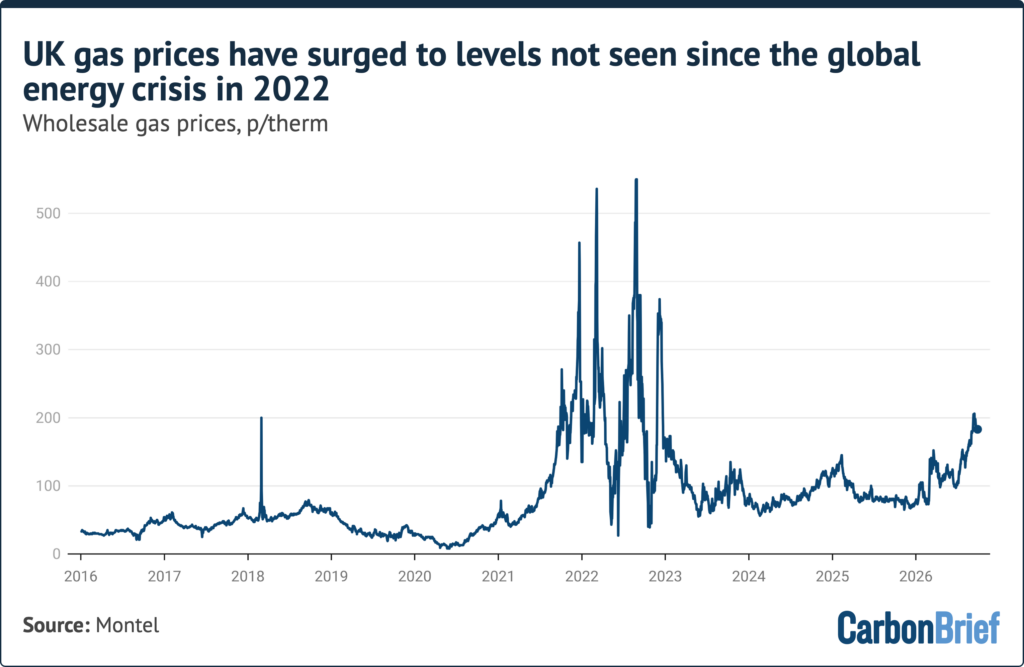
Prior to the sequence of global shocks that began in 2020, wholesale UK gas prices hovered at historical baselines averaging approximately 30 to 35 pence per therm. The geopolitical disruption triggered by Russia’s full-scale invasion of Ukraine in 2022 fundamentally reconfigured European energy economics. As Russian pipeline flows to the continent collapsed, wholesale gas markets adjusted upward. Between 2023 and early 2026, UK wholesale gas prices settled into a high-cost baseline averaging 90p per therm—roughly triple the pre-pandemic standard.
The Hormuz Outbreak (February–March 2026)
The fragile equilibrium was broken in early 2026 with the outbreak of armed conflict between the United States and Iran, precipitating the blockade and disruption of maritime traffic through the Strait of Hormuz—the world’s primary transit choke point for petroleum and LNG. Wholesale natural gas markets reacted instantaneously. Between March and mid-summer, average UK gas prices surged to 134p per therm, representing a nearly fourfold increase over 2019 levels. Initial tracking by Carbon Brief in April and May highlighted early evidence that expanding wind and solar capacity was mitigating the shock, preventing billions in extra trade deficits during the first 90 days of hostility.
The Autumn Escalation (September 2026)
By September 2026, compounding factors escalated the market shock. As European nations entered the pre-winter replenishment cycle with gas storage inventories at historically depressed levels, global competition for non-Strait-dependent LNG cargoes intensified between European and Asian buyers. UK wholesale gas prices spiked to an average of 189p per therm—the highest monthly average recorded since the height of the 2022 energy crisis.
Simultaneously, weather conditions and newly commissioned capacity combined to deliver record clean energy production. In September alone, UK wind and solar installations delivered nearly 10 Terawatt-hours (TWh) of electricity. This record output generated a single-month import saving of £1.3 billion, pushing the cumulative avoided gas import bill to £5.9 billion since the outbreak of war.
Consumer Impact Threshold (October 1, 2026)
On October 1, 2026, the real-world economic consequences of this market bifurcation materialized for British households as energy regulator Ofgem updated its quarterly price cap. While the surge in gas prices forced a 33% increase in average domestic gas heating bills—amounting to an annual increase of approximately £200 per household—the inflation in domestic electricity bills was contained to just 4%. The disproportionate expansion of cheap renewable generation acted as a structural brake on wholesale power prices, preventing power bill surges from matching the hikes seen in heating gas.
Supporting Context & Metrics
Displacing Thermal Power: The Generation Balance
The displacement of gas-fired thermal generation by zero-carbon sources has shifted the fundamentals of the UK power grid. In 2026 to date, total gas-fired power generation fell by nearly 10% year-on-year, directly corresponding to a 14% year-on-year increase in combined wind and solar production.
Energy Source
2026 Year-to-Date Share of UK Electricity
Year-on-Year Trend
Impact on Fuel Imports
Wind & Solar
41%
+14% generation
Displaced >100 LNG cargoes
Natural Gas
25%
-10% generation
£5.9bn avoided expenditure
The physical scale of these avoided imports is substantial. Supplying the gas needed to generate the equivalent electricity provided by wind and solar during this period would have required over 100 additional specialized LNG tanker deliveries. In an environment where global shipping lanes are constrained and maritime insurance premiums around conflict zones have escalated, avoiding this volume of sea-borne imports substantially reduced operational risks for UK energy buyers.
       UK ELECTRICITY GENERATION MIX (2026 YTD)

       [==================== 41% ====================]  Wind & Solar (Record High)
       [============== 25% ==============]              Natural Gas (Down ~10% YoY)
       [================= 34% =================]        Other (Nuclear, Biomass, Imports, etc.)
Macroeconomic and Cross-Border Spillover Effects
The financial protection provided by UK clean energy stands in contrast to the broader economic damages suffered by regions reliant on fossil fuel imports. Across the European Union, total emergency expenditures for foreign fossil fuel imports reached an extra €100 billion since the inception of the Hormuz conflict, straining trade balances and compounding industrial inflation.
Furthermore, the price shock extended across all refined hydrocarbon products. In the UK, retail diesel prices reached record territory, approaching £2 per litre. This volatility underscored the cost advantages of electrified transit. Comparative analyses published by Carbon Brief demonstrate that operating an electric vehicle (EV) powered by the increasingly renewable UK grid became up to nine times cheaper per mile than driving an equivalent petrol or diesel vehicle under current market conditions.
Official Statements & Policy Debate
The divergence between gas and electricity inflation occupied center stage at the Labour Party Conference, where government ministers and policy analysts analyzed the structural lessons of the ongoing crisis.
+-----------------------------------------------------------------------------------+
|                            KEY LEADERSHIP STATEMENTS                              |
+-----------------------------------------------------------------------------------+
|                                                                                   |
|  "We are already taking more control of our electricity prices with a massive     |
|   expansion of home-grown renewables and nuclear. I have asked Miatta to speed   |
|   up the breaking of the link between what we pay for power at home and the       |
|   international gas market, to get bills down."                                   |
|                                                                                   |
|   -- Prime Minister Andy Burnham                                                  |
|                                                                                   |
+-----------------------------------------------------------------------------------+
|                                                                                   |
|  "[UK energy bills remain vulnerable because the nation is structurally]           |
|   exposed to global fossil-fuel markets."                                         |
|                                                                                   |
|   -- Miatta Fahnbulleh, Secretary of State for Energy Security                    |
|                                                                                   |
+-----------------------------------------------------------------------------------+
|                                                                                   |
|  "The link between electricity and gas prices has already begun to break."        |
|                                                                                   |
|   -- Andrew Sissons, Director for Sustainable Future, Nesta                       |
|                                                                                   |
+-----------------------------------------------------------------------------------+
Addressing party delegates, Secretary of State for Energy Security Miatta Fahnbulleh targeted the UK’s legacy reliance on global fossil fuel commodities. She argued that domestic price spikes were not an inevitable consequence of power system operational costs, but rather a structural vulnerability driven by open exposure to international supply bottlenecks.
Building upon this theme, Prime Minister Andy Burnham identified clean energy expansion as the primary defense against global energy shocks. Burnham reaffirmed his administration’s explicit goal to overhaul the wholesale electricity market design, specifically targeting the marginal pricing mechanism that historically allowed natural gas prices to dictate the clearing price for all generated power:
"We are already taking more control of our electricity prices with a massive expansion of home-grown renewables and nuclear," Prime Minister Burnham stated during his conference address. "I have asked Miatta to speed up the breaking of the link between what we pay for power at home and the international gas market, to get bills down."
Independent market analysts echoed the perspective that a structural break is underway. Andrew Sissons, Director for Sustainable Future at the thinktank Nesta, emphasized that the empirical data from the October price cap adjustment validates this transition. Sissons noted in a public assessment that "the link between electricity and gas prices has already begun to break," pointing to the 29-percentage-point growth differential between gas and electricity tariff increases as tangible proof that renewable volume is dampening price transmission.
Future Outlook
Market Reform and Price Uncoupling
As the Hormuz crisis continues to disrupt global fuel supplies, the central focus for UK policy shifts from temporary emergency relief to long-term market redesign. Currently, under the UK’s pay-as-bid marginal wholesale market framework, gas-fired power plants often set the market clearing price for electricity even when renewables supply the vast majority of grid demand.
The government’s commitment to "decouple" green electricity prices from marginal gas costs represents a significant policy shift. Achieving complete decoupling will require reforming wholesale market architecture—potentially through dual-market structures or expanded Contracts for Difference (CfD) mechanisms—to ensure that the low operational costs of wind and solar are passed directly to end consumers rather than tracking volatile international gas benchmarks.
CURRENT MARGINAL PRICING vs. PROPOSED DECOUPLED MARKET

[ Current Model ]
All Generation Units (Wind/Solar/Nuclear) <=== PRICED AT ===> High Marginal Gas Price
Result: High retail electricity costs despite low production costs for renewables.

[ Proposed Decoupled Model ]
Renewable / Zero-Carbon Pool          <=== PRICED AT ===> Low Operational Cost (CfDs)
Natural Gas / Thermal Peaking Pool    <=== PRICED AT ===> International Gas Market Rate
Result: Retail electricity bills buffered from global fossil fuel volatility.
Winter Risk Profile and Infrastructure Priorities
With winter approaching in the Northern Hemisphere, market fundamentals indicate ongoing vulnerability for fossil fuel buyers. European natural gas reserves remain under-capitalized relative to historical norms, setting up a competitive bidding scenario against Asian import markets for flexible spot-market LNG shipments. Should cold weather coincide with prolonged diplomatic or military disruptions in the Middle East, wholesale gas prices could experience additional upward pressure.
To lock in security of supply under these high-volatility scenarios, the UK grid requires targeted infrastructure investments, including:
Grid Capacity Upgrades: Strengthening transmission corridors to route offshore wind generation from coastal landfall sites directly to major urban demand centers.
Long-Duration Energy Storage (LDES): Deploying utility-scale pumped hydro, compressed air, and advanced battery storage systems to absorb peak renewable output during high-wind conditions and release it during calm periods, reducing reliance on gas peaker plants.
Accelerated Solar Deployment: Expanding both rooftop commercial and utility-scale solar projects to balance seasonal output profiles alongside wind assets.
The events of 2026 demonstrate that domestic renewable capacity acts as a vital economic shock absorber. By generating a record 41% of national power and offsetting £5.9 billion in volatile gas imports, wind and solar installations have defended the UK economy against severe geopolitical exposure, establishing a strong case for accelerating the transition away from fossil fuel imports.