


Executive Overview
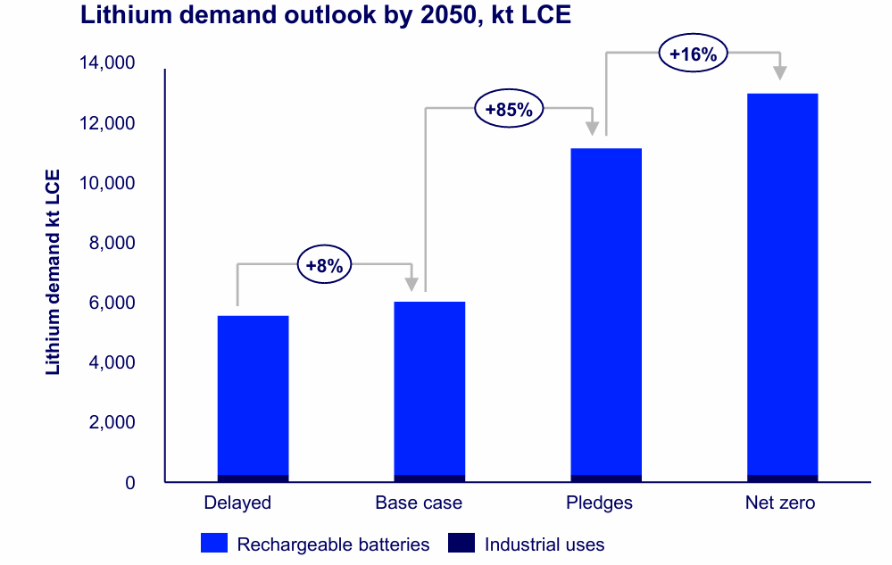
The global race to decarbonize the global economy is hitting a hard metallurgical reality. According to a landmark analysis released by energy research firm Wood Mackenzie in its latest Energy Transition Outlook for Lithium, worldwide demand for lithium could skyrocket to an unprecedented 13 million tonnes annually by 2050—assuming global climate policies maintain their aggressive trajectories.
However, beneath the celebratory milestones of electric vehicle (EV) adoption and utility-scale solar and wind buildouts lies a stark warning: the global market is barreling toward a severe supply crunch much sooner than anticipated. Without an immediate, unprecedented wave of capital deployment, technological innovation, and new mining approvals, acute lithium shortages could materialize as early as 2028.
"The lithium market is heading into a supply crunch much sooner than many industry players expect," cautions Allan Pedersen, research director at Wood Mackenzie. "Under ambitious climate scenarios, we see deficits emerging from 2028. The industry needs to act now, as governments progress policies toward Net Zero."
This report explores the root causes of the looming deficit, the macroeconomic realities of scaling global extraction and refining, the limits of recycling in the near term, and the staggering financial investments required to prevent the green transition from stalling out.
Detailed Chronology and Transition Pathways
To understand the trajectory of the lithium market, Wood Mackenzie modeled four distinct energy transition pathways, each dictating a vastly different future for raw material consumption.
The Evolution of Demand Scenarios
- Delayed Transition: A sluggish policy environment where climate targets are routinely pushed back, resulting in a 2050 lithium demand of roughly 5.6 million tonnes of lithium carbonate equivalent (LCE).
- Base Case & Country Pledges: Intermediate scenarios where existing or moderately strengthened national climate commitments are honored, pushing mid-century demand well past the 10 million tonne mark.
- Net Zero Scenario: An aggressive, accelerated decarbonization pathway where global temperature rises are capped at 1.5°C, driving global lithium demand to a staggering 13.2 million tonnes by 2050.
Regardless of which pathway the world ultimately traces, the timeline remains unforgiving. The market transition can be broken down into three critical chronological phases:
Phase 1: The Pre-Crisis Window (Present to 2027)
In the immediate term, current mining projects, expansions of brine operations in South America’s "Lithium Triangle," and hard-rock pegmatite (spodumene) mines in Australia are keeping pace with or slightly outstripping near-term vehicle production dips and plateauing EV growth curves in select Western markets. However, this equilibrium is deceptive. Project lead times—spanning environmental permitting, financing, exploration, and construction—routinely take anywhere from 7 to 10 years. Mines that are not already in the pipeline today will do little to alleviate market pressures later in the decade.
Phase 2: The Critical Deficit Horizon (2028–2035)
According to Wood Mackenzie’s predictive modeling, structural deficits are poised to tear open between 2028 and 2030. This window marks the collision point between surging global EV mandates—such as bans on internal combustion engine (ICE) sales in Europe and multiple U.S. states—and the exhaustion of existing mine life spans.
During this timeframe, capital expenditure (CapEx) must peak aggressively. Wood Mackenzie estimates that total investment needs will surge between 2030 and 2034, requiring between $100 billion and $276 billion to build out greenfield mines, chemical conversion plants, and regionalized supply chains.
Phase 3: The Maturation and Recycling Era (2035–2050)
By the late 2030s and into the 2040s, the lithium market will undergo a fundamental structural shift. The first generation of mass-market EV batteries will reach their end-of-life, unlocking a massive secondary stream of recovered raw materials through recycling. While primary extraction will still dominate, closed-loop supply chains will begin to alleviate some of the virgin mining pressures, assuming processing infrastructure is built concurrently.
Supporting Context and Metrics: What Is Driving the Surge?
The exponential rise in lithium demand is not driven by a single sector, but rather by the electrification of transportation and the parallel modernization of global electrical grids.
The Dominance of Electric Vehicles
Transport electrification remains the undeniable heavyweight champion of lithium consumption. Across all of Wood Mackenzie’s evaluated transition scenarios, electric vehicles account for an overwhelming 72% to 80% of total global lithium demand.
- Under the Country Pledges pathway, electric vehicles are projected to capture approximately 75% of global new vehicle sales by 2040.
- Under the aggressive Net Zero pathway, that penetration rate climbs to an astonishing 95%.
By the year 2050, rechargeable batteries deployed across all applications—spanning mobility, consumer electronics, and industrial uses—will command between 96% and 98% of total global lithium demand. The chemical element, once a niche commodity used primarily in ceramics, grease, and early-generation medical devices, has fundamentally transformed into the geopolitical "white petroleum" of the 21st century.
Energy Storage Systems (ESS)
While passenger and commercial EVs steal the headlines, stationary energy storage systems (ESS) are quietly carving out a vital secondary pillar of demand. As wind and solar installations dominate new electrical power generation worldwide, grids require massive, multi-hour battery storage systems to smooth out intermittency and balance supply with demand. Wood Mackenzie projects that energy storage lithium demand will compound at a steady rate of 6% to 7% annually across all forward-looking scenarios.
The Limits of Near-Term Recycling
As policymakers look for silver bullets to solve mineral supply constraints, recycling is frequently touted as an immediate fix. However, the laws of physics and the lifecycle of lithium-ion batteries dictate a different timeline.

While recycled supply is projected to grow at a blistering pace of 13% to 16% annually, meaningful, industrial-scale volumes cannot materialize until the 2040s. Simply put, you cannot recycle batteries that have not yet been manufactured, sold, and driven to the end of their useful lives.
By 2050, ambitious transition scenarios suggest recycling could supply between 2.3 million and 2.7 million tonnes of LCE. Yet, even with this massive secondary market up and running, a severe mathematical shortfall remains:
- Under the Country Pledges scenario, the cumulative supply shortfall hits 6.7 million tonnes LCE by 2050.
- Under the Net Zero scenario, that deficit widens to a yawning 8.5 million tonnes LCE.
The $100 Billion to $276 Billion Question
Bridging these vast supply gaps requires a staggering commitment of capital. Wood Mackenzie’s analysis breaks down the required investments across the various transition pathways:
- Delayed Transition Scenario: ~$104 billion
- Base Case Scenario: ~$114 billion
- Country Pledges Scenario: ~$236 billion
- Net Zero Scenario: ~$276 billion
This capital expenditure must encompass everything from unconventional extraction methods—such as extracting lithium from oilfield wastewater, a burgeoning industry seeing early commercial traction in regions like the United States—to traditional hard-rock open-pit mining and direct lithium extraction (DLE) from brine fields.
Official Statements and Industry Perspectives
The findings from Wood Mackenzie’s Energy Transition Outlook underscore a growing consensus among mining executives, financial institutions, and policy architects: the energy transition’s speed is no longer constrained by consumer demand or technological viability, but by the physical availability of raw materials.

"The industry is caught in a classic structural lag," noted a prominent commodities analyst following the report’s release. "Automakers spent the last five years aggressively securing off-take agreements and marketing electric fleets, but upstream capital investment has consistently lagged behind downstream ambitions. When the deficit hits in 2028, it won’t matter how many EV factories are built if the battery cells lack the chemistry to power them."
Furthermore, geopolitical tensions are complicating the capital-raising landscape. With major economies—including the United States, the European Union, and China—implementing strict domestic sourcing requirements, Friend-shoring, and localized supply chain mandates (such as the U.S. Inflation Reduction Act), capital cannot simply flow to the cheapest or most abundant deposits. It must be funneled into jurisdictions that meet rigid environmental, social, and governance (ESG) standards, further driving up project costs and development timelines.
Future Outlook: Can the Industry Move Fast Enough?
As the global economy marches toward the critical 2028 threshold, the path forward requires a multi-pronged approach involving industry stakeholders, governments, and financial markets.
- Streamlining Permitting Without Lowering Standards: Governments must find ways to fast-track environmental reviews and permitting for critical mineral projects without compromising ecological safety. A decade-long permitting process is fundamentally incompatible with a 2028 deficit horizon.
- Accelerating Technological Innovation: Continued advancements in Direct Lithium Extraction (DLE), which extracts lithium from brine significantly faster and with a smaller physical footprint than traditional evaporation ponds, must be commercially scaled. Similarly, processing lithium from unconventional sources—such as geothermal brines and oilfield wastewater—must move from pilot plants to full industrial output.
- De-risking Upstream Investments: Traditional project financing models often view mining as overly volatile due to commodity price swings. Governments and institutional investors must deploy public-private partnerships, price floors, and loan guarantees to ensure capital flows uninterrupted through the 2030-2034 investment peak.
The bottom line is definitive: regardless of the policy path the global community ultimately embraces, lithium demand will eclipse current supply plans. The defining question for the remainder of this decade is not whether the world needs more lithium, but whether financial markets and industrial players can mobilize fast enough to fund, build, and operate the infrastructure required to power a clean energy future.



