

Executive Overview
Weeks after catastrophic flash floods tore through the valleys and towns of Nepal on August 26, the Himalayan nation finds itself locked in a grueling, multi-front humanitarian crisis. While emergency services and international aid organizations have managed to establish a baseline supply of food and foundational provisions for thousands of displaced residents, critical infrastructural breakdowns continue to plague recovery operations. Survivors sheltered in temporary camps grapple with acute shortages of essential medicines and cash, forcing vulnerable individuals to resort to desperate measures—such as trading basic food rations for meager sums of money—to secure life-saving pharmaceuticals.
The disaster, which authorities and geological experts attribute to a catastrophic glacial collapse, has left a staggering trail of destruction. At least 1,252 people have been confirmed dead in Nepal, with more than 4,200 individuals remaining unaccounted for. Across the northern border in Tibet, Chinese authorities report an additional 21 fatalities and 541 missing persons. Nearly 4,000 displaced Nepalese citizens are currently housed across 34 makeshift relief centers.
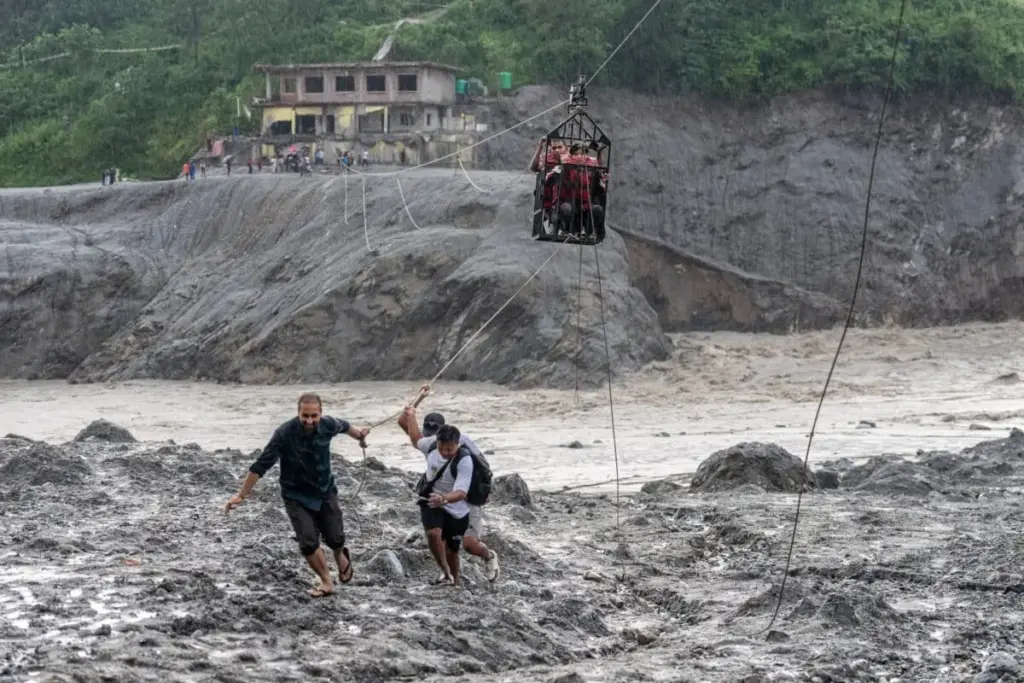
Compounding the human toll is the severe isolation of entire communities. Vital transportation arteries, including roads and bridges, have been obliterated, prompting grassroots ingenuity like improvised zip lines to span raging rivers. Meanwhile, highly specialized international rescue teams from India, China, and the United States have converged on the disaster zone. Their primary, high-stakes objective: tunneling into blocked hydroelectric facilities where hundreds of missing workers are feared trapped. As Nepal navigates this unprecedented calamity, the intersection of climate change, infrastructure vulnerability, and humanitarian logistics has pushed the nation to its absolute limits.
Detailed Chronology: The Unfolding Crisis
The Cataclysm of August 26
The disaster struck with terrifying suddenness on the morning of August 26. What began as heavy seasonal monsoon conditions was severely amplified by a catastrophic glacial collapse in the high Himalayas. The resulting torrent of water, mud, and debris rushed down mountain valleys with unprecedented force, transforming tranquil rivers into raging walls of destruction. Towns and villages nestled along major waterways were overwhelmed in a matter of minutes.
In the immediate aftermath, communications were severed, and electricity grids failed, plunging vast swaths of the affected districts into darkness. Initial rescue operations were paralyzed by the sheer scale of the geographical obstruction. Landslides buried entire stretches of highway, and concrete bridges were swept away as if they were made of matchsticks.
The First Week: Emergency Responses and Camp Life
By the end of the first week following the disaster, the government, in coordination with local volunteers and non-governmental organizations, established 34 makeshift relief centers to accommodate the displaced. Approximately 4,000 individuals found refuge in these camps, primarily set up in school grounds, open fields, and government compounds.
While basic food supplies—such as rice, lentils, and packaged noodles—began flowing into the camps, the logistical pipeline for medical supplies and cash liquidity lagged severely behind. In Devighat, a severely impacted town within the Nuwakot district, survivors faced the grim reality of infrastructural neglect regarding healthcare. Suresh Kumar Karanjit, who tragically lost his younger brother to the floodwaters, found himself fighting another battle within the camp walls: managing a chronic heart condition without access to his prescribed medication.
Because the camp’s rudimentary medical station lacked his specific pharmaceutical requirements, Karanjit had to improvise. He sold a carton of instant noodles—allocated to him as part of his daily relief package—for a mere 400 Nepalese rupees (approximately $2.60 USD) to purchase his medication from a private vendor. His experience mirrors that of numerous other camp residents who, despite receiving adequate caloric sustenance, find themselves entirely unequipped to manage pre-existing health conditions, chronic illnesses, and psychological trauma.
Current Operations: Ziplines and Tunnel Excavation
As weeks have passed, the physical isolation of cut-off communities has forced residents and local authorities to adopt unorthodox survival strategies. In Bidur town, situated along the swollen banks of the Trishuli River, the destruction of local bridges cut off essential cross-river travel. In response, residents engineered a temporary zip line system. Army personnel stationed at the site now manage the makeshift crossing, assisting citizens as they slide across the raging current to reach essential services on the opposite bank.
Concurrently, rescue efforts have shifted underground. The epicenter of these complex operations now focuses on several major hydroelectric projects across the region, where workers were trapped underground when the flash floods struck. Roughly 900 power plant workers remain missing, believed to be entombed within massive subterranean tunnels and excavation shafts.
International specialized teams have arrived to assist local personnel, utilizing advanced detection equipment and heavy-duty excavation tools. However, progress has been agonizingly slow. At the Trishuli-3A hydropower project, lawmakers and rescue coordinators reported that workers had to manually clear and open the upper sections of the passage. While an emergency access road was carved out over the course of a week to reach the site, further rock blasting and heavy debris clearance remain mandatory before large-scale machinery can be safely deployed into the tunnels.
Supporting Context & Metrics: The Scale of Destruction
To comprehend the magnitude of the humanitarian crisis in Nepal, one must analyze the staggering statistical footprint left by the August 26 disaster.

Human Toll and Demographics
- Confirmed Fatalities in Nepal: 1,252 deaths.
- Missing Persons in Nepal: Over 4,200 individuals still unaccounted for.
- Cross-Border Impact (Tibet, China): 21 deaths and 541 missing persons, according to late-week reports from Beijing.
- Displaced Population: Nearly 4,000 individuals currently sheltering in 34 centralized relief camps.
- Hydropower Sector Losses: Approximately 900 missing workers believed trapped inside subterranean infrastructure associated with various damaged hydroelectric facilities.
Infrastructure and Environmental Factors
The catastrophic nature of the floods has renewed fierce global debates regarding the accelerating impacts of climate change on high-altitude glacial systems. Scientific assessments indicate that warming global temperatures have destabilized glacial lakes throughout the Himalayas, increasing the frequency and severity of Glacial Lake Outburst Floods (GLOFs). When these natural dams fail, millions of cubic meters of water rush downward into populated river basins with little to no advanced warning.
Furthermore, Nepal’s burgeoning hydropower sector—crucial for the nation’s economic development and energy independence—proved acutely vulnerable to the disaster. Many facilities are built deep within river gorges and mountain tunnels, making them prime traps for sudden, high-velocity inundations. The destruction of these projects not only halts energy production but also creates massive recovery bottlenecks, as heavy silt, boulders, and debris fill subterranean chambers to the brim.
Official Statements and Institutional Responses
Government officials and disaster management authorities have faced intense public scrutiny regarding the speed and comprehensiveness of the relief distribution. In response to mounting criticisms over medical shortages and financial liquidity within the camps, Dharam Raj Uprety, Nepal’s chief disaster management official, defended the government’s operational strategy.
"Health centers staffed by qualified medical professionals and stocked with essential medicines have been established at every designated shelter," Uprety stated during a press briefing. "Our primary focus moving forward is not merely nutritional sustenance, but stringent hygiene and sanitation protocols to mitigate the severe risk of post-flood waterborne diseases."
Uprety emphasized that while localized logistical bottlenecks are inevitable given the catastrophic terrain damage, civil and military authorities are working around the clock to streamline the supply chain. Mobile banking units and cash-transfer programs are reportedly being mobilized to address the liquidity crisis that forced individuals like Suresh Kumar Karanjit to barter their food rations for medicine.
On the international front, diplomatic and operational ties have deepened. Responding to urgent appeals from Kathmandu, specialized disaster response units deployed from India, China, and the United States. These foreign contingents brought specialized canine units, thermal imaging gear for tunnel detection, and heavy engineering equipment.
However, political representatives supervising the ground operations remain cautiously realistic about the survivability of those trapped underground. Ram Neupane, a local lawmaker overseeing the Trishuli-3A rescue site, noted the grim realities of the excavation process:
"We have managed to forge an access road to the mouth of the excavation site, but the volume of rock and silt is immense. Every meter cleared requires precise blasting and manual clearing. Whether the workers trapped inside are still alive is a question we are racing against time to answer."
Future Outlook: Recovery, Reconstruction, and Resilience
As Nepal looks toward the horizon, the road to recovery is undeniably long, arduous, and fraught with systemic challenges. The immediate priority remains twofold: locating the thousands of missing individuals—particularly those trapped within the dark labyrinths of the nation’s damaged hydropower tunnels—and upgrading the living conditions within the 34 temporary relief camps.
Short-Term Priorities
- Medical Supply Chain Overhaul: Authorities must swiftly decentralize medical procurement, ensuring that chronic disease medications, pediatric care, and trauma counseling are directly accessible within every relief camp without requiring out-of-pocket cash transactions.
- Sanitation and Disease Prevention: With thousands living in close quarters amid damp conditions, aggressive sanitation campaigns are critical to stave off outbreaks of cholera, dysentery, and other waterborne epidemics.
- Subterranean Rescue Acceleration: Collaborative operations involving international specialists must maintain momentum at the hydropower sites. Even as the probability of finding survivors diminishes with each passing day, recovering the remains of the missing remains a profound humanitarian imperative for grieving families.
Long-Term Reconstruction Challenges
Beyond the immediate humanitarian response, Nepal faces a monumental structural reconstruction phase. Rebuilding national infrastructure—roads, bridges, electrical grids, and commercial facilities—will require billions of dollars in foreign aid, international loans, and sustained domestic policy focus.
Crucially, the disaster serves as a harsh awakening for regional urban planners and energy developers. Future infrastructure projects across the Himalayan region must incorporate rigorous climate-resilient engineering, accounting for the growing threat of glacial lake outbursts and extreme weather anomalies. Early warning systems must be upgraded and integrated seamlessly with vulnerable communities downriver to prevent future occurrences of such staggering loss of life.
For the survivors currently enduring the hardships of camp life in Devighat, Bidur, and beyond, the path forward is marked by grief, uncertainty, and resilience. As Nepal begins to heal from the wounds of August 26, the international community’s continued solidarity and financial commitment will dictate whether the nation can successfully rebuild not just its physical infrastructure, but the shattered lives of its people.



