The global automotive landscape has crossed a historic threshold. According to comprehensive new analysis published by the energy think tank Ember, more than 25% of all new cars sold worldwide in 2025 are now electric vehicles (EVs). What was once treated as an elite, niche market largely confined to early adopters in wealthy Western nations and select pockets of Scandinavia has transformed into a sweeping, borderless industrial revolution.
Crucially, this acceleration is no longer spearheaded solely by traditional automotive powerhouses in North America and Western Europe. Instead, the current wave of adoption is being driven by emerging markets—many of which boasted virtually negligible EV sales figures just half a decade ago. From Southeast Asia and Latin America to the Middle East and Eastern Europe, developing nations are bypassing traditional vehicular evolution phases entirely, executing a classic "leapfrog" strategy directly from baseline internal combustion engines (ICE) into advanced electric mobility.
At the core of this seismic shift is a dramatic reconfiguration of global trade and manufacturing, catalyzed by a massive influx of affordable, high-technology electric vehicles exported from China. As governments across the Global South implement forward-thinking policy frameworks, tax reductions, and domestic manufacturing incentives, consumers are responding in record numbers. The implications of this pivot extend far beyond showroom floors: with EVs operating at roughly three times the thermodynamic efficiency of traditional fossil-fuel vehicles, this sudden market saturation is beginning to deliver structural, measurable shocks to global oil demand.
Detailed Chronology of a Global Pivot
2019 to 2025: From Niche Curiosity to Mass Market Domination
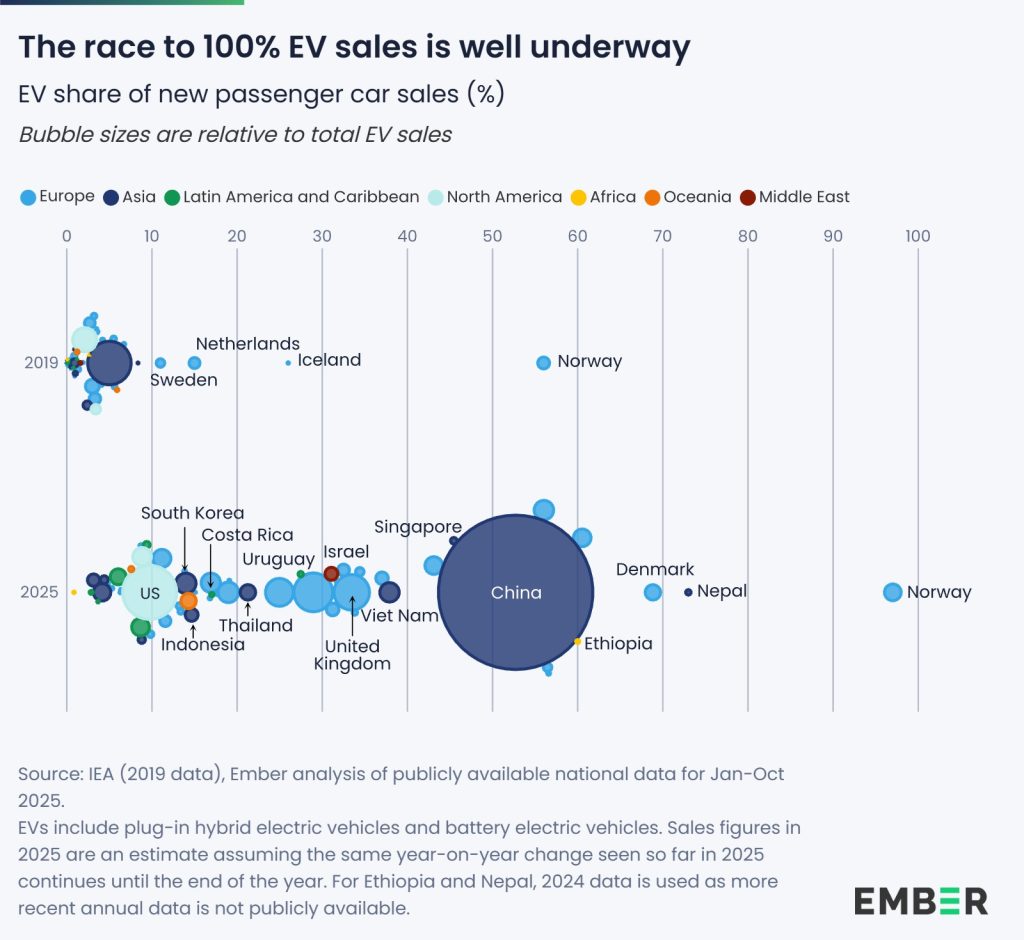
To truly grasp the magnitude of the 2025 milestone, one must examine the trajectory of the preceding half-decade. In 2019, the global electric vehicle market was heavily concentrated. Data from Ember indicates that there were only four countries worldwide where electric vehicles managed to capture a double-digit percentage (10% or more) of total new car sales. These early adoption leaders were heavily skewed toward Norway and a handful of progressive European markets equipped with massive state-sponsored subsidies and robust, early-stage charging networks.
Fast forward to 2025, and that exclusive club has exploded into a global phenomenon. Today, there are an astonishing 39 countries where EVs command more than 10% of the new car sales market. This widespread democratization of electric mobility highlights how battery costs, manufacturing scale, and model availability have converged to make EVs competitive across radically diverse economic landscapes.
The Rise of ASEAN as an Electric Powerhouse
Perhaps the most dramatic narrative of the 2025 automotive year is the meteoric rise of the Association of Southeast Asian Nations (ASEAN) region. Historically viewed as emerging economies where two-wheelers and cheap, reliable internal combustion hatchbacks dominated due to upfront cost constraints, ASEAN nations have fundamentally upended expectations.
In 2025, countries like Singapore and Vietnam achieved staggering EV sales penetration rates of approximately 40%. To put that into perspective, these emerging Southeast Asian markets have officially overtaken established legacy automotive markets like the United Kingdom and the broader European Union in terms of relative EV adoption speed.
Meanwhile, Indonesia crossed the 15% EV sales share threshold this year, a milestone of particular geopolitical and symbolic importance as it marks the first time Indonesia’s monthly and annual adoption metrics have surpassed those of the United States. Simultaneously, Thailand punched well above its weight class, registering a 20% EV market share. In a testament to the sheer velocity of Thai consumer adoption, the country purchased more electric vehicles in the first three quarters of 2025 alone than the entirety of Denmark—a nation long celebrated as a European green transition poster child.
Latin America, Türkiye, and the New Global Map
The transformation is by no means isolated to Asia. Across Latin America, Uruguay emerged as a regional pacesetter in 2025, recording a 27% EV market share that puts it roughly neck-and-neck with the European Union average. While larger Latin American economies like Mexico and Brazil continue to scale up their adoption curves steadily, their growth profiles outpace traditional holdouts like Japan. In Japan, the domestic EV market share has remained stubbornly stagnant at roughly 3% since 2022, bound by entrenched domestic hybrid preferences and slow infrastructure updates.
In Eastern Europe and Western Asia, Türkiye carved out a formidable position. Reaching a 17% EV market share in 2025, Türkiye officially surpassed Belgium to cement its status as Europe’s fourth-largest Battery Electric Vehicle (BEV) market by sheer sales volume.
Supporting Context & Metrics: The Chinese Export Wave
The sudden, widespread accessibility of electric vehicles in emerging economies is inextricably linked to the meteoric rise of Chinese automotive manufacturing. Since mid-2023, industry analysts have tracked a pronounced pivot in China’s export strategy. While trade tensions, tariff barriers, and regulatory scrutiny have created friction in parts of the OECD (Organization for Economic Co-operation and Development)—most notably the United States and the European Union—Chinese automakers have found eager, welcoming partners across non-OECD emerging markets.
Where the Cars Are Going
Data compiled for 2025 highlights that nearly all growth in Chinese EV export volume is being absorbed by developing economies. Nations such as Brazil, Mexico, the United Arab Emirates, and Indonesia now populate the top 10 global destinations for Chinese-made electric cars.
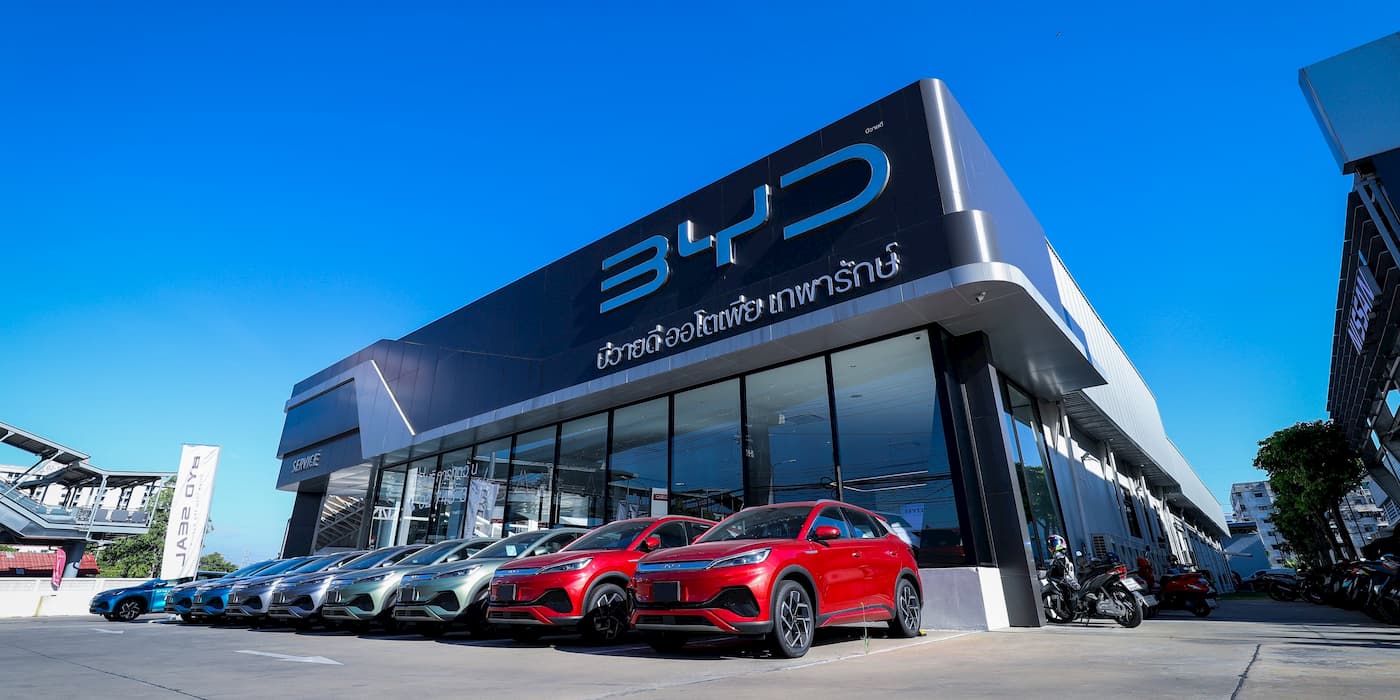
This symbiotic relationship thrives on mutual economic alignment. Emerging market governments are intensely motivated to curb urban air pollution, lower their heavy fiscal reliance on imported fossil fuels, and attract foreign direct investment. In response, Chinese automakers—backed by mature domestic supply chains, ultra-efficient battery production (such as CATL and BYD), and highly competitive price points—have flooded these markets with stylish, tech-forward EVs that routinely underbid legacy Western and Japanese competitors.
To anchor these commercial relationships, many emerging market governments have dismantled protectionist barriers temporarily, offering reduced import tariffs, tax holidays for EV buyers, and lucrative incentives designed to entice Chinese original equipment manufacturers (OEMs) to build domestic assembly plants.
The Oil Shock: Thermodynamic Efficiency in Action
The environmental and macroeconomic implications of this mass adoption curve are profound, manifesting primarily through the lens of energy efficiency.
Internal combustion engine (ICE) vehicles are notoriously inefficient, losing the vast majority of chemical energy contained in gasoline or diesel as waste heat. Electric vehicles, by contrast, are fundamentally distinct pieces of engineering: EVs are roughly three times more efficient than ICE vehicles.
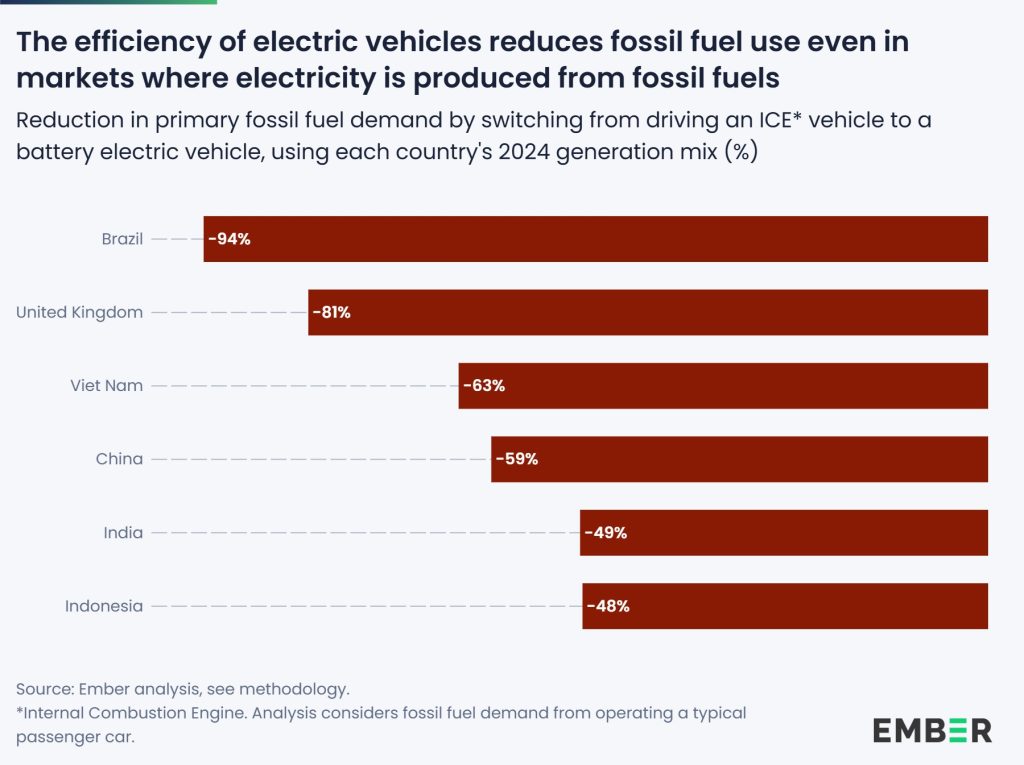
This stark thermodynamic advantage translates into immediate, tangible reductions in oil consumption, even in developing nations where the underlying electrical grid still relies heavily on fossil fuels like coal or natural gas.
In Brazil, where the national electricity grid is predominantly green and powered by vast hydroelectric and renewable resources, the transition to BEVs slashes individual fossil fuel demand by an astonishing 90%.
In Indonesia, a country actively working to clean up a coal-heavy grid, the widespread adoption of BEVs still manages to cut fossil fuel demand for transport nearly in half compared to equivalent internal combustion fleets.
Official Statements and Industry Insights
The pace and nature of this global transition have prompted deep reflection among energy economists and data modelers.
Weighing in on the 2025 findings, Euan Graham, electricity and data analyst at Ember, underscored the profound nature of the structural shift:
"This is a major turning point. In 2025, the center of gravity has moved. Emerging markets are no longer catching up; they are leading the shift to electric mobility. These countries see the strategic advantages of EVs, from cleaner air to reduced fossil fuel imports."
Graham further emphasized that the decisions being made today will dictate the long-term viability of this momentum, warning that infrastructure bottlenecks must be proactively managed:
"Emerging markets will shape the future of the global car market. The choices made now on charging infrastructure and early support will determine how fast this momentum continues."
Industry stakeholders note that as emerging nations build out charging corridors alongside their initial waves of vehicle adoption, they are avoiding the legacy infrastructure debt that has occasionally slowed down Western markets. By integrating smart-charging protocols and decentralized renewable energy microgrids from day one, developing economies are positioning their transport sectors for long-term resilience.
Future Outlook: Navigating the Next Phase of Global Electrification
As the world looks beyond 2025, the trajectory of the electric vehicle market is set to be defined less by whether the transition will happen, but rather by how fast supply chains, grid architectures, and policy frameworks can adapt to unrelenting consumer demand.
The Infrastructure Imperative
With 39 countries now boasting double-digit EV sales shares, the primary friction point is shifting from vehicle affordability to charging accessibility. In densely populated urban centers across Southeast Asia and Latin America, the proliferation of multi-family dwellings and street-parking realities necessitates innovative charging solutions. Initiatives mirroring those seen globally—such as massive parking-spot electrification sweeps (like LAZ Parking’s recent rollout of chargers across tens of thousands of everyday spaces)—will need to become standard blueprint designs for municipal planners in emerging megacities.
Furthermore, homeowners and businesses looking to transition away from fossil fuels entirely are increasingly coupling their transport choices with broader home-energy upgrades. The integration of rooftop solar photovoltaic systems, advanced home battery storage, and high-efficiency heat pumps (supported by consumer advisory services like EnergySage) is creating a cohesive ecosystem where driving electric, heating homes efficiently, and generating clean power merge into a single, unified consumer lifestyle.
Geopolitical and Industrial Realities
For legacy Western automakers, the 2025 data serves as a stark wake-up call. The narrative that electric vehicles are merely a luxury product for wealthy developed nations has been comprehensively dismantled. Emerging markets have proven that when affordable, high-quality EVs are made available alongside sensible government incentives, consumer demand explodes organically.
As Chinese manufacturers cement their dominance across Latin America, the Middle East, and Southeast Asia, Western trade policymakers face a difficult balancing act. Protecting domestic legacy manufacturing through high tariffs risks isolating Western brands from the fastest-growing automotive markets on earth, potentially ceding the future of the global car market entirely to agile eastern competitors.
Ultimately, the 2025 Ember analysis confirms that the global EV revolution has passed the point of no return. The "leapfrog" effect is real, durable, and reshaping geopolitics, energy markets, and urban environments from Bangkok to São Paulo. The next decade will not be about initiating the electric transition, but managing its unstoppable, worldwide acceleration.